 FOSTA
FOSTAP 434 - Development of an industrially manufactured supply and technology module for multi-storey detached houses
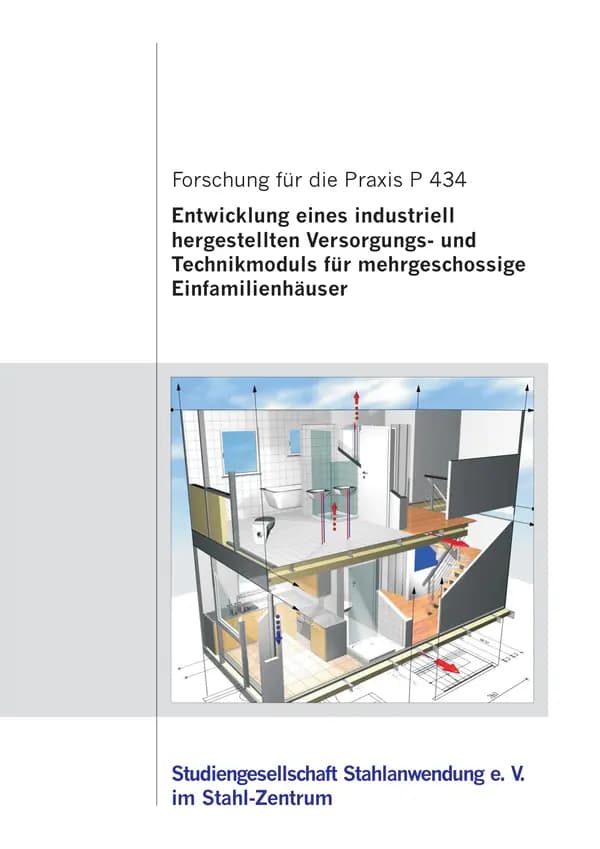
P 434 - Development of an industrially manufactured supply and technology module for multi-storey detached houses Authors: E. Schöne Publication: 2003 Normally, traditionally built houses as well as prefabricated houses have similar components as regards building technology. For example, this includes the supply with power and gas, the heating technology, the supply and disposal of water, sanitary equipment, communication technology as well as staircases and an optional lift. The current research project aimed at the concentration of these technologies to form a so-called supply and technical (VT) module for universal applications as far as possible. As an example, a product suitable for series production and adaptable to individual conditions was to be developed and produced for series production. The cost-efficient high-quality steel frame design proven in module construction was the starting point for this as a static support structure. During an intensive planning phase predictive requirements were collected and designed to form a model. Static calculation showed that the VT modules could compatibly be placed one above the other for houses with up to 5 floors. The concept is based on a strict separation of the VT modules from the other rooms in the building. All interfaces have largely been standardized and are of the plug-in or screw-type. Thus, building units erected with the traditional building technology, room module and prefabricated wood design can be interconnected easily. During a modernization of old buildings with multiple floors the specially designed VT modules can be “docked” to existing buildings.
available anytime
View details →€25.50
excl. VAT
 FOSTA
FOSTAP 426 - Pilot study on the use of the laser-MSG hybrid process for high-performance welding of steel
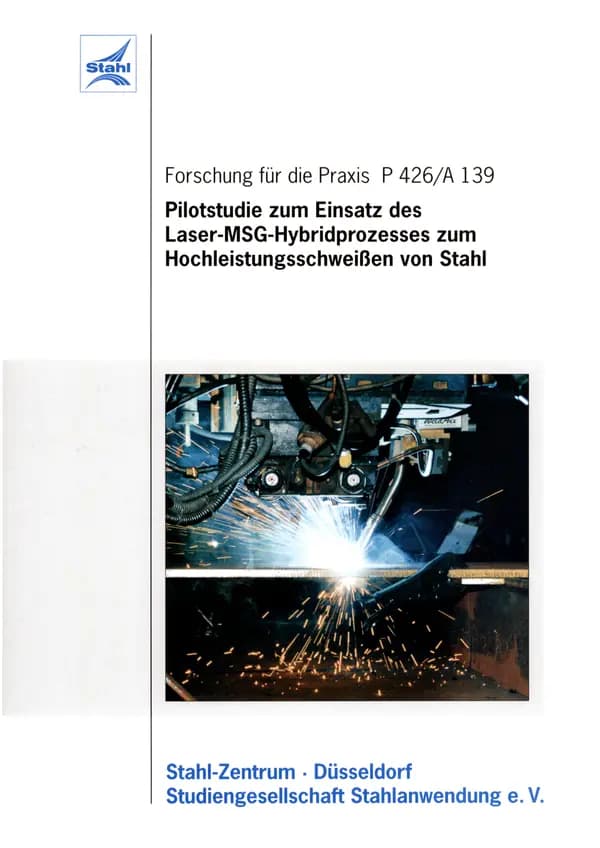
P 426 - Pilot study on the use of the laser-MSG hybrid process for high-performance welding of steel Authors: U. Dilthey, H. Keller Publication: 2001 The combination of the laser beam welding process with arc welding methods allows the realisation of a joining method with considerable application possibilities. Among the possible process variants is the CO2-laser GMA Hybrid welding method; its applicability has been determined within the framework of this project on high-performance welding of different steel qualities. In this connection, tests were carried out on a typical higher-strength shipbuilding steel GL-A 36 (AH36, 1.0583), on a high-alloy steel X6CrNiMoTi17-12-2 (1.4571) and on two high-strength steels S700MC (1.8974) and L450MB (X65, 1.8975). Here, one of the objectives was the determination of the maximum gap bridging ability amax with butt joints for different plate thickness ranges. At plates with t = 5 mm a gap of amax = 2 mm could be bridged; for t = 8 mm the achieved a max was 1.35 mm and for t = 12 mm the value for a max was 0.7 mm. These welds were carried out in flat position (PA) without any backing support. Moreover, welds in the horizontal position (PC) were carried out at a plate thickness of 20 mm; the horizontal position was chosen, as welding a plate of that thickness in the flat position would, by reason of the relatively large weld pool, lead to the immediate sag of the molten metal. Applying these weld methods, the gap width a max = 0.7 mm could be bridged without any process-specific problems.
available anytime
View details →€20.00
excl. VAT
 FOSTA
FOSTAP 405 - Corrosion protection on cut surfaces of strip galvanised steel sheets
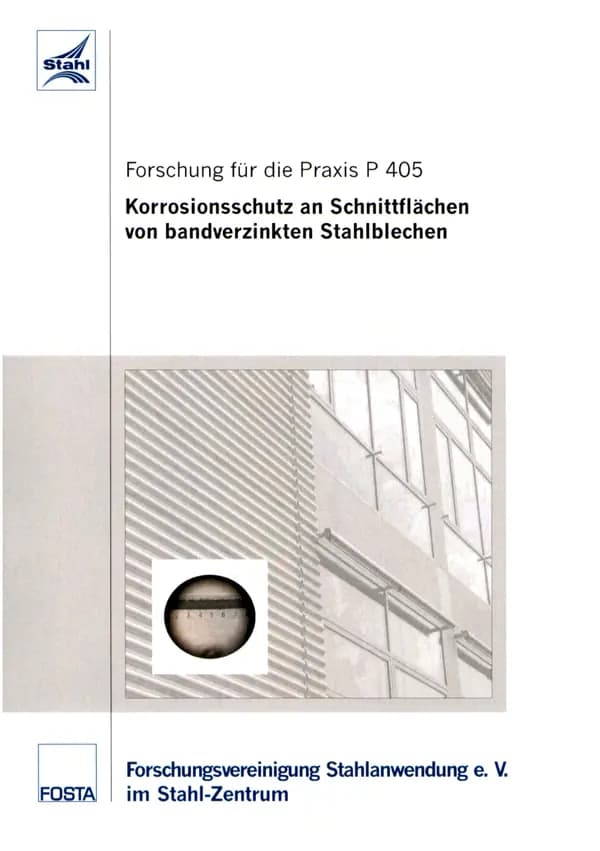
P 405 - Corrosion protection on cut surfaces of strip galvanised steel sheets Authors: R. Neugebauer, M. Demmler, W. Thate Publication: 2004 Steel sheets with a metallic and an additional organic coating are construction materials with a high corrosion resistance. On cutting pre-coated and final quality-coated sheets, which will not be painted subsequently, the corrosion protection system applied is damaged in the process of engineering. At the cut surfaces the base material steel will become approachable to atmospheric corrosion. Unwelcome corrosion effects and delamination of the coating at the cut surfaces are observed. The aim of the investigations was to avoid these effects using the available surface protection through suitable processing. In a test program run on a broad basis the corrosion resistance of the cut surfaces of 14 sheet materials were investigated, which differed in the mechanical properties of the base material, the kind of galvanization, and the technology of the organic coating. Cutting punch and diameter of the die as well as the cutting die clearance were varied systematically and compared in their influence on corrosion working with the methods punching and counter cut. The quality of the cut surfaces was evaluated on the basis of corrosion protection data in dependence of the kind of the coating system, the kind of galvanization, the thickness of the galvanization, the kind of base material, the thickness of the steel sheet, and the oiling of the sheet.
available anytime
View details →€25.50
excl. VAT
 FOSTA
FOSTAP 430 - Prospective market study on the use of hollow steel spheres and hollow steel sphere structures
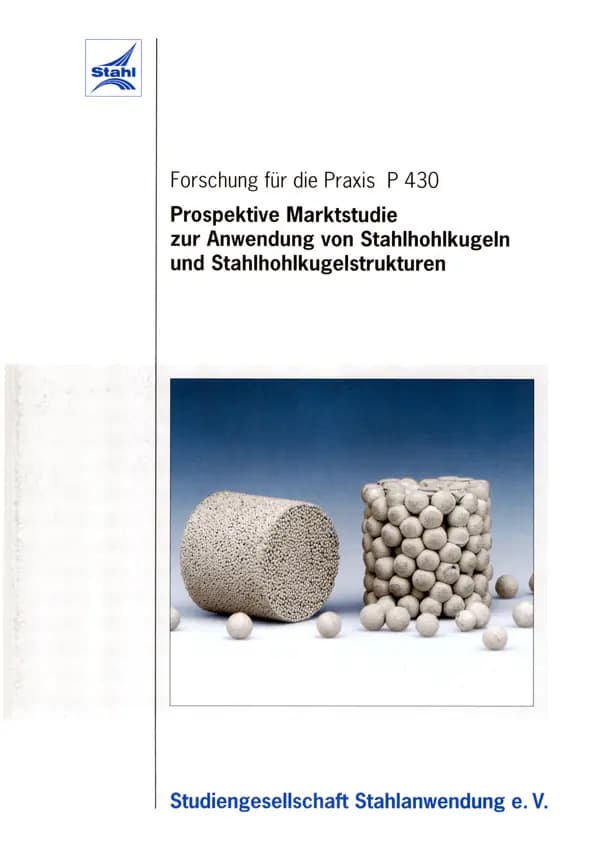
Metallic hollow spheres and hollow sphere structures made from them are an interesting technical alternative to metal foams. This study presents an assessment of the potential properties and possible applications of steel-based hollow sphere products. Based on literature and patent research, the currently available options for manufacturing hollow spheres are explained and compared. From today's perspective, the most favourable technology for mass production is the coating of polystyrene spheres with powdered materials and subsequent thermal treatment. The organic components are expelled and the metal powder particles are sintered to form a solid spherical shell. Requirements for the starting raw materials and the most interesting properties to be achieved, such as sphere diameter, shell thickness, bulk density, porosity and strength, are described. Possible applications for hollow steel spheres or structures made from them are seen in particular for crash absorbers, sound and heat insulators and lightweight structural elements. Comparisons are also drawn with the relatively similar application potential of metal foams, particularly those made of aluminium. The survey of industrial companies resulted in numerous suggestions for the market potential of hollow steel spheres or hollow steel sphere structures and the properties required. The study presents a development strategy for the manufacture and utilisation of products based on hollow steel spheres. The work is supplemented by an estimate of the likely manufacturing costs. The use and thus utilisation of secondary raw materials from steel production and processing may be a particularly advantageous option. STUDIENGESELLSCHAFT STAHLANWENDUNG e.V. Publication: 1999 Authors: Dr.-Ing. L. Schneider, Dipl.-Ing. U. Waag
available anytime
View details →€20.00
excl. VAT
 FOSTA
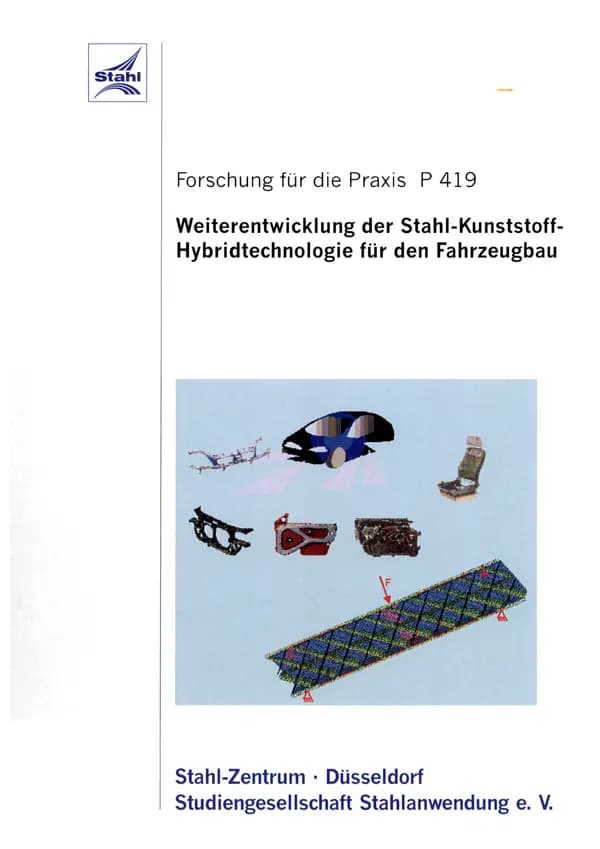
FOSTAP 419 - Further development of steel-plastic hybrid technology for vehicle construction
P 419: Further development of steel-plastic hybrid technology for vehicle construction The combination of different materials to optimise parts and components in vehicle technology is becoming increasingly important. The aim of this thesis was to demonstrate the potential of an innovative technology in which sheet metal structures are reinforced by injected plastic ribs. Based on a general overview of the specific structure of this type of component, a number of components realised in hybrid technology using different manufacturing processes and materials are examined in more detail. The advantages of the different material combinations are particularly emphasised. For an investigation of the structural behaviour and an assessment of the calculability using the finite element method, a specific substructure was selected from the existing components under consideration. The performance of the hybrid components compared to unreinforced components was confirmed in real component tests. Compared to conventional components, they have a higher integration potential with a combination of very good mechanical properties and reduced weight. The targeted arrangement of the mutually complementary and reinforcing plastic and steel structures allows the components to be optimally designed for each individual case. The finite element method was used to demonstrate that the behaviour of hybrid components can be described using numerical methods. The focus was placed on mapping the component behaviour up to material failure. The selected material description allows the behaviour of the overall structure to be calculated up to the failure of the plastic component in the test. The potential of hybrid technology for further applications can be summarised as follows: The technology is preferably suitable for components that are detachably connected to the vehicle at several points, as this provides optimum force transmission into the structure and the possibility of repair can be easily realised. The design freedom of the plastic can be utilised particularly advantageously for components with a large number of connection and fastening points. This finding is confirmed in a forward-looking way by dismountable front-end systems that have already been realised as series components. STUDIENGESELLSCHAFT STAHLANWENDUNG e.V. Publication: 2002 Authors: Dipl.-Ing. T. Parr, Prof. Dr.-Ing. H. Wallentowitz
available anytime
View details →€20.00
excl. VAT
 FOSTA
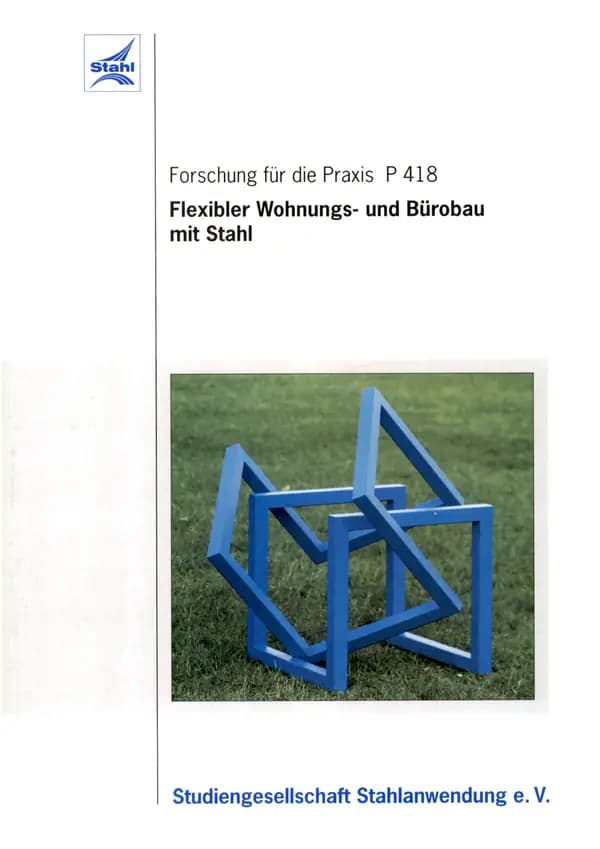
FOSTAP 418 - Flexible residential and office construction with steel
P 418: Flexible residential and office construction with steel The chances of success for flexible residential and office construction can be increased through co-operation between different players. This is shown by international examples. The major challenge for residential and office construction with steel in Germany for successful market development lies primarily in linking available partial solutions or those already under development into an integrated system. Following an assessment of the current situation, this paper by the Institut Arbeit und Technik, Gelsenkirchen, sets out general principles according to which steel can be used profitably and successfully in residential and office construction. A detailed description of individual subsystems that have already been introduced to the market is not given, but rather the significance and the system approach for advantageous construction with steel is described. Due to the special features of the German construction market, a system solution is particularly important. Building with steel faces tough competition from conventional construction and precast concrete construction. In this competitive situation, it is important to develop an integrated system offering within the shortest possible time that offers favourable construction costs and the greatest possible flexibility in construction. The German steel industry can achieve this through a joint solution. With such an offer, the German steel industry has the opportunity to become the global or at least European lead market for residential and office construction with steel. As innovation research makes clear, lead markets play a decisive role in the economic success of new products and new solutions because they provide concrete information about demand at an early stage. They set trends and standards for the further technical and economic development of new products and create networks with customers. The major advantages of an integrated system are offset by comparatively low costs. The German steel industry, which produces the load-bearing structural components, only has to agree on a basic catalogue that provides a framework for ensuring compatibility and covers the following points: - uniformly defined dimensions for the standard parts of the system - standardised interfaces for connecting the elements of the system - a standardised solution for the integration of building services - a standardised grid dimension for the wall and ceiling design - Quality standards for all elements of the system The co-operation for the development of a modular system creates a suitable basis on which the competitiveness of the participating companies can be sustainably strengthened. Such a basic catalogue allows the steel companies to offer their various support systems and profiles as well as other proprietary solutions in a competitive manner. At the same time, this catalogue offers the advantages of an integrated system solution that will be further differentiated on the market. STUDIENGESELLSCHAFT STAHLANWENDUGN e.V. Publication: 1999 Authors: Prof. Dr F. Lehner, Dipl. Soz. wiss. F. Öz, Dipl. Soz. B. Widmaier
available anytime
View details →€20.00
excl. VAT
 FOSTA
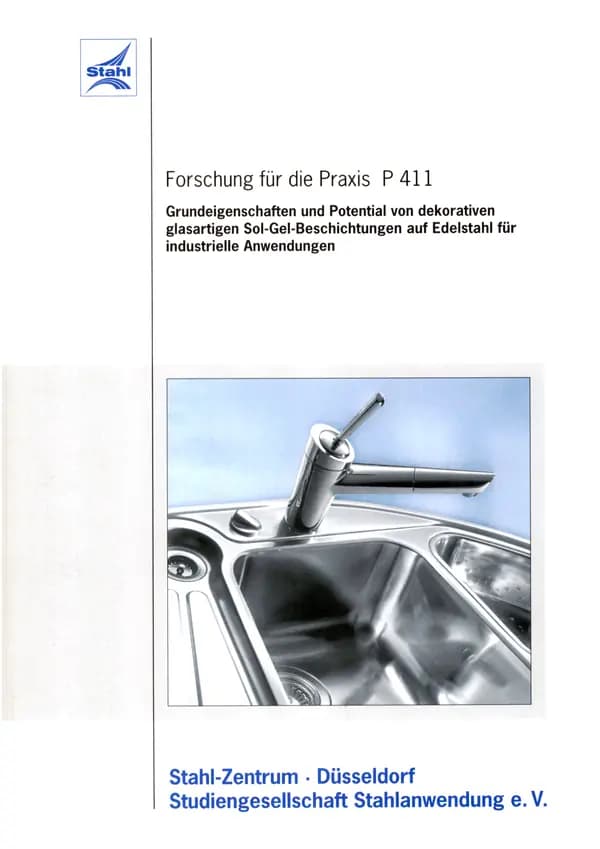
FOSTAP 411 - Basic properties and potential of decorative glassy sol-gel coatings on stainless steel for industrial applications
P 411: Basic properties and potential of decorative glassy sol-gel coatings on stainless steel for industrial applications Stainless steels, commonly referred to as stainless steels, are often used for decorative purposes in the household and architectural sectors. Depending on the application and stress, an attractive appearance can only be achieved in the long term if measures are taken to prevent scratching in daily use and discolouration under thermal stress. The aim of the research project was to investigate the basic properties and potential of decorative glass-like sol-gel coatings as a transparent alternative to enamel coatings with corresponding properties. As part of the present work, a glass-like sol-gel coating system already developed by the Institute for New Materials (INM) was tested for the requirements of the industrial partners involved in the project. In particular, the extent to which these requirements can be met with continuous or piece coating and the extent to which the system can be formed, welded or mechanically joined was investigated. Parallel to the tests at the industrial partners, investigations were carried out at the INM to optimise the existing system (particle incorporation, component variations) and to combine several coating systems (primer layer plus metal oxides). The results of the investigations have shown that the properties of stainless steel surfaces can be significantly improved in some areas by applying the glass-like coatings. The coatings can achieve at least temporary (approx. 500 h) tarnish protection at 500 °C. The abrasion resistance of the stainless steel surface is significantly improved. After 500 cycles of the abrasion test, there are only isolated scratches, whereas uncoated steel is already severely damaged after 10 cycles. Furthermore, in the area of high-temperature protection, it was demonstrated that the investigated glass-like coatings offer a clear advantage over conventional sealing methods when it comes to maintaining the visual appearance of stainless steel. However, tests with mechanical stresses have also shown that the glass-like coatings do not offer sufficient elasticity for any necessary forming operations. forming operations. In the case of piece coatings, on the other hand, glass-like sol-gel coatings can offer advantages depending on the requirements profile. This applies to scratch resistance, tarnish protection and transparency of the coating as well as easier cleaning. Colouring without major impairment of the metallic appearance is also conceivable. However, significant optimisation steps are still required to exploit this potential in the household and office furniture sector, in the automotive and architectural sectors and for decorative purposes. STUDIENGESELLSCHAFT STAHLANWENDUNG e.V. Publication: 2001 Authors: Dr rer. nat. M. Amlung, Dr.-Ing. K. Endres, Dipl.-Chem. Ch. Schelle
available anytime
View details →€20.00
excl. VAT
 FOSTA
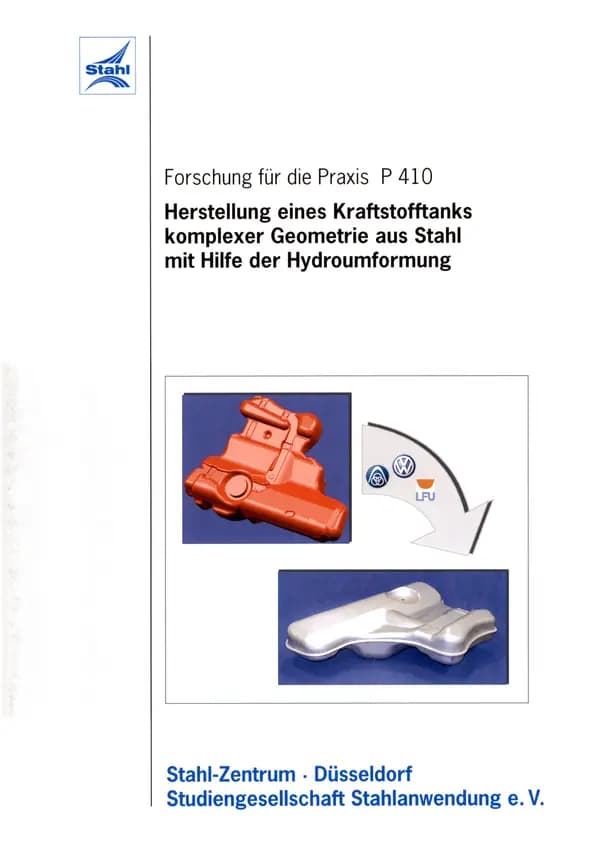
FOSTAP 410 - Production of a fuel tank of complex geometry from steel using hydroforming
P 410: Production of a fuel tank of complex geometry from steel using hydroformingIn the course of stricter environmental protection requirements, the release of fuel oil components must be completely avoided. This requirement will soon apply to fuel tanks and can currently only be safely fulfilled with steel as a material. Design and safety requirements in car construction demand the positioning of the fuel tank in the less critical but very complex cavities of the car body in the event of a crash. The aim of this research project was to develop technical and economical solutions for the production of geometrically highly complex hollow bodies made of steel for this application with the help of active-media-based sheet metal forming. For the investigations, the tank of a New Beetle, PQ 34, from Volkswagen AG, which was previously made of plastic, was selected as an example for a medium-volume compact car. The austenitic stainless steel 1.4301, which had been tested in preliminary tests (P 242 Untersuchung der Herstellmöglichkeiten eines modernen Kraftstofftanks aus Stahl mit Hilfe hydromechanischer und hydrostatischer Umformverfahren, Order No. P 242, ISBN 3- 930621-78-9, Verlag und Vertriebsgesellschaft mbH, Düsseldorf), served as the material basis. In preliminary simulation work, promising forming processes, adapted process control and special tool design were investigated and selected. Finally, the upper shell of the tank was manufactured by deep-drawing 0.6 mm thick sheet metal. The geometrically much more demanding lower shell was successfully produced by single-stage hydromechanical deep drawing from 0.8 mm thick sheet metal. The tanks, which were joined to prototypes from the two half-shells using TIG welding, were then subjected to Volkswagen AG's factory-internal component tests. This showed that all necessary safety requirements could be fully met due to the material-specific high residual deformation capacity. Without further optimisation steps, a weight reduction of 1.7 kg or 20 % was achieved for the steel tank compared to the plastic version. In some cases, the wall thickness in steel is only one tenth of that in plastic, resulting in a filling quantity that is almost 3 litres or almost 4% higher. Based on these test results, it can be concluded that Stainless steels, and probably also other corrosion-protected steels, can be processed into geometrically very complex fuel tanks in conjunction with modern hydroforming processes and a process and material-appropriate design. Steel thus offers a highly topical alternative material for solving future environmental protection requirements for fuel tanks. STUDIENGESELLSCHAFT STAHLANWENDUNG e.V. Publication: 2001 Authors: Prof. Dr E. Friebe, Dipl.-Wirtsch.-lng. T.Langhammer, Dipl.-Ing. P. Corsten, ]}, Dr W. Homberg, Dipl.-Ing. A. Wellendorf, Dr A.t Birkert, Dr F. Trösken, M. Carl, Dr J. Krautschick, Dr P. Papaiacovou
available anytime
View details →€20.00
excl. VAT
 FOSTA
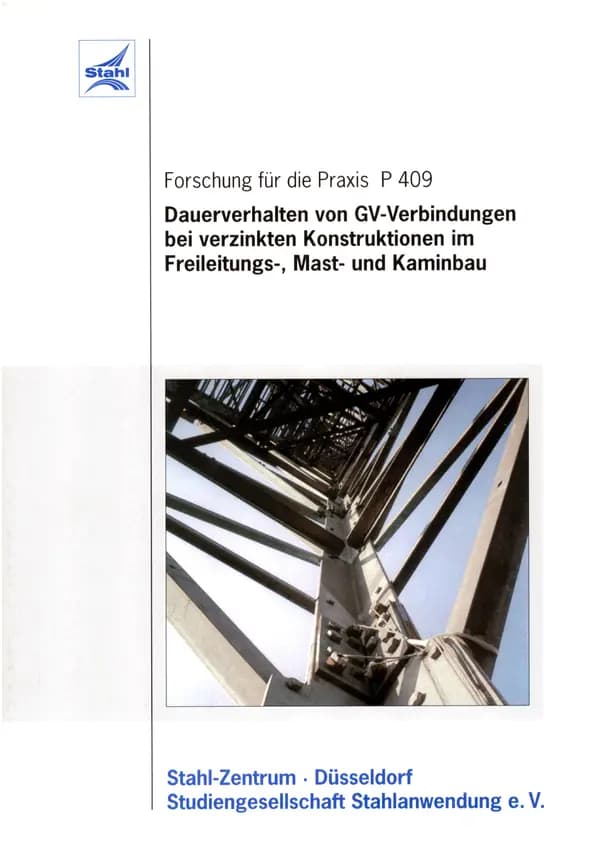
FOSTAP 409 - Fatigue behaviour of GV joints in galvanised structures in overhead line, pylon and chimney construction
P 409: Fatigue behaviour of GV joints in galvanised structures in overhead line, pylon and chimney construction The starting point of the investigations was the loss of clamping force observed in mast structures on shear-stressed GV (slip-resistant prestressed) connections made with galvanised, high-strength tempered (HV) screw sets. This construction technique, which has not yet been regulated by the building authorities, is widely used in radio mast construction. The aim of the research project was to determine reliable statements about clamping force losses and changes in the friction properties of the clamping pack coatings over a long period of time. The test results were to be used to derive improved handling for the construction technology used with regard to long-term safety. The procedure for the investigations was divided into three parts: Firstly, field tests were carried out on shear-stressed corner post joints of a Mannesmann Mobilfunk radio mast built in steel lattice construction under operating conditions, and secondly, laboratory tests were carried out on similar unstressed corner post joint specimens. This was supplemented by laboratory tests on double-section, tensile shear stressed test specimens. They were carried out, among other things, as fatigue and endurance tests with subsequent static tensile testing. The bolted joints were tightened using the torque method. Four different types of friction surface treatment were tested, including two duplex coating systems. It was found that preload losses always occur. They are greatest where the contact surface coating (galvanisation and/or alkali silicate zinc dust coating) has the greatest thickness and the corrosion protection requirements are best met. The preload force losses were of a magnitude that suggested a mathematical consideration, e.g. by applying a reduced limit sliding force. The friction ratios and sliding load capacities found in the clamping packages were in some cases less favourable than assumed in DIN 18800. Only the friction surface treatment (hot-dip galvanised + swept + alkali silicate coated) carried out in accordance with the standard specification achieved the minimum values for the sliding load-bearing capacity in the static rapid test. The results of these tests should be considered as suggestions in addition to the new draft standards DIN V 18800, Part 7 and EN V 1090. Taking them into account makes clamping force losses more manageable and leads to improved long-term serviceability of galvanised structures that are designed with slip-resistant pretensioned bolted connections. STUDIENGESELLSCHAFT STAHLANWENDUNG e.V. Publication: 2001 Authors: Dipl.-Ing. Ch. Kammel, Prof. Dr.-lng. G. Sedlacek
available anytime
View details →€30.00
excl. VAT
 FOSTA
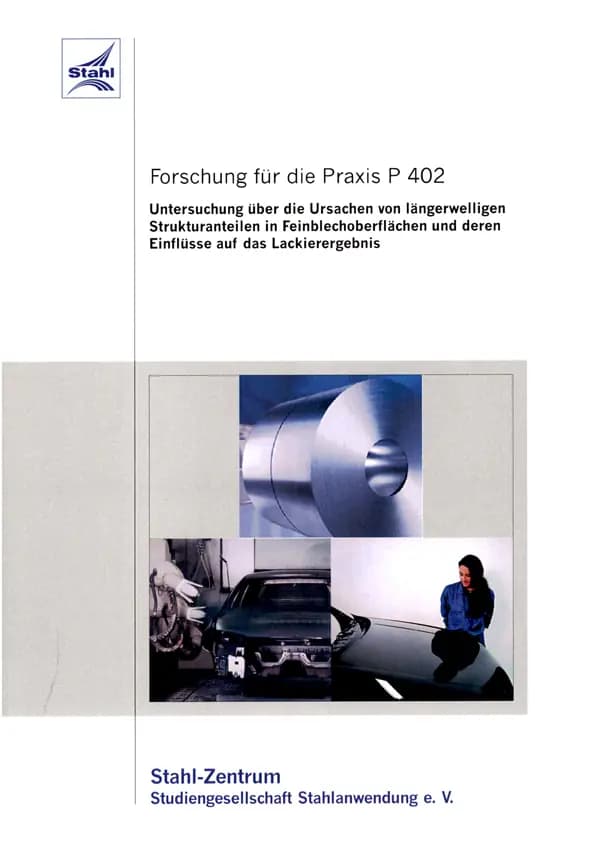
FOSTAP 402 - Longer wavelength structure components in thin sheet surfaces and their influence on the painting result
P 402: Longer wavelength structural components in thin sheet surfaces and their influence on the painting result Longer-wave structure components in the top coat of automotive sheet metal are undesirable, as these are recognisable as so-called orange peel and worsen the visual impression of the product and the customer equates this with poor top coat quality. Known influencing factors include the paint system, the type of application and the conditions selected. The aim of the research project, which was carried out in close co-operation with representatives of the steel, paint and automotive industries, was to determine the influence of the sheet metal surface on the painting result of non-formed and formed sheet metal. The investigations were based on thin sheets from various steel companies as well as paint finishes in laboratories of the paint and automotive industry and paint finishes in five paint lines of the participating automotive companies. The labelling of the elongation waviness was examined, its cause investigated and its effect evaluated. Among the parameters that are currently regarded as determining factors for the lengthening waviness in the thin sheet surface, those with the best significance for achieving a high-quality paint finish were identified. Factors that are particularly effective when skin-passing the thin sheets, essentially the type of texturing of the rollers and, to a lesser extent, the roller grinding and the degree of skin-passing, were identified as the causes of elongation waviness. In contrast, there was no recognisable influence from the condition of the uncoated strip. For the parameters with the best significance, areas were identified in which the longitudinal waviness in the thin sheet surface is low and only has a subordinate influence on the formation of the top coat levelling structure. With suitable measures, it will now be possible to further optimise the thin sheet surface with regard to the reduction of longer wavelength structure components for subsequent painting operations The research results will contribute to further improving the visual impression of painted surfaces, e.g. of cars, but also of household goods. STUDIENGESELLSCHAFT STAHLANWENDUNG e.V. Publication: 2003 Authors: Dr.-Ing. O. German
available anytime
View details →€40.00
excl. VAT
 FOSTA
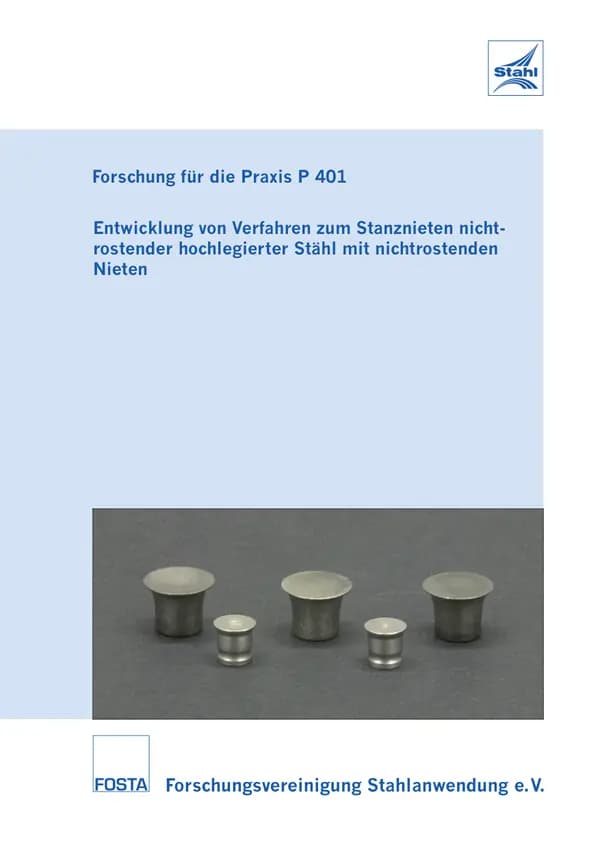
FOSTAP 401 - Development of processes for self-pierce riveting of stainless high-alloy steels with stainless rivets
P 401 - Development of processes for self-pierce riveting of stainless high-alloy steels with stainless rivets High-alloy stainless steels are increasingly being used in the capital goods and consumer goods industries. The reasons for the growing use of this group of materials can be found in their technical properties. The main characteristics of stainless steels are corrosion resistance, heat and fire resistance, good mechanical and physical properties, favourable processing properties, attractive appearance, germ-repellent hygienic surfaces, environmental friendliness and recyclability. The combination of many of these properties in one material is what makes stainless steels so attractive. steels. Productivity advances have made it possible to reduce the price of the most commonly used material 1.4301 over the last 20 years. The use of stainless sheet materials is increasingly being favoured in various areas of sheet metal processing. The corrosion properties, but also the good forming properties, particularly when using austenitic grades, play an important role here. Resistance spot welding and roll seam welding are successfully used in the processing of stainless sheet steel materials. Although the critical temperature ranges are passed through very quickly, the heat input during joining can have a detrimental effect on corrosion resistance. The occurrence of annealing colours, which have a negative effect on the visual appearance and corrosion resistance, is countered by the use of shielding gas or, more frequently, by reworking using pickling or grinding. This reworking considerably increases the cost of the joint and should no longer be necessary if the joining technology used in this project is utilised. The use of self-pierce riveting processes, in particular semi-tubular self-pierce riveting processes, has so far largely been considered impractical for stainless steel sheets. This is not least due to the fact that there was no rivet on the market in the field of semi-tubular self-pierce riveting technology that enabled the processing of stainless steel materials as a stainless rivet. The project created the basis for describing the self-pierce riveting processes in terms of their processing properties when using stainless steels. Results have been compiled for the user which provide information on the reliable processing of stainless steels with stainless self-pierce rivets for the design of a joining device and work with the setting unit. Furthermore, characteristic values are provided that describe the load-bearing behaviour of these joints. The investigations demonstrated that stainless self-pierce rivets can be produced using methods comparable with industrial standards and can be processed in combination with stainless sheet materials. The research project was carried out at the Laboratory for Materials and Joining Technology at the University of Paderborn, at the Department of Mechanical Engineering - Automation Technology, South Westphalia University of Applied Sciences, Soest department and at ThyssenKrupp Nirosta GmbH, Krefeld, with technical support and financial assistance from the Forschungsvereinigung Stahlanwendung e. V., Düsseldorf, with funds from the Stiftung Stahlanwendungsforschung, Essen. Authors: O. Hahn, W. Flügge, A. Schulz Beenken, J. Schulte, S. Schuberth Publication: 2009
available anytime
View details →€36.00
excl. VAT
 FOSTA
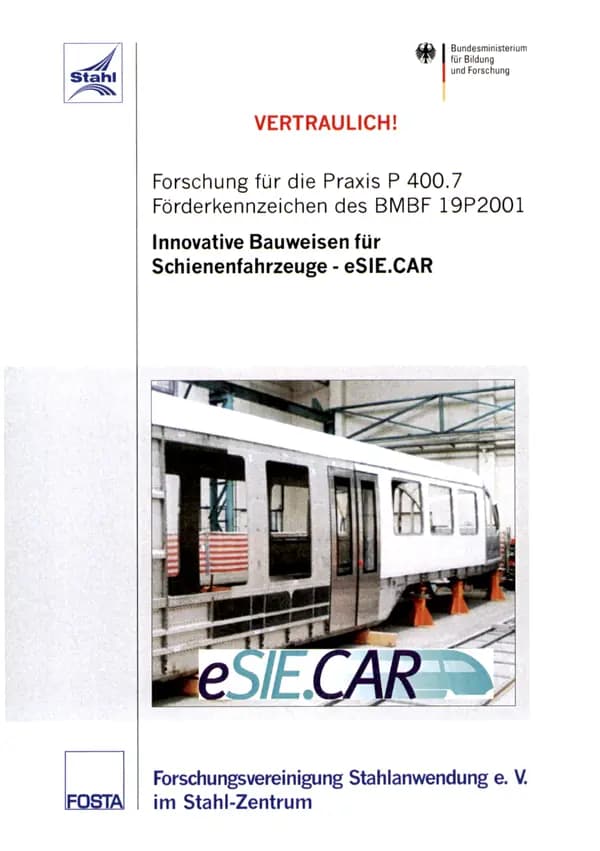
FOSTAP 400 - Innovative construction methods for rail vehicles
P 400 - Innovative construction methods for rail vehicles Authors: K. Altenburg, et.al. Publication: 2005
available anytime
View details →€25.50
excl. VAT