
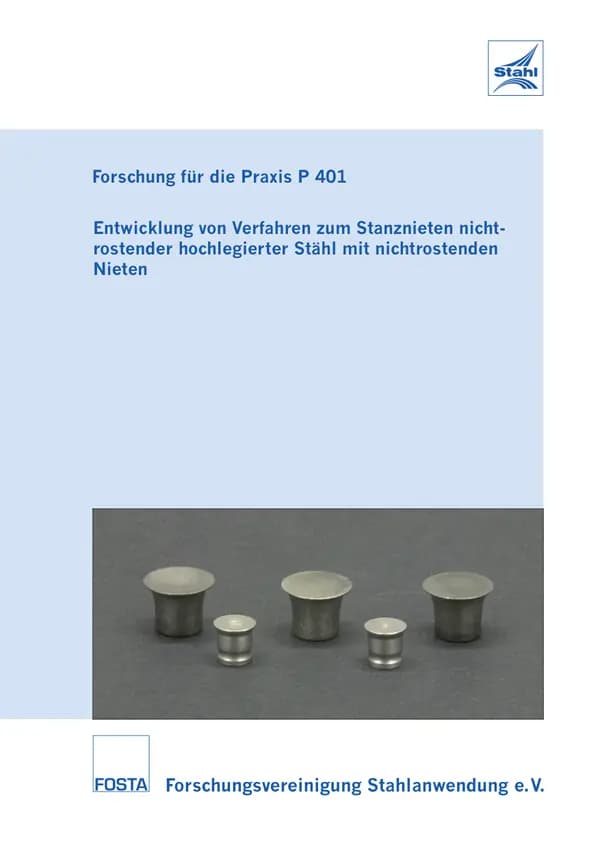
P 401 - Development of processes for self-pierce riveting of stainless high-alloy steels with stainless rivets
High-alloy stainless steels are increasingly being used in the capital goods and consumer goods industries. The reasons for the growing use of this group of materials can be found in their technical properties. The main …
Content
- Authors
- O. Hahn, W. Flügge, A. Schulz Beenken, J. Schulte, S. Schuberth
- Publication
- 2009
High-alloy stainless steels are increasingly being used in the capital goods and consumer goods industries. The reasons for the growing use of this group of materials can be found in their technical properties. The main characteristics of stainless steels are corrosion resistance, heat and fire resistance, good mechanical and physical properties, favourable processing properties, attractive appearance, germ-repellent hygienic surfaces, environmental friendliness and recyclability. The combination of many of these properties in one material is what makes stainless steels so attractive. steels. Productivity advances have made it possible to reduce the price of the most commonly used material 1.4301 over the last 20 years.
Show full description
The use of stainless sheet materials is increasingly being favoured in various areas of sheet metal processing. The corrosion properties, but also the good forming properties, particularly when using austenitic grades, play an important role here. Resistance spot welding and roll seam welding are successfully used in the processing of stainless sheet steel materials. Although the critical temperature ranges are passed through very quickly, the heat input during joining can have a detrimental effect on corrosion resistance. The occurrence of annealing colours, which have a negative effect on the visual appearance and corrosion resistance, is countered by the use of shielding gas or, more frequently, by reworking using pickling or grinding. This reworking considerably increases the cost of the joint and should no longer be necessary if the joining technology used in this project is utilised. The use of self-pierce riveting processes, in particular semi-tubular self-pierce riveting processes, has so far largely been considered impractical for stainless steel sheets. This is not least due to the fact that there was no rivet on the market in the field of semi-tubular self-pierce riveting technology that enabled the processing of stainless steel materials as a stainless rivet. The project created the basis for describing the self-pierce riveting processes in terms of their processing properties when using stainless steels. Results have been compiled for the user which provide information on the reliable processing of stainless steels with stainless self-pierce rivets for the design of a joining device and work with the setting unit. Furthermore, characteristic values are provided that describe the load-bearing behaviour of these joints. The investigations demonstrated that stainless self-pierce rivets can be produced using methods comparable with industrial standards and can be processed in combination with stainless sheet materials. The research project was carried out at the Laboratory for Materials and Joining Technology at the University of Paderborn, at the Department of Mechanical Engineering - Automation Technology, South Westphalia University of Applied Sciences, Soest department and at ThyssenKrupp Nirosta GmbH, Krefeld, with technical support and financial assistance from the Forschungsvereinigung Stahlanwendung e. V., Düsseldorf, with funds from the Stiftung Stahlanwendungsforschung, Essen.
Zum Zoomen hovern
€36.00excl. VAT
Payment by card (Stripe) or invoice (DE, AT, CH). Download link by email: automatically after ordering by card, after order approval for invoice (valid for 30 days). Terms
P 401 - Development of processes for self-pierce riveting of stainless high-alloy steels with stainless rivets—
€36.00