
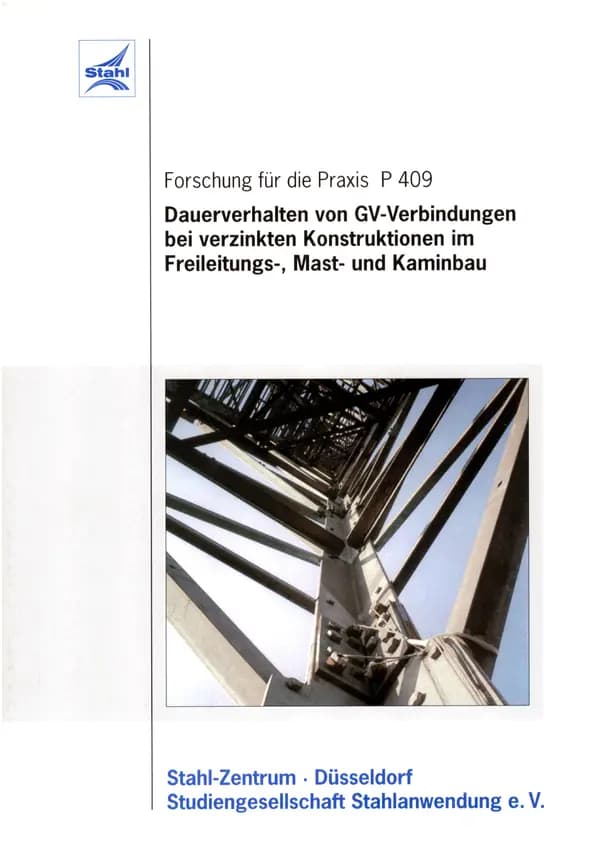
P 409 - Fatigue behaviour of GV joints in galvanised structures in overhead line, pylon and chimney construction
The starting point of the investigations was the loss of clamping force observed in mast structures on shear-stressed GV (slip-resistant prestressed) connections made with galvanised, high-strength tempered (HV) screw …
Content
- Publication
- 2001
- Authors
- Dipl.-Ing. Ch. Kammel, Prof. Dr.-lng. G. Sedlacek
The starting point of the investigations was the loss of clamping force observed in mast structures on shear-stressed GV (slip-resistant prestressed) connections made with galvanised, high-strength tempered (HV) screw sets. This construction technique, which has not yet been regulated by the building authorities, is widely used in radio mast construction. The aim of the research project was to determine reliable statements about clamping force losses and changes in the friction properties of the clamping pack coatings over a long period of time. The test results were to be used to derive improved handling for the construction technology used with regard to long-term safety.
Show full description
The procedure for the investigations was divided into three parts: Firstly, field tests were carried out on shear-stressed corner post joints of a Mannesmann Mobilfunk radio mast built in steel lattice construction under operating conditions, and secondly, laboratory tests were carried out on similar unstressed corner post joint specimens. This was supplemented by laboratory tests on double-section, tensile shear stressed test specimens. They were carried out, among other things, as fatigue and endurance tests with subsequent static tensile testing. The bolted joints were tightened using the torque method. Four different types of friction surface treatment were tested, including two duplex coating systems. It was found that preload losses always occur. They are greatest where the contact surface coating (galvanisation and/or alkali silicate zinc dust coating) has the greatest thickness and the corrosion protection requirements are best met. The preload force losses were of a magnitude that suggested a mathematical consideration, e.g. by applying a reduced limit sliding force. The friction ratios and sliding load capacities found in the clamping packages were in some cases less favourable than assumed in DIN 18800. Only the friction surface treatment (hot-dip galvanised + swept + alkali silicate coated) carried out in accordance with the standard specification achieved the minimum values for the sliding load-bearing capacity in the static rapid test. The results of these tests should be considered as suggestions in addition to the new draft standards DIN V 18800, Part 7 and EN V 1090. Taking them into account makes clamping force losses more manageable and leads to improved long-term serviceability of galvanised structures that are designed with slip-resistant pretensioned bolted connections. STUDIENGESELLSCHAFT STAHLANWENDUNG e.V.
Zum Zoomen hovern
€30.00excl. VAT
Payment by card (Stripe) or invoice (DE, AT, CH). Download link by email: automatically after ordering by card, after order approval for invoice (valid for 30 days). Terms
P 409 - Fatigue behaviour of GV joints in galvanised structures in overhead line, pylon and chimney construction—
€30.00