The combination of different materials to optimise parts and components in vehicle technology is becoming increasingly important. The aim of this thesis was to demonstrate the potential of an innovative technology in …
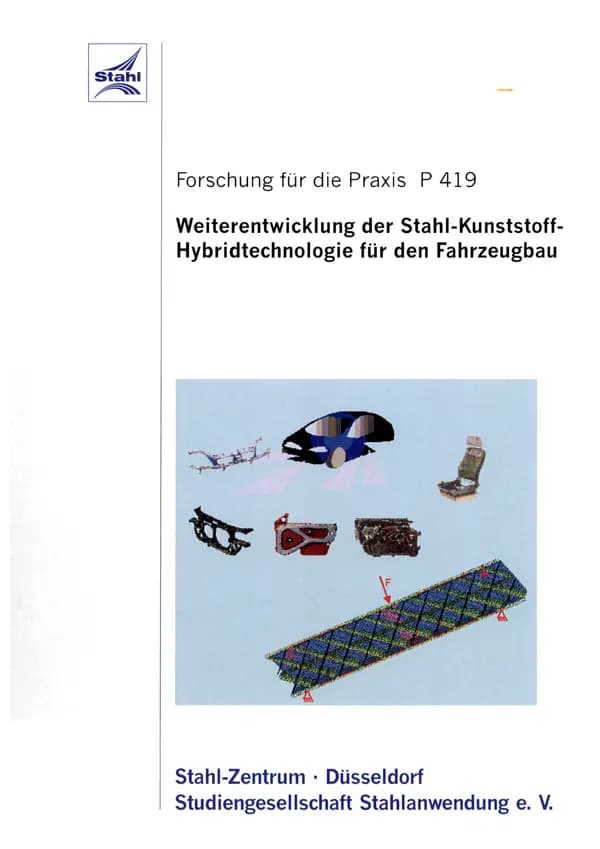
The combination of different materials to optimise parts and components in vehicle technology is becoming increasingly important. The aim of this thesis was to demonstrate the potential of an innovative technology in which sheet metal structures are reinforced by injected plastic ribs. Based on a general overview of the specific structure of this type of component, a number of components realised in hybrid technology using different manufacturing processes and materials are examined in more detail. The advantages of the different material combinations are particularly emphasised. For an investigation of the structural behaviour and an assessment of the calculability using the finite element method, a specific substructure was selected from the existing components under consideration.
The performance of the hybrid components compared to unreinforced components was confirmed in real component tests. Compared to conventional components, they have a higher integration potential with a combination of very good mechanical properties and reduced weight. The targeted arrangement of the mutually complementary and reinforcing plastic and steel structures allows the components to be optimally designed for each individual case. The finite element method was used to demonstrate that the behaviour of hybrid components can be described using numerical methods. The focus was placed on mapping the component behaviour up to material failure. The selected material description allows the behaviour of the overall structure to be calculated up to the failure of the plastic component in the test. The potential of hybrid technology for further applications can be summarised as follows: The technology is preferably suitable for components that are detachably connected to the vehicle at several points, as this provides optimum force transmission into the structure and the possibility of repair can be easily realised. The design freedom of the plastic can be utilised particularly advantageously for components with a large number of connection and fastening points. This finding is confirmed in a forward-looking way by dismountable front-end systems that have already been realised as series components. STUDIENGESELLSCHAFT STAHLANWENDUNG e.V.
Payment by card (Stripe) or invoice (DE, AT, CH). Download link by email: automatically after ordering by card, after order approval for invoice (valid for 30 days). Terms
Machine-translated title and description. The document itself is in German.
Digital download
Other parts and editions as well as neighbouring documents of the same series.

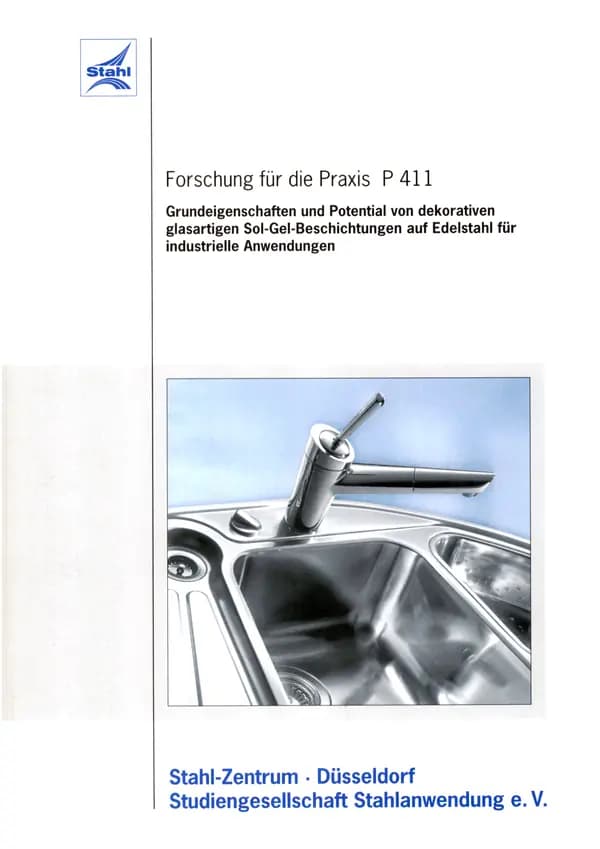
P 411: Basic properties and potential of decorative glassy sol-gel coatings on stainless steel for industrial applications Stainless steels, commonly referred to as stainless steels, are often used for decorative purposes in the household and architectural sectors. Depending on the application and stress, an attractive appearance can only be achieved in the long term if measures are taken to prevent scratching in daily use and discolouration under thermal stress. The aim of the research project was to investigate the basic properties and potential of decorative glass-like sol-gel coatings as a transparent alternative to enamel coatings with corresponding properties. As part of the present work, a glass-like sol-gel coating system already developed by the Institute for New Materials (INM) was tested for the requirements of the industrial partners involved in the project. In particular, the extent to which these requirements can be met with continuous or piece coating and the extent to which the system can be formed, welded or mechanically joined was investigated. Parallel to the tests at the industrial partners, investigations were carried out at the INM to optimise the existing system (particle incorporation, component variations) and to combine several coating systems (primer layer plus metal oxides). The results of the investigations have shown that the properties of stainless steel surfaces can be significantly improved in some areas by applying the glass-like coatings. The coatings can achieve at least temporary (approx. 500 h) tarnish protection at 500 °C. The abrasion resistance of the stainless steel surface is significantly improved. After 500 cycles of the abrasion test, there are only isolated scratches, whereas uncoated steel is already severely damaged after 10 cycles. Furthermore, in the area of high-temperature protection, it was demonstrated that the investigated glass-like coatings offer a clear advantage over conventional sealing methods when it comes to maintaining the visual appearance of stainless steel. However, tests with mechanical stresses have also shown that the glass-like coatings do not offer sufficient elasticity for any necessary forming operations. forming operations. In the case of piece coatings, on the other hand, glass-like sol-gel coatings can offer advantages depending on the requirements profile. This applies to scratch resistance, tarnish protection and transparency of the coating as well as easier cleaning. Colouring without major impairment of the metallic appearance is also conceivable. However, significant optimisation steps are still required to exploit this potential in the household and office furniture sector, in the automotive and architectural sectors and for decorative purposes. STUDIENGESELLSCHAFT STAHLANWENDUNG e.V. Publication: 2001 Authors: Dr rer. nat. M. Amlung, Dr.-Ing. K. Endres, Dipl.-Chem. Ch. Schelle
available anytime
€20.00
excl. VAT

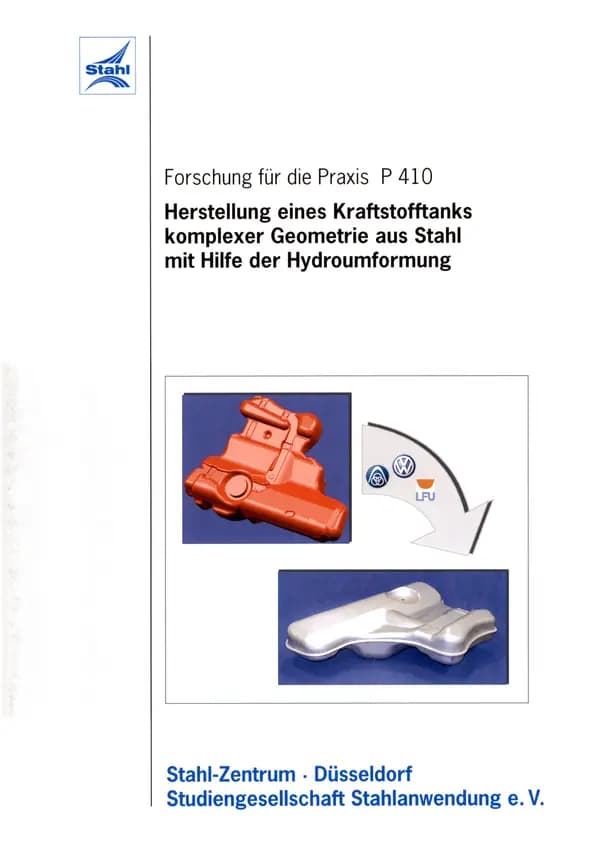
P 410: Production of a fuel tank of complex geometry from steel using hydroformingIn the course of stricter environmental protection requirements, the release of fuel oil components must be completely avoided. This requirement will soon apply to fuel tanks and can currently only be safely fulfilled with steel as a material. Design and safety requirements in car construction demand the positioning of the fuel tank in the less critical but very complex cavities of the car body in the event of a crash. The aim of this research project was to develop technical and economical solutions for the production of geometrically highly complex hollow bodies made of steel for this application with the help of active-media-based sheet metal forming. For the investigations, the tank of a New Beetle, PQ 34, from Volkswagen AG, which was previously made of plastic, was selected as an example for a medium-volume compact car. The austenitic stainless steel 1.4301, which had been tested in preliminary tests (P 242 Untersuchung der Herstellmöglichkeiten eines modernen Kraftstofftanks aus Stahl mit Hilfe hydromechanischer und hydrostatischer Umformverfahren, Order No. P 242, ISBN 3- 930621-78-9, Verlag und Vertriebsgesellschaft mbH, Düsseldorf), served as the material basis. In preliminary simulation work, promising forming processes, adapted process control and special tool design were investigated and selected. Finally, the upper shell of the tank was manufactured by deep-drawing 0.6 mm thick sheet metal. The geometrically much more demanding lower shell was successfully produced by single-stage hydromechanical deep drawing from 0.8 mm thick sheet metal. The tanks, which were joined to prototypes from the two half-shells using TIG welding, were then subjected to Volkswagen AG's factory-internal component tests. This showed that all necessary safety requirements could be fully met due to the material-specific high residual deformation capacity. Without further optimisation steps, a weight reduction of 1.7 kg or 20 % was achieved for the steel tank compared to the plastic version. In some cases, the wall thickness in steel is only one tenth of that in plastic, resulting in a filling quantity that is almost 3 litres or almost 4% higher. Based on these test results, it can be concluded that Stainless steels, and probably also other corrosion-protected steels, can be processed into geometrically very complex fuel tanks in conjunction with modern hydroforming processes and a process and material-appropriate design. Steel thus offers a highly topical alternative material for solving future environmental protection requirements for fuel tanks. STUDIENGESELLSCHAFT STAHLANWENDUNG e.V. Publication: 2001 Authors: Prof. Dr E. Friebe, Dipl.-Wirtsch.-lng. T.Langhammer, Dipl.-Ing. P. Corsten, ]}, Dr W. Homberg, Dipl.-Ing. A. Wellendorf, Dr A.t Birkert, Dr F. Trösken, M. Carl, Dr J. Krautschick, Dr P. Papaiacovou
available anytime
€20.00
excl. VAT
Payment by card (Stripe) or invoice (DE, AT, CH). Download link by email: automatically after ordering by card, after order approval for invoice (valid for 30 days). Terms