
FOSTA
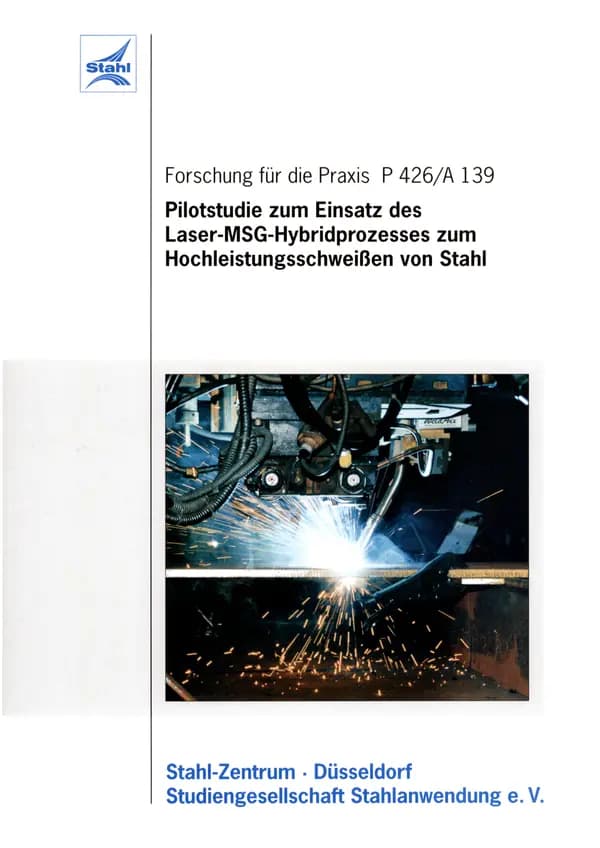
The combination of the laser beam welding process with arc welding methods allows the realisation of a joining method with considerable application possibilities. Among the possible process variants is the CO2-laser GMA …
The combination of the laser beam welding process with arc welding methods allows the realisation of a joining method with considerable application possibilities. Among the possible process variants is the CO2-laser GMA Hybrid welding method; its applicability has been determined within the framework of this project on high-performance welding of different steel qualities. In this connection, tests were carried out on a typical higher-strength shipbuilding steel GL-A 36 (AH36, 1.0583), on a high-alloy steel X6CrNiMoTi17-12-2 (1.4571) and on two high-strength steels S700MC (1.8974) and L450MB (X65, 1.8975). Here, one of the objectives was the determination of the maximum gap bridging ability amax with butt joints for different plate thickness ranges.
At plates with t = 5 mm a gap of amax = 2 mm could be bridged; for t = 8 mm the achieved a max was 1.35 mm and for t = 12 mm the value for a max was 0.7 mm. These welds were carried out in flat position (PA) without any backing support. Moreover, welds in the horizontal position (PC) were carried out at a plate thickness of 20 mm; the horizontal position was chosen, as welding a plate of that thickness in the flat position would, by reason of the relatively large weld pool, lead to the immediate sag of the molten metal. Applying these weld methods, the gap width a max = 0.7 mm could be bridged without any process-specific problems.
Machine-translated title and description. The document itself is in German.
Payment by card (Stripe) or invoice (DE, AT, CH). Download link by email: automatically after ordering by card, after order approval for invoice (valid for 30 days). Terms
Digital download
Other parts and editions as well as neighbouring documents of the same series.
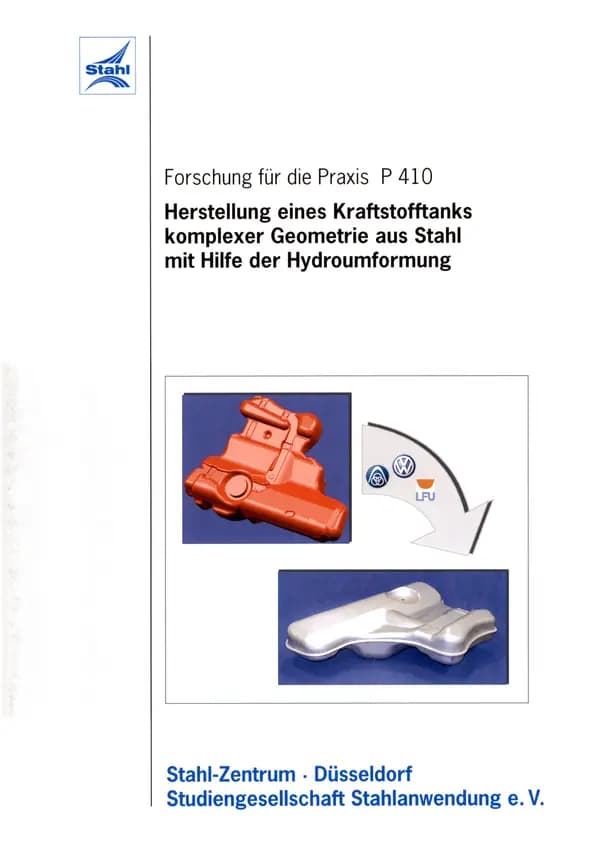
P 410: Production of a fuel tank of complex geometry from steel using hydroformingIn the course of stricter environmental protection requirements, the release of fuel oil components must be completely avoided. This requirement will soon apply to fuel tanks and can currently only be safely fulfilled with steel as a material. Design and safety requirements in car construction demand the positioning of the fuel tank in the less critical but very complex cavities of the car body in the event of a crash. The aim of this research project was to develop technical and economical solutions for the production of geometrically highly complex hollow bodies made of steel for this application with the help of active-media-based sheet metal forming. For the investigations, the tank of a New Beetle, PQ 34, from Volkswagen AG, which was previously made of plastic, was selected as an example for a medium-volume compact car. The austenitic stainless steel 1.4301, which had been tested in preliminary tests (P 242 Untersuchung der Herstellmöglichkeiten eines modernen Kraftstofftanks aus Stahl mit Hilfe hydromechanischer und hydrostatischer Umformverfahren, Order No. P 242, ISBN 3- 930621-78-9, Verlag und Vertriebsgesellschaft mbH, Düsseldorf), served as the material basis. In preliminary simulation work, promising forming processes, adapted process control and special tool design were investigated and selected. Finally, the upper shell of the tank was manufactured by deep-drawing 0.6 mm thick sheet metal. The geometrically much more demanding lower shell was successfully produced by single-stage hydromechanical deep drawing from 0.8 mm thick sheet metal. The tanks, which were joined to prototypes from the two half-shells using TIG welding, were then subjected to Volkswagen AG's factory-internal component tests. This showed that all necessary safety requirements could be fully met due to the material-specific high residual deformation capacity. Without further optimisation steps, a weight reduction of 1.7 kg or 20 % was achieved for the steel tank compared to the plastic version. In some cases, the wall thickness in steel is only one tenth of that in plastic, resulting in a filling quantity that is almost 3 litres or almost 4% higher. Based on these test results, it can be concluded that Stainless steels, and probably also other corrosion-protected steels, can be processed into geometrically very complex fuel tanks in conjunction with modern hydroforming processes and a process and material-appropriate design. Steel thus offers a highly topical alternative material for solving future environmental protection requirements for fuel tanks. STUDIENGESELLSCHAFT STAHLANWENDUNG e.V. Publication: 2001 Authors: Prof. Dr E. Friebe, Dipl.-Wirtsch.-lng. T.Langhammer, Dipl.-Ing. P. Corsten, ]}, Dr W. Homberg, Dipl.-Ing. A. Wellendorf, Dr A.t Birkert, Dr F. Trösken, M. Carl, Dr J. Krautschick, Dr P. Papaiacovou
available anytime
€20.00
excl. VAT
Payment by card (Stripe) or invoice (DE, AT, CH). Download link by email: automatically after ordering by card, after order approval for invoice (valid for 30 days). Terms