 FOSTA
FOSTAP 518 - Increasing the safety of traffic systems by optimising the protective effect of steel crash barriers
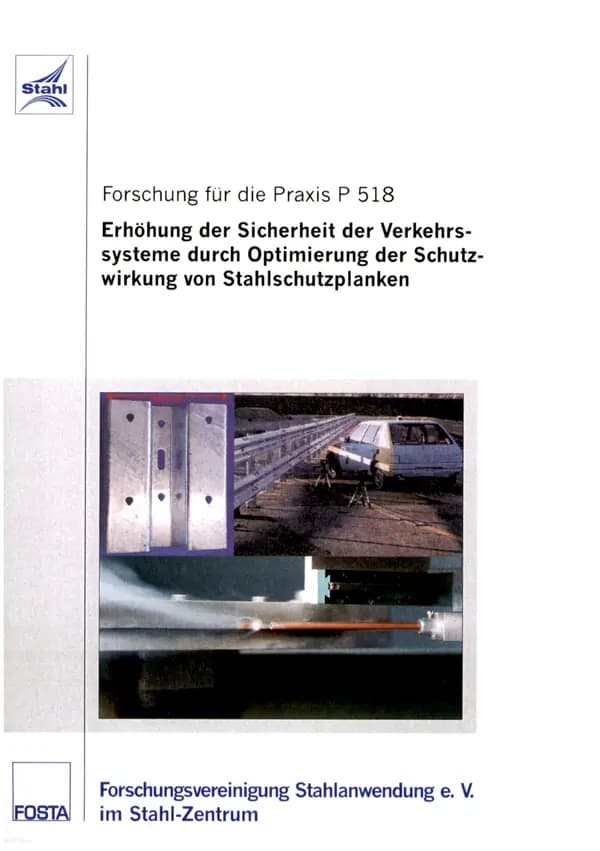
P 518 - Increasing the safety of traffic systems by optimising the protective effect of steel crash barriers The transport policy target set by the European Commission in the European Road Safety Action Programme 2003-2010 of halving the number of road fatalities by 2010 requires not only an increase in vehicle safety but also an improvement in the containment effect through optimised vehicle restraint systems with a simultaneous reduction in occupant stress in the event of a collision. The aim of the research project was to develop a modular, intelligent steel crash barrier system that fulfils the increased protection requirements for vehicle restraint systems set out in EN 1317 and at the same time ensures optimum protection, sustainability through the effective use of resources and multifunctionality depending on the intended use. The developed steel crash barrier systems make an important contribution to the fulfilment of the ambitious protection goals. In particular, the successfully tested System Rail H2 and System Rail H3 can be used in a wide range of applications due to the great demand for vehicle restraint systems with the higher containment levels H2 and H3 and, thanks to their cost-effectiveness, can compete effectively with other products and materials due to their modular element design. With the help of simulation calculations, suitable predictions could be made for the behaviour of the newly developed systems in the impact tests. With the increasingly improved simulation technology used, further optimisation of steel crash barrier systems can be supported even more reliably in the future. As part of the research project, the opening of the market for continuously surface-coated steel products for use as crash barrier beams was largely achieved by demonstrating the equivalence of the corrosion protection of new types of corrosion protection coatings with the established, standard batch galvanised products in laboratory and outdoor weathering tests. Compared to batch galvanising, the continuously applied coatings agozal Double-Dip® (Agozal Oberflächenveredelung), GALFAN® (ThyssenKrupp Stahl) and zinc (Stahlwerke Bremen) as well as a discontinuously applied powder coating (Tigerwerk Lack- und Farbenfabrik) and a DUPLEX system consisting of a thin, continuously applied galvanising and a subsequent powder coating showed better resistance to the stress conditions selected for laboratory tests. In all laboratory tests, the analysed products performed at least equally well. Based on the interim results of the ongoing outdoor weathering tests on removed samples, it can be expected that the tested products will be approved without restriction by the Federal Highway Research Institute once the tests have been successfully completed, provided that all other requirements are met in accordance with the then applicable technical regulations. As part of the research project, the possibility of coating the cut surfaces of the new products using a laser was also investigated in order to improve corrosion protection on the cut surfaces. Ways of increasing the process speed, including through dual-beam technology, i.e. the simultaneous use of two laser beam sources acting in series, were identified and the feasibility of process speeds of up to approx. 60 m/min, which correspond to the typical process speeds in strip galvanising lines, was demonstrated. The coating thicknesses produced guarantee adequate corrosion protection. However, a profitability calculation for the use of lasers shows that implementation in practice will prove difficult in the foreseeable future due to the high system costs. RESEARCH ASSOCIATION FOR STAHLANWENDUNG e.V. Publication: 2004 Authors: Prof. Dr.-Ing. Dr. h.c. G. Sedlacek, Dipl.-Ing. A. Geßler, Dipl.-Ing. Ch. Kammel, ]}, Dr.-Ing. S. Myslowicki, Prof. Dr. rer. nat. R. Poprawe, Dipl.-Phys. G. Vitr
available anytime
View details →€50.00
excl. VAT
 FOSTA
FOSTAP 517 - Alloy concept for seamless Mannesmann Stahlbau hollow sections (MSH sections) with increased fire resistance to save on fire protection measures
P 517 - Alloy concept for seamless Mannesmann Stahlbau hollow sections (MSH sections) with increased fire resistance to save on fire protection measures As part of the research project, two alloy concepts were developed for the production of seamless hollow sections made of fire-resistant steel. The "fine-grain structural steel" alloy concept is based on a common fine-grain structural steel with a minimum yield strength of 690 MPa, while the "line pipe steel" alloy concept is based on a typical carbon-manganese line pipe steel with good weldability. The addition of molybdenum, tungsten and niobium in certain gradations was intended to increase the high-temperature strength and thus the fire resistance. The steel grades of both concepts exhibit strength properties at ambient temperature that exceed the requirements for a conventional unalloyed structural steel with a minimum yield strength of 355 MPa. The toughness requirements (at least 27J at -20°C) are met for steels of both concepts in the normalised or quenched and tempered condition. In the rolled condition, however, the 27 J impact energy at room temperature is only achieved by the variants based on line pipe steel. In the temperature range of 600 to 750°C, which is relevant for fire-resistant steels, the newly developed steels have a hot yield strength that is up to 100 MPa higher than that of structural steel S355. In order to take into account the effects of creep during firing, "hot creep tests" were developed as part of this project, in which loaded specimens were heated. Samples loaded with up to 100 MPa lasted longer than 30 min in the hot creep test and thus achieved a duration relevant for fire resistance class F30 without exceeding the critical creep speed. The tests showed that the hot yield strength is a more conservative criterion for the load-bearing capacity of steels at high temperatures than the critical creep speed. Fire tests on industrially manufactured profiles, as originally requested, were postponed because corresponding components from an industrial melt with optimised heat treatments or rolling parameters were not available. FORSCHUNGSVEREINIGUNG STAHLANWENDUNG e.V. Publication: 2004 Authors: Dr.-Ing. M. Probst-Hein, Dr.-Ing. U. Zeislmair
available anytime
View details →€20.00
excl. VAT
 FOSTA
FOSTAP 516 - Lightweight steel and composite steel structures for building refurbishment
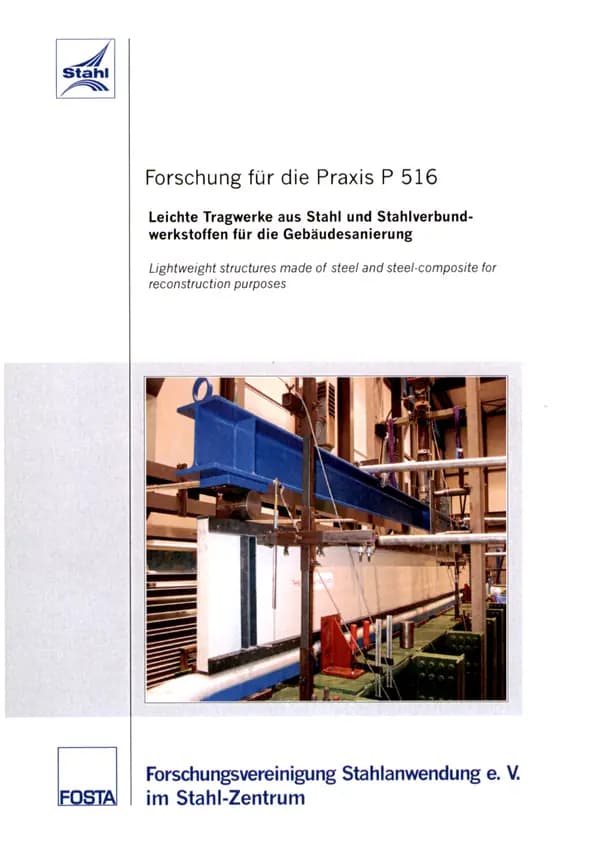
P 516 - Lightweight steel and composite steel structures for building refurbishment As part of the present research project P516, the field of building refurbishment and its influencing factors were first analysed. Based on the knowledge gained, a needs analysis and assessment was carried out in accordance with a utility value analysis. The aim was to develop new construction elements from existing building products. Based on this, the following three component groups were analysed: - kinematic supporting structures - Lightweight ceiling system made of single bars - lightweight beams with webs made of sandwich elements While the first two fields were investigated exclusively on a theoretical-numerical basis, the focus in the development of a lightweight girder was on the extensive test programme carried out. The analysis of the kinematic load-bearing structures showed that the application possibilities for such a system are very limited due to the relatively high compliance. The system only achieves an acceptable level of deflection under load when a large number of locking rods are inserted, which means that the amount of work involved would be too great and economic use - even as a niche product - would be out of the question. In the "lightweight ceiling system" sub-project, initial considerations were made regarding the the required manual transport and the resulting reasonable loads. Based on the knowledge gained, the focus of the sub-project was initially on the investigation of suitable cross-sections in addition to the fundamental analysis of the load-bearing behaviour. An extensive parameter study was carried out. The main difficulty was the search for a suitable connection method, whereby connections based on wedging were ultimately favoured. The system is well suited for use in structural maintenance and renovation. When developing a lightweight beam using sandwich elements, small-scale tests were initially carried out to identify suitable fasteners, accompanied by analyses of the materials used. In addition to self-tapping screws, adhesive joints proved to be suitable for connecting the beam web (sandwich element) to the flanges (folded sheet metal). More than 40 component tests were then carried out, whereby numerous parameters were varied. These included the type of load application, the beam height, the thickness and beading of the surface layers, the geometry of the chords and the combination of several fasteners. In addition, the behaviour of the girder without chords was analysed as well as the behaviour of girders with large web cut-outs for the building equipment. Using a new test technique, it was possible to apply a linear load to the beam by utilising hydrostatic pressure. The newly developed beam showed a very high load-bearing capacity with a low dead weight and at the same time a benign failure. In the load-bearing state, a combined state was achieved in addition to the bending load-bearing effect due to the formation of a tension band. A combination of adhesive and screw connections proved to be ideal with regard to the fasteners used. A numerical study carried out in parallel using the FE method revealed the optimisation potential of the beam. The design proposal presented is based on a deflection limitation of the beam. In conclusion, it can be stated that with the lightweight floor system and the beams with webs made of sandwich elements, two different options were developed that are well suited for use in the renovation of structures. Authors: U. Peil, D. C. Ruff Publication: 2006
available anytime
View details →€30.00
excl. VAT
 FOSTA
FOSTAP 514 - Investigation into climate protection using stainless steel
P 514 - Investigation into climate protection using stainless steel The need for new solar shading systems has arisen because the existing solar shading systems in modern buildings have to fulfil a variety of functions. These are: - Sun and energy protection - Glare protection - Visibility to the outside - Light control for optimum daylight utilisation - Privacy protection - Weather protection In addition, thermal insulation and thus energy saving should be emphasised through this application. Wind loads on the outside of buildings are an important issue. Due to increased wind loads, especially in northern Germany, the sun protection systems of some medium-height buildings are not functional for approx. 70 hours/year in full sunlight, as they are "raised" due to structural sensitivity. More resistant materials such as stainless steel should be used here to withstand this wind load and produce fewer "downtimes" with increased exposure to the sun. The F-values of the façade are of great importance as they characterise the thermal insulation in summer. With the new façades and glazing systems, these F-values can be around 0.15 to 0.2. With the stainless steel façade system, these F-values can be achieved below 0.1. In the area of winter thermal insulation, a new approach can be seen that temporary thermal insulation using radiant active surfaces is favourable, e.g. non-corroding steel sheets. However, it must be emphasised that the radiation components of the surfaces of stainless steel have been completely neglected to date. These radiation components are of a considerably greater nature than the transmission values of a roller shutter curtain. In the verifications that have been carried out, the energy loss can be reduced by half for these external façades. Overall, it should be noted that no stainless steel is currently used in this market segment. It can be seen that the basic materials used do not show any major price differences between stainless steel and aluminium. Authors: Dipl. Ing. D. Kallinich Publication: 2009
available anytime
View details →€20.00
excl. VAT
 FOSTA
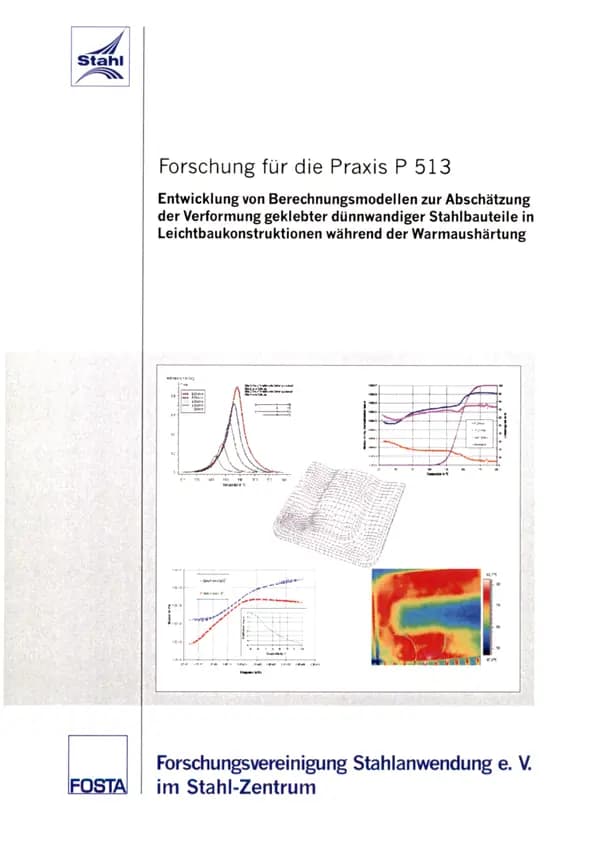
FOSTAP 513 - Development of calculation models for estimating the deformation of bonded thin-walled steel components in lightweight constructions during heat curing
P 513 - Development of calculation models for estimating the deformation of bonded thin-walled steel components in lightweight constructions during heat curing In modern vehicle construction and especially in car body construction, adhesive bonding technology is widely used as a flat joining method due to the possible increase in stiffness and the reduction in the risk of corrosion as a result of the sealing effect. Adhesive bonding offers the possibility of making a significant contribution to reducing vehicle weights with steel sheets of low thickness and high strength. The production of a bonded joint is divided into various individual steps that determine the property profile of the bonded joint. The cross-linking process of the adhesive has a significant influence on the properties. The simulation of the deformations resulting from production due to the residual stresses in the adhesive layer was the subject of the investigations. The reasons for the build-up of residual stresses are the different thermal expansion of the joining partners and the reaction-related volume change of the adhesives during cross-linking. In order to simulate the deformations that occur during the manufacturing process, it is necessary to describe the adhesive as a function of temperature and time, taking into account its reaction kinetics. To describe the viscoelastic properties during crosslinking, chemo- and thermorheologically simple material behaviour was assumed for the adhesives investigated. The modelling of the mechanical behaviour was based on the assumption that a noticeable stress build-up only occurs after the adhesive has reached the gel point; a stress build-up before the gel point is neglected. The yoke test was used to investigate the influence of temperature- and cross-linking-related adhesive shrinkage on the "local" deformation behaviour of sheet steel joints. The influence of joining part relative movements in the manufacturing process was investigated using a steel sunroof cover. When calculating "global" deformations using the sunroof cover as an example, the local-temporal temperature distribution in the component proved to be a significant influencing parameter. The calculated deformation is essentially dependent on the selected temperature boundary conditions. Here it is desirable to determine the temperature distribution via an upstream heat conduction analysis and to use it as an input parameter for further simulation. The results of the investigations presented show that it is possible to simulate large sheet metal components and the deformations resulting from the heat curing of the adhesive by "switching on" the adhesive layer elements in the FEM. The prerequisite for this is that the adhesive reaches the gel point very late in the heating phase or only in the isothermal holding phase and cures completely in the holding phase. It is possible to estimate the mechanical adhesive properties for any temperature profile using time-temperature and time-crosslinking density superposition. Authors: J. Jendrny Publication: 2004
available anytime
View details →€30.00
excl. VAT
 FOSTA
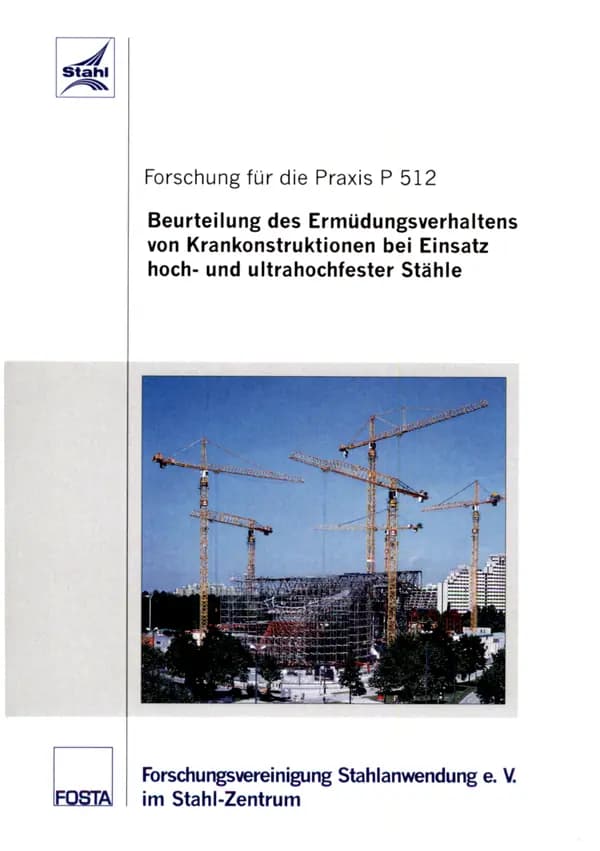
FOSTAP 512 - Assessment of the fatigue behaviour of crane structures when using high-strength and ultra-high-strength steels
P 512 - Assessment of the fatigue behaviour of crane structures when using high-strength and ultra-high-strength steels The performance of cranes and crane construction is significantly increased by the use of high-strength steels. The standards and regulations currently in force assume that high-strength steels up to a yield strength of 460 N/mm² are to be classified in the same way as normal-strength steels in terms of their fatigue behaviour. There are no standardised regulations on the fatigue behaviour of high-strength fine-grained structural steels with yield strengths in the range of 460 to 1100 N/mm². This considerably limits the utilisation of the high strength of these steels. Therefore, the input variables for the fatigue analysis must be scrutinised more closely. As part of this research project, typical notch details for crane construction made of high-strength and ultra-high-strength steels were analysed theoretically and experimentally. Furthermore, the concept of geometric stresses, which has already been successfully applied to hollow section nodes, was applied to crane-specific notch details. In addition, measurements were carried out on selected existing crane systems in order to realistically record the actual load situation. In advance, the details for which the most urgent need for research was identified were agreed with the "Crane-specific notch details" working group. The following design details with variations in geometry and materials were analysed: - Angled connections (K-joints) - Welded-on longitudinal ribs - Laser- and plasma-cut recesses - Butt joints of sheets of different thicknesses - Welded-on lamellas or reinforcement plates The results of these investigations are used to achieve a higher utilisation of the high-strength and ultra-high-strength materials by adapting the fatigue analyses. The savings in construction weight, the reduced sheet thickness and the associated lower welding volume lead to an improvement in economic efficiency and an increase in the performance of crane and conveyor systems and their substructures. The notch catalogue of the new European standardisation can be expanded to include crane-specific notch details. Furthermore, beyond the area of hollow section nodes, a general method for determining the fatigue load with stress concentration factors and using the finite element method is specified, which is used when it is not possible to clearly assign a detail to a specific notch detail. Authors: R. Puthli ,S. Herion Steine, J. Bergers, G. Sedlacek , C. Müller, J. Stötzel, S. Höhler, Ö. Bucak Publication: 2006
available anytime
View details →€50.00
excl. VAT
 FOSTA
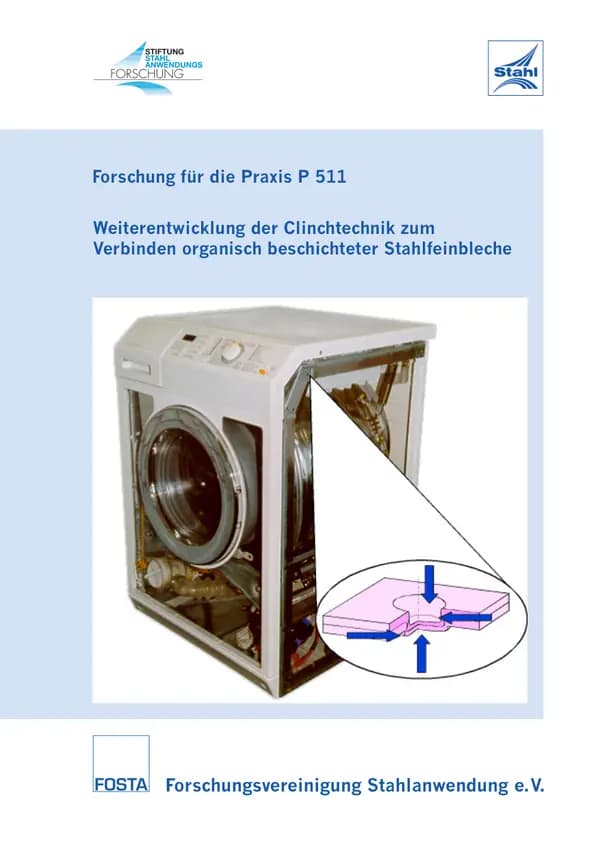
FOSTAP 511 - Further development of clinching technology for joining organically coated steel sheets
P 511 - Further development of clinching technology for joining organically coated steel sheets The aim of the research project was to optimise and further develop clinching technology for joining coil-coated semi-finished products in order to largely limit or avoid the paint damage that occurs with the current state of clinching technology. With regard to reducing coating damage, both the surfaces and geometries of the clinching tools and the coating systems were optimised. The aim was to achieve a significant improvement in visual appearance and corrosion resistance. As part of the project, various liquid and powder coating systems used, for example, in the household appliance industry and in steel furniture construction were investigated. These coating systems were applied to a standardised substrate on a laboratory scale in order to exclude the influence of the substrate material. The tests were carried out using a clinching system with a three-part mould from BTM and a clinching system with an unsplit mould from TOX. The degree of coating damage after the clinching process was primarily assessed visually. Furthermore, the LWF developed a top-mounted measuring cell that allows very good comparative measurements to be made on the clinched joints with regard to the degree of coating damage. However, precise statements about the extent of the damaged coating area as a function of the of the measured current flow, due to the sensitivity of the measurement method with regard to time, temperature, etc., is currently not possible. The results indicate that, with regard to the chemical basis of the analysed liquid coating systems, the polyester coatings showed better clinching suitability than the polyurethane systems. In principle, it can also be said that the pre-treatment of all coating systems has a decisive influence on the adhesion of the coating to the substrate and that there is great potential for optimisation here. Significant improvements in clinchability were achieved by optimising the coatings and pre-treatments. The use of clinching tools optimised in terms of geometry and surface also made it possible to reduce coating damage on both the punch and die sides without reducing the joint strength, in some cases even considerably depending on the coating system. The extensive investigations carried out as part of the project showed that the coating damage is generally highly dependent on the coating system to be clinched. By using clinching tools with optimised geometry and surface, damage to the coating layer could be reduced, but not completely prevented. Authors: O. Hahn, L. Schmidt, B.A. Behrens, S. Hübner, F.W. Bach, M. Schäper Publication: 2010
available anytime
View details →€40.00
excl. VAT
 FOSTA
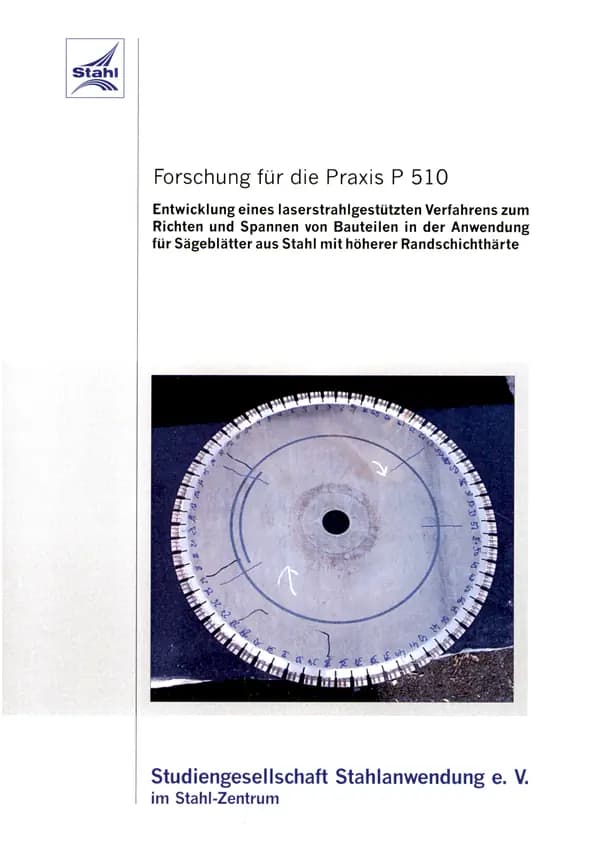
FOSTAP 510 - Development of a laser-assisted process for straightening and clamping components in the application for saw blades made of steel with higher surface layer hardness
P 510 - Development of a laser-assisted process for straightening and clamping components in the application for saw blades made of steel with higher surface hardness Circular saw blades consist of the cutting tool body (blade) and the cutting parts attached to it. Tool steels with a constant hardness of 38 to 46 HRC across the cross-section are used for the blade body. The cutting parts for wood and wood-based material processing are mainly carbide teeth attached to them by brazing, and diamond segments for stone processing by brazing and laser welding. When using saw blades, there is a requirement for a narrow kerf and stable blade behaviour. These requirements are met by using stiffer saw blades and by adjusting the dynamic behaviour of the cutting parts. A reduction in the kerf width and stable blade behaviour due to stiffer blades was achieved by using case-hardened pre-material. The steel grades 13CrMo4-5 (1.3566) and 14NiCr14 (1.5752) with a low carbon content were used and case-hardened. Due to the high surface hardness of up to 60 HRC, the mechanical forming required for clamping and straightening is only possible with increased effort, so that the straightening and clamping process must be carried out by other methods, e.g. by localised short-term heating. With the laser straightening process, surface crack-free forming could be achieved in preliminary tests. This demonstrated the general suitability of the laser levelling process. The risks of the process lie in the fact that the complex heat treatment process of case hardening the sheet metal must be adapted to the requirement profile of the circular saw blades without leading to excessive distortion of the components. The diverse parameter variations of case hardening must be taken into account. This increases the overall component strength (fatigue bending fatigue strength). This reduces the bending vibrations that occur during use, particularly at high speeds. The result is a reduction in noise emissions and an improvement in cutting quality. Due to the higher component strength, the blade thickness can be reduced. The project objectives of developing a process for manufacturing sawing tools from sheet metal with a higher surface layer hardness and a method for straightening and clamping using a laser beam to reduce the kerf width, increase the cutting surface quality and minimise the environmental impact were achieved. The new tools were trialled during the work in industry, and the aim is to implement them in daily production in the medium term. STUDIENGESELLSCHAFT STAHLANWENDUNG e.V. Publication: 2003 Authors: Dr.-Ing. G. C. Stehr, Dipl.-Ing. U. V. Münz
available anytime
View details →€20.00
excl. VAT
 FOSTA
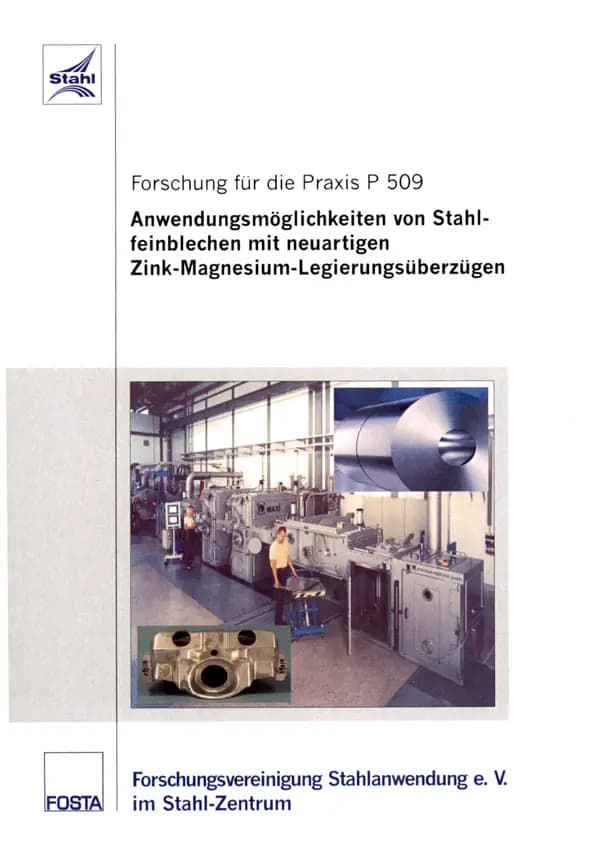
FOSTAP 509 - Possible applications of thin steel sheets with novel zinc-magnesium alloy coatings
P 509 - Possible applications of thin steel sheets with novel zinc-magnesium alloy coatings With the introduction of galvanised sheet metal, the steel industry has been offering its customers products with a considerably longer service life for many years. However, functional coating systems have not only been developed for corrosion protection alone; many metallic coatings also serve to improve processing properties or fulfil decorative purposes. The good corrosion resistance of injection-moulded parts made of Zn-Mg alloys is well known, so that there have been repeated attempts to apply corresponding coatings to sheet steel. PVD (physical vapour deposition) vacuum coating processes are particularly suitable for applying such coatings to uncoated or galvanised sheet steel. These processes can be used to produce both targeted distribution gradients in the layer structure and extremely thin, uniform layers. With specially adapted multi-layer systems, it is possible to fulfil several application profiles at the same time. As part of the research project to test Zn-Mg coatings vapour-deposited on hot-dip galvanised sheet metal, a newly constructed in-line vacuum pilot coating system was used at the Fraunhofer Institute for Electron Beam and Plasma Technology (FEP), with which large sample sheets (500 mm x 500 mm) can be vapour-deposited on one or both sides. This made it possible to provide extensive sample material for the necessary application technology tests and to create the basis for the application technology of the newly coated sheets. With regard to the many areas of application for optimally coated sheets (construction, household appliance industry, phono industry, automotive industry and its suppliers), it was thus possible to test important requirements such as increased corrosion resistance, improved joinability and paintability as well as suitability for forming. The results of the research project have shown that highly corrosion-resistant Zn-Mg alloy coatings with promising properties can be produced by combining conventional hot-dip galvanising and vacuum vapour deposition technology (PVD). The Zn-Mg system combines excellent corrosion properties with good processing behaviour. This was demonstrated in particular in the practical tests on a component from the automotive industry (wiper axle reinforcement). Overall, the tests in the pilot plant showed good reproducibility both in the production of the vapour-deposited test panels and in their property values, as well as the potential of the process for scalability in a continuous process. A possible next step is to examine the scalability to industrial standards, taking particular account of the economic efficiency of the coating process. the economic efficiency of the coating process. RESEARCH ASSOCIATION STAHLANWENDUNG e .V. Publication: 2004 Authors: Dipl.-Ing. J. Hagler, Dr rer. nat. T. Koll, Dr rer. nat. K. Ullrich, Dr rer. nat. B. Scheffel, Dr M. de Meyer, Dr rer. nat. B. Schumacher, Dr A. Spalek, Dr G. Steinbeck
available anytime
View details →€40.00
excl. VAT
 FOSTA
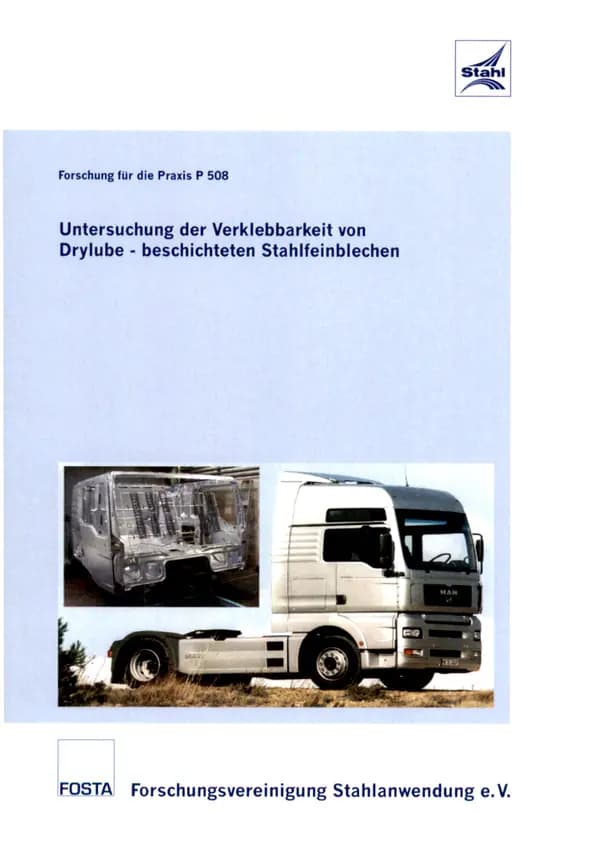
FOSTAP 508 - Investigation of the bondability of Drylube-coated steel sheets
P 508 - Investigation of the bondability of Drylube-coated steel sheets Conventionally, thin sheets are protected against corrosion by the manufacturer for transport and storage using oil. In recent years, pure anti-corrosion oils have been largely replaced by prelubes, which, in addition to corrosion protection, were also able to guarantee the properties of previously used forming aids. Recently, vehicle manufacturers have become considerably more interested in non-running, non-slip dry lubricant coatings (Drylubes; corrosion protection and forming aids), which are already increasingly being used for aluminium. The adhesive compatibility of the newly developed, non-slip anti-corrosion coatings (Drylubes) was initially unclear. As some of these coatings are solid polymer films, there were concerns as to whether they could be absorbed by the usual, heat-curing bodyshell adhesives. This was checked on the basis of the similar process sequence used by all vehicle manufacturers in the bodyshell (application of the adhesive to the temporary coating, joining of the components and fixing, removal of the temporary coating in the area of the paintwork immediately before the cathodic dip coating, complete curing of the adhesive only in the cathodic dip coating oven). The tests showed that the bondability and compatibility of the Drylube dry lubricants analysed can generally be described as good. Individual incompatibilities were identified and explained using damage models. Initial optimisation approaches were examined and show possibilities for avoiding weak points. The results of this research report thus make a significant contribution to the optimisation of production processes in body-in-white construction, particularly with regard to bonded lightweight construction methods with Drylube-coated thin sheets. The objectives of the joint research were developed in a "Bonding of Steel" working group under the direction of the Forschungsvereinigung Stahlanwendung e.V., Düsseldorf. This working group includes representatives of the steel processing industry (motor vehicles, commercial vehicles, white goods) as well as representatives of the steel industry. Authors: O. Deutscher, W. Brockmann, P. L. Geiß, K. Jürgen Grüner, T. Neeb Publication: 2009
available anytime
View details →€20.00
excl. VAT
 FOSTA
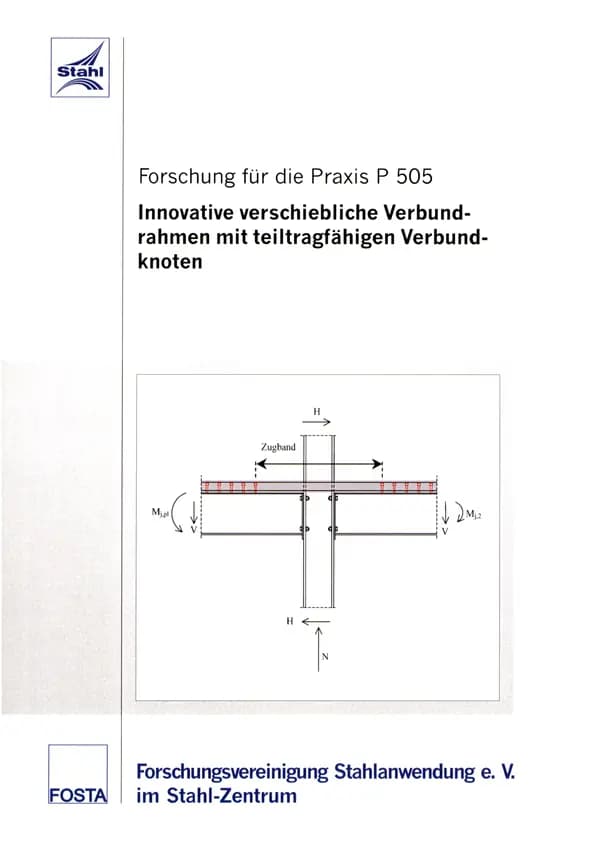
FOSTAP 505 - Innovative sliding composite frames with partially load-bearing composite nodes
P 505 - Innovative sliding composite frames with partially load-bearing composite nodes By dispensing with additional stiffeners in the column, partially load-bearing composite nodes can be produced efficiently and easily. At the same time, the degree of reinforcement in the concrete slab can be reduced to the minimum reinforcement. The moment load-bearing capacity of the node is 15 to 60 % of the transom load-bearing capacity and is sufficient to ensure bracing via the frame effect, making additional bracing superfluous. The resulting innovative sliding composite frames allow the greatest possible flexibility in the use of industrial, office and commercial buildings and multi-storey car parks, thus meeting future requirements. In order to be able to take the moment load-bearing reserve of the partially load-bearing nodes into account in the calculation, it must be ensured that the associated rotation of the node is possible when the moment redistribution occurs. It must be ensured that the existing node rotation of the node is greater than the rotation requirement resulting from the system and the load. This is the only way to realise innovative sliding composite frame structures with simple partially load-bearing composite nodes. The required node rotations of sliding composite frames are determined analytically and by means of a computer programme. The various influences on the required rotation capacity are analysed in a parameter study. The rotation increases due to the effects of 2nd order theory. In addition, the construction sequence influences the node rotations: Dispensing with an auxiliary support increases the rotation in the steel node. The node rotation is most strongly determined by the degree of plasticisation of the composite beam in the field area. With high degrees of plasticisation, the calculation according to yield hinge theory underestimates the required node rotation, so that a calculation according to yield zone theory must be carried out or the field moment must be limited. In the present research project, special ductile composite nodes were developed that fulfil the rotation requirements of the displaceable composite frames investigated. Nine tests were carried out on composite nodes. A special arrangement of the shear stud dowels on the top flange of the composite beam increased the plastic area of the reinforced concrete slab subjected to tensile stress and thus also increased the existing rotational capacity of the composite node. Plasticising the reinforcement results in significantly larger effective widths than according to Eurocode EC 4-1-1 (1994). A test with a reduced number of headed studs showed that partial bond leads to lower existing rotation capacities. Three additional component tests (reinforced concrete expansion bodies) were carried out for the "reinforcement in tension" component. These and existing test results show that the hardening factor fu/fy of the reinforcing bar correlates with the ductility of this component. Five steel node tests were carried out to optimise the "end plate in bending" component in terms of ductility. The node geometry was varied in order to prevent brittle bolt failure, thus significantly increasing the existing rotational capacity of the node. Based on these investigations and on Eurocode 4-1-1 (1994) and ECCS Doc. No. 109 (1999), design rules were established for sliding composite frames with partially load-bearing composite nodes. Among other things, this report presents the so-called "beamline method", which ideally includes the load-bearing capacity check and the rotation check at the same time. This method allows for a range of different node solutions. The manufacturer can select the optimum solution depending on the circumstances. The project has shown how efficient innovative sliding composite frames can be realised with easy-to-manufacture partially load-bearing composite nodes that have both sufficient system load-bearing capacity and sufficient ductility of the nodes. Authors: U. Kuhlmann, M. Schäfer Publication: 2004
available anytime
View details →€50.00
excl. VAT
 FOSTA
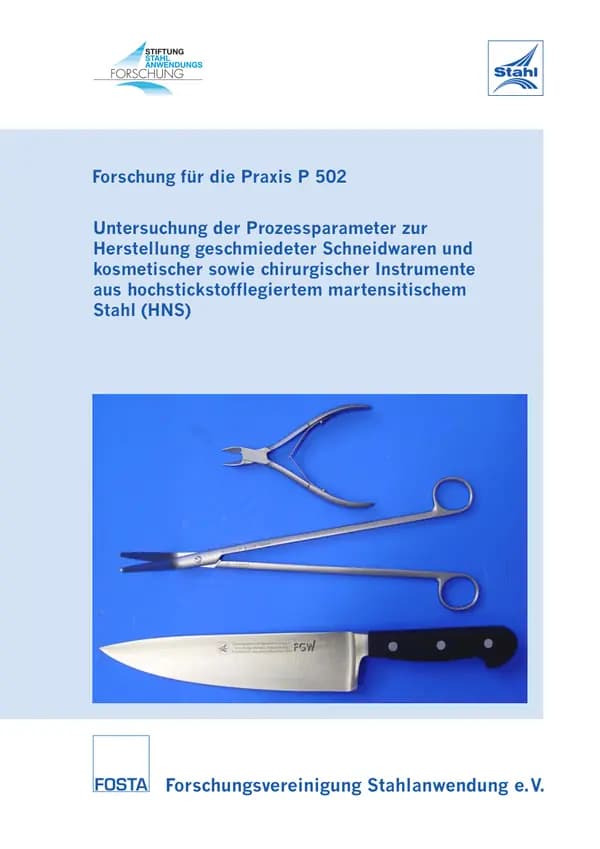
FOSTAP 502 - Investigation of process parameters for the production of forged cutlery and cosmetic and surgical instruments made of high nitrogen alloyed martensitic steel (HNS)
P 502 - Investigation of process parameters for the production of forged cutlery and cosmetic and surgical instruments made of high nitrogen alloyed martensitic steel (HNS) Conventional cutlery, cosmetic forceps and surgical scissors made of martensitic steels often show signs of corrosion under the harsh cleaning, disinfection and sterilisation conditions in dishwashers and autoclaves. In addition to the physical parameters, the water quality with its low alkalinity and exposure to chlorine ions play a significant role. This tendency to pitting corrosion significantly impairs the use of surgical and cosmetic instruments and leads to customer complaints for high-quality cutlery. The use of a more corrosion-resistant steel for high-quality consumer goods and professional instruments is therefore obvious. Due to their excellent corrosion and wear resistance, nitrogen-alloyed steels represent a viable alternative material for the future. In the present research project, two variants of the nitrogen-alloyed steel X30CrMoN15-1, brand name Cronidur, were analysed with regard to their suitability for the production of forged cutlery and cosmetic and surgical instruments. The two batches differ in their nitrogen content. The investigations focused on adapting and optimising the manufacturing processes. As part of the project, usable chef's knives, corner forceps and dissecting scissors were successfully produced. The tests show that both steel grades are ideally suited to the manufacture of these product groups. However, adjustments to the forging parameters, the soft annealing process and the heat treatment conditions are required to optimise the processing of the X30CrMoN15-1 blanks in the existing systems. In addition to the high hardness and excellent bending strength of the knife blades, both variants also showed an increase in corrosion resistance and edge retention compared to conventional steels. However, these results are heavily dependent on the heat treatment. The optimum for corrosion resistance and cutting performance can only be achieved with different heat treatment parameters. A compromise between the two properties is therefore unavoidable. In the corrosion tests for surgical applications, the lower-nitrogen variant shows mixed results. In addition to an exceptionally high breakdown voltage in the current density potential measurement, only average results were achieved in the stress-crack corrosion test. In the copper sulphate test, on the other hand, the steel surface shows no signs of intercrystalline corrosion. In the practical tests on cosmetic pliers, it was clearly established that the X30CrMoN15-1 is superior to conventional steel in terms of both cutting properties and corrosion behaviour. These research results make it possible to implement the production of cutlery made from X30CrMoN15-1 in large-scale production. This lays the foundation for the development of marketable products with improved properties in terms of corrosion resistance and wear resistance. Authors: G.C. Stehr, S. Zind Publication: 2010
available anytime
View details →€30.00
excl. VAT