
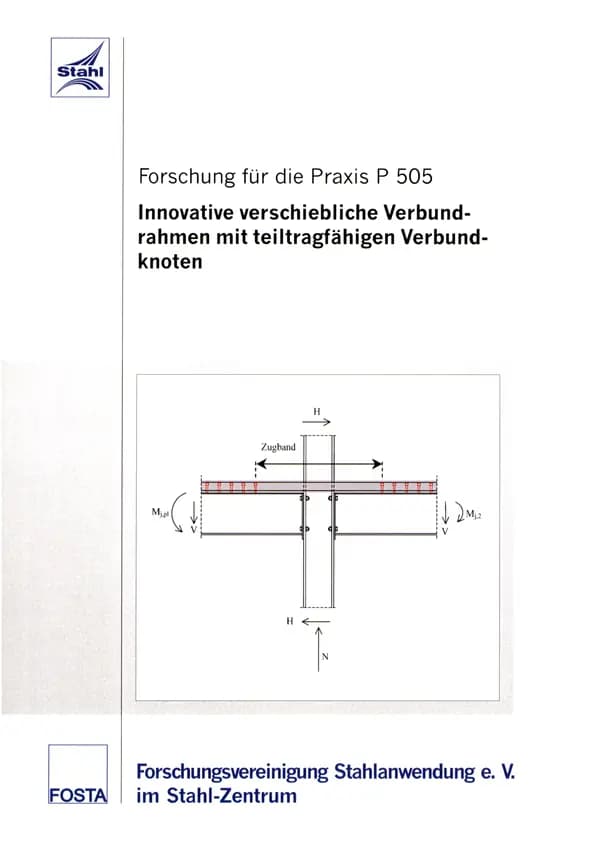
P 505 - Innovative sliding composite frames with partially load-bearing composite nodes
By dispensing with additional stiffeners in the column, partially load-bearing composite nodes can be produced efficiently and easily. At the same time, the degree of reinforcement in the concrete slab can be reduced to …
Content
- Authors
- U. Kuhlmann, M. Schäfer
- Publication
- 2004
By dispensing with additional stiffeners in the column, partially load-bearing composite nodes can be produced efficiently and easily. At the same time, the degree of reinforcement in the concrete slab can be reduced to the minimum reinforcement. The moment load-bearing capacity of the node is 15 to 60 % of the transom load-bearing capacity and is sufficient to ensure bracing via the frame effect, making additional bracing superfluous. The resulting innovative sliding composite frames allow the greatest possible flexibility in the use of industrial, office and commercial buildings and multi-storey car parks, thus meeting future requirements.
Show full description
In order to be able to take the moment load-bearing reserve of the partially load-bearing nodes into account in the calculation, it must be ensured that the associated rotation of the node is possible when the moment redistribution occurs. It must be ensured that the existing node rotation of the node is greater than the rotation requirement resulting from the system and the load. This is the only way to realise innovative sliding composite frame structures with simple partially load-bearing composite nodes. The required node rotations of sliding composite frames are determined analytically and by means of a computer programme. The various influences on the required rotation capacity are analysed in a parameter study. The rotation increases due to the effects of 2nd order theory. In addition, the construction sequence influences the node rotations: Dispensing with an auxiliary support increases the rotation in the steel node. The node rotation is most strongly determined by the degree of plasticisation of the composite beam in the field area. With high degrees of plasticisation, the calculation according to yield hinge theory underestimates the required node rotation, so that a calculation according to yield zone theory must be carried out or the field moment must be limited. In the present research project, special ductile composite nodes were developed that fulfil the rotation requirements of the displaceable composite frames investigated. Nine tests were carried out on composite nodes. A special arrangement of the shear stud dowels on the top flange of the composite beam increased the plastic area of the reinforced concrete slab subjected to tensile stress and thus also increased the existing rotational capacity of the composite node. Plasticising the reinforcement results in significantly larger effective widths than according to Eurocode EC 4-1-1 (1994). A test with a reduced number of headed studs showed that partial bond leads to lower existing rotation capacities. Three additional component tests (reinforced concrete expansion bodies) were carried out for the "reinforcement in tension" component. These and existing test results show that the hardening factor fu/fy of the reinforcing bar correlates with the ductility of this component. Five steel node tests were carried out to optimise the "end plate in bending" component in terms of ductility. The node geometry was varied in order to prevent brittle bolt failure, thus significantly increasing the existing rotational capacity of the node. Based on these investigations and on Eurocode 4-1-1 (1994) and ECCS Doc. No. 109 (1999), design rules were established for sliding composite frames with partially load-bearing composite nodes. Among other things, this report presents the so-called "beamline method", which ideally includes the load-bearing capacity check and the rotation check at the same time. This method allows for a range of different node solutions. The manufacturer can select the optimum solution depending on the circumstances. The project has shown how efficient innovative sliding composite frames can be realised with easy-to-manufacture partially load-bearing composite nodes that have both sufficient system load-bearing capacity and sufficient ductility of the nodes.
Zum Zoomen hovern
€50.00excl. VAT
Payment by card (Stripe) or invoice (DE, AT, CH). Download link by email: automatically after ordering by card, after order approval for invoice (valid for 30 days). Terms
P 505 - Innovative sliding composite frames with partially load-bearing composite nodes—
€50.00