The transport policy target set by the European Commission in the European Road Safety Action Programme 2003-2010 of halving the number of road fatalities by 2010 requires not only an increase in vehicle safety but also …
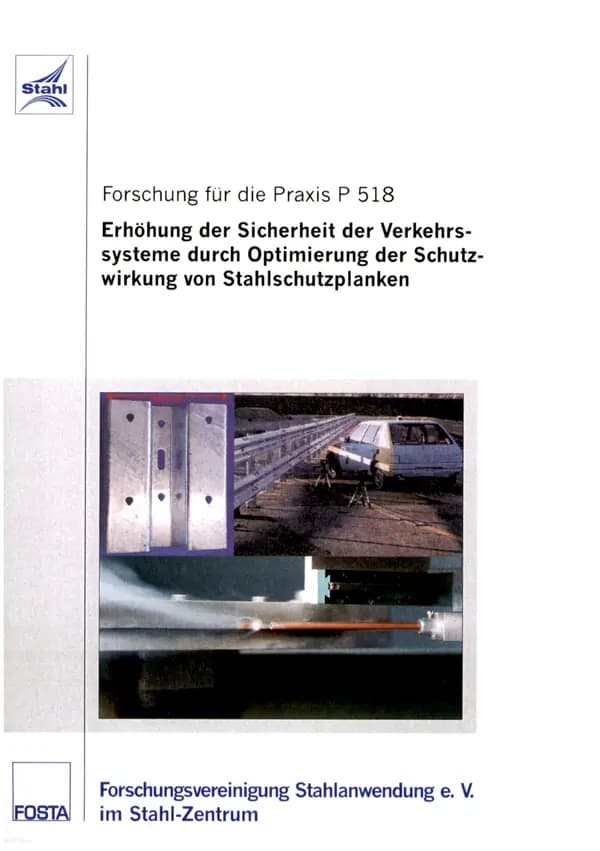
The transport policy target set by the European Commission in the European Road Safety Action Programme 2003-2010 of halving the number of road fatalities by 2010 requires not only an increase in vehicle safety but also an improvement in the containment effect through optimised vehicle restraint systems with a simultaneous reduction in occupant stress in the event of a collision. The aim of the research project was to develop a modular, intelligent steel crash barrier system that fulfils the increased protection requirements for vehicle restraint systems set out in EN 1317 and at the same time ensures optimum protection, sustainability through the effective use of resources and multifunctionality depending on the intended use.
The developed steel crash barrier systems make an important contribution to the fulfilment of the ambitious protection goals. In particular, the successfully tested System Rail H2 and System Rail H3 can be used in a wide range of applications due to the great demand for vehicle restraint systems with the higher containment levels H2 and H3 and, thanks to their cost-effectiveness, can compete effectively with other products and materials due to their modular element design. With the help of simulation calculations, suitable predictions could be made for the behaviour of the newly developed systems in the impact tests. With the increasingly improved simulation technology used, further optimisation of steel crash barrier systems can be supported even more reliably in the future. As part of the research project, the opening of the market for continuously surface-coated steel products for use as crash barrier beams was largely achieved by demonstrating the equivalence of the corrosion protection of new types of corrosion protection coatings with the established, standard batch galvanised products in laboratory and outdoor weathering tests. Compared to batch galvanising, the continuously applied coatings agozal Double-Dip® (Agozal Oberflächenveredelung), GALFAN® (ThyssenKrupp Stahl) and zinc (Stahlwerke Bremen) as well as a discontinuously applied powder coating (Tigerwerk Lack- und Farbenfabrik) and a DUPLEX system consisting of a thin, continuously applied galvanising and a subsequent powder coating showed better resistance to the stress conditions selected for laboratory tests. In all laboratory tests, the analysed products performed at least equally well. Based on the interim results of the ongoing outdoor weathering tests on removed samples, it can be expected that the tested products will be approved without restriction by the Federal Highway Research Institute once the tests have been successfully completed, provided that all other requirements are met in accordance with the then applicable technical regulations. As part of the research project, the possibility of coating the cut surfaces of the new products using a laser was also investigated in order to improve corrosion protection on the cut surfaces. Ways of increasing the process speed, including through dual-beam technology, i.e. the simultaneous use of two laser beam sources acting in series, were identified and the feasibility of process speeds of up to approx. 60 m/min, which correspond to the typical process speeds in strip galvanising lines, was demonstrated. The coating thicknesses produced guarantee adequate corrosion protection. However, a profitability calculation for the use of lasers shows that implementation in practice will prove difficult in the foreseeable future due to the high system costs. RESEARCH ASSOCIATION FOR STAHLANWENDUNG e.V.
Payment by card (Stripe) or invoice (DE, AT, CH). Download link by email: automatically after ordering by card, after order approval for invoice (valid for 30 days). Terms
Machine-translated title and description. The document itself is in German.
Digital download
Other parts and editions as well as neighbouring documents of the same series.

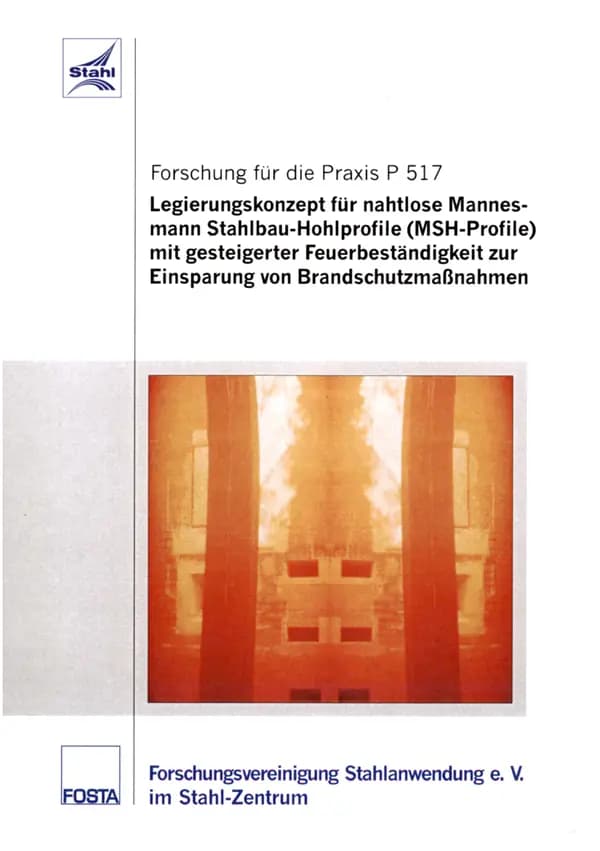
P 517 - Alloy concept for seamless Mannesmann Stahlbau hollow sections (MSH sections) with increased fire resistance to save on fire protection measures As part of the research project, two alloy concepts were developed for the production of seamless hollow sections made of fire-resistant steel. The "fine-grain structural steel" alloy concept is based on a common fine-grain structural steel with a minimum yield strength of 690 MPa, while the "line pipe steel" alloy concept is based on a typical carbon-manganese line pipe steel with good weldability. The addition of molybdenum, tungsten and niobium in certain gradations was intended to increase the high-temperature strength and thus the fire resistance. The steel grades of both concepts exhibit strength properties at ambient temperature that exceed the requirements for a conventional unalloyed structural steel with a minimum yield strength of 355 MPa. The toughness requirements (at least 27J at -20°C) are met for steels of both concepts in the normalised or quenched and tempered condition. In the rolled condition, however, the 27 J impact energy at room temperature is only achieved by the variants based on line pipe steel. In the temperature range of 600 to 750°C, which is relevant for fire-resistant steels, the newly developed steels have a hot yield strength that is up to 100 MPa higher than that of structural steel S355. In order to take into account the effects of creep during firing, "hot creep tests" were developed as part of this project, in which loaded specimens were heated. Samples loaded with up to 100 MPa lasted longer than 30 min in the hot creep test and thus achieved a duration relevant for fire resistance class F30 without exceeding the critical creep speed. The tests showed that the hot yield strength is a more conservative criterion for the load-bearing capacity of steels at high temperatures than the critical creep speed. Fire tests on industrially manufactured profiles, as originally requested, were postponed because corresponding components from an industrial melt with optimised heat treatments or rolling parameters were not available. FORSCHUNGSVEREINIGUNG STAHLANWENDUNG e.V. Publication: 2004 Authors: Dr.-Ing. M. Probst-Hein, Dr.-Ing. U. Zeislmair
available anytime
€20.00
excl. VAT

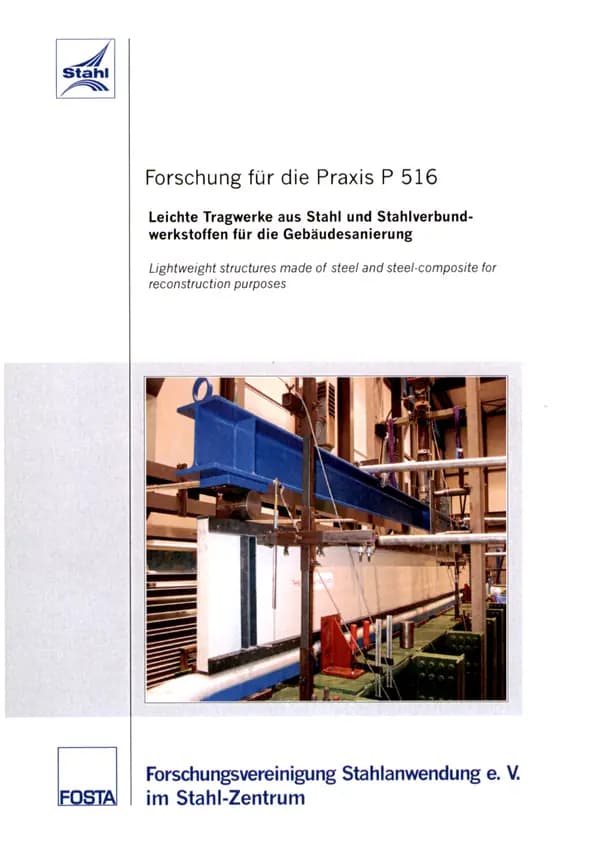
P 516 - Lightweight steel and composite steel structures for building refurbishment As part of the present research project P516, the field of building refurbishment and its influencing factors were first analysed. Based on the knowledge gained, a needs analysis and assessment was carried out in accordance with a utility value analysis. The aim was to develop new construction elements from existing building products. Based on this, the following three component groups were analysed: - kinematic supporting structures - Lightweight ceiling system made of single bars - lightweight beams with webs made of sandwich elements While the first two fields were investigated exclusively on a theoretical-numerical basis, the focus in the development of a lightweight girder was on the extensive test programme carried out. The analysis of the kinematic load-bearing structures showed that the application possibilities for such a system are very limited due to the relatively high compliance. The system only achieves an acceptable level of deflection under load when a large number of locking rods are inserted, which means that the amount of work involved would be too great and economic use - even as a niche product - would be out of the question. In the "lightweight ceiling system" sub-project, initial considerations were made regarding the the required manual transport and the resulting reasonable loads. Based on the knowledge gained, the focus of the sub-project was initially on the investigation of suitable cross-sections in addition to the fundamental analysis of the load-bearing behaviour. An extensive parameter study was carried out. The main difficulty was the search for a suitable connection method, whereby connections based on wedging were ultimately favoured. The system is well suited for use in structural maintenance and renovation. When developing a lightweight beam using sandwich elements, small-scale tests were initially carried out to identify suitable fasteners, accompanied by analyses of the materials used. In addition to self-tapping screws, adhesive joints proved to be suitable for connecting the beam web (sandwich element) to the flanges (folded sheet metal). More than 40 component tests were then carried out, whereby numerous parameters were varied. These included the type of load application, the beam height, the thickness and beading of the surface layers, the geometry of the chords and the combination of several fasteners. In addition, the behaviour of the girder without chords was analysed as well as the behaviour of girders with large web cut-outs for the building equipment. Using a new test technique, it was possible to apply a linear load to the beam by utilising hydrostatic pressure. The newly developed beam showed a very high load-bearing capacity with a low dead weight and at the same time a benign failure. In the load-bearing state, a combined state was achieved in addition to the bending load-bearing effect due to the formation of a tension band. A combination of adhesive and screw connections proved to be ideal with regard to the fasteners used. A numerical study carried out in parallel using the FE method revealed the optimisation potential of the beam. The design proposal presented is based on a deflection limitation of the beam. In conclusion, it can be stated that with the lightweight floor system and the beams with webs made of sandwich elements, two different options were developed that are well suited for use in the renovation of structures. Authors: U. Peil, D. C. Ruff Publication: 2006
available anytime
€30.00
excl. VAT

P 514 - Investigation into climate protection using stainless steel The need for new solar shading systems has arisen because the existing solar shading systems in modern buildings have to fulfil a variety of functions. These are: - Sun and energy protection - Glare protection - Visibility to the outside - Light control for optimum daylight utilisation - Privacy protection - Weather protection In addition, thermal insulation and thus energy saving should be emphasised through this application. Wind loads on the outside of buildings are an important issue. Due to increased wind loads, especially in northern Germany, the sun protection systems of some medium-height buildings are not functional for approx. 70 hours/year in full sunlight, as they are "raised" due to structural sensitivity. More resistant materials such as stainless steel should be used here to withstand this wind load and produce fewer "downtimes" with increased exposure to the sun. The F-values of the façade are of great importance as they characterise the thermal insulation in summer. With the new façades and glazing systems, these F-values can be around 0.15 to 0.2. With the stainless steel façade system, these F-values can be achieved below 0.1. In the area of winter thermal insulation, a new approach can be seen that temporary thermal insulation using radiant active surfaces is favourable, e.g. non-corroding steel sheets. However, it must be emphasised that the radiation components of the surfaces of stainless steel have been completely neglected to date. These radiation components are of a considerably greater nature than the transmission values of a roller shutter curtain. In the verifications that have been carried out, the energy loss can be reduced by half for these external façades. Overall, it should be noted that no stainless steel is currently used in this market segment. It can be seen that the basic materials used do not show any major price differences between stainless steel and aluminium. Authors: Dipl. Ing. D. Kallinich Publication: 2009
available anytime
€20.00
excl. VAT

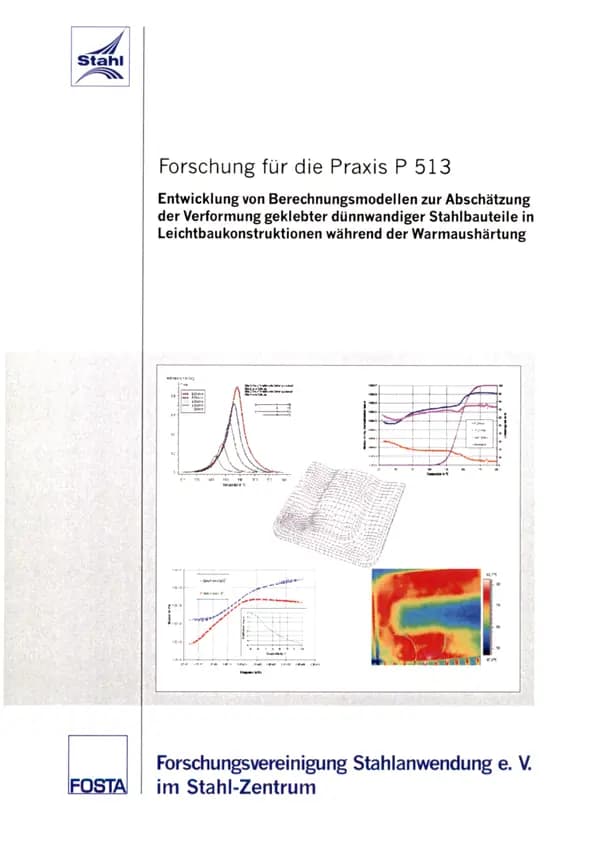
P 513 - Development of calculation models for estimating the deformation of bonded thin-walled steel components in lightweight constructions during heat curing In modern vehicle construction and especially in car body construction, adhesive bonding technology is widely used as a flat joining method due to the possible increase in stiffness and the reduction in the risk of corrosion as a result of the sealing effect. Adhesive bonding offers the possibility of making a significant contribution to reducing vehicle weights with steel sheets of low thickness and high strength. The production of a bonded joint is divided into various individual steps that determine the property profile of the bonded joint. The cross-linking process of the adhesive has a significant influence on the properties. The simulation of the deformations resulting from production due to the residual stresses in the adhesive layer was the subject of the investigations. The reasons for the build-up of residual stresses are the different thermal expansion of the joining partners and the reaction-related volume change of the adhesives during cross-linking. In order to simulate the deformations that occur during the manufacturing process, it is necessary to describe the adhesive as a function of temperature and time, taking into account its reaction kinetics. To describe the viscoelastic properties during crosslinking, chemo- and thermorheologically simple material behaviour was assumed for the adhesives investigated. The modelling of the mechanical behaviour was based on the assumption that a noticeable stress build-up only occurs after the adhesive has reached the gel point; a stress build-up before the gel point is neglected. The yoke test was used to investigate the influence of temperature- and cross-linking-related adhesive shrinkage on the "local" deformation behaviour of sheet steel joints. The influence of joining part relative movements in the manufacturing process was investigated using a steel sunroof cover. When calculating "global" deformations using the sunroof cover as an example, the local-temporal temperature distribution in the component proved to be a significant influencing parameter. The calculated deformation is essentially dependent on the selected temperature boundary conditions. Here it is desirable to determine the temperature distribution via an upstream heat conduction analysis and to use it as an input parameter for further simulation. The results of the investigations presented show that it is possible to simulate large sheet metal components and the deformations resulting from the heat curing of the adhesive by "switching on" the adhesive layer elements in the FEM. The prerequisite for this is that the adhesive reaches the gel point very late in the heating phase or only in the isothermal holding phase and cures completely in the holding phase. It is possible to estimate the mechanical adhesive properties for any temperature profile using time-temperature and time-crosslinking density superposition. Authors: J. Jendrny Publication: 2004
available anytime
€30.00
excl. VAT
Payment by card (Stripe) or invoice (DE, AT, CH). Download link by email: automatically after ordering by card, after order approval for invoice (valid for 30 days). Terms