
P 502 - Investigation of process parameters for the production of forged cutlery and cosmetic and surgical instruments made of high nitrogen alloyed martensitic steel (HNS)
Conventional cutlery, cosmetic forceps and surgical scissors made of martensitic steels often show signs of corrosion under the harsh cleaning, disinfection and sterilisation conditions in dishwashers and autoclaves. In …
Content
- Authors
- G.C. Stehr, S. Zind
- Publication
- 2010
Conventional cutlery, cosmetic forceps and surgical scissors made of martensitic steels often show signs of corrosion under the harsh cleaning, disinfection and sterilisation conditions in dishwashers and autoclaves. In addition to the physical parameters, the water quality with its low alkalinity and exposure to chlorine ions play a significant role. This tendency to pitting corrosion significantly impairs the use of surgical and cosmetic instruments and leads to customer complaints for high-quality cutlery. The use of a more corrosion-resistant steel for high-quality consumer goods and professional instruments is therefore obvious.
Show full description
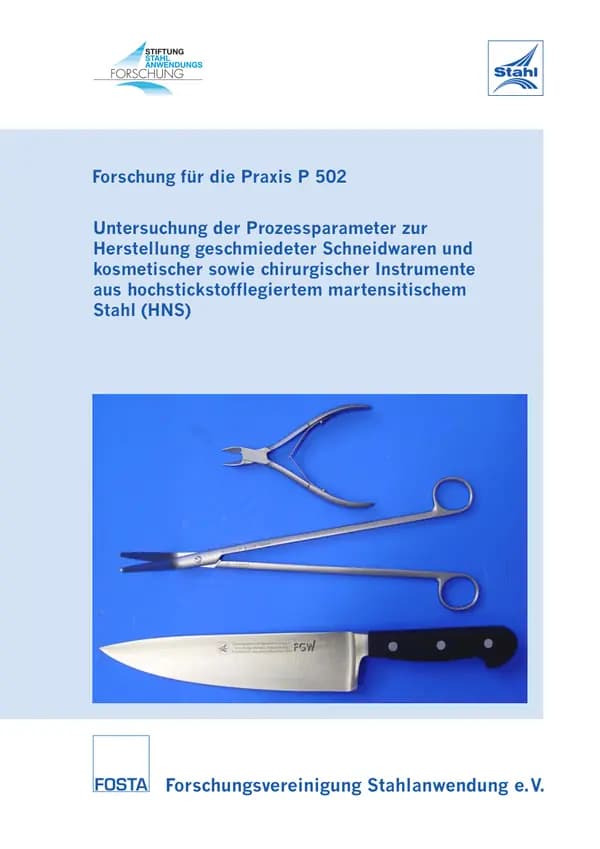
Due to their excellent corrosion and wear resistance, nitrogen-alloyed steels represent a viable alternative material for the future. In the present research project, two variants of the nitrogen-alloyed steel X30CrMoN15-1, brand name Cronidur, were analysed with regard to their suitability for the production of forged cutlery and cosmetic and surgical instruments. The two batches differ in their nitrogen content. The investigations focused on adapting and optimising the manufacturing processes. As part of the project, usable chef's knives, corner forceps and dissecting scissors were successfully produced. The tests show that both steel grades are ideally suited to the manufacture of these product groups. However, adjustments to the forging parameters, the soft annealing process and the heat treatment conditions are required to optimise the processing of the X30CrMoN15-1 blanks in the existing systems. In addition to the high hardness and excellent bending strength of the knife blades, both variants also showed an increase in corrosion resistance and edge retention compared to conventional steels. However, these results are heavily dependent on the heat treatment. The optimum for corrosion resistance and cutting performance can only be achieved with different heat treatment parameters. A compromise between the two properties is therefore unavoidable. In the corrosion tests for surgical applications, the lower-nitrogen variant shows mixed results. In addition to an exceptionally high breakdown voltage in the current density potential measurement, only average results were achieved in the stress-crack corrosion test. In the copper sulphate test, on the other hand, the steel surface shows no signs of intercrystalline corrosion. In the practical tests on cosmetic pliers, it was clearly established that the X30CrMoN15-1 is superior to conventional steel in terms of both cutting properties and corrosion behaviour. These research results make it possible to implement the production of cutlery made from X30CrMoN15-1 in large-scale production. This lays the foundation for the development of marketable products with improved properties in terms of corrosion resistance and wear resistance.
Zum Zoomen hovern
€30.00excl. VAT
Payment by card (Stripe) or invoice (DE, AT, CH). Download link by email: automatically after ordering by card, after order approval for invoice (valid for 30 days). Terms
P 502 - Investigation of process parameters for the production of forged cutlery and cosmetic and surgical instruments made of high nitrogen alloyed martensitic steel (HNS)—
€30.00