Matplus LogoMatplus Shop
/
/
HomeStoreFOSTAFOSTA Documentation
Topics
Matplus LogoMatplus ShopFollow us on LinkedIn
FOSTA
  • FOSTA Overview
  • FOSTA Documentation
  • Topics
  • Technical Standards
  • Steel-iron worksheets (SEB)
  • Steel and iron usage lists (SEE)
  • Steel-iron delivery terms (SEL)
  • Steel-iron test sheets (SEP)
  • Steel-iron material sheets (SEW)
Legal
  • FAQ
  • Imprint
  • Cookie Policy
  • Privacy Policy
  • Legal Notice
  • Withdrawal policy
  • Withdraw from contract
  • General Terms and Conditions

Payment by card (Stripe) or invoice (DE, AT, CH) · Digital delivery: download link to your PDFs by email, automatically after ordering by card, after order approval for invoice; valid for 30 days.

© 2026 Matplus Shop. All rights reserved.

Header
FOSTA

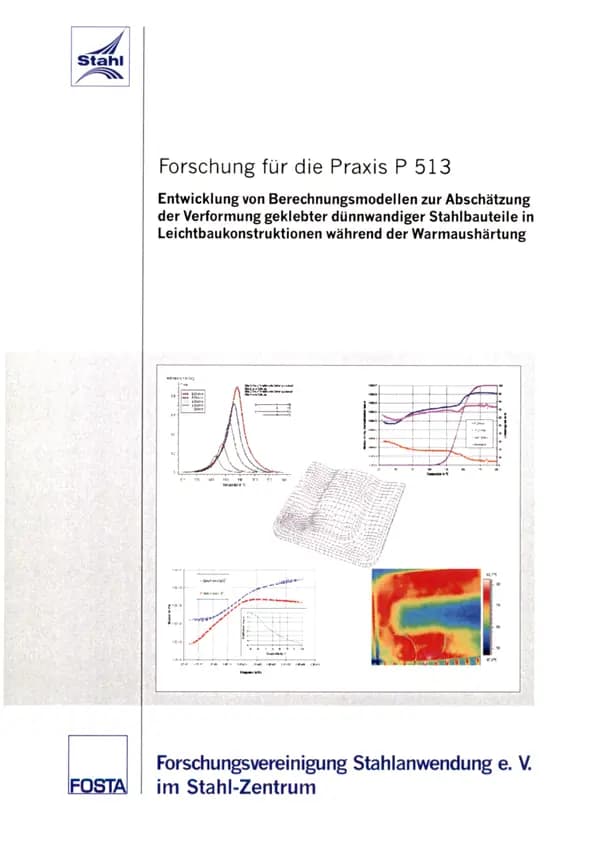
P 513 - Development of calculation models for estimating the deformation of bonded thin-walled steel components in lightweight constructions during heat curing

In modern vehicle construction and especially in car body construction, adhesive bonding technology is widely used as a flat joining method due to the possible increase in stiffness and the reduction in the risk of …

Content

Authors
J. Jendrny
Publication
2004

In modern vehicle construction and especially in car body construction, adhesive bonding technology is widely used as a flat joining method due to the possible increase in stiffness and the reduction in the risk of corrosion as a result of the sealing effect. Adhesive bonding offers the possibility of making a significant contribution to reducing vehicle weights with steel sheets of low thickness and high strength. The production of a bonded joint is divided into various individual steps that determine the property profile of the bonded joint. The cross-linking process of the adhesive has a significant influence on the properties.

Show full description

The simulation of the deformations resulting from production due to the residual stresses in the adhesive layer was the subject of the investigations. The reasons for the build-up of residual stresses are the different thermal expansion of the joining partners and the reaction-related volume change of the adhesives during cross-linking. In order to simulate the deformations that occur during the manufacturing process, it is necessary to describe the adhesive as a function of temperature and time, taking into account its reaction kinetics. To describe the viscoelastic properties during crosslinking, chemo- and thermorheologically simple material behaviour was assumed for the adhesives investigated. The modelling of the mechanical behaviour was based on the assumption that a noticeable stress build-up only occurs after the adhesive has reached the gel point; a stress build-up before the gel point is neglected. The yoke test was used to investigate the influence of temperature- and cross-linking-related adhesive shrinkage on the "local" deformation behaviour of sheet steel joints. The influence of joining part relative movements in the manufacturing process was investigated using a steel sunroof cover. When calculating "global" deformations using the sunroof cover as an example, the local-temporal temperature distribution in the component proved to be a significant influencing parameter. The calculated deformation is essentially dependent on the selected temperature boundary conditions. Here it is desirable to determine the temperature distribution via an upstream heat conduction analysis and to use it as an input parameter for further simulation. The results of the investigations presented show that it is possible to simulate large sheet metal components and the deformations resulting from the heat curing of the adhesive by "switching on" the adhesive layer elements in the FEM. The prerequisite for this is that the adhesive reaches the gel point very late in the heating phase or only in the isothermal holding phase and cures completely in the holding phase. It is possible to estimate the mechanical adhesive properties for any temperature profile using time-temperature and time-crosslinking density superposition.
P 513 - Development of calculation models for estimating the deformation of bonded thin-walled steel components in lightweight constructions during heat curing
Zum Zoomen hovern
€30.00excl. VAT

Payment by card (Stripe) or invoice (DE, AT, CH). Download link by email: automatically after ordering by card, after order approval for invoice (valid for 30 days). Terms

P 513 - Development of calculation models for estimating the deformation of bonded thin-walled steel components in lightweight constructions during heat curing—
€30.00
Machine-translated title and description. The document itself is in German.

What's included

✓

Digital download

Similar documents

Other parts and editions as well as neighbouring documents of the same series.

  • Thumbnail
    FOSTA

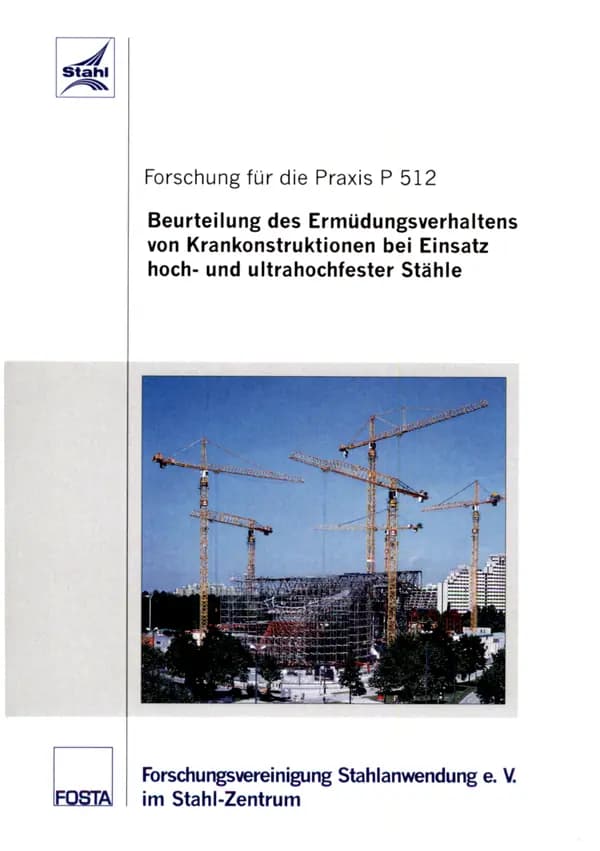
    P 512 - Assessment of the fatigue behaviour of crane structures when using high-strength and ultra-high-strength steels

    P 512 - Assessment of the fatigue behaviour of crane structures when using high-strength and ultra-high-strength steels The performance of cranes and crane construction is significantly increased by the use of high-strength steels. The standards and regulations currently in force assume that high-strength steels up to a yield strength of 460 N/mm² are to be classified in the same way as normal-strength steels in terms of their fatigue behaviour. There are no standardised regulations on the fatigue behaviour of high-strength fine-grained structural steels with yield strengths in the range of 460 to 1100 N/mm². This considerably limits the utilisation of the high strength of these steels. Therefore, the input variables for the fatigue analysis must be scrutinised more closely. As part of this research project, typical notch details for crane construction made of high-strength and ultra-high-strength steels were analysed theoretically and experimentally. Furthermore, the concept of geometric stresses, which has already been successfully applied to hollow section nodes, was applied to crane-specific notch details. In addition, measurements were carried out on selected existing crane systems in order to realistically record the actual load situation. In advance, the details for which the most urgent need for research was identified were agreed with the "Crane-specific notch details" working group. The following design details with variations in geometry and materials were analysed: - Angled connections (K-joints) - Welded-on longitudinal ribs - Laser- and plasma-cut recesses - Butt joints of sheets of different thicknesses - Welded-on lamellas or reinforcement plates The results of these investigations are used to achieve a higher utilisation of the high-strength and ultra-high-strength materials by adapting the fatigue analyses. The savings in construction weight, the reduced sheet thickness and the associated lower welding volume lead to an improvement in economic efficiency and an increase in the performance of crane and conveyor systems and their substructures. The notch catalogue of the new European standardisation can be expanded to include crane-specific notch details. Furthermore, beyond the area of hollow section nodes, a general method for determining the fatigue load with stress concentration factors and using the finite element method is specified, which is used when it is not possible to clearly assign a detail to a specific notch detail. Authors: R. Puthli ,S. Herion Steine, J. Bergers, G. Sedlacek , C. Müller, J. Stötzel, S. Höhler, Ö. Bucak Publication: 2006

    available anytime

    €50.00

    excl. VAT

    View details →
  • Thumbnail
    FOSTA

    P 514 - Investigation into climate protection using stainless steel

    P 514 - Investigation into climate protection using stainless steel The need for new solar shading systems has arisen because the existing solar shading systems in modern buildings have to fulfil a variety of functions. These are: - Sun and energy protection - Glare protection - Visibility to the outside - Light control for optimum daylight utilisation - Privacy protection - Weather protection In addition, thermal insulation and thus energy saving should be emphasised through this application. Wind loads on the outside of buildings are an important issue. Due to increased wind loads, especially in northern Germany, the sun protection systems of some medium-height buildings are not functional for approx. 70 hours/year in full sunlight, as they are "raised" due to structural sensitivity. More resistant materials such as stainless steel should be used here to withstand this wind load and produce fewer "downtimes" with increased exposure to the sun. The F-values of the façade are of great importance as they characterise the thermal insulation in summer. With the new façades and glazing systems, these F-values can be around 0.15 to 0.2. With the stainless steel façade system, these F-values can be achieved below 0.1. In the area of winter thermal insulation, a new approach can be seen that temporary thermal insulation using radiant active surfaces is favourable, e.g. non-corroding steel sheets. However, it must be emphasised that the radiation components of the surfaces of stainless steel have been completely neglected to date. These radiation components are of a considerably greater nature than the transmission values of a roller shutter curtain. In the verifications that have been carried out, the energy loss can be reduced by half for these external façades. Overall, it should be noted that no stainless steel is currently used in this market segment. It can be seen that the basic materials used do not show any major price differences between stainless steel and aluminium. Authors: Dipl. Ing. D. Kallinich Publication: 2009

    available anytime

    €20.00

    excl. VAT

    View details →
  • Thumbnail
    FOSTA

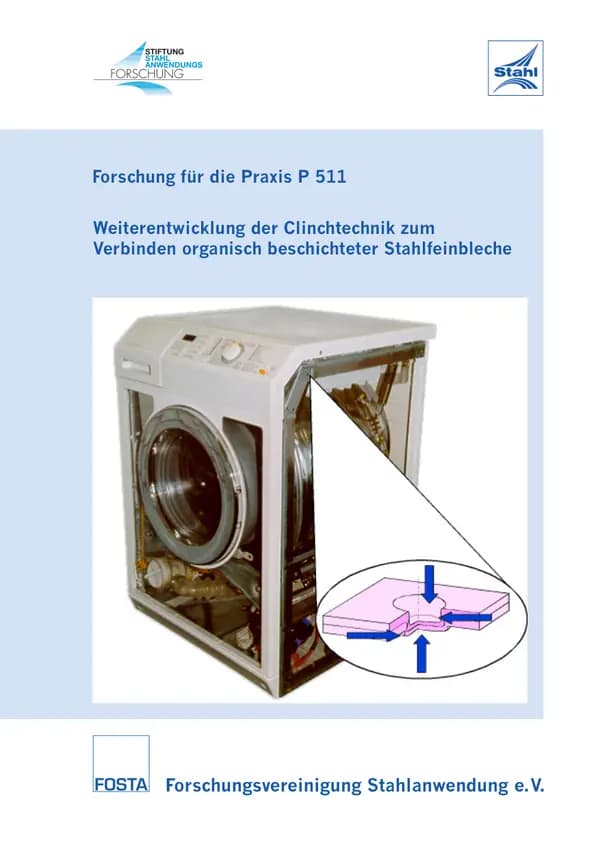
    P 511 - Further development of clinching technology for joining organically coated steel sheets

    P 511 - Further development of clinching technology for joining organically coated steel sheets The aim of the research project was to optimise and further develop clinching technology for joining coil-coated semi-finished products in order to largely limit or avoid the paint damage that occurs with the current state of clinching technology. With regard to reducing coating damage, both the surfaces and geometries of the clinching tools and the coating systems were optimised. The aim was to achieve a significant improvement in visual appearance and corrosion resistance. As part of the project, various liquid and powder coating systems used, for example, in the household appliance industry and in steel furniture construction were investigated. These coating systems were applied to a standardised substrate on a laboratory scale in order to exclude the influence of the substrate material. The tests were carried out using a clinching system with a three-part mould from BTM and a clinching system with an unsplit mould from TOX. The degree of coating damage after the clinching process was primarily assessed visually. Furthermore, the LWF developed a top-mounted measuring cell that allows very good comparative measurements to be made on the clinched joints with regard to the degree of coating damage. However, precise statements about the extent of the damaged coating area as a function of the of the measured current flow, due to the sensitivity of the measurement method with regard to time, temperature, etc., is currently not possible. The results indicate that, with regard to the chemical basis of the analysed liquid coating systems, the polyester coatings showed better clinching suitability than the polyurethane systems. In principle, it can also be said that the pre-treatment of all coating systems has a decisive influence on the adhesion of the coating to the substrate and that there is great potential for optimisation here. Significant improvements in clinchability were achieved by optimising the coatings and pre-treatments. The use of clinching tools optimised in terms of geometry and surface also made it possible to reduce coating damage on both the punch and die sides without reducing the joint strength, in some cases even considerably depending on the coating system. The extensive investigations carried out as part of the project showed that the coating damage is generally highly dependent on the coating system to be clinched. By using clinching tools with optimised geometry and surface, damage to the coating layer could be reduced, but not completely prevented. Authors: O. Hahn, L. Schmidt, B.A. Behrens, S. Hübner, F.W. Bach, M. Schäper Publication: 2010

    available anytime

    €40.00

    excl. VAT

    View details →
  • Thumbnail
    FOSTA

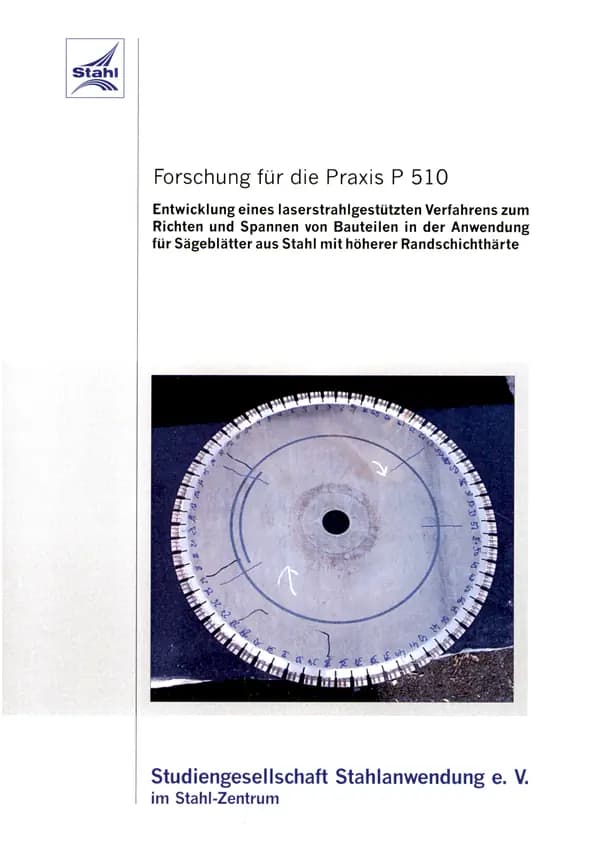
    P 510 - Development of a laser-assisted process for straightening and clamping components in the application for saw blades made of steel with higher surface layer hardness

    P 510 - Development of a laser-assisted process for straightening and clamping components in the application for saw blades made of steel with higher surface hardness Circular saw blades consist of the cutting tool body (blade) and the cutting parts attached to it. Tool steels with a constant hardness of 38 to 46 HRC across the cross-section are used for the blade body. The cutting parts for wood and wood-based material processing are mainly carbide teeth attached to them by brazing, and diamond segments for stone processing by brazing and laser welding. When using saw blades, there is a requirement for a narrow kerf and stable blade behaviour. These requirements are met by using stiffer saw blades and by adjusting the dynamic behaviour of the cutting parts. A reduction in the kerf width and stable blade behaviour due to stiffer blades was achieved by using case-hardened pre-material. The steel grades 13CrMo4-5 (1.3566) and 14NiCr14 (1.5752) with a low carbon content were used and case-hardened. Due to the high surface hardness of up to 60 HRC, the mechanical forming required for clamping and straightening is only possible with increased effort, so that the straightening and clamping process must be carried out by other methods, e.g. by localised short-term heating. With the laser straightening process, surface crack-free forming could be achieved in preliminary tests. This demonstrated the general suitability of the laser levelling process. The risks of the process lie in the fact that the complex heat treatment process of case hardening the sheet metal must be adapted to the requirement profile of the circular saw blades without leading to excessive distortion of the components. The diverse parameter variations of case hardening must be taken into account. This increases the overall component strength (fatigue bending fatigue strength). This reduces the bending vibrations that occur during use, particularly at high speeds. The result is a reduction in noise emissions and an improvement in cutting quality. Due to the higher component strength, the blade thickness can be reduced. The project objectives of developing a process for manufacturing sawing tools from sheet metal with a higher surface layer hardness and a method for straightening and clamping using a laser beam to reduce the kerf width, increase the cutting surface quality and minimise the environmental impact were achieved. The new tools were trialled during the work in industry, and the aim is to implement them in daily production in the medium term. STUDIENGESELLSCHAFT STAHLANWENDUNG e.V. Publication: 2003 Authors: Dr.-Ing. G. C. Stehr, Dipl.-Ing. U. V. Münz

    available anytime

    €20.00

    excl. VAT

    View details →
€30.00excl. VAT

Payment by card (Stripe) or invoice (DE, AT, CH). Download link by email: automatically after ordering by card, after order approval for invoice (valid for 30 days). Terms

P 513 - Development of calculation models for estimating the deformation of bonded thin-walled steel components in lightweight constructions during heat curing—
€30.00