 FOSTA
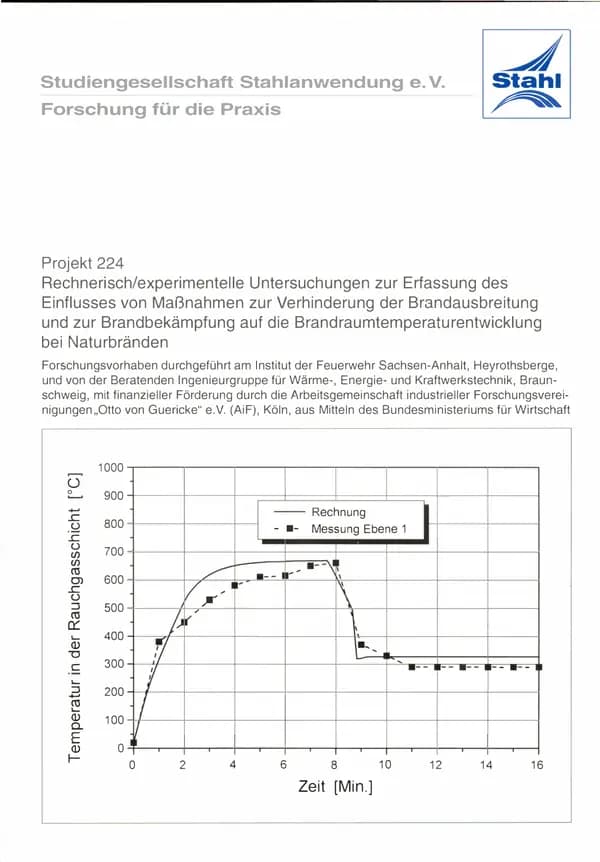
FOSTAP 224 - Computational/experimental investigations to determine the influence of measures to prevent the spread of fire and for firefighting on the development of fire room temperature in natural fires
P 224: Computational/experimental investigations to determine the influence of measures to prevent the spread of fire and for firefighting on the development of fire room temperature in natural fires Today, the fire protection design of a building is generally still based on the general requirement in accordance with the standardised "unit temperature curve" (ETK) in accordance with DIN 4102 or ISO 834. Effective progress towards a more realistic assessment of the temperature development in the event of fire is possible on the basis of object-related "natural fire curves". This is particularly important for steel and steel composite structures, as the generalised basis for assessment can lead to considerable additional measures being required for structural fire protection compared to competing types of construction. The aim of the research project was to develop a physically based model, based on experimental investigations, with which the influence of the use of extinguishing water (sprinklers, fire brigade) on the development of fire room temperatures in natural fires can be calculated. The research results made it possible to demonstrate the reduction of fire room temperatures, the influence of mass burning and the reduction of the temperatures of steel construction elements through fire extinguishing measures and the prevention of fire spread in living spaces and rooms of greater height on a full-scale. The calculation results reflect the physical behaviour accordingly. The results of this project represent a previously missing building block for a more realistic assessment of the property-related safety level, which can be used to move away from generalised fire protection design principles, particularly with regard to the required fire resistance of the components. This can significantly improve the market position of steel construction. In this way, fire protection is taken into account in a risk-appropriate and economically sensible manner. STUDIENGESELLSCHAFT STAHLANWENDUNG e.V. Publication: 1995 Authors: Dr.-Ing. J. Klaus, Dipl.-Ing. K.-J. Kohl, Dipl.-Ing. M. Kutz
available anytime
View details →€30.00
excl. VAT
 FOSTA
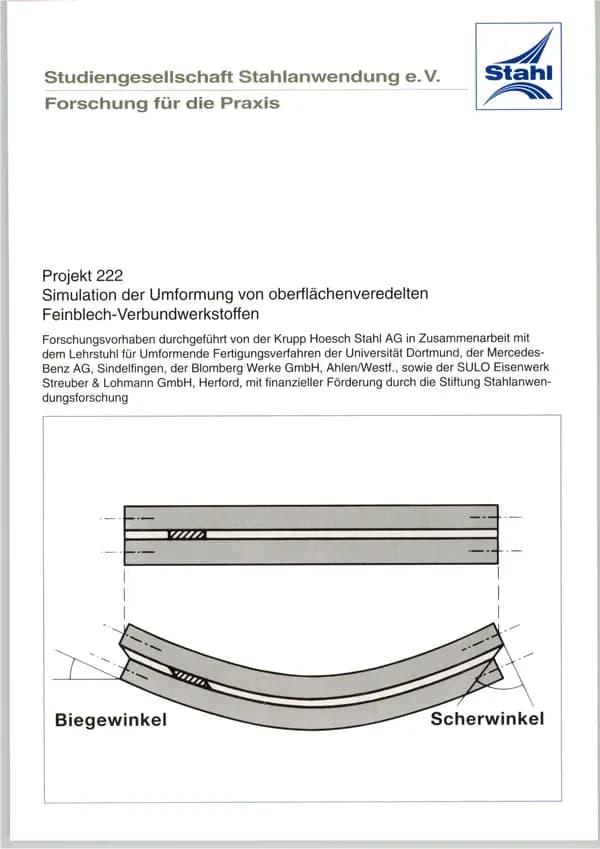
FOSTAP 222 - Simulation of the forming of surface-finished thin sheet composites
P 222: Simulation of the forming of surface-finished thin sheet composites Environmental protection and ergonomic workplace design make it necessary to further reduce the noise emissions of machines and components. This is leading to an increase in the use of vibration-damping composite sheets, which consist of a steel/viscoelastic core layer/steel cross-section. Compared to a solid sheet, there are modified forming properties that make it necessary to adapt the production parameters. As part of the research project, a simulation method was to be developed to determine these parameters and enable a reliable prediction of the forming behaviour. Various simulation models based on the finite element method (FEM) were evaluated with regard to forming techniques for steel composite sheets. As part of these investigations, a model in which the visco-elastic core layer is described by "spring elements" proved to be realistic and universally applicable. In addition to the simple determination of the required characteristic values, this simulation model can be used to comprehensively describe the forming behaviour of steel composite sheets in bending and deep-drawing processes. For bending, the springback and thus the required die angle and the stamping force can be determined. For deep drawing, the sheet holder force and friction can be calculated. In addition, this model can be used to determine not only the deformation in the sheet metal but also the leg deflection, the cover sheet offset and the zones of possible wrinkling. The comparison of the calculation results with experimental investigations on model components showed that the simulation model developed and the characteristic values determined with it can be used in a targeted manner. This makes it possible to carry out a feasibility study during the design phase and to determine the most important process parameters. This was confirmed by simulating the forming of components manufactured industrially from composite sheet metal. The acoustic tests finally carried out with these components, which were manufactured on a trial basis from sheet steel composites, show that the use of vibration-damping composite sheet metal can lead to a significant reduction in noise emissions from machines and other noise sources. STUDIENGESELLSCHAFT STAHLANWENDUNG e.V. Publication: 1995 Authors: Dr.rer.nat. M. Büscher, Dr.-lng. E.-J. Drewes, Prof. Dr.-lng. E. von Finckenstein, Dipl.-Ing. L. Keßler, Dr.-Ing. W. Nester, Dr.-lng. V. Steininger, Dr.-lng. H. U. Weigel
available anytime
View details →€30.00
excl. VAT
 FOSTA
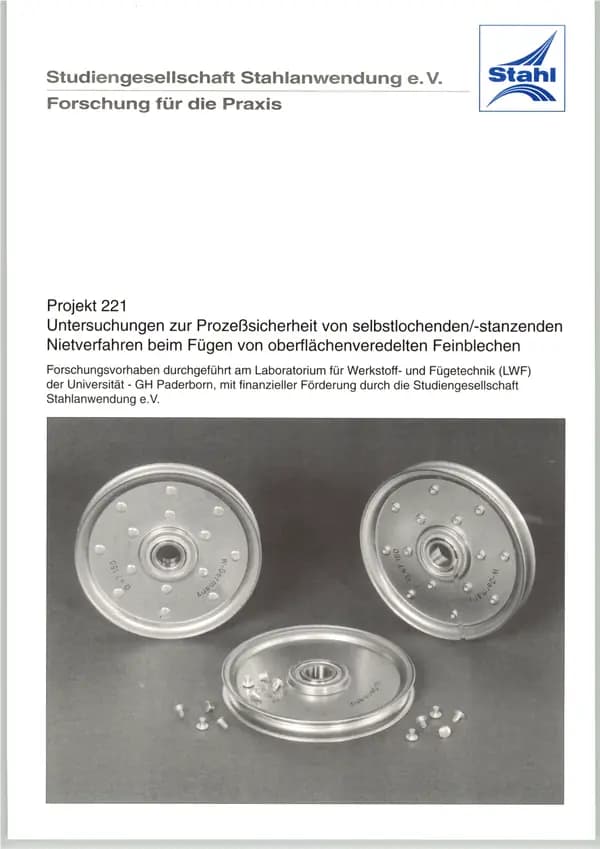
FOSTAP 221 - Investigations into the process reliability of self-piercing/punching riveting processes when joining surface-finished thin sheets
P 221: Investigations into the process reliability of self-piercing/punching riveting processes when joining surface-finished thin sheets Self-pierce riveting is a forming joining process for the low-heat joining of sheet metal, tube and profile parts that has already been introduced to the market. As part of the project, self-pierce riveting with solid rivets and self-pierce riveting with semi-tubular rivets were used in investigations into process reliability when joining surface-finished thin sheets. Self-pierce riveting with semi-tubular rivets showed great advantages in comparison to resistance spot welding for specimens subjected to oscillating loads. Punch riveted test specimens made of galvanised sheet metal (St05Z) achieved 5 times the service life at a load amplitude of 13.5 kN (H specimen with 10 joints). The highest fatigue strength was achieved with the higher-strength material (ZStE420). In contrast to resistance spot welding, this results in an increase in joint strength with an increase in the yield strength of the joining part material under oscillating component loading. The self-pierce rivet geometry improved by the work for the research project considerably increased the joint strength of self-pierce rivet joints in sheet steel. The influence of the joining part surface on the joining result could be reduced. A rounding of the transition area between the countersunk head and rivet shank counteracted the frequent formation of cracks in the self-pierce rivet head. The new self-pierce rivet geometry was used in the final tests with oscillating loads on the samples. An increased hold-down force in the self-pierce riveting process significantly reduced component distortion and led to improved reproducibility of the result. This finding was taken up by the manufacturers and has already been realised in standard setting tools. When joining coil-coated sheet metal, quasi-static strength values comparable to those measured on hot-dip galvanised sheet metal (St05Z) were achieved. This provides a high-performance joining technology for joining organically coated sheet steel materials. Self-pierce riveting is economically interesting due to the savings in preparation measures on the parts to be joined and the short cycle times. A wide range of joining tasks can be covered at a low investment cost. The results of the research project are of particular interest to the metalworking industry. By switching to surface-finished sheet steel in conjunction with high-performance joining technology, decisive improvements in market position can be achieved. STUDIENGESELLSCHAFT STAHLANWENDUNG e.V. Publication: 1995 Authors: Prof. Dr.-Ing. Hahn, Dipl.-Ing. W. Lappe
available anytime
View details →€30.00
excl. VAT
 FOSTA
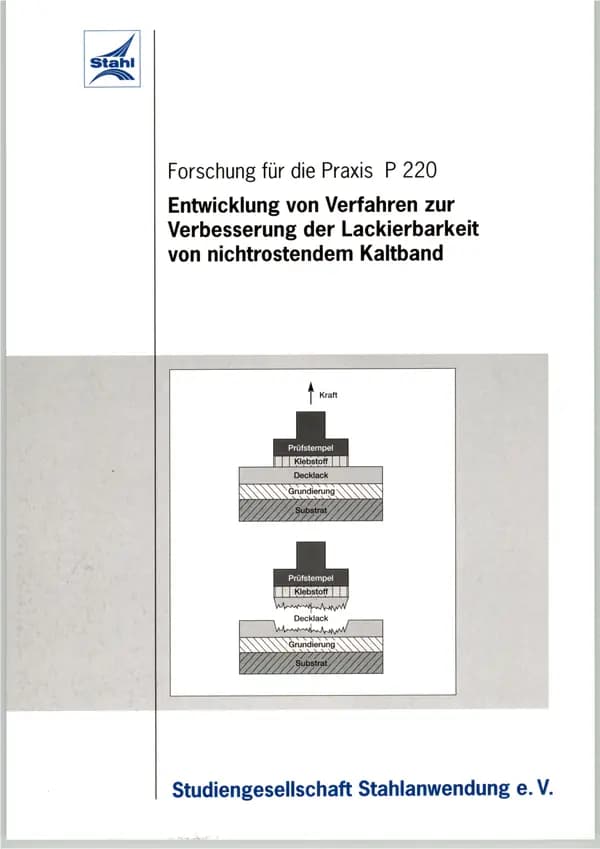
FOSTAP 220 - Development of processes to improve the paintability of stainless cold-rolled strip
P 220: Development of processes to improve the paintability of stainless cold-rolled strip Cold-rolled stainless steel strip is mainly painted for decorative reasons, but also for functional reasons. The otherwise required inert behaviour of the stainless steel surface is an obstacle to the adhesion of the paint to the substrate. Smooth surfaces, weld seams with their tarnishing colours or lubricant residues present additional difficulties. The aim of the project was to demonstrate methods for improving the adhesive strength of selected commercial coating systems on stainless cold-rolled strip. The tests were carried out on an austenitic stainless steel (1.4301 Ille and llld) and a ferritic stainless steel (1.4003 lla and Ille), i.e. with differently smooth surfaces. In accordance with the conditions in practice, the materials were coated without and with contamination by tarnish colours and greases as well as without and with pre-treatment by blasting, acid and adhesion promoter. The paints analysed were commercially available solvent-based and water-based systems, single and two-coat systems and coil-coated sheets. The research results show clear differences in adhesion for the paint systems analysed. There are coating systems with sufficiently good properties for each type of surface finish. Therefore, if suitable coating systems are used, there is no need for extensive pre-treatment of the surface. The investigations have shown that good adhesion properties comparable to those of unalloyed steels can be achieved if stainless steels are used and the coating system is selected to suit the stresses involved. By implementing the project results, the costs for painting products made of stainless cold-rolled strip can be reduced. The use of stainless steels in a painted condition, e.g. in container, tanker and wagon construction as well as in the construction industry, will become more attractive. It also opens up additional sales opportunities in new areas of application. STUDIENGESELLSCHAFT STAHLANWENDUNG e.V. Publication: 1996 Authors: Dipl.-Chem. A. Fuchs, Dipl.-Chem. J. Haller, Dipl.-Ing. U. Karsten, Dr. rer. nat. H.-J.Krautschick, Dr. rer. nat. J. Reck
available anytime
View details →€30.00
excl. VAT
 FOSTA
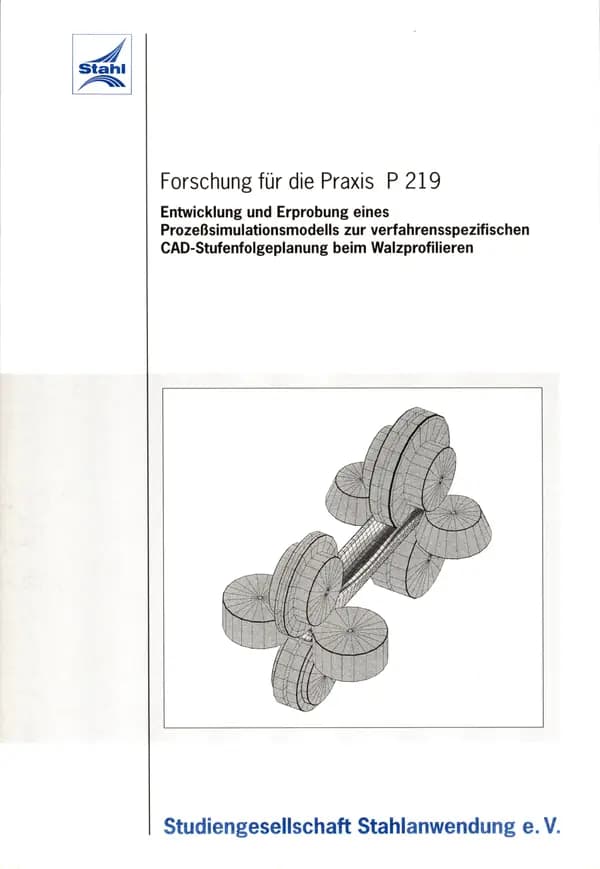
FOSTAP 219 - Development and testing of a process simulation model for process-specific CAD step sequence planning in roll forming
P 219: Development and testing of a process simulation model for process-specific CAD step sequence planning in roll forming The trend towards integral and lightweight construction, increasing automation in machining and processing stages and the ever smaller batch sizes demanded by the market require cold rolled section manufacturers to increase product quality and flexibility at the same time. The main potential for improvement lies in reducing the time needed to develop new roll forming tools and start production. Even today, step sequence planning and tool design for roll forming are still largely based on empirically acquired employee knowledge. In order to relieve the designer of routine tasks, computer-aided planning and design systems (CAE) specially developed for roll forming are now available. However, planning errors can currently only be detected after the tools have been manufactured and installed in the roll forming machine. This results in considerable costs due to long setting times and possibly necessary tool changes, which can jeopardise the economic efficiency of the process. As part of this project, a programme module, the so-called technology processor, was developed which makes it possible to generate a finite element analysis (FEM) of the roll forming process from the data of the CAE system and to evaluate the results. The planning process with the aid of the technology processor in the CAE system conventionally begins with the definition of the final profile cross-section, the determination of the sequence of forming stages and the design of the individual forming rolls. The geometric and technological data of the roll forming process defined in this way is transferred to the technology processor. This creates the required input data for the FEM simulation largely automatically, starts the calculation and then analyses the calculation result. Planning errors can thus be detected and rectified at an early stage with the help of numerical simulation. In this way, considerable costs can be saved by avoiding mould reworking. In addition, production time is gained through shorter planning and setting times. Computer-aided planning systems in conjunction with the technology processor allow cold profile manufacturers - generally small and medium-sized companies - to produce without relying solely on employee expertise and to process orders more quickly and with less susceptibility to faults. The rights to the programme module developed as part of this project are held by Studiengesellschaft Stahlanwendung e.V. and are available on request. STUDIENGESELLSCHAFT STAHLANWENDUNG e.V. Publication: 1996 Authors: Prof. Dr.-Ing. D. Schmoeckel, Dipl.-Ing. B. Sitzmann, Dipl.-Witsch.-Ing. Sitzmann, Dipl.-Witsch.-Ing. N. Stricker
available anytime
View details →€30.00
excl. VAT
 FOSTA
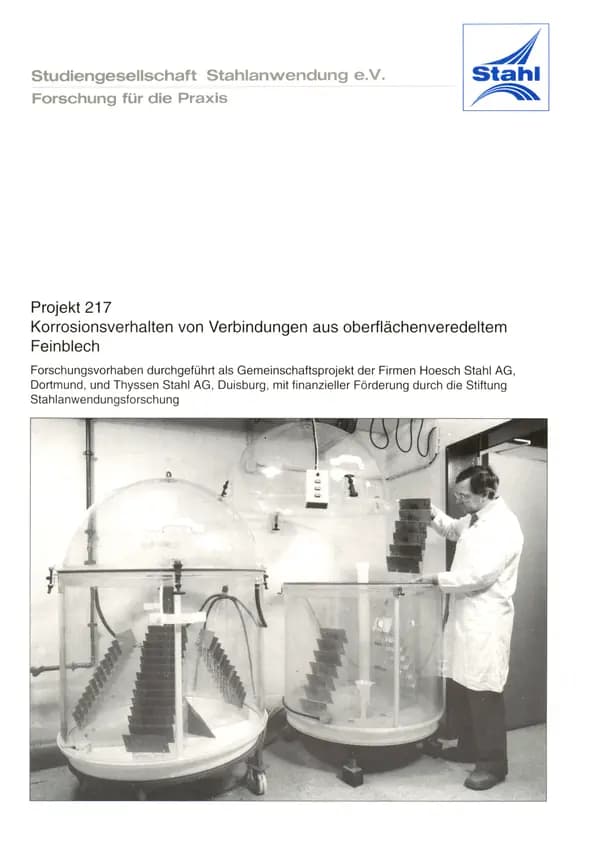
FOSTAP 217 - Corrosion behaviour of joints made of surface-finished sheet metal
P 217: Corrosion behaviour of joints made of surface-finished sheet metal In the sheet metal working industry, metal surface-finished thin sheets are joined together by using adapted joining processes. Damage to the corrosion-inhibiting coating must be expected during this processing step. Processors of surface-finished sheet metal, e.g. the automotive or EBM (iron, sheet metal, metal processing) industries, must be able to assess corrosive damage in relation to the mechanical properties of joined materials. As part of the research project, it was therefore investigated whether common, simple corrosion testing methods can be used for joined materials, with which the damage that occurs in practice can be realistically assessed. Uncoated cold-rolled strip, hot-dip galvanised sheet metal, Galvannealed and Galfan were used. The materials were joined to themselves using the following joining methods: MAG, laser and resistance spot welding, MIG soldering, pressure joining and hemming. The results show that regardless of the corrosion test method, red rust occurs preferentially in the joining area. However, it is not possible to draw any conclusions about the actual strength of a corroded joint from this visual appearance of corrosion. A direct comparison of the materials with each other is also only permissible to a limited extent, as the corrosive media used attack the materials differently due to the prevailing corrosion mechanisms. However, each corrosion test method can be substituted on its own for quality assurance purposes. Statements about the corrosion behaviour of thin sheets under practical conditions are more likely to be obtained by combined test methods. The investigations also show that in the case of joined thin sheets, the positioning of the joining area in the test must be carried out in accordance with the position on the object intended by the designer. Studiengesellschaft Stahlanwendung e.V. Publication: 1993 Authors: Dr.-Ing. H. Beenken, Dipl.-Ing. R. Kothe, Dipl.-Chem. U. Renner
available anytime
View details →€20.00
excl. VAT
 FOSTA
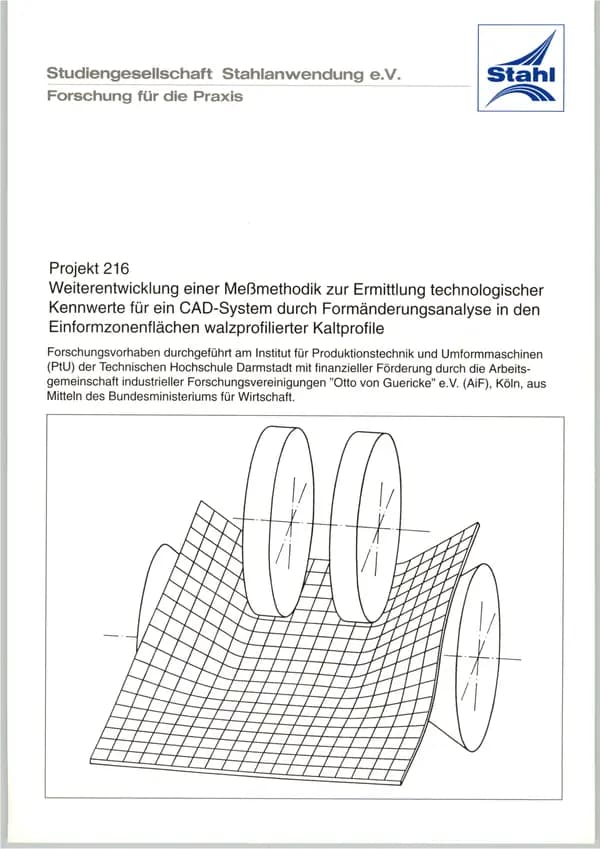
FOSTAP 216 - Further development of a measuring method for determining technological parameters for a CAD system by analysing deformation in the forming zone surfaces of roll-formed cold profiles
P 216 - Further development of a measuring method to determine technological parameters for a CAD system by analysing deformation in the forming zone surfaces of roll-formed cold profiles The forming process in roll forming for the production of bar-shaped cold-formed profiles is extremely complex and has not yet been fully analysed theoretically. Machines and tool design are still largely based on the experience of employees in roll forming companies. In order to be able to plan the profiling step sequence and tool geometry better, faster and more independently of the experience of individual employees in the future, precise knowledge of the forming process is required. As part of this research project, a new method was developed with which the forming zone can be mapped and analysed as a mathematical model. The basis for this is the mapping of the moulding zone geometry as a free-formed surface. This opens up the possibility of calculating elongations, curvatures and also surface information based on a consistent database. With the help of a point grid applied to the sheet before forming and an analysis of the distortions after the profiling process, it was possible to determine local geometry and deformation values for different profiling parameters such as angle step sequence, sheet thickness and leg length. A new instrument for analysing deformation was developed with the method for mathematically mapping the forming zone geometry as a free-formed surface. It offers a good tool for a possible future simulation of the roll forming process, with which a sufficiently good mapping of the deformation process can be achieved. In the future, a sophisticated simulation technique will provide the designer with an instrument that can also be used to calculate new profile geometries and optimise step sequence planning. Publication: March 1993 Authors: Prof. Dr.-lng. D. Schmoeckel, Dipl.-Wirtsch.-Ing. N. Strieker
available anytime
View details →€20.00
excl. VAT
 FOSTA
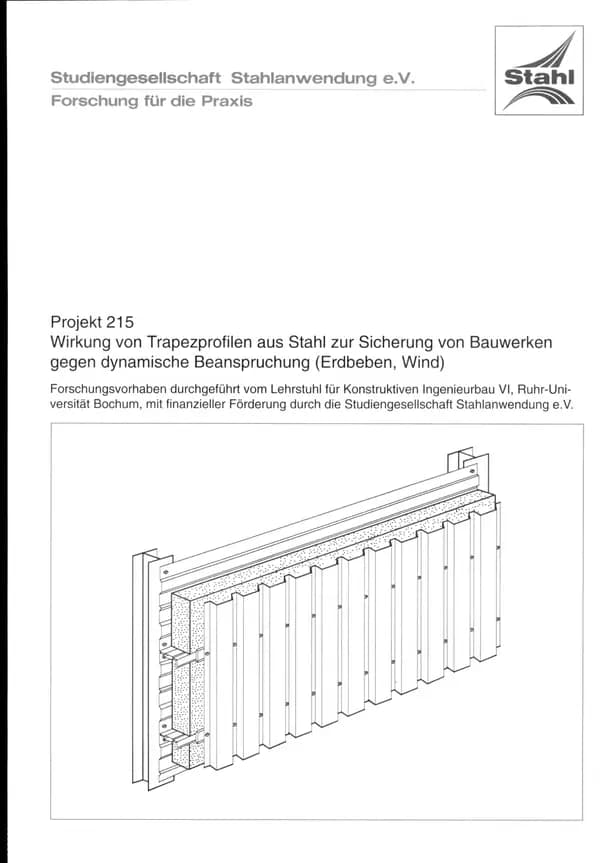
FOSTAP 215 - Effect of trapezoidal steel profiles for securing structures against dynamic loads (earthquake, wind)
P 215 - Effect of trapezoidal steel profiles for securing structures against dynamic loads (earthquake, wind) Today, trapezoidal steel profiles are proven components for roof and wall constructions. Their cost-effectiveness and versatility, supported by a wide range of products, have led to their widespread use in industrial construction. The possibility of bracing in the roof area has long been a technical standard. Their use as stiffening elements in wall constructions is not yet a matter of course, although the behaviour of trapezoidal steel profile shear bays under dynamic load offers particularly interesting prospects. The aim of the research project was to determine the dynamic behaviour of trapezoidal steel profile shear panels, including their damping properties due to friction and plastic deformation, and to provide a calculation basis for their use in structural reinforcement against dynamic effects (e.g. earthquakes and wind). The stiffness, damping and load-bearing properties of selected trapezoidal steel profile wall structures (single-skin and double-skin) were determined and analysed by means of realistic component tests under dynamic loading. Linear, quasi-linear and non-linear calculation models were created to characterise the dynamic behaviour, which can be used in calculation systems for the analysis of structures under dynamic loading. The presented description of large deformations under dynamic load includes the special case of modal analysis and the special case of static calculation. The data obtained experimentally for the wall structures analysed in this research report were transferred to wall structures with other geometric and material characteristics using transformation rules. The procedure for calculating the dynamic behaviour of a wall structure is explained using an example. With the results of this report, the calculating engineer is able to integrate trapezoidal profile wall structures into his supporting structure and to verify their load-bearing capacity under dynamic loading. It has been shown that trapezoidal steel shear walls can make a very good contribution to securing structures against both wind and earthquakes. In addition, they still offer high load-bearing reserves even with large deformations. This study emphasises the versatility of the possible applications and the development potential of lightweight trapezoidal steel profile elements, which promise even greater use in earthquake-prone areas in the future. Publication date: October 1993 Authors: Prof. Dr.-Ing. E. Reyer, Dipl.-Ing. M. Parche, Dipl . -Ing. N. Aburas
available anytime
View details →€30.00
excl. VAT
 FOSTA
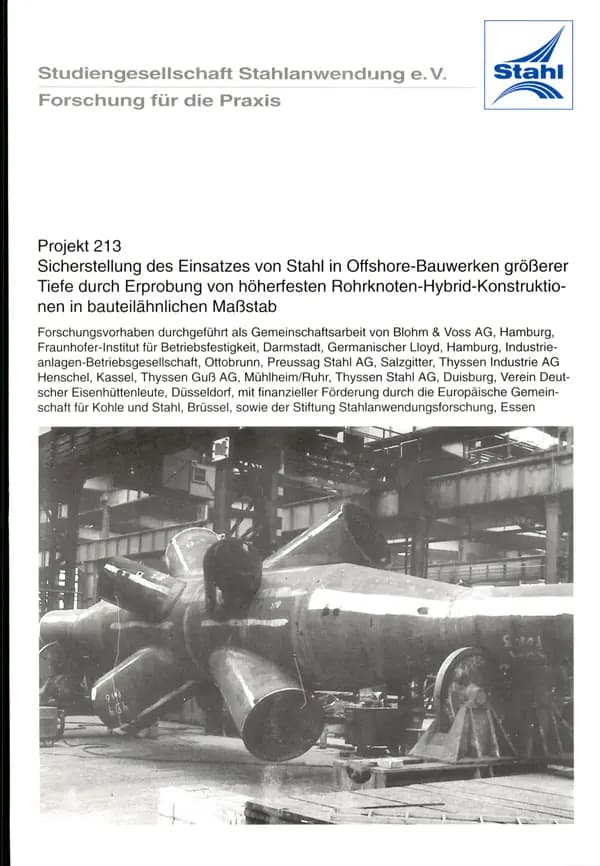
FOSTAP 213 - Ensuring the use of steel in offshore structures at greater depths by testing higher-strength pipe node hybrid constructions on a component-like scale
P 213 - Ensuring the use of steel in offshore structures at greater depths by testing higher-strength pipe node hybrid constructions on a component-like scale Offshore structures are built using steel and concrete construction methods. For steel, the transition to ever greater depths requires new construction concepts in which the pipe node weld seams are removed from the areas of highest stress by using cast steel (hybrid construction methods). The aim of the research project was to test this concept for higher-strength steels and reduced wall thicknesses under the corrosive and vibrational stresses typical of offshore applications. In contrast to earlier investigations with the material StE 355 for the pipes and GS-8 Mn 7 as a cast steel insert (wall thickness s=38 mm), the focus here was on the higher-strength steel StE 500 for pipes and the newly developed cast material GS-12 MnMo 74 (s=28 mm). Hybrid pipe nodes on a component-like scale were tested in artificial seawater in a single-stage test and under seaway-typical loading. Despite the reduction in wall thickness, the use of these higher-strength materials resulted in an increase in the crack resistance in the critical areas of the cast steel insert by a factor of 2. Supplementary investigations on two conventionally welded pipe nodes without cast inserts showed that a TIG post-treatment and shot peening of the weld seams on these pipe nodes means additional safety against cracking at high cost. The results of the investigation provide an extended basis for the design of pipe joints. In addition, calculation models for application to different load constellations have been developed and are available. Offshore construction with steel using the hybrid pipe node concept and high-strength steel remains a durable, technically and economically viable alternative to concrete, even for greater sea depths. The advantages of this concept also apply to steel and mechanical engineering, e.g. in conveyor technology, in steel building and bridge construction and in vehicle technology. Publication: December 1995 Authors: Dr D. Christianus, Dr A. Engels, Dr W. Fischer, Dr F.-J. Flolßdorf, Dr K. Freier, Dr H.-J. Hansen, Dr T. Kuftmaul, Dr E. Lachmann, Dipl.-lng. K. Lipp, Dr B. Musgen, Dr B. Musgen, Dr B. Lipp. B. Musgen, Dr.- lng. U. Schriever, Dr W. Schutz, Dr K. Seifert, Prof . Dr C. M. Sonsino, Dipl.-lng. R. Strewinski, Dr . -lng. R. Umbach
available anytime
View details →€30.00
excl. VAT
 FOSTA
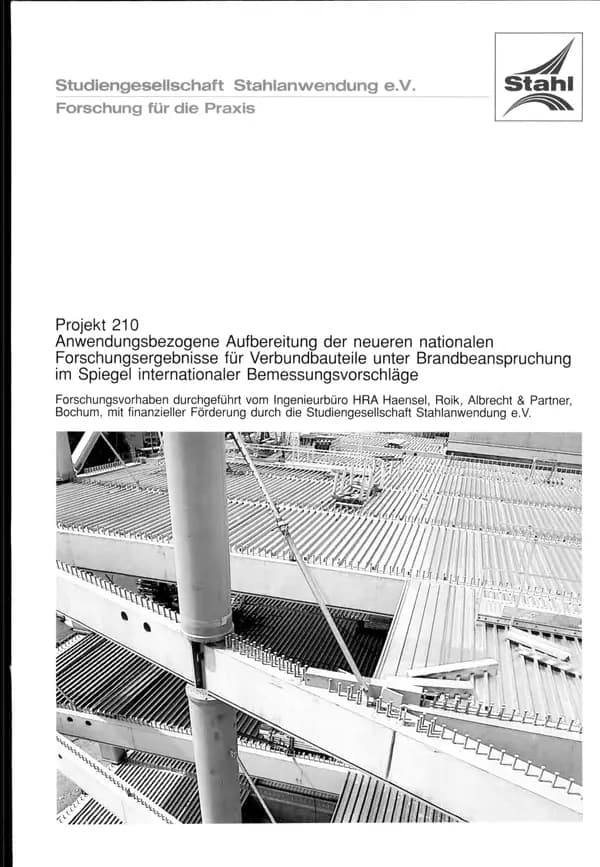
FOSTAP 210 - Application-related processing of recent national research results for composite components under fire exposure in the light of international design proposals
P 210: Application-related processing of recent national research results for composite components under fire exposure in the light of international design proposals The present compilation of research results on the fire behaviour of composite components, as carried out to a considerable extent on behalf of the Studiengesellschaft Stahlanwendung at various competent bodies, is intended to highlight application-ready design methods and prepare them for easy use in practice. A further objective of this compendium is to secure the fire protection design methods in an international comparison. The focus should be less on the description and justification of the fire behaviour of the composite components and more on the practical design according to the current state of knowledge. In the first step, test data and results from 116 fire tests on composite columns and beams and additional data from other international sources were compiled in tabular form. The data directly usable for design purposes was compiled from the available results. Where design or approximation methods are already available, these were presented with details of the principles and areas of application for the individual components, composite floors, beams and columns. Existing verification methods have been analysed and commented on by means of parameter studies. The German Steel Construction Association has examined the fire protection verification methods with regard to their compatibility with established standards and guidelines, and clarified their acceptability in practice within national and international committee work. In the case of composite columns, the physical processes under fire exposure are so complex that generally valid approximation methods for the variety of possible design variants in composite construction are fundamentally prohibited. The calculation methods discussed in this research project can therefore only cover selected types of columns. The exclusive validity of the methods within the specified area of application is self-evident. The authors expressly point out that the limits of validity have in some cases only changed or been narrowed after publication of the verification methods as a result of experience in practical building applications. In individual cases, there is a risk of overestimating the load-bearing capacity of composite columns in the event of fire. In the case of components subject to bending stress, the load-bearing capacity in the event of fire can be determined with sufficient accuracy using so-called "fire-reduced" cross-sections, whereby the determination of the plastic cross-section values is strongly based on known structural methods. The research activities of recent years have reached a level that allows structural engineers to carry out the fire protection design as a supplement to the static calculation using approximation methods. This makes it possible to simplify the fire protection verification in the building approval procedure, detached from the rigid classification system of DIN 4102. However, the formal recognition of mathematical fire protection certificates can only be expected with the introduction of European standards (Eurocodes); it can be assumed that these will already be the state of the art in many places. STUDIENGESELLSCHAFT STAHLANWENDUNG e.V. Publication: 1992 Authors: o.A.
available anytime
View details →€30.00
excl. VAT
 FOSTA
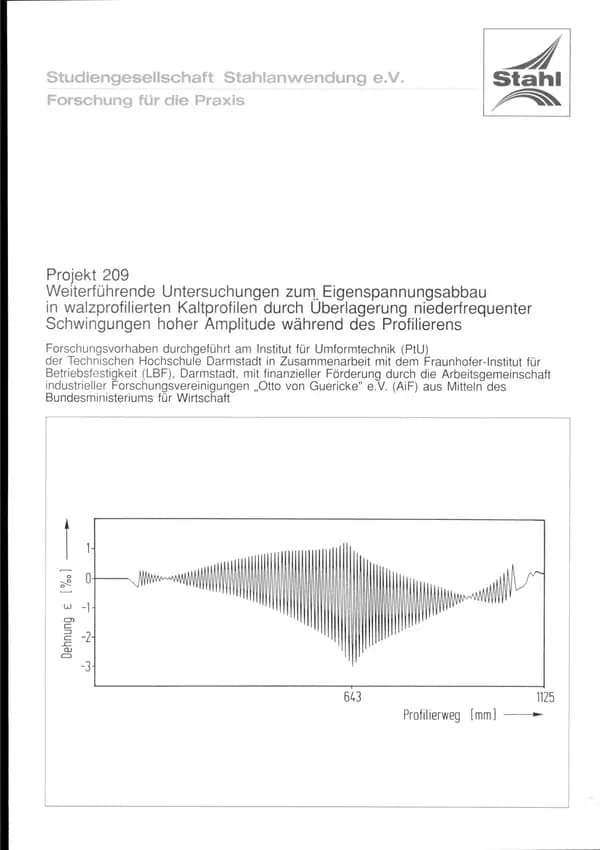
FOSTAP 209 - - Further investigations into the reduction of residual stresses in roll-formed cold profiles by superimposing high-amplitude low-frequency vibrations during profiling
P 209: Further investigations into the reduction of residual stresses in roll-formed cold profiles by superimposing high-amplitude low-frequency vibrations during profiling As a result of the inhomogeneous shape changes during roll forming, residual stresses arise in the profile strand. These are responsible for shape and dimensional deviations in all subsequent processing steps. In a previous project (P 151), the fundamental suitability of superimposing mechanical vibrations to reduce residual stresses in roll-formed cold-rolled steel profiles was demonstrated. However, as the overall quality of a profile determines its technical/economic value, the aim of the further research project dealt with here was to determine the relationships between residual stresses, shape deviations and material properties after residual stress reduction by vibration superposition. The investigations were carried out on U-sections made of structural steel with different sheet thicknesses. The borehole method was used to comprehensively determine the residual stresses along the profile unwinding. Vibration superposition proved to be particularly suitable for profiles with a small ratio of side length to sheet thickness in order to achieve comprehensive homogenisation of the residual stress state, especially in the area close to the strip edge. Important shape deviation criteria can be improved in a targeted manner; with shape deviation-optimising parameter settings, profiles with reduced residual stress are always produced, so that time-consuming residual stress measurements can be dispensed with in practice. The fatigue strength is only insignificantly reduced in the area relevant to operational strength. Cyclic strain hardening with vibration superposition was able to achieve an increase in the average overall yield strength of 6 to 10 % for all the sheet thicknesses investigated. The process developed - integration of a simple, mechanical vibration exciter - enables a targeted improvement in profile quality by superimposing mechanical vibrations. It can also be used to compensate for shape deviations caused by reducing the number of forming stages. In the following research report, the findings are documented in such a way that an independent introduction of the process is possible for simple profiles or, through further development of the vibration kinematics, also for complicated profiles in steel processing companies. Studiengesellschaft Stahlanwendung e. V. Publication: 1992 Authors: Prof. Dr.-Ing. D. Schmoeckel, Dipl.-Ing. D. Busse
available anytime
View details →€30.00
excl. VAT
 FOSTA
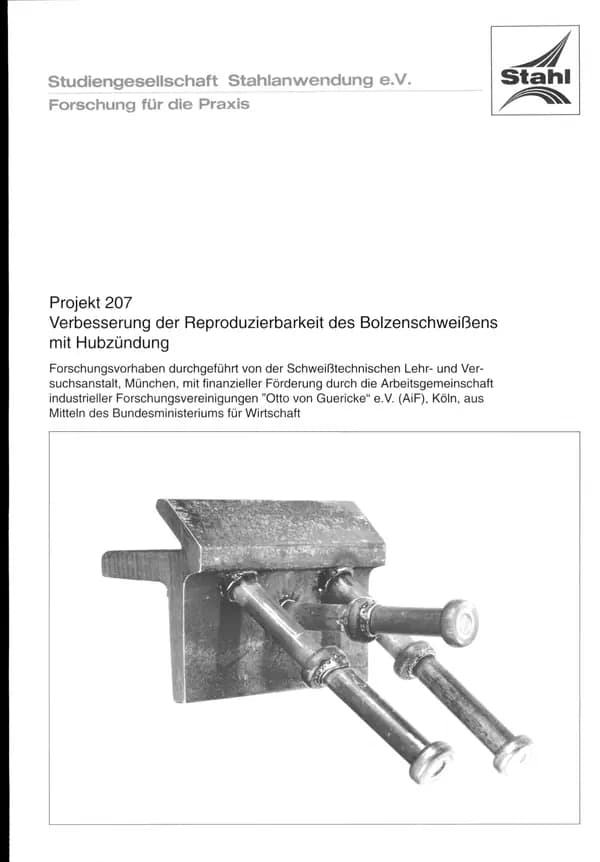
FOSTAP 207 -Improving the reproducibility of drawn arc stud welding
P 207: Improving the reproducibility of drawn arc stud welding Drawn arc stud welding is an economical joining process for joining pin-shaped components (studs) with diameters ranging from 2 to 22 mm to sheet metal, profiles or pipes. As a result of irregularities in the welding and movement sequence, faulty welded joints and limitations in load-bearing capacity are repeatedly observed in practice. The aim of the research project was to develop new concepts for welding guns with improved lift and immersion behaviour and to develop suitable measuring devices to make it easier to detect and correct faults in the device or its settings. To solve this task, a pneumatically and a mechanically-magnetically operated system, each with stud length compensation, were developed and tested as new movement concepts for drawn arc stud welding. Both motion sequences fulfil the requirements for the repeat accuracy of lift and penetration in equal measure. With the mechanical-magnetic movement sequence, the feasibility of a completely new welding gun concept was successfully demonstrated. The movement sequence can be precisely maintained with these guns. Concepts and practical measuring devices have been developed and tested for monitoring the welding process, which, by observing the current, welding time, arc voltage, lift height and immersion depth, can recognise incorrect welding settings or execution. The stud welding process is used by many small and medium-sized companies due to its simple handling and low equipment costs. At a time of new European quality assurance systems and product liability laws, the research results have met with great interest from these companies in particular. This has led, among other things, to suggestions from this work being taken up by appliance manufacturers during the realisation of the research project and taken into account in the development of new appliance concepts. STUDIENGESELLSCHAFT STAHLANWENDUNG e.V. Publication: 1993 Authors: Dipl.-Ing. (Univ) A. Jenicek, Dipl.-Ing. A. Nentwig, Dr.-Ing. W. Welz
available anytime
View details →€20.00
excl. VAT