
P 209 - - Further investigations into the reduction of residual stresses in roll-formed cold profiles by superimposing high-amplitude low-frequency vibrations during profiling
As a result of the inhomogeneous shape changes during roll forming, residual stresses arise in the profile strand. These are responsible for shape and dimensional deviations in all subsequent processing steps. In a …
Content
- Publication
- 1992
- Authors
- Prof. Dr.-Ing. D. Schmoeckel, Dipl.-Ing. D. Busse
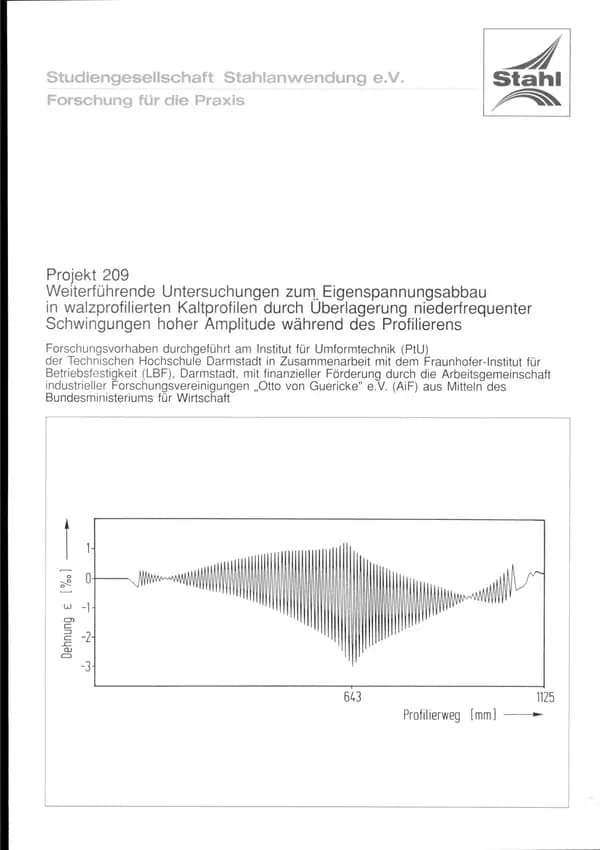
As a result of the inhomogeneous shape changes during roll forming, residual stresses arise in the profile strand. These are responsible for shape and dimensional deviations in all subsequent processing steps. In a previous project (P 151), the fundamental suitability of superimposing mechanical vibrations to reduce residual stresses in roll-formed cold-rolled steel profiles was demonstrated. However, as the overall quality of a profile determines its technical/economic value, the aim of the further research project dealt with here was to determine the relationships between residual stresses, shape deviations and material properties after residual stress reduction by vibration superposition.
Show full description
The investigations were carried out on U-sections made of structural steel with different sheet thicknesses. The borehole method was used to comprehensively determine the residual stresses along the profile unwinding. Vibration superposition proved to be particularly suitable for profiles with a small ratio of side length to sheet thickness in order to achieve comprehensive homogenisation of the residual stress state, especially in the area close to the strip edge. Important shape deviation criteria can be improved in a targeted manner; with shape deviation-optimising parameter settings, profiles with reduced residual stress are always produced, so that time-consuming residual stress measurements can be dispensed with in practice. The fatigue strength is only insignificantly reduced in the area relevant to operational strength. Cyclic strain hardening with vibration superposition was able to achieve an increase in the average overall yield strength of 6 to 10 % for all the sheet thicknesses investigated. The process developed - integration of a simple, mechanical vibration exciter - enables a targeted improvement in profile quality by superimposing mechanical vibrations. It can also be used to compensate for shape deviations caused by reducing the number of forming stages. In the following research report, the findings are documented in such a way that an independent introduction of the process is possible for simple profiles or, through further development of the vibration kinematics, also for complicated profiles in steel processing companies. Studiengesellschaft Stahlanwendung e. V.
Zum Zoomen hovern
€30.00excl. VAT
Payment by card (Stripe) or invoice (DE, AT, CH). Download link by email: automatically after ordering by card, after order approval for invoice (valid for 30 days). Terms
P 209 - - Further investigations into the reduction of residual stresses in roll-formed cold profiles by superimposing high-amplitude low-frequency vibrations during profiling—
€30.00