
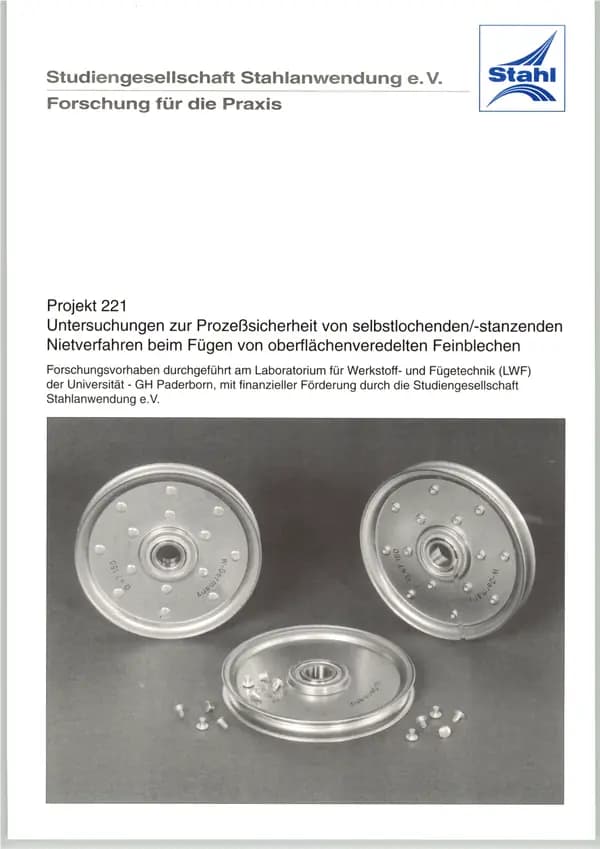
P 221 - Investigations into the process reliability of self-piercing/punching riveting processes when joining surface-finished thin sheets
Self-pierce riveting is a forming joining process for the low-heat joining of sheet metal, tube and profile parts that has already been introduced to the market. As part of the project, self-pierce riveting with solid …
Content
- Publication
- 1995
- Authors
- Prof. Dr.-Ing. Hahn, Dipl.-Ing. W. Lappe
Self-pierce riveting is a forming joining process for the low-heat joining of sheet metal, tube and profile parts that has already been introduced to the market. As part of the project, self-pierce riveting with solid rivets and self-pierce riveting with semi-tubular rivets were used in investigations into process reliability when joining surface-finished thin sheets. Self-pierce riveting with semi-tubular rivets showed great advantages in comparison to resistance spot welding for specimens subjected to oscillating loads. Punch riveted test specimens made of galvanised sheet metal (St05Z) achieved 5 times the service life at a load amplitude of 13.5 kN (H specimen with 10 joints).
Show full description
The highest fatigue strength was achieved with the higher-strength material (ZStE420). In contrast to resistance spot welding, this results in an increase in joint strength with an increase in the yield strength of the joining part material under oscillating component loading. The self-pierce rivet geometry improved by the work for the research project considerably increased the joint strength of self-pierce rivet joints in sheet steel. The influence of the joining part surface on the joining result could be reduced. A rounding of the transition area between the countersunk head and rivet shank counteracted the frequent formation of cracks in the self-pierce rivet head. The new self-pierce rivet geometry was used in the final tests with oscillating loads on the samples. An increased hold-down force in the self-pierce riveting process significantly reduced component distortion and led to improved reproducibility of the result. This finding was taken up by the manufacturers and has already been realised in standard setting tools. When joining coil-coated sheet metal, quasi-static strength values comparable to those measured on hot-dip galvanised sheet metal (St05Z) were achieved. This provides a high-performance joining technology for joining organically coated sheet steel materials. Self-pierce riveting is economically interesting due to the savings in preparation measures on the parts to be joined and the short cycle times. A wide range of joining tasks can be covered at a low investment cost. The results of the research project are of particular interest to the metalworking industry. By switching to surface-finished sheet steel in conjunction with high-performance joining technology, decisive improvements in market position can be achieved. STUDIENGESELLSCHAFT STAHLANWENDUNG e.V.
Zum Zoomen hovern
€30.00excl. VAT
Payment by card (Stripe) or invoice (DE, AT, CH). Download link by email: automatically after ordering by card, after order approval for invoice (valid for 30 days). Terms
P 221 - Investigations into the process reliability of self-piercing/punching riveting processes when joining surface-finished thin sheets—
€30.00