
P 222 - Simulation of the forming of surface-finished thin sheet composites
Environmental protection and ergonomic workplace design make it necessary to further reduce the noise emissions of machines and components. This is leading to an increase in the use of vibration-damping composite …
Content
- Publication
- 1995
- Authors
- Dr.rer.nat. M. Büscher, Dr.-lng. E.-J. Drewes, Prof. Dr.-lng. E. von Finckenstein, Dipl.-Ing. L. Keßler, Dr.-Ing. W. Nester, Dr.-lng. V. Steininger, Dr.-lng. H. U. Weigel
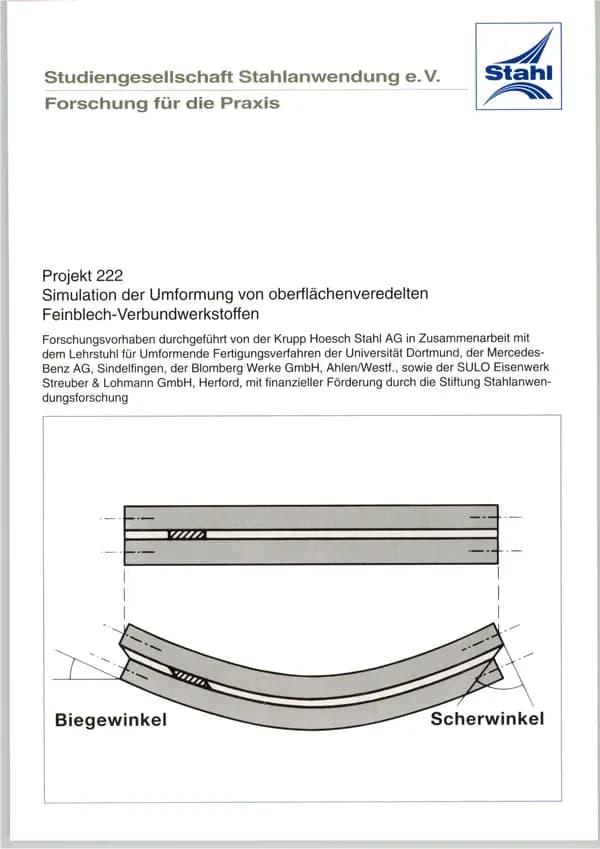
Environmental protection and ergonomic workplace design make it necessary to further reduce the noise emissions of machines and components. This is leading to an increase in the use of vibration-damping composite sheets, which consist of a steel/viscoelastic core layer/steel cross-section. Compared to a solid sheet, there are modified forming properties that make it necessary to adapt the production parameters. As part of the research project, a simulation method was to be developed to determine these parameters and enable a reliable prediction of the forming behaviour. Various simulation models based on the finite element method (FEM) were evaluated with regard to forming techniques for steel composite sheets.
Show full description
As part of these investigations, a model in which the visco-elastic core layer is described by "spring elements" proved to be realistic and universally applicable. In addition to the simple determination of the required characteristic values, this simulation model can be used to comprehensively describe the forming behaviour of steel composite sheets in bending and deep-drawing processes. For bending, the springback and thus the required die angle and the stamping force can be determined. For deep drawing, the sheet holder force and friction can be calculated. In addition, this model can be used to determine not only the deformation in the sheet metal but also the leg deflection, the cover sheet offset and the zones of possible wrinkling. The comparison of the calculation results with experimental investigations on model components showed that the simulation model developed and the characteristic values determined with it can be used in a targeted manner. This makes it possible to carry out a feasibility study during the design phase and to determine the most important process parameters. This was confirmed by simulating the forming of components manufactured industrially from composite sheet metal. The acoustic tests finally carried out with these components, which were manufactured on a trial basis from sheet steel composites, show that the use of vibration-damping composite sheet metal can lead to a significant reduction in noise emissions from machines and other noise sources. STUDIENGESELLSCHAFT STAHLANWENDUNG e.V.
Zum Zoomen hovern
€30.00excl. VAT
Payment by card (Stripe) or invoice (DE, AT, CH). Download link by email: automatically after ordering by card, after order approval for invoice (valid for 30 days). Terms
P 222 - Simulation of the forming of surface-finished thin sheet composites—
€30.00