
P 210 - Application-related processing of recent national research results for composite components under fire exposure in the light of international design proposals
The present compilation of research results on the fire behaviour of composite components, as carried out to a considerable extent on behalf of the Studiengesellschaft Stahlanwendung at various competent bodies, is …
Content
- Publication
- 1992
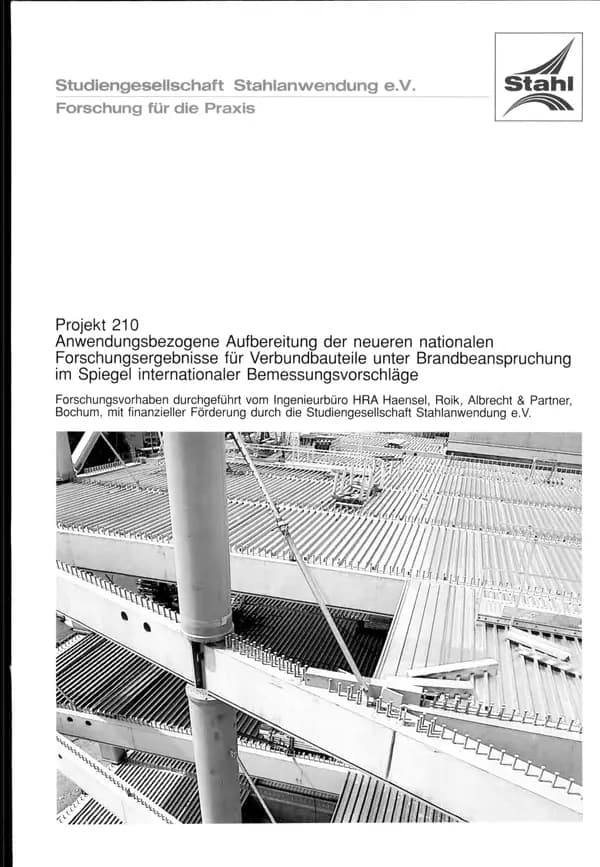
The present compilation of research results on the fire behaviour of composite components, as carried out to a considerable extent on behalf of the Studiengesellschaft Stahlanwendung at various competent bodies, is intended to highlight application-ready design methods and prepare them for easy use in practice. A further objective of this compendium is to secure the fire protection design methods in an international comparison. The focus should be less on the description and justification of the fire behaviour of the composite components and more on the practical design according to the current state of knowledge. In the first step, test data and results from 116 fire tests on composite columns and beams and additional data from other international sources were compiled in tabular form.
Show full description
The data directly usable for design purposes was compiled from the available results. Where design or approximation methods are already available, these were presented with details of the principles and areas of application for the individual components, composite floors, beams and columns. Existing verification methods have been analysed and commented on by means of parameter studies. The German Steel Construction Association has examined the fire protection verification methods with regard to their compatibility with established standards and guidelines, and clarified their acceptability in practice within national and international committee work. In the case of composite columns, the physical processes under fire exposure are so complex that generally valid approximation methods for the variety of possible design variants in composite construction are fundamentally prohibited. The calculation methods discussed in this research project can therefore only cover selected types of columns. The exclusive validity of the methods within the specified area of application is self-evident. The authors expressly point out that the limits of validity have in some cases only changed or been narrowed after publication of the verification methods as a result of experience in practical building applications. In individual cases, there is a risk of overestimating the load-bearing capacity of composite columns in the event of fire. In the case of components subject to bending stress, the load-bearing capacity in the event of fire can be determined with sufficient accuracy using so-called "fire-reduced" cross-sections, whereby the determination of the plastic cross-section values is strongly based on known structural methods. The research activities of recent years have reached a level that allows structural engineers to carry out the fire protection design as a supplement to the static calculation using approximation methods. This makes it possible to simplify the fire protection verification in the building approval procedure, detached from the rigid classification system of DIN 4102. However, the formal recognition of mathematical fire protection certificates can only be expected with the introduction of European standards (Eurocodes); it can be assumed that these will already be the state of the art in many places. STUDIENGESELLSCHAFT STAHLANWENDUNG e.V.
Zum Zoomen hovern
€30.00excl. VAT
Payment by card (Stripe) or invoice (DE, AT, CH). Download link by email: automatically after ordering by card, after order approval for invoice (valid for 30 days). Terms
P 210 - Application-related processing of recent national research results for composite components under fire exposure in the light of international design proposals—
€30.00