
FOSTA
In steel constructions with hollow sections, the stiffenerless connection is usually favoured, i.e. direct welding of the hollow sections to each other. One of these connections is the "T-joint" of rectangular hollow …
In steel constructions with hollow sections, the stiffenerless connection is usually favoured, i.e. direct welding of the hollow sections to each other. One of these connections is the "T-joint" of rectangular hollow sections discussed in this report. This type of node is used, for example, for Vierendeel beams and cantilevers welded to columns. The load-bearing behaviour of such hollow section nodes was investigated under moment, shear force and normal force loading. Based on the results obtained, a proposal for the future standardisation of the design of this type of node was made. We would like to thank Prof. Dr.-Ing. F. Mang and his colleagues for their work and also the Ministry of the Interior of North Rhine-Westphalia for their financial support of this research project. We would also like to thank the working group "Profile connections" of the Studiengesellschaft für Anwendungstechnik von Eisen und Stahl e.v., which contributed to this research project by providing suggestions, preparation and supervision. STUDIENGESELLSCHAFT FÜR ANWENDUNGSTECHNIK VON EISEN UND STAHL e.V.
Machine-translated title and description. The document itself is in German.
Payment by card (Stripe) or invoice (DE, AT, CH). Download link by email: automatically after ordering by card, after order approval for invoice (valid for 30 days). Terms
Digital download
Other parts and editions as well as neighbouring documents of the same series.
P 81 - Underground steel structures - Information and recommendations for design, calculation and execution Publication: 1982 Authors: Prof. Dr.-Ing. G. Girnau, Dr.-Ing. A. Haack, Dr.-Ing. N. Klawa, Prof. Dr.-Ing. H. Duddeck, Dr.-Ing. A. Städing
available anytime
€70.00
excl. VAT
P 80 - Investigations into the applicability of drawn arc stud welding for welding galvanised steel sheets Stud welding has proven to be a very economical process in numerous applications, particularly in the construction industry. In order to be able to extend the application range of this process, investigations are required to improve the process and to investigate the behaviour of the materials to be welded. Stud welding is used in structural steel engineering, civil engineering and bridge construction to achieve a bond between steel and concrete. In the course of the further development of composite construction, the steel cell ceiling represents a significant advance. Strip-galvanised sheets are used as formwork elements for the floor, through which the studs have to be welded to the steel girder. In order to clarify the problems arising in stud welding, the present research work was carried out by Prof.Dr.-Ing. F. Eichhorn, Institute for Welding Manufacturing Processes (ISF) at the TH Aachen and Dipl.-Ing. H.-W. Langenbahn, also ISF, on behalf of the Studiengesellschaft für Anwendungstechnik von Eisen und Stahl e.V. and with financial support from the Arbeitsgemeinschaft Industrieller Forschungsvereinigungen e.V. (AIF), Cologne. The test results show that perfect stud welded joints can be achieved on the materials investigated if suitable welding conditions are selected. The use of drawn arc stud welding means a considerable increase in the performance of the process and thus in economic efficiency. Further important information on the same complex of topics can be found in the research work already completed by the Studiengesellschaft P 26 "Investigations into the applicability of stud welding for weather-resistant and high-strength structural steels" and in the project P 79 "Investigations into reducing the susceptibility to defects in drawn arc stud welding" currently being carried out at the SLV-Munich. We would like to take this opportunity to thank Prof.Dr.-Ing. Eichhorn and his colleague, Dipl.-Ing. Langenbahn, for their work. We would also like to thank the members of the working group of the Studiengesellschaft für Anwendungstechnik von Eisen und Stahl e.V., who provided expert support for the work. STUDIENGESELLSCHAFT FÜR ANWENDUNGSTECHNIK VON EISEN UND STAHL e.V. Publication: 1982 Authors: Prof. Dr.-Ing. F. Eichhorn, Dipl.-Ing. H.-W. Langenbahn
available anytime
€20.00
excl. VAT
P 79 - Investigation into reducing the susceptibility to defects in drawn arc stud welding Stud welding is a very economical joining process that has already found a permanent area of application in many branches of industry. As the demands on the long-term operational behaviour and safety of the components are constantly increasing, the quality and reproducibility of the welded joints are inevitably subject to higher requirements. Due to the large number of influencing variables involved in stud welding, optimising and keeping the parameters constant is a necessary but not easy task. In order to solve these problems, the present research work was carried out at the Schweißtechnische Lehr- und Versuchsanstalt, Munich, under the direction of Dr W. Welz, on behalf of the Studiengesellschaft für Anwendungstechnik von Eisen und Stahl e.V. and with financial support from the Arbeitsgemeinschaft Industrieller Forschungsvereinigungen e.V. (AIF), Cologne. The research results are practice-orientated, so that a direct application is possible. Optimised welding data are given, whereby the latest current sources, a computer-controlled welding device, toroidal coils for influencing the blowing effect and high-speed film recordings were used to determine the results. The modern investigation methods show the possibilities that will represent the state of the art in stud welding in the future. Further information on the same complex of topics can be found in the research work already completed by the Studiengesellschaft für Anwendungstechnik von Eisen und Stahl e.V. STUDIENGESELLSCHAFT FÜR ANWENDUNGSTECHNIK VON EISEN UND STAHL e.V. Publication: 1982 Authors: Dr.-Ing. W. Welz
available anytime
€20.00
excl. VAT
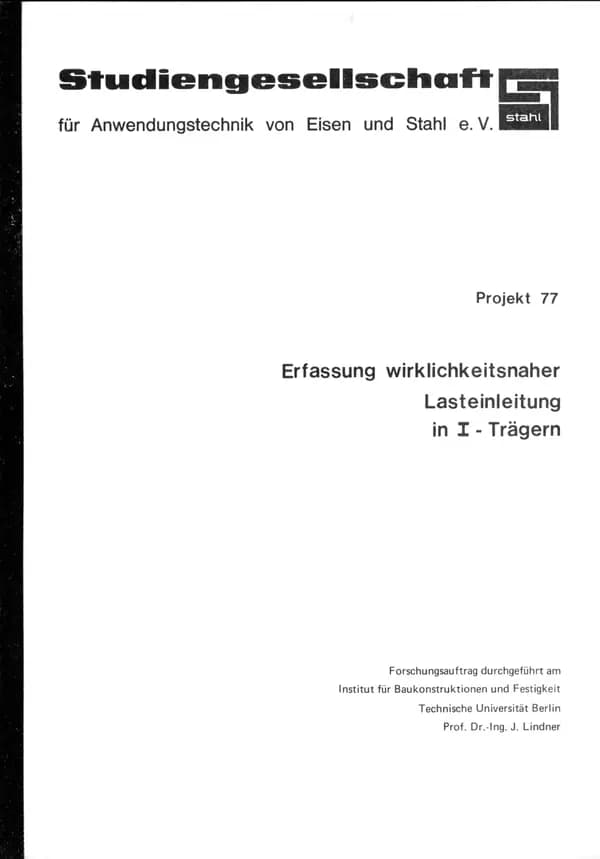
P 77 - Recording of realistic load application in I-beams For beams subjected to bending loads with an I-section, for example, there is a risk of lateral deflection. The exact structural analysis required for such cases is both difficult and time-consuming. It is therefore generally carried out in practice on the basis of extensive simplifications. Although this is on the safe side, it generally does not fully utilise the safety reserves available in the supporting structure. The work presented here is intended to significantly simplify the effort previously required for theoretical lateral-torsional buckling analyses. In addition, the area for which a lateral-torsional buckling analysis is required is to be advantageously limited and the remaining area of an economical design is to be opened up. In order to arrive at the desired simplified calculation and design methods, the results determined in extensive test series were compared with theoretical values determined using complex computer programmes in order to arrive at simplified calculation methods. This has made a remarkable contribution to rationalising design work and at the same time increasing the competitiveness of steel. This applies both to steel construction itself and to all other branches of industry that are confronted with these problems. The research project was carried out by the ''Fachgebiet Stahlbau" at the Institute for Structural Design and Strength at the Technical University of Berlin on behalf of the Studiengesellschaft für Anwendungstechnik von Eisen und Stahl e.V. with financial support from the Arbeitsgemeinschaft Industrieller Forschungsvereinigungen e.V. Köln, (AIF). STUDIENGESELLSCHAFT FÜR ANWENDUNGSTECHNIK VON EISEN UND STAHL e.V. Publication: 1982 Authors: Prof. Dr.-Ing. J. Lindner, Dr.-Ing. J. S. Schmidt
available anytime
€30.00
excl. VAT
Payment by card (Stripe) or invoice (DE, AT, CH). Download link by email: automatically after ordering by card, after order approval for invoice (valid for 30 days). Terms