
FOSTA
For beams subjected to bending loads with an I-section, for example, there is a risk of lateral deflection. The exact structural analysis required for such cases is both difficult and time-consuming. It is therefore …
For beams subjected to bending loads with an I-section, for example, there is a risk of lateral deflection. The exact structural analysis required for such cases is both difficult and time-consuming. It is therefore generally carried out in practice on the basis of extensive simplifications. Although this is on the safe side, it generally does not fully utilise the safety reserves available in the supporting structure. The work presented here is intended to significantly simplify the effort previously required for theoretical lateral-torsional buckling analyses. In addition, the area for which a lateral-torsional buckling analysis is required is to be advantageously limited and the remaining area of an economical design is to be opened up.
In order to arrive at the desired simplified calculation and design methods, the results determined in extensive test series were compared with theoretical values determined using complex computer programmes in order to arrive at simplified calculation methods. This has made a remarkable contribution to rationalising design work and at the same time increasing the competitiveness of steel. This applies both to steel construction itself and to all other branches of industry that are confronted with these problems. The research project was carried out by the ''Fachgebiet Stahlbau" at the Institute for Structural Design and Strength at the Technical University of Berlin on behalf of the Studiengesellschaft für Anwendungstechnik von Eisen und Stahl e.V. with financial support from the Arbeitsgemeinschaft Industrieller Forschungsvereinigungen e.V. Köln, (AIF). STUDIENGESELLSCHAFT FÜR ANWENDUNGSTECHNIK VON EISEN UND STAHL e.V.
Machine-translated title and description. The document itself is in German.
Payment by card (Stripe) or invoice (DE, AT, CH). Download link by email: automatically after ordering by card, after order approval for invoice (valid for 30 days). Terms
Digital download
Other parts and editions as well as neighbouring documents of the same series.
P 44 - Steel tracks for the EMS short stator and long stator version The Federal Republic of Germany is a leader in the development of electromagnetic monorail systems. Research funding for electromagnetic monorail systems is provided by the Federal Ministry of Research and Technology. The tracks for electromagnetic suspension railways account for the largest share of the investment costs in the event of realisation; therefore, particular importance is attached to the development of the tracks. The Studiengesellschaft für Anwendungstechnik von Eisen und Stahl e.V. (Study Association for Application Technology of Iron and Steel) has sponsored the present research work in order to develop favourable track systems for electromagnetic suspension railways in steel construction, taking into account all the possibilities of modern steel construction. As a result of this research work, all the necessary track developments in steel construction could be brought to a successful conclusion in addition to the work sponsored by the Federal Ministry of Research and Technology. The research work also provides a summarised overview of the status of track development at the end of 1977. It can be a valuable aid for study purposes and further developments. Elements of the results of these investigations were also used in the first application-oriented test track made of steel at the International Transport Exhibition in Hamburg in 1979. It is to be expected that the possible solutions for rail crossings shown in this research work will be of interest for future applications, especially for bridges with large spans. The research work was carried out on behalf of the Studiengesellschaft für Anwendungstechnik von Eisen und Stahl e.V. by the companies Thyssen-Klönne MAN Gustavsburg plant Mannesmannröhren-Werke in a joint research project. STUDIENGESELLSCHAFT FÜR ANWENDUNGSTECHNIK VON EISEN UND STAHL e.V. Publication: 1977 Authors: Dipl.-Ing. Dr. techn. F. Tschemmernegg, Dr.-Ing. W. Moheit, Dipl.-Ing. D. Dutta, Dipl.-Ing. J. Krampen
available anytime
€40.00
excl. VAT
P 36 - Investigation of the noise behaviour of steel superstructures in truss construction made of open and closed hollow sections Publication: 1977 Authors: Dr rer. nat. A. Schommer, Lic. fis. G. Volberg
available anytime
€20.00
excl. VAT
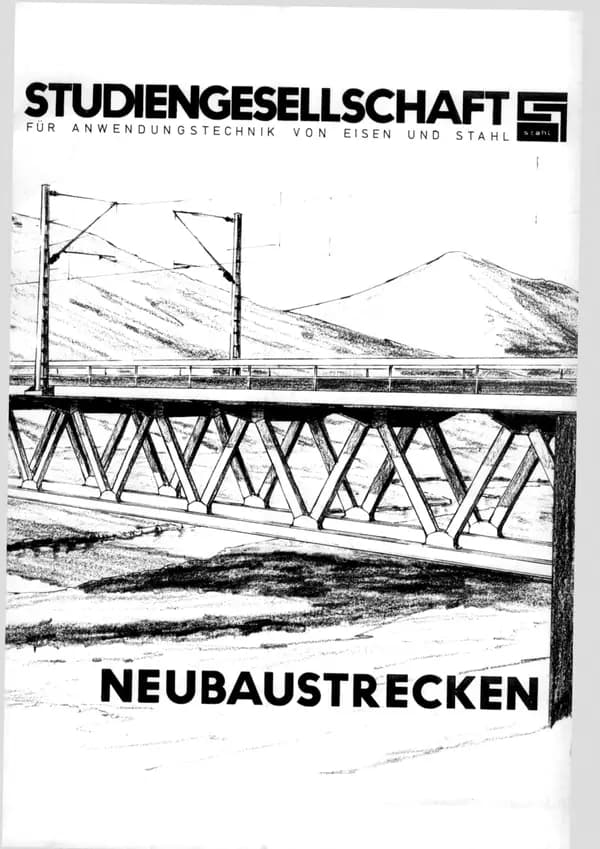
P 21 - Steel structures in truss construction for lane-bound high-speed traffic Publication: 1977 Authors: o.A.
available anytime
€20.00
excl. VAT
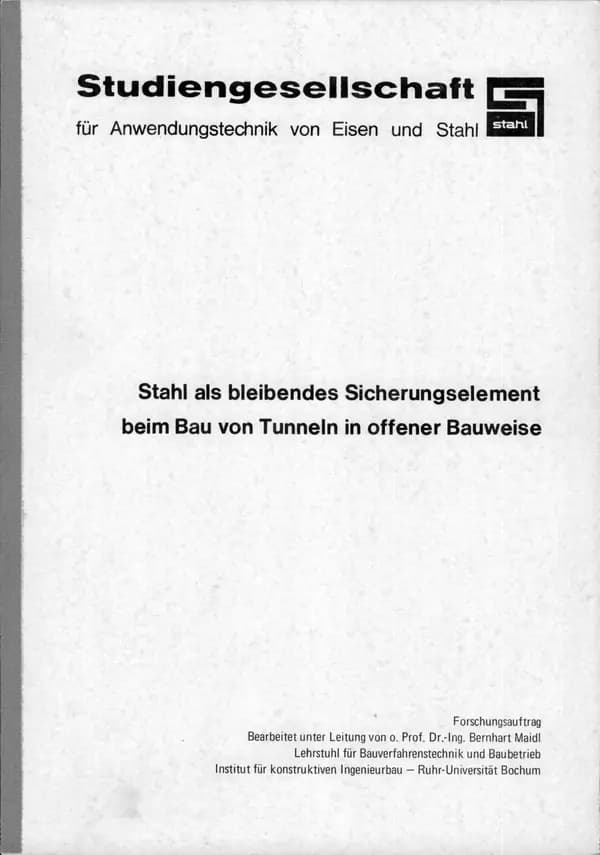
P 20 - Steel as a permanent safety element in the construction of cut-and-cover tunnels The starting point for the considerations that led to the award of this research contract was the fact that iron and steel structures have long been used as a permanent support element for tunnelling by mining methods. In contrast, reinforced concrete has been used almost exclusively for open tunnelling. Technically satisfactory solutions are known from special proposals, which are also competitive with reinforced concrete in terms of cost. The fact that such offers were not realised is certainly also due to the following reasons: - Steel for open tunnelling can only refer to a few application examples, - Regulations, guidelines and recommendations hardly address the possibilities of steel, the tendering and awarding authorities only think in terms of concrete, and there are also objections with regard to corrosion, noise and fire, - Regulations, guidelines and recommendations hardly address the possibilities of steel, the tendering and awarding authorities only think in terms of concrete, and objections can also be found here with regard to corrosion, noise and fire, - Civil engineering projects are mostly typical projects of the construction industry, which thinks almost exclusively in concrete, - Steel construction companies are less willing to accept the conditions and risks associated with awarding contracts and contractual practices. There are certainly a number of other more or less concrete reasons. The task of the research contract was therefore to investigate the fundamental possibilities of using steel as a permanent safety element in the construction of tunnels using the cut-and-cover method. This work was supervised by a working group of the Studiengesellschaft für Anwendungstechnik von Eisen und Stahl e.V. (Society for the Study of Application Technology of Iron and Steel). Publication: 1977 Authors: Prof. Dr.-Ing. Maidl, Dipl.-Ing. J. Wolter, Dipl.-Ing. H. Droste
available anytime
€30.00
excl. VAT
Payment by card (Stripe) or invoice (DE, AT, CH). Download link by email: automatically after ordering by card, after order approval for invoice (valid for 30 days). Terms