The development of high-strength multiphase steels and new manufacturing processes has opened up a wide range of design possibilities for structural improvements and weight reductions in the field of car bodies. The aim …
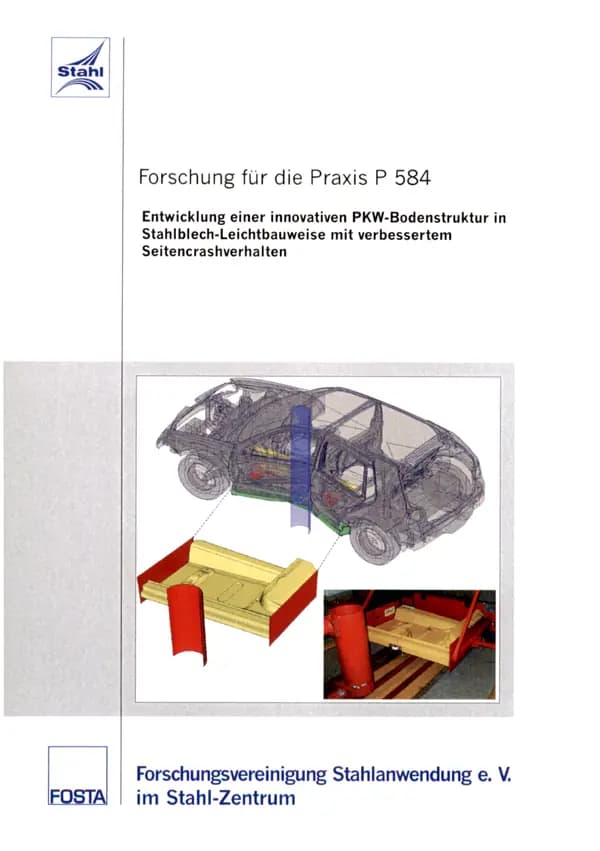
The development of high-strength multiphase steels and new manufacturing processes has opened up a wide range of design possibilities for structural improvements and weight reductions in the field of car bodies. The aim of the present work was to demonstrate the potential of modern steel materials and manufacturing processes in the area of the vehicle floor assembly for improving side crash behaviour. Using the finite element method, a validated complete vehicle model was used to show that the sills, floor pan and centre tunnel, as the three main elements of the floor assembly, dissipate approx. 40% of the total deformation energy in a bollard impact.
Component tests were derived from the observations of the overall vehicle crash, in which modern materials and manufacturing processes for the sill, floor and tunnel could be analysed. Drop tower tests were used to confirm the results of the structures designed in the simulation. The sill of the newly developed floor assembly was designed as a profiled structure to enable the use of higher-strength steel materials in particular. A fundamental advantage of the chosen sill design was the continuous profile surface. The usual local reinforcements in the shell design could be avoided in the profiled sill design through a load-adapted component design by combining the processes of flexible rolling and partial tempering. In the case of the flat components for the floor and tunnel, the sandwich and lattice sheets tested showed significantly better, albeit much more elastic, deformation behaviour than solid steel sheets of the same weight and stiffness. In addition, a noticeable stiffening of the sheets was achieved with the help of corrugation patterns. The best individual components from the main groups, which were analysed separately, were combined to form the overall structure of the new floor assembly consisting of the sill, floor panel, tunnel, seat cross member and seat pan. In a further component test of this composite, the intrusions into the vehicle interior were reduced by more than 40% compared to the original structure. Finally, the new structure was integrated into the overall vehicle model in the FEM simulation and compared with the production vehicle. Significant improvements in deformation behaviour were also achieved. The main advantage proved to be the load-adapted sill profile design, with which the essential requirements for a large-area energy distribution and the preservation of a significantly larger survival space were fully achieved.

Payment by card (Stripe) or invoice (DE, AT, CH). Download link by email: automatically after ordering by card, after order approval for invoice (valid for 30 days). Terms
Machine-translated title and description. The document itself is in German.
Digital download
Other parts and editions as well as neighbouring documents of the same series.

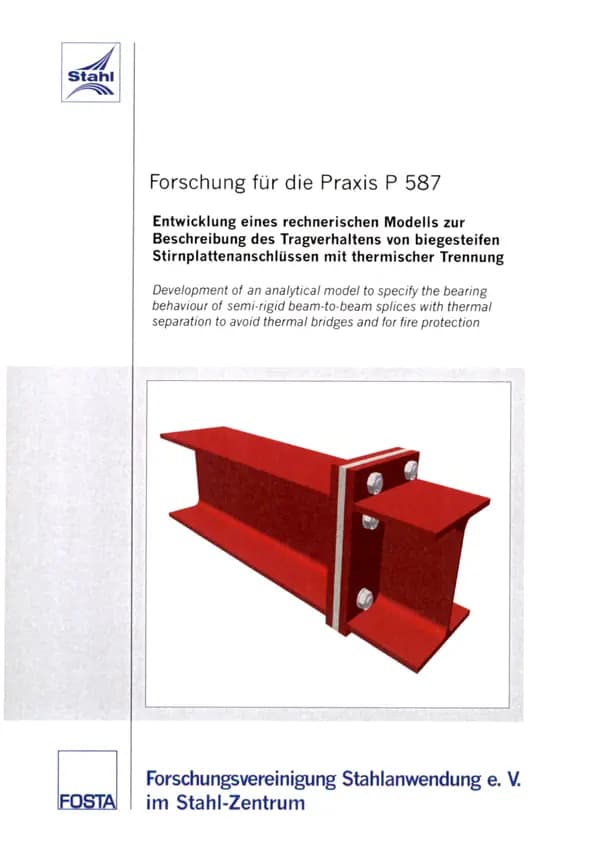
P 587 - Development of a mathematical model to describe the load-bearing behaviour of rigid end plate connections with a thermal break to prevent thermal bridges and for fire protection reasons The end plate joint is a very frequently used connection type in structural steelwork for the rigid connection of two load-bearing members to each other. The two end plates welded to the ends of the supporting members to be joined are detachably connected to each other using bolts. If the supporting members penetrate a thermally insulating building envelope, this connection can be used for thermal separation by placing a thermally insulating intermediate plate between the two end plates. To further reduce the heat flow, stainless steel screws are used due to their lower thermal conductivity. The aim of the research project is to record the load-bearing and deformation behaviour of the thermally separated end plate joint and to develop modelling approaches for this. Part of the series of tests carried out involves determining the material properties of the interface material used and the stainless steel bolts. The creep behaviour of the investigated interface material was described in the form of a creep function. In the main tests, thermally separated end plate joints were investigated under a combined moment-shear load. The interface thicknesses and the moment-shear force ratios were varied in the connection. For the investigated connection parameters, the application of the component model according to Eurocode 3 for determining the load-bearing moments of thermally separated end plate joints was confirmed with a few restrictions. However, it is not advisable to use the model to calculate the stiffness of the connection under consideration. Instead, the stiffnesses determined in the tests were specified and processed with a statistical evaluation for an application and creation of a design rule. The findings obtained from four dynamic tests indicate that the use of stainless steel bolts in such a connection, even for predominantly static loading, should only be carried out with verification of fatigue. Authors: J. Lange, T. Göpfert Publication: 2006
available anytime
€20.00
excl. VAT

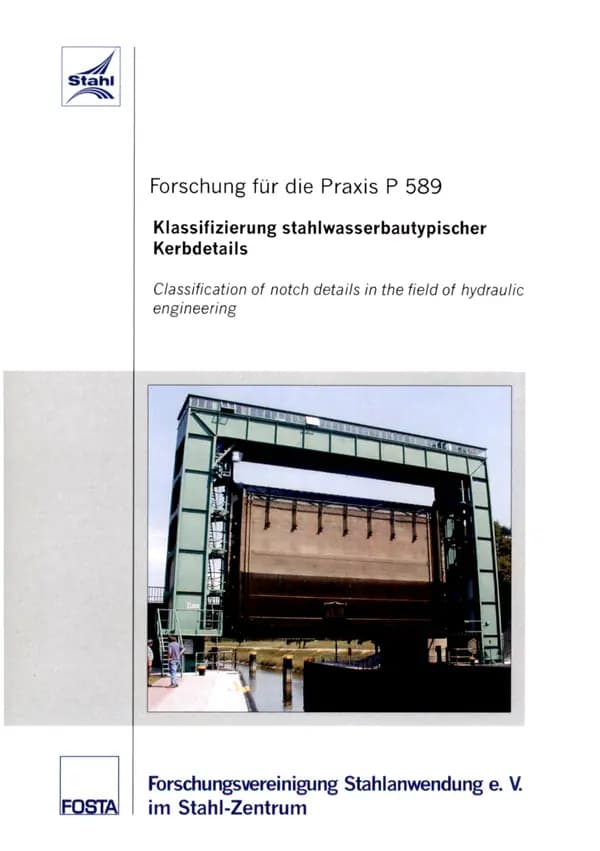
P 589 - Classification of notch details typical for hydraulic steel structures In the past, the influence of fatigue loads on welded hydraulic steel structures such as sluice gates, longitudinal channel closures or navigation basin closures was underestimated in the design of hydraulic steel structures. With the introduction of the new hydraulic steel construction standard DIN 19704, which is based on DIN 18800 and DIN EN 1993 in its verification form, Part 1.9 of Eurocode 3 "Fatigue loading" also plays a special role. This code deals with details relevant to hydraulic steel structures. However, structural shapes and notch cases can occur in hydraulic steel structures that cannot be adequately designed with the available codes. Due to this fact, the present research project P 589 was carried out. Two notch cases typical of closure structures were analysed both theoretically using the finite element method and experimentally. The notch details were determined in advance together with the Federal Institute for Hydraulic Engineering, Karlsruhe (BAW) to ensure the application orientation of the test programme. In the present research project, Wöhler lines were established and a proposal for the classification of the investigated details according to the notch class concept of DIN EN1993-1-9 was made. Furthermore, the test results were transferred to other dimensional ratios through the use of FEM parameter studies. In addition, the SCF concept was assessed for practical application in hydraulic steel construction. This research project was initiated by the Federal Institute for Hydraulic Engineering, Karlsruhe. The test specimens were provided by Geiger International GmbH & Co KG, Karlsruhe and DSD Noell GmbH, Würzburg. Authors: R. Puthli, S. Herion, O. Fleischer, S. Meßner Publication: 2007
available anytime
€30.00
excl. VAT

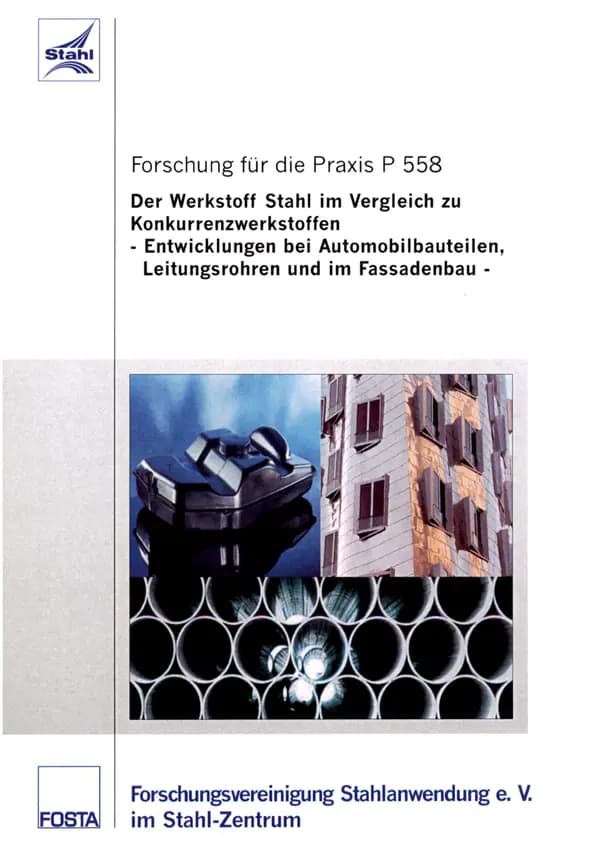
P 558 - The material steel in comparison to competing materials Developments in automotive components, line pipes and façade construction Declines in the use of steel in traditional sales markets and the realisation of the associated image deficits compared to other materials led to the initiation of a study on behalf of the Forschungsvereinigung Stahlanwendung e. V. (Research Association for Steel Applications) to compare the basic properties of steel with those of its competitor materials. As part of the research project P 472 of the Research Association, steels and competitor materials were therefore compared and analysed with regard to their component-neutral properties, properties during further processing and properties of components. The results present an objective view of steel as a versatile, high-quality and innovative material and provide comprehensive information on its advantages over competing materials. In addition, it was shown that steels also fulfil the requirements of economic efficiency, resource conservation and ecology in an almost ideal way. The aim of this research project was to leave the field of specific material and component properties and to analyse current developments and material trends for selected components and component groups and to investigate their causes. In collaboration with the working group accompanying the project, three areas of application relevant to the flat steel industry were defined: Automotive components, line pipes for drinking water and wastewater systems and exterior facades. The parts tree of the C-Class vehicle presented in the automotive study ULSAB-AVC (Ultra Light Steel Auto Body - Advanced Vehicle Concepts) served as the basis for selecting the automotive components. C-Class vehicle presented in the automotive study. Parts that are currently not or no longer made of steel were deliberately selected for analysis. Very similar reasons were decisive for the pipes and facades, as the massive use of competing materials has also been observed for some time in these traditional sales areas of the flat steel industry. Strongly varying trends can be recognised in automotive components. While steel has been almost completely displaced by alternative materials for some components, it is clearly the best and most cost-effective solution in other areas (e.g. leaf springs). Competition is not expected from other material classes, but rather from the introduction of new component systems (air suspension). In the case of body attachments (wings), it is clear that steel is still the most cost-effective and most manageable alternative for large quantities, but there is great pressure in this area due to lightweight construction and design requirements, which means that aluminium and various plastics are accepted and also demanded, especially in premium vehicle classes. There are also striking differences from region to region. In Japan, for example, steel fuel tanks for passenger cars are the standard, while in Europe high-density polyethylene is still used almost exclusively. It remains to be seen what influence the LEV II emissions regulations coming into force in 2004 (and subsequently EU IV) will have on the use of materials in fuel tanks. Weight-saving requirements dominate almost all the automotive components analysed or are at least an important issue for OEMs. Car manufacturers are demanding innovative solutions that fulfil the complex of technical, economic and ecological requirements. Vehicle manufacturers are not fixated on one material, and the costs also play a subordinate role if an alternative solution offers corresponding added value. As a result, they are open to the introduction of new solutions, and it is not unusual for a manufacturer's vehicle range to include numerous solutions made from different materials and designs of the same component in parallel. In any case, steel companies are called upon to continue developing innovative concepts together with system suppliers, as car manufacturers are increasingly moving towards modular construction and demanding complete systems, including the choice of materials and technological design. The End-of-Life Vehicles Directive, which comes into force in 2005 and stipulates a recycling rate of at least 85% (95% from 2015) of the average vehicle weight, whereby the proportion of reuse and material recycling must be at least 80% (85% from 2015) of the average vehicle weight, should have a positive effect on steel as a material. In the public and industrial water supply and wastewater disposal sectors, plastics are currently dominating the market, particularly in piping systems, and have become increasingly important as pipe materials worldwide since their market launch in the mid-1930s. This leading position is due on the one hand to the increased demand for pipelines in recent decades and on the other to the partial displacement of traditional pipe materials. of traditional pipe materials. Despite the establishment of modern laying and renovation techniques, which in turn primarily benefit plastics, the traditional materials concrete, vitrified clay and cast iron are holding their own, especially in urban areas. The most interesting area of application for steel pipes has been identified in residential water supply systems for medium-diameter pressurised water pipes. Nowadays, the demands placed on external façades are no longer limited to the fulfilment of technical requirements; the aesthetic appearance of the building is much more important. Artistic design options should be used to give the appearance of the building a special touch and thus characterise its surroundings. Depending on the type of building, different materials dominate the scene. dominate the scene. While steel is most frequently used for the façade of factory and workshop buildings, image deficits have been identified in this respect for higher-value buildings. The low level of awareness of the specific properties of steel among architects and clients alike led to a preference for other materials - among metals, for example, aluminium enjoys a high status. As it has been shown Since it has been shown that steel in its different variants is excellently suited as a façade material, it seems necessary to actively raise awareness in this area. It is also important to bear in mind that fashions are not negligible unknown factors in façade construction, but they have a lasting influence on the choice of material and affect all material groups. Authors: O. Deutscher, R. Ebner, P. Prevedel, G. Geißler, H. Rösner, M. Oeter Publication: 2004
available anytime
€20.00
excl. VAT

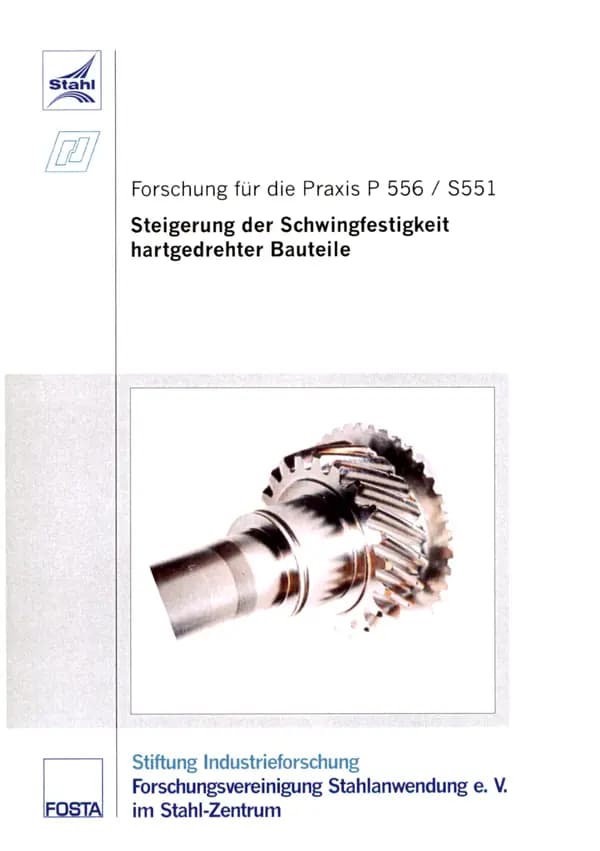
P 556 - Increasing the fatigue strength of hard-turned components Hard turning is a machining process that has increasingly found its way into industrial practice. Hard turning can achieve surface qualities comparable to grinding. However, the results of the research project SIF No. 406 "Fatigue strength of hard turned / ground components" have shown that increasing tool wear during hard turning leads to a decrease in fatigue strength. The aim of the present project is therefore to investigate the transferability of the findings obtained on the steel grade 16MnCr5 (1.7131) to other materials. To this end, investigations are planned on notched round samples of the case-hardened steel grade 18CrNiMo7-6 (1.6587) and the induction surface hardened material 42CrMo4 (1.7225). The potential for increasing the fatigue strength after hard turning with worn tools is to be tested for the post-treatment processes of hard burnishing and high-pressure water jetting. At the beginning of the project, the optimum process parameters for hard machining are determined. After hard machining, the analysed components exhibit similar roughness depths Rz for all machining conditions of the three materials, which lie in a range of Rz = 2 to 3μm. The grinding machining process also resulted in comparable surface qualities for all materials analysed. The fatigue strength tests confirm a drop in fatigue strength for the steel grades 16MnCr5 and 18CrNiMo7-6 in the fatigue and endurance strength range when hard turning is performed with worn tools. The strength of the ground samples of 18CrNiMo7-6 and 16MnCr5 is below that of the hard-turned test series. The 42CrMo4 samples are obviously affected by other effects. Increasing wear of the tool during hard turning does not cause a drop in fatigue strength in either the creep rupture strength or the fatigue strength range. Grinding provides the highest fatigue strength for the 42CrMo4 in the induction edge-hardened condition. When comparing the fatigue strength values of the analysed steel grades analysed, it can be seen that the 16MnCr5 has the highest fatigue strength and the 42CrMo4 the lowest. After hard turning with high tool wear (VBc = 200 μm) and subsequent high-pressure water blasting, there is a significant increase in the fatigue strength to the initial level of the samples made from case-hardened 16MnCr5 using a new tool. After hard burnishing, there is a significant increase in fatigue strength above the initial level of the samples produced with the new tool. The application of a new surface form number according to Liu to the test results shows that the surface form number can differentiate between turned and ground surfaces. Thus, a differentiated consideration of the different surface surface topographies of the manufacturing processes. FE process simulations carried out for hard turning show that the influence of tool wear on the temperatures and stresses in the workpiece edge zone can be modelled. Thus, by selecting a suitable material and machining process and, if necessary, a suitable post-treatment, hard turning or grinding can be used specifically as a final finishing process - a finding that benefits small and medium-sized industry in particular. Authors: M. Köhler, H. Zenner, A. Esderts, C. Müller, H. K. Tönshoff, B. Denkena Publication: 2005
available anytime
€25.50
excl. VAT
Payment by card (Stripe) or invoice (DE, AT, CH). Download link by email: automatically after ordering by card, after order approval for invoice (valid for 30 days). Terms