
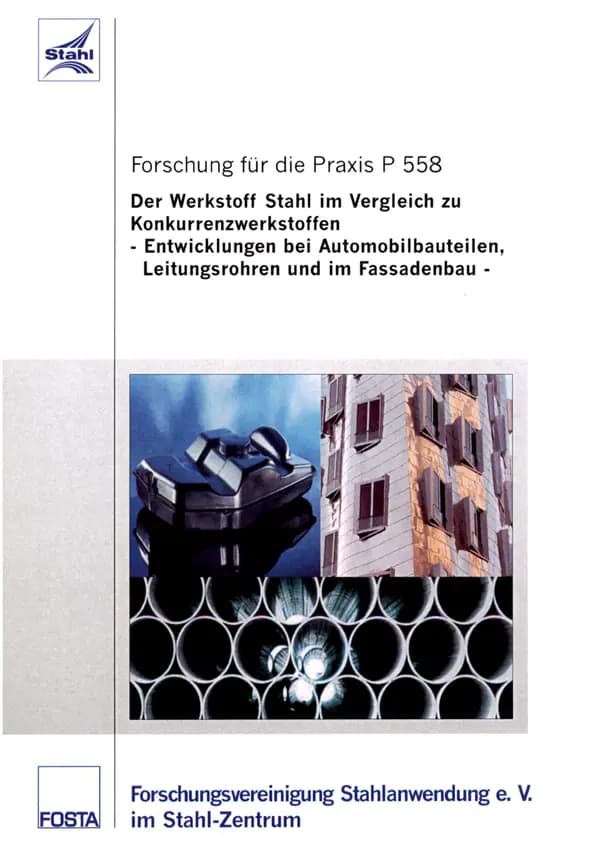
P 558 - The material steel in comparison to competing materials Developments in automotive components, line pipes and façade construction
Declines in the use of steel in traditional sales markets and the realisation of the associated image deficits compared to other materials led to the initiation of a study on behalf of the Forschungsvereinigung …
Content
- Authors
- O. Deutscher, R. Ebner, P. Prevedel, G. Geißler, H. Rösner, M. Oeter
- Publication
- 2004
Declines in the use of steel in traditional sales markets and the realisation of the associated image deficits compared to other materials led to the initiation of a study on behalf of the Forschungsvereinigung Stahlanwendung e. V. (Research Association for Steel Applications) to compare the basic properties of steel with those of its competitor materials. As part of the research project P 472 of the Research Association, steels and competitor materials were therefore compared and analysed with regard to their component-neutral properties, properties during further processing and properties of components. The results present an objective view of steel as a versatile, high-quality and innovative material and provide comprehensive information on its advantages over competing materials.
Show full description
In addition, it was shown that steels also fulfil the requirements of economic efficiency, resource conservation and ecology in an almost ideal way. The aim of this research project was to leave the field of specific material and component properties and to analyse current developments and material trends for selected components and component groups and to investigate their causes. In collaboration with the working group accompanying the project, three areas of application relevant to the flat steel industry were defined: Automotive components, line pipes for drinking water and wastewater systems and exterior facades. The parts tree of the C-Class vehicle presented in the automotive study ULSAB-AVC (Ultra Light Steel Auto Body - Advanced Vehicle Concepts) served as the basis for selecting the automotive components. C-Class vehicle presented in the automotive study. Parts that are currently not or no longer made of steel were deliberately selected for analysis. Very similar reasons were decisive for the pipes and facades, as the massive use of competing materials has also been observed for some time in these traditional sales areas of the flat steel industry. Strongly varying trends can be recognised in automotive components. While steel has been almost completely displaced by alternative materials for some components, it is clearly the best and most cost-effective solution in other areas (e.g. leaf springs). Competition is not expected from other material classes, but rather from the introduction of new component systems (air suspension). In the case of body attachments (wings), it is clear that steel is still the most cost-effective and most manageable alternative for large quantities, but there is great pressure in this area due to lightweight construction and design requirements, which means that aluminium and various plastics are accepted and also demanded, especially in premium vehicle classes. There are also striking differences from region to region. In Japan, for example, steel fuel tanks for passenger cars are the standard, while in Europe high-density polyethylene is still used almost exclusively. It remains to be seen what influence the LEV II emissions regulations coming into force in 2004 (and subsequently EU IV) will have on the use of materials in fuel tanks. Weight-saving requirements dominate almost all the automotive components analysed or are at least an important issue for OEMs. Car manufacturers are demanding innovative solutions that fulfil the complex of technical, economic and ecological requirements. Vehicle manufacturers are not fixated on one material, and the costs also play a subordinate role if an alternative solution offers corresponding added value. As a result, they are open to the introduction of new solutions, and it is not unusual for a manufacturer's vehicle range to include numerous solutions made from different materials and designs of the same component in parallel. In any case, steel companies are called upon to continue developing innovative concepts together with system suppliers, as car manufacturers are increasingly moving towards modular construction and demanding complete systems, including the choice of materials and technological design. The End-of-Life Vehicles Directive, which comes into force in 2005 and stipulates a recycling rate of at least 85% (95% from 2015) of the average vehicle weight, whereby the proportion of reuse and material recycling must be at least 80% (85% from 2015) of the average vehicle weight, should have a positive effect on steel as a material. In the public and industrial water supply and wastewater disposal sectors, plastics are currently dominating the market, particularly in piping systems, and have become increasingly important as pipe materials worldwide since their market launch in the mid-1930s. This leading position is due on the one hand to the increased demand for pipelines in recent decades and on the other to the partial displacement of traditional pipe materials. of traditional pipe materials. Despite the establishment of modern laying and renovation techniques, which in turn primarily benefit plastics, the traditional materials concrete, vitrified clay and cast iron are holding their own, especially in urban areas. The most interesting area of application for steel pipes has been identified in residential water supply systems for medium-diameter pressurised water pipes. Nowadays, the demands placed on external façades are no longer limited to the fulfilment of technical requirements; the aesthetic appearance of the building is much more important. Artistic design options should be used to give the appearance of the building a special touch and thus characterise its surroundings. Depending on the type of building, different materials dominate the scene. dominate the scene. While steel is most frequently used for the façade of factory and workshop buildings, image deficits have been identified in this respect for higher-value buildings. The low level of awareness of the specific properties of steel among architects and clients alike led to a preference for other materials - among metals, for example, aluminium enjoys a high status. As it has been shown Since it has been shown that steel in its different variants is excellently suited as a façade material, it seems necessary to actively raise awareness in this area. It is also important to bear in mind that fashions are not negligible unknown factors in façade construction, but they have a lasting influence on the choice of material and affect all material groups.
Zum Zoomen hovern
€20.00excl. VAT
Payment by card (Stripe) or invoice (DE, AT, CH). Download link by email: automatically after ordering by card, after order approval for invoice (valid for 30 days). Terms
P 558 - The material steel in comparison to competing materials Developments in automotive components, line pipes and façade construction—
€20.00