
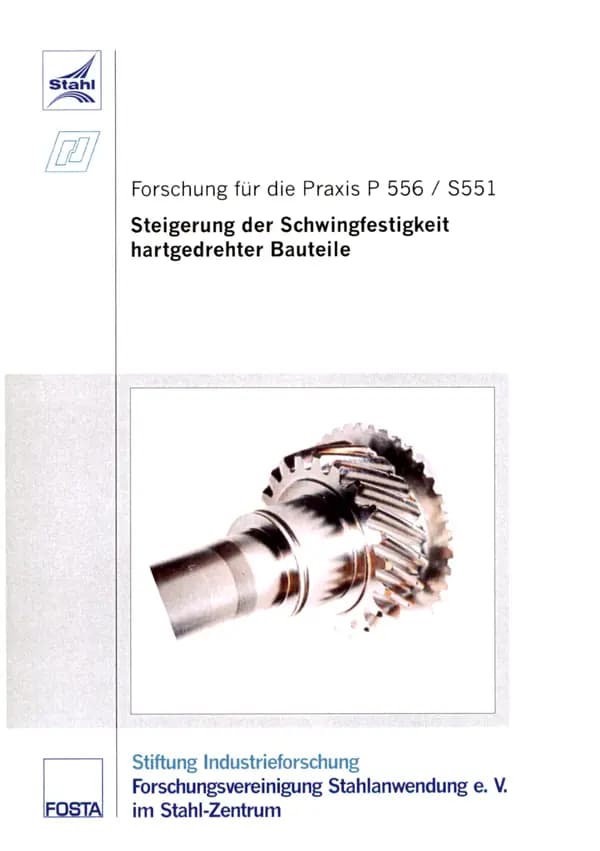
P 556 - Increasing the fatigue strength of hard-turned components
Hard turning is a machining process that has increasingly found its way into industrial practice. Hard turning can achieve surface qualities comparable to grinding. However, the results of the research project SIF No. …
Content
- Authors
- M. Köhler, H. Zenner, A. Esderts, C. Müller, H. K. Tönshoff, B. Denkena
- Publication
- 2005
Hard turning is a machining process that has increasingly found its way into industrial practice. Hard turning can achieve surface qualities comparable to grinding. However, the results of the research project SIF No. 406 "Fatigue strength of hard turned / ground components" have shown that increasing tool wear during hard turning leads to a decrease in fatigue strength. The aim of the present project is therefore to investigate the transferability of the findings obtained on the steel grade 16MnCr5 (1.7131) to other materials. To this end, investigations are planned on notched round samples of the case-hardened steel grade 18CrNiMo7-6 (1.6587) and the induction surface hardened material 42CrMo4 (1.7225).
Show full description
The potential for increasing the fatigue strength after hard turning with worn tools is to be tested for the post-treatment processes of hard burnishing and high-pressure water jetting. At the beginning of the project, the optimum process parameters for hard machining are determined. After hard machining, the analysed components exhibit similar roughness depths Rz for all machining conditions of the three materials, which lie in a range of Rz = 2 to 3μm. The grinding machining process also resulted in comparable surface qualities for all materials analysed. The fatigue strength tests confirm a drop in fatigue strength for the steel grades 16MnCr5 and 18CrNiMo7-6 in the fatigue and endurance strength range when hard turning is performed with worn tools. The strength of the ground samples of 18CrNiMo7-6 and 16MnCr5 is below that of the hard-turned test series. The 42CrMo4 samples are obviously affected by other effects. Increasing wear of the tool during hard turning does not cause a drop in fatigue strength in either the creep rupture strength or the fatigue strength range. Grinding provides the highest fatigue strength for the 42CrMo4 in the induction edge-hardened condition. When comparing the fatigue strength values of the analysed steel grades analysed, it can be seen that the 16MnCr5 has the highest fatigue strength and the 42CrMo4 the lowest. After hard turning with high tool wear (VBc = 200 μm) and subsequent high-pressure water blasting, there is a significant increase in the fatigue strength to the initial level of the samples made from case-hardened 16MnCr5 using a new tool. After hard burnishing, there is a significant increase in fatigue strength above the initial level of the samples produced with the new tool. The application of a new surface form number according to Liu to the test results shows that the surface form number can differentiate between turned and ground surfaces. Thus, a differentiated consideration of the different surface surface topographies of the manufacturing processes. FE process simulations carried out for hard turning show that the influence of tool wear on the temperatures and stresses in the workpiece edge zone can be modelled. Thus, by selecting a suitable material and machining process and, if necessary, a suitable post-treatment, hard turning or grinding can be used specifically as a final finishing process - a finding that benefits small and medium-sized industry in particular.
Zum Zoomen hovern
€25.50excl. VAT
Payment by card (Stripe) or invoice (DE, AT, CH). Download link by email: automatically after ordering by card, after order approval for invoice (valid for 30 days). Terms
P 556 - Increasing the fatigue strength of hard-turned components—
€25.50