 FOSTA
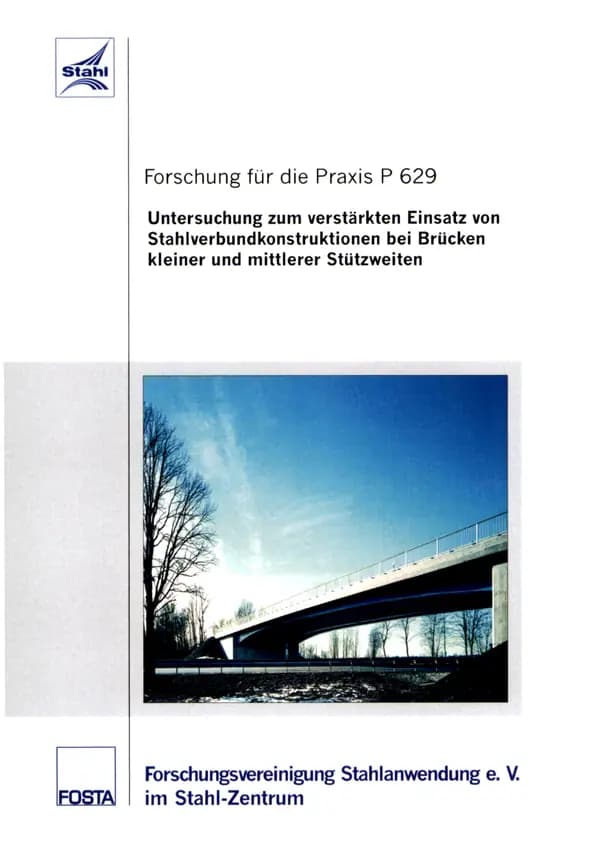
FOSTAP 629 - Investigations on the reinforced use of steel composite structures for bridges with small and medium spans
P 629 - Investigations on the reinforced use of steel composite structures for bridges with small and medium spans Composite steel construction has been able to gain considerable market share for road bridges in Germany in recent years. Composite cross-sections are still the exception for railway bridges. Especially in the small and medium span range, reinforced concrete structures are being built. This project analyses the existing road and rail bridges in Germany and determines the market potential for composite bridges in the small and medium span range. Taking the market situation into account, new systems will be developed and illustrated using sketches and examples, and their economic viability will be assessed. The results of the research project are listed at the end of the chapter and relate to bridge structures in the small and medium span range: - A considerable competitive advantage results for the composite construction method under the approach of the total economic costs. These costs, which are made up of the construction of the structure, the user costs incurred during construction and the maintenance costs, are shown. The common construction methods are compared and illustrated with examples. - The possible applications and limits of composite girders in frame systems are calculated and evaluated for the railway mode of transport. On the basis of this investigation, the design sketches produced as part of the project will be made available to the railway for the arch structure, load-bearing bridge and frame bridge systems. - A brochure has been produced to illustrate the advantages of composite structures. It is aimed at clients who are still unfamiliar with the composite construction method. The document summarises the results of the research project with a focus on road bridges and explains the advantages of composite construction using examples. Authors: Dipl.-Ing. V. Schmitt, Dipl.-Ing. G. Seidl, Dipl.-Ing. Ch. Vogel, Dipl.-Ing. B. Schülke, Dr E. Koch Publication: 2005
available anytime
View details →€30.00
excl. VAT
 FOSTA
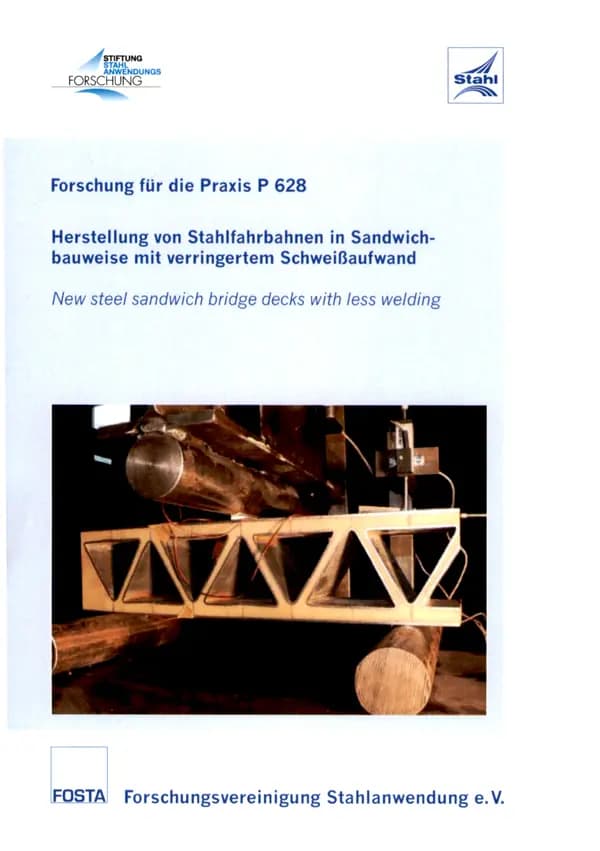
FOSTAP 628 - Production of steel carriageways in sandwich construction with reduced welding effort
P 628 - Production of steel carriageways in sandwich construction with reduced welding effort When correctly designed and manufactured, orthotropic slabs are the optimum roadway solution for bridge construction with the longest service life. Due to the increased welding effort, however, the question of alternative steel solutions is raised time and again. A steel-polymer sandwich construction, which is already being used successfully in shipbuilding, is an option here. The Sandwich Plate System (SPS) consists of an upper and lower plate with a dense elastomer core layer that guarantees a shear-resistant bond. Initial applications of this sandwich in bridge construction were carried out in the substitution of welded carriageway elements for demountable D-bridge systems and as prefabricated carriageway elements for permanent bridges of smaller spans. In addition, applications for the permanent reinforcement of existing orthotropic slabs are also of interest: In the so-called SPS overlay process, a second cover plate is placed on top of the existing carriageway plate at a distance of 2-3 cm and the cavity is filled with elastomer. This considerably reduces the cover plate bending of conventional orthotropic slabs, which is critical for fatigue. The subject of this report is an extension of the SPS design principle to hollow slabs of greater height for bridge decks with high traffic loads. The cavities are created by inserting profiles in a round, square or triangular shape and only the space between the profiles and the cover plates is filled with the elastomer. This construction method promises larger span widths of the carriageway slabs and, especially with transverse orientation of the profiles, the possibility of prefabrication across the entire width of the carriageway with easy-to-close transverse joints. The report deals in detail with the material properties and limit state descriptions for the various components of the SPS hollow core slab and provides a complete calculation procedure based on this. Initial test calculations show that the solution with round hollow sections in the sandwich core in particular produces very favourable properties. The reliability of the calculation method was verified by measurements on sample components. Authors: M. Feldmann, G. Sedlacek, S. Möller, A. Geßler, D. Ungermann, J. Kalameya Publication: 2010
available anytime
View details →€30.00
excl. VAT
 FOSTA
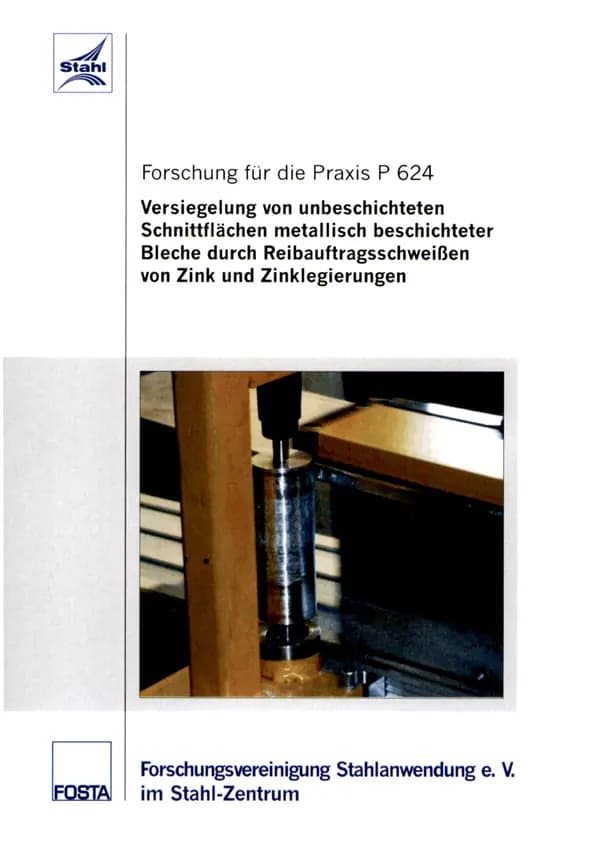
FOSTAP 624 - Sealing of uncoated cut surfaces of metal-coated sheets by friction cladding of zinc and zinc alloys
P 624 - Sealing of uncoated cut surfaces of metal-coated sheets by friction cladding of zinc and zinc alloys During the processing of strip galvanised and strip coated sheet metal, uncoated areas can occur, for example on the cut edges. In the sheet thickness range of 2 mm to 3 mm, the so-called cathodic protection effect of the adjacent galvanised surface areas may not always be sufficient in certain applications. In order to be able to offer a solution in such cases, a friction cladding process for edge coating of the cut edges (impact shears and slit strip) of continuously coated steel sheets with a thickness of 4 mm was developed and investigated. In this process, the edges to be coated are guided along a rotating zinc bolt. The resulting frictional heat plasticises the zinc on the surface of the bolt and the contact pressure of the zinc bolt removes it from the edge surface. In order to determine technological parameters for future integration into existing production processes, e.g. in a profiling line, and thus enable a cost-effective application, test sheets were galvanised in a test facility designed for this purpose. This test facility allows an automated process of the test sheets including the infeed movement of the rotating zinc bolt (40 mm diameter) with contact forces of up to 2 kN. The sheets were clamped at an angle in order to abrade the zinc bolt evenly along its length. The fixture was clamped on an NC milling machine. The zinc bolt was driven via the milling head by means of a movable shaft with rotational speeds of up to 2750 rpm. The contact force-time curve of the rotating zinc bolt during the test sequence was recorded at a sampling rate of 10 Hz. In parameter studies with a contact force of up to 2 kN and a rotational speed of the bolt of up to 2750 rpm (circumferential speed of up to 6.4 m/s), it was possible to produce continuously abraded zinc coating thicknesses of between 10 m and 200 m in conjunction with preheating the test edges to approx. 100°C and the zinc bolt to approx. 250°C. By increasing the rotational speed of the zinc bolt to 8500 rpm using a direct drive, the frictional heat increased to such an extent that it was possible to dispense with preheating the sheet edges. Successful coating results were achieved on edges cut with impact shears. Comparative salt spray tests revealed a significantly better corrosion resistance of the coated guillotine shear edges compared to an unprotected edge. In the Kesternich test, the corrosion resistance of coated edges was also found to be better than that of uncoated edges. FOSTA Research Association for Steel Application e. V. Publication: 2007 Authors: Dipl.- Ing. K. Lehmann, Dr.- Ing. A. Richter, Prof. Dr.- Ing. S. Pahl
available anytime
View details →€30.00
excl. VAT
 FOSTA
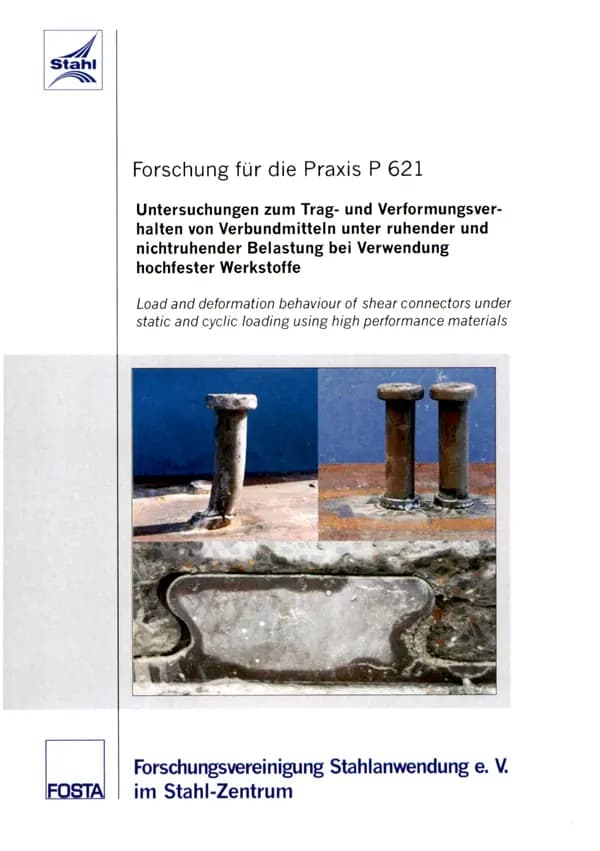
FOSTAP 621 - Investigations into the load-bearing and deformation behaviour of composite materials under static and non-static loading when using high-strength materials
P 621 - Investigations into the load-bearing and deformation behaviour of composite materials under static and non-static loading when using high-strength materials An important aspect in the further development of steel composite construction is the use of high-strength materials, which enable components to absorb higher loads and with larger spans. In particular, the task is to use high-strength materials not only for components that are predominantly subjected to normal forces (columns), but also for components subjected to bending, by further clarifying the load-bearing capacities, deformation characteristics and fatigue strengths in the composite joint that are controlled by the specific ductility properties. The aim of the research project is to further investigate the potential of the selected composite materials on the basis of the previous FOSTA project (P 486) and to develop optimised solutions for a permanently load-bearing and ductile composite joint. In addition to the static load-bearing capacity, investigations under cyclic loading are a focus of the research work as well as the transfer of the results from the shear tests to composite beams. For this purpose, single-span beam tests with partial bonding under static and cyclic loading are carried out and described. The static tests have shown that headed stud anchors with a diameter of 22 and 25 mm can be categorised as ductile according to EC 4. By increasing the weld bead dimensions, both the load-bearing capacity and the ductility are improved. Head studs with cut-in threads and riser studs are analysed as removable composite means. The joint behaves in the same way as a pretensioned bolted connection with both composite materials. The use of demountable bonded joints in high-strength concrete can only be recommended under special circumstances due to the early loss of stiffness. Continuous bonding agents are suitable as bonding agents in high-strength concrete; in addition to high initial stiffness and ductility, high load-bearing capacities are achieved. The design of continuous bonding agents according to Zapfe was confirmed, and a further criterion was formulated for the steel failure of the puzzle strip. Based on the static tests, the service life and static residual load-bearing capacity are determined using force-controlled fatigue tests. The Ø22 mm shear stud dowel and the puzzle strip are used as a bonding agent. Fatigue failure of the shear stud dowels occurs after approx. 2.3 million load cycles, the static residual load-bearing capacity is reduced by approx. 25% after up to 1.0 million load cycles. The results show good agreement with the Hanswille failure models. No failure was observed in the puzzle moulding under cyclic loading up to 2.0 million load cycles. After opening the test specimens, cracks were localised in the moulding recesses. However, these had no influence on the residual static load-bearing capacity. Despite the high utilisation of the composite materials, neither the shear stud dowel nor the puzzle strip failed in the static beam tests and the plastic moment load-bearing capacity according to EC 4 was achieved. The cyclic beam tests show that the fatigue behaviour can be predicted in relatively good agreement with the slip-crack growth laws of Feldmann and Gesella derived from previously used materials. The design proposals derived from the test results provide the planning engineer with a simple and reliable design aid for selecting the type and number of bonding agents as a function of the degree of dowelling. FOSTA Research Association for Steel Application e. V. Publication: 2007 Authors: Prof. Dr.-Ing. M. Feldmann, Prof. Dr.-Ing. Hegger, Dipl.-Ing. O. Hechler
available anytime
View details →€40.00
excl. VAT
 FOSTA
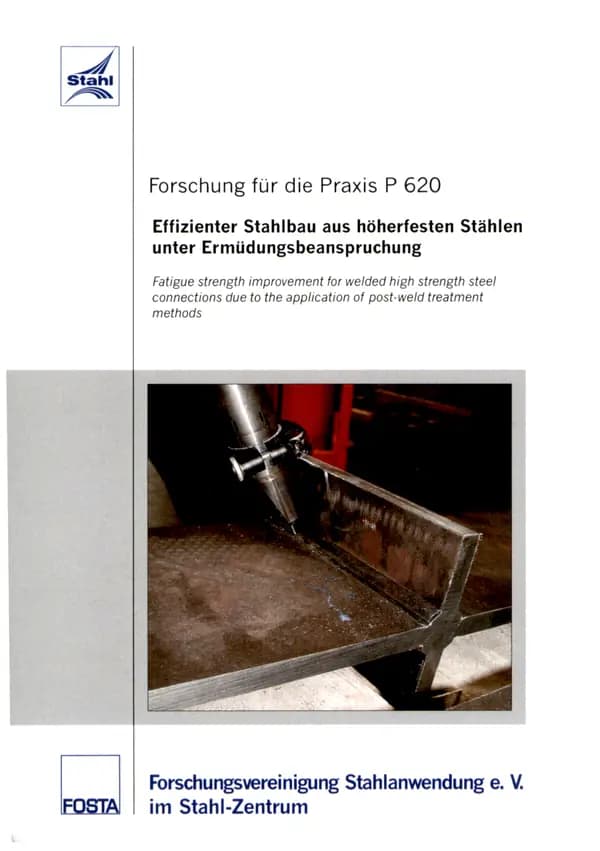
FOSTAP 620 - Efficient steel construction from high-strength steels under fatigue loading
P 620 - Efficient steel construction from high-strength steels under fatigue loading The assessment of the fatigue strength of welded joints in the current standards in bridge construction is limited to the notch drop and the stress range and is independent of the yield strength. The use of higher-strength steels in welded structures therefore often offers no advantages in the case of high fatigue stresses. It is possible to effectively improve the fatigue strength of welded structures, especially those made of high-strength steels, by using post-weld treatment processes. In the construction industry, however, the use of weld post-treatment methods is still very limited, as the currently valid standards and the future European standards do not yet offer the possibility of utilising the advantages of these methods in structural design. The focus of this research project is on improving the fatigue strength of welded joints made of high-strength steels through the use of weld post-treatment processes. As part of a parameter study in composite road bridge construction, it was shown that an effective application of high-strength steels can be achieved through the locally limited use of post-treatment processes on critical construction details. Within the scope of this research project, the post-treatment processes TIG melting and the hitherto little-known post-treatment process "Ultrasonic Impact Treatment" (UIT) were used. Extensive experimental investigations on small and large test specimens demonstrated the effectiveness of both processes for improving fatigue strength on the construction detail of the welded-on transverse stiffener. The UIT process proved to be more effective for the higher-strength steel grade S690. In some cases, the improvement in fatigue strength was so high that the fracture initiation points shifted into the base material. In experimental tests on beams, the effectiveness of the UIT treatment was also demonstrated in components and at high medium stresses. Based on a systematic evaluation of existing test series, the existing regulations for the assessment of fatigue safety for the construction detail of the transverse stiffener left in the welded state and the existing recommendations for the application of the TIG fusion post-treatment process were confirmed. In addition, a design proposal based on the nominal stress concept for the application of the UIT process to the structural detail of the transverse stiffener was derived on the basis of the company's own experimental and numerical investigations. The results of this research project offer the possibility of using higher-strength structural steels in fatigue-stressed welded structures by means of a locally limited This results in a significant improvement in the marketability of welded structures. This results in a significant improvement in the market opportunities for steel construction compared to other construction methods. RESEARCH ASSOCIATION FOR STEEL APPLICATION e.V. Publication: 2006 Authors: Prof. Dr.-Ing. U. Kuhlmann, Dr.-Ing. A. Dürr, Prof. Dr.-Ing. Bergmann
available anytime
View details →€40.00
excl. VAT
 FOSTA
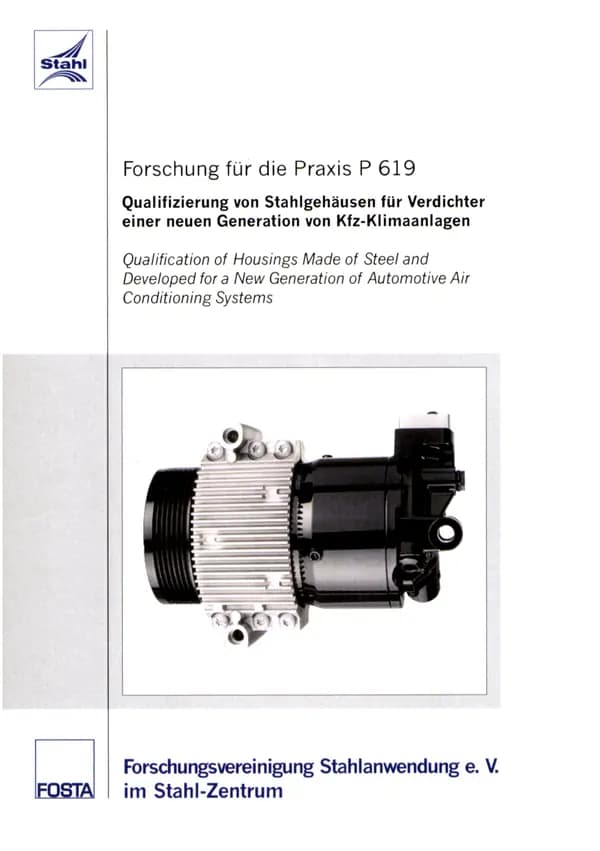
FOSTAP 619 - Qualification of steel housings for compressors of a new generation of automotive air conditioning systems
P 619 - Qualification of steel housings for compressors of a new generation of automotive air conditioning systems A compressor whose housing is made of steel has been developed and tested for a new generation of environmentally neutral automotive air conditioning systems operated with CO2 as a refrigerant. All current compressors in motor vehicle air conditioning systems using the conventional refrigerant R134a are designed with a die-cast aluminium housing, as are the compressors built for initial tests as part of feasibility studies on CO2 systems. The housing made of steel was thus a new approach. The reason for this was that the new compressors are expected to have significantly higher internal housing pressures of up to 132 bar and temperatures of up to 150°C for air conditioning systems, which are likely to cause creep stress on the aluminium, resulting in a possible fatigue strength problem and intolerable creep expansion. With steel, on the other hand, creep in the temperature range up to 300°C is negligible. A cylindrical shape was chosen for the steel housing in order to minimise production costs. In order to minimise mechanical processing, this was preformed using cold extrusion. Several development stages of the housing were trialled as part of the project. The final stage was a welded construction. The cylindrical area of the housing with base (housing tube) is cold extruded from material S420NL (1.8912), the so-called insert, which essentially takes over the bearing of the drive shaft, is machined from material S460N (1.8901) and welded into the housing base via a laser circular seam. The strength and service life potential of the housing was investigated both experimentally using burst and vibration tests and numerically using finite element analyses. The characterisation of the housing material, the seam quality and the condition of the housing after the experimental tests was carried out using mechanical-technological, non-destructive, metallographic and fractographic testing methods. At the same time, the compressor manufacturer adapted the proven compressor technology used in the R134a systems to the cylindrical housing shape, redesigned it for the significantly higher operating pressures and temperatures and tested it and and optimised in test bench tests. Two test series of twenty housings each were produced for the final housing tests of the project. Nine of these were analysed non-destructively and metallographically, particularly in the area of the laser circumferential weld, which was the focus of particular attention. Apart from pores, which primarily occurred in the seam outlet, there were no negative findings. The burst and vibration tests carried out did not reveal any failure initiated by the pores. The service life of the housings was assessed on the basis of the results obtained from finite element analyses and component vibration tests. The two operating load cases "extreme operation" (switching on the air conditioning system under very high ambient temperatures) and "AC normal operation" were used for this purpose. For the former, based on the specified operating cycles, a fatigue strength of S 300 was obtained. For "AC normal operation", a housing failure probability of 0.1 to 1.0 % is to be assumed based on the definition of the housing fatigue strength with N 107 fatigue cycles for an operating time of 5000 h. Burst tests were carried out at 150°C and -40°C with two housings that were tested for the load case "extreme operation" and withstood N 107 cycles, which is virtually equivalent to the end of life (EOL). The maximum pressures achieved in each case exceeded the minimum failure pressures required by SAE for the housings in the EOL state. In no case did failure occur due to bursting, but in each case due to leakage at the sealing of the screw connection between the housing and cylinder head. The test results thus describe a status of the steel compressor housing that can be regarded as a good basis for optimising the housing for series production. Compared to aluminium housings, the fact that a possible creep behaviour influencing the service life is not to be expected with steel at the given operating temperatures should prove to be an advantage. Authors: E. Roos, K. Maile, S. Offermanns, X. Schuler, W. Stadtmüller Publication: 2007
available anytime
View details →€30.00
excl. VAT
 FOSTA
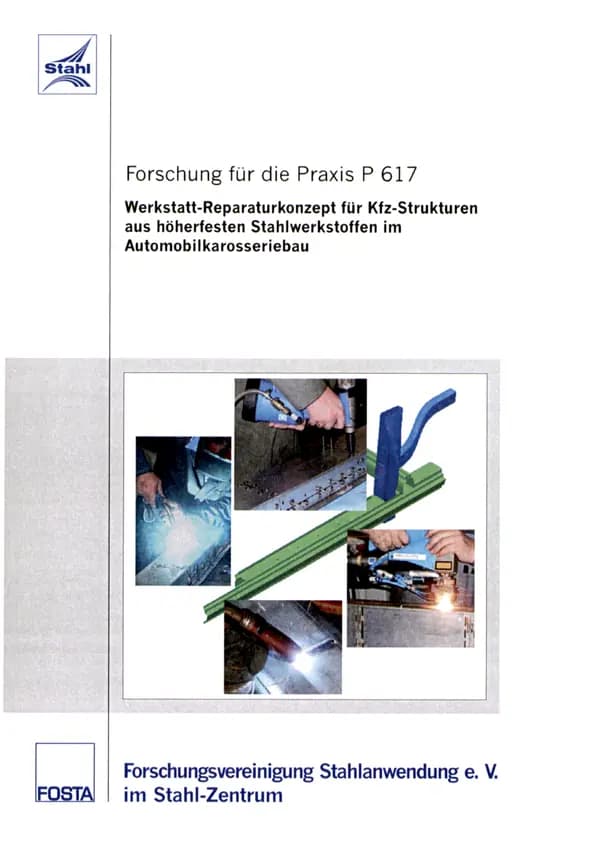
FOSTAP 617 - Workshop repair concept for vehicle structures made of high-strength steel materials in automotive body construction
P 617 - Workshop repair concept for vehicle structures made of high-strength steel materials in automotive body construction The aim of this research project was to develop a repair strategy for vehicle components made of high-strength steel materials, taking into account practical transferability. A further objective was to achieve the component properties before damage occurs in order to guarantee the property profiles with regard to fatigue strength and crash behaviour after a repair. As part of the first and second project phases, various practically relevant repair joining methods were investigated with regard to their use for the repair of vehicle structures made of high-strength steel materials. The results of the load-bearing capacity tests under quasi-static, oscillating and impact loading of these repair joints were compared and evaluated with the corresponding results of the near-series production joints. Resistance spot welding, resistance spot welding bonding and laser beam welding were used as near-series production joining methods. The repair methods considered were adhesive bonding, blind riveting, blind rivet bonding, MIG soldering, resistance spot welding, MAG welding and hand-held laser beam welding. Parallel to these investigations, the possibilities of using various practical cutting techniques for cutting automotive structures made of high-strength steel materials were analysed. Building on this, the next phase of the project focussed on the development of repair concepts for various structures made of high-strength steel components. Here, a partial cut-out and a partial section repair on component-like Z-profiles were designed and realised using various repair joining methods. The profiles were then crash-loaded using a drop weight tester and the deformation behaviour of the repaired Z-profiles was compared with that of the non-repaired profiles. The repair concept developed for a partial cut-out repair on the Z-profile was verified in the final project phase on a sill with minor damage. verified. The repair joining methods of blind rivet bonding, hand-guided laser welding and MAG welding were used in the investigations on the real component. The repair strategy developed in this project created the basis for the repair of automotive structures made of high-strength steel materials. The results thus obtained already form a comprehensive basis for calculable workshop repairs with regard to the restoration of component properties. Authors: O. Hahn, M. Wibbeke, D. Böhme, S. Allmeier, H. Haferkamp, B. Boese, H. Matthiß, C. Schmid Publication: 2006
available anytime
View details →€41.00
excl. VAT
 FOSTA
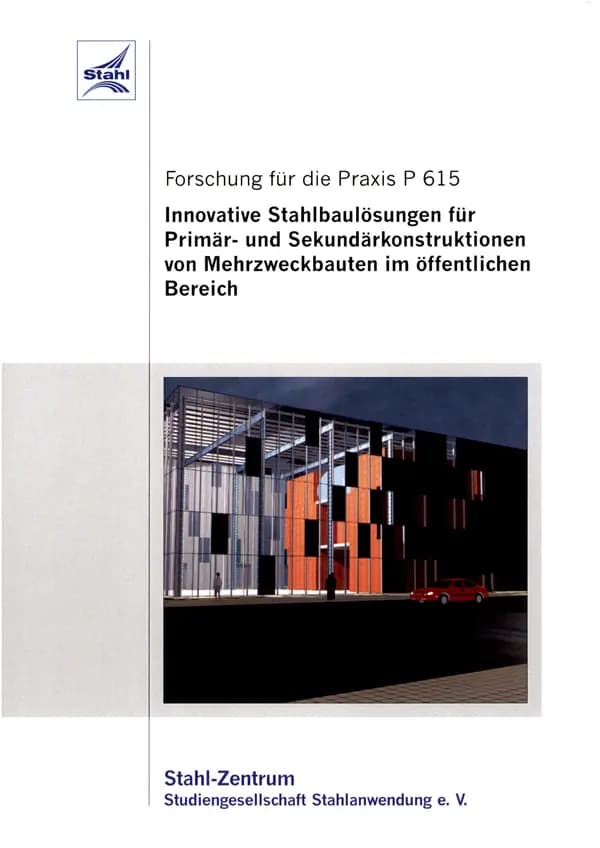
FOSTAP 615 - Innovative steel construction solutions for primary and secondary structures of multi-purpose buildings in the public sector
P 615 - Innovative steel construction solutions for primary and secondary structures of multi-purpose buildings in the public sector Particularly in the area of public construction projects, reservations about economical and innovative realisations in the steel sector are noticeable. This is due in particular to unfounded prejudices and a lack of knowledge among users about the current state of the art. Frequently discussed topics originate from the areas of building physics and corrosion protection. However, where steel structures are used, the results of the latest research and development work in the construction industry are rarely or only very inadequately taken into account during realisation. In order to facilitate the decision in favour of the use of steel as early as the preliminary planning stage, this documentation uses a potential specific construction task as an example to illustrate the structural and economic advantages associated with the extensive use of steel for such buildings. The aim here is to demonstrate a sensible use of steel in a concrete realisation. Authors: K. Luig, V. Lenze Publication: 2003
available anytime
View details →€20.00
excl. VAT
 FOSTA
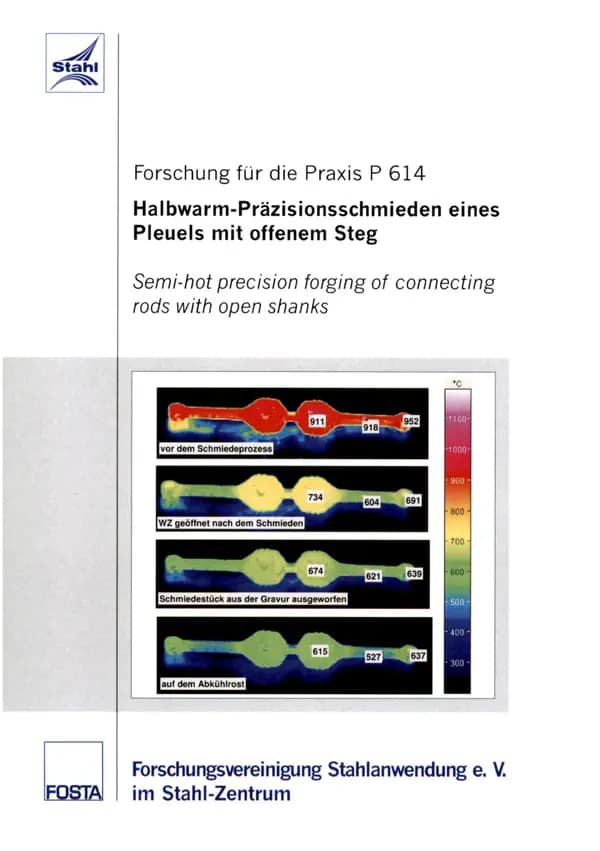
FOSTAP 614 - Semi-hot precision forging of a connecting rod with open web
P 614 - Semi-hot precision forging of a connecting rod with open web The research objective of this project was to investigate the precision forging of a connecting rod double piece as a residue-minimised component production and weight reduction in the field of warm forging. Two different materials were selected, C70S6 as a typical crackable material for connecting rod production and an AFP steel 38MnVS6. As a result, material and component analyses were to be carried out. The material properties were determined in the laboratory. The connecting rods were forged using a complex tool specially developed for precision forging with integrated hydraulic volume compensation. The tool can be used in the nominal temperature range of 950 °C to 1200 °C. An essential part of the project was the development of an optimum intermediate mould for precision forging. This development was carried out on two tracks in direct combination with practical testing and simulation. Once the exact geometry of the intermediate mould had been determined, it was produced by conventional die forging (rough/finish forging and trimming) with very tight tolerances. For forging in the area of warm forging, the die inserts and the active parts in the complex mould must be heated to an operating temperature above 200 °C and kept at this temperature for the duration of forging. The forging tests for precision forging were carried out at three different forming temperatures: 950 °C, 1050 °C and 1200 °C. An electric chamber furnace was used to heat the intermediate moulds for precision forging. During the "precision forging" forging process, the forces occurring on the active parts in the die were measured. These forces were used to precisely dimension the hydraulic volume compensation. A chemical analysis of the base material was carried out as part of the evaluation of the material-related investigations and the material-specific characteristic values of yield strength, tensile strength, elongation at break and constriction at break were determined. These characteristic values formed the basis for the fatigue strength tests on the service life of the precision-forged connecting rod doubles. The material analyses also included a structural analysis of the material in the web area of the connecting rod. The evaluation for the C70S6 was based on the practice-relevant values from MAHLE Brockhaus GmbH. The individual connecting rods are tested by a certified test laboratory on the basis of the VW standard "VW 500 30". The evaluation for the material 38MnVS6 was not carried out in comparison with C70S6, as both materials are not comparable due to their The evaluation for the material 38MnVS6 was not carried out comparatively with C70S6, as both materials have very different characteristics due to their composition of their microstructure and the resulting properties. Authors: R. Neugebauer, H. Hartwig, A. Wagner, R. Salomon Publication: 2008
available anytime
View details →€30.00
excl. VAT
 FOSTA
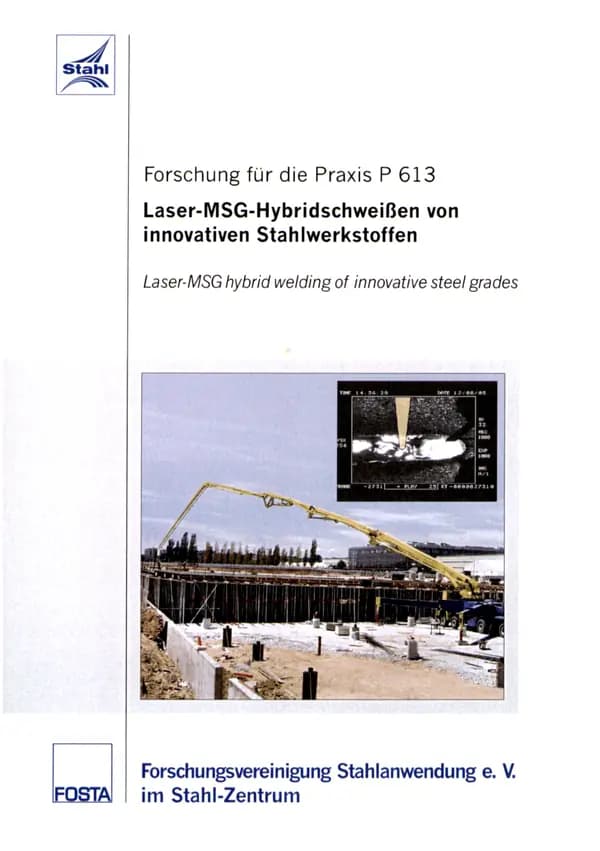
FOSTAP 613 - Laser-MSG hybrid welding of innovative steel materials
P 613 - Laser-MSG hybrid welding of innovative steel materials The aim of the research project was to provide the crane, vehicle and plant construction industry with a tool that can be used to weld high-strength fine-grain structural steels economically and safely using the laser-MSG hybrid process. To this end, suitable welding consumables and the corresponding temperature cycles were qualified together with the process for these steels. The process is particularly interesting for the steel S1300QL, which has only recently been trialled and represents the current upper limit of water-quenched and tempered fine-grain structural steels suitable for welding in terms of strength. Its suitability for hybrid welding was demonstrated for the first time in this project. With the only representative of thermomechanically rolled steels analysed, the steel S700MC (1.8974), joints were produced together with a MoNi-type welding wire that met the requirements in terms of strength and toughness. In the tensile test, fracture occurred in the weld metal as the hardness of the weld metal was lower than that of the base material. The water-quenched and tempered fine-grained structural steels S690QL (1.8928) and S960QL (1.8933) proved to be comparable in terms of the behaviour of the welded joint. As the hardness of the heat-affected zone and weld metal was significantly higher than that of the base material, the fracture occurred in the unaffected sheet. A "hardness sag" in the heat-affected zone could not be observed either with extremely short or longer cooling times. The values for the impact energy required in the delivery conditions were also met at low temperatures down to -40°C. It was demonstrated that laser MAG hybrid welding is suitable for welding high-strength fine-grain structural steels in the sheet thickness range between 5 and 7 mm for vehicle and crane construction with nominal yield strengths of 690 MPa up to 1300 MPa. The solid and metal powder wires developed for MAG welding can be processed with the laser hybrid welding process without any problems. Authors: H. Haferkamp, O. Meier, B. Boese, R. Mittelstädt, G. Kuscher Publication: 2007
available anytime
View details →€30.00
excl. VAT
 FOSTA
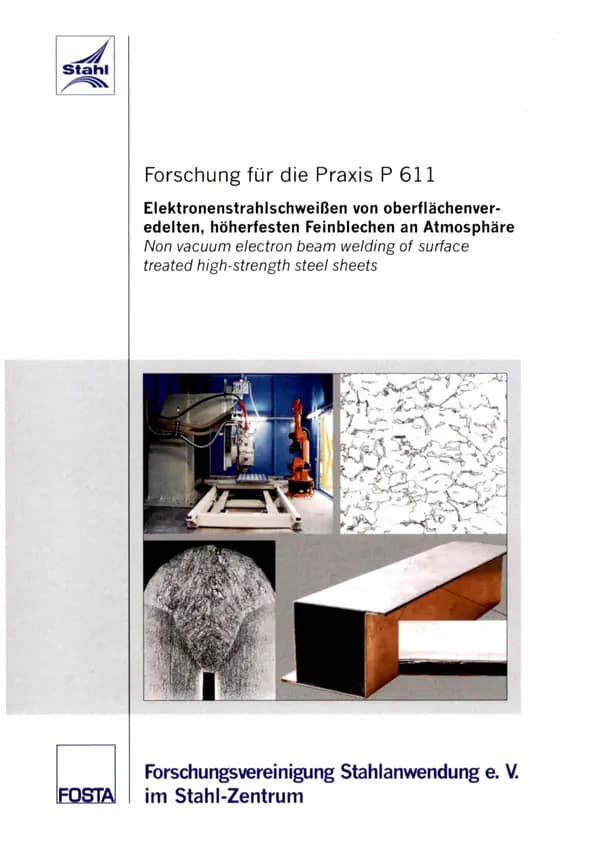
FOSTAP 611 - Electron beam welding of surface-finished, high-strength thin sheets to atmosphere
P 611 - Electron beam welding of surface-finished, high-strength thin sheets to atmosphere With regard to the weight reduction of car bodies, various lightweight construction concepts are gaining importance. For lightweight construction, this requires the use of new, higher-strength sheet steel materials. These require joining processes that are metallurgically suitable as well as highly reliable and economical. Electron beam welding in an atmosphere (non-vacuum electron beam welding, NVEBW) is a suitable beam welding process for sheet metal processing due to the high welding speeds that can be achieved and the good gap-bridging capability. As part of the research project, the suitability of this joining process for welding surface-coated high-strength and ultra-high-strength sheet steel was investigated. The galvanised and hot-dip aluminised steel sheet materials investigated cover a wide range of materials currently used in car body construction in terms of their carbon equivalent as well as their strength and elongation properties. The NVEBW of galvanised steel sheet materials at welding speeds of at least 8 m/min demonstrated large process tolerances with regard to gap bridging, sheet thickness jumps, edge offset and positioning inaccuracies. Welding parameters were identified for all seam geometries analysed that ensure sufficient zinc degassing and therefore flawless seams. While no special measures for zinc degassing are required for I-seams, tailored blanks and end fillet welds, a joint gap is absolutely necessary for the NVEBW of flanged seams and lap seams. The NVEBW of hot-dip aluminised sheet steel is also possible in all seam geometries examined and can be carried out without a welding gap. The increased alloying element content of the high-strength and ultra-high-strength steels and the microstructure resulting from the welding process lead to weld hardening. Weld seam hardening reduces the formability of all investigated sheet steel grades, but in most cases does not reduce the strength of the welded joints. In addition to pore formation, which can result from the evaporation of the zinc coating, edge notches, bonding defects and humping were identified as possible weld defects and measures to prevent them were presented. Application-oriented investigations of the behaviour under crash load and corrosion tests were also carried out on selected weld seams. The investigations show the potential of the NVEBW of coated steel sheet for car body construction. This was also demonstrated with an NVEB-welded component example and with component-like welded Z-profiles. Authors: F. W. Bach, G. Kremer, K. Lau Publication: 2006
available anytime
View details →€30.00
excl. VAT
 FOSTA
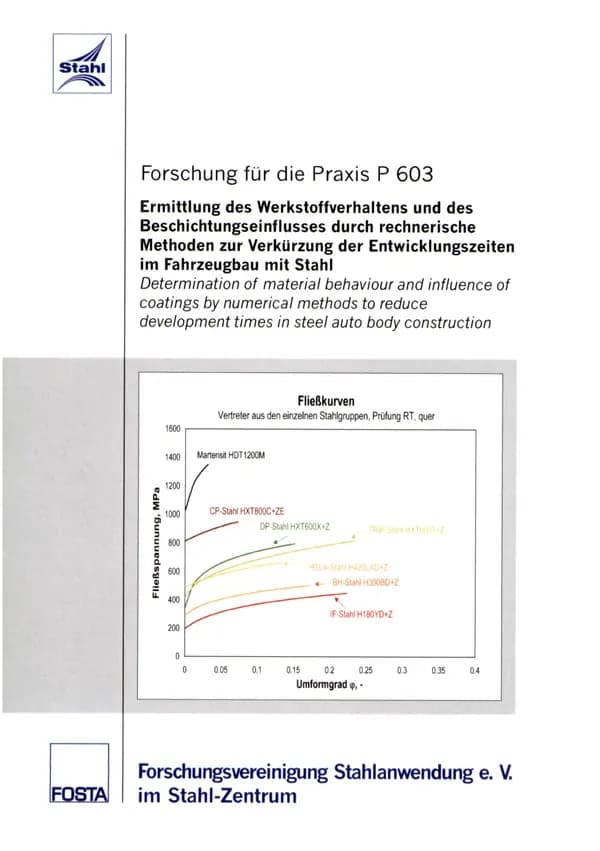
FOSTAP 603 - Determination of material behaviour and the influence of coatings using computational methods to shorten development times in vehicle construction with steel
P 603 - Determination of material behaviour and the influence of coatings using computational methods to shorten development times in vehicle construction with steel 1Shorter development times and an increasing number of variants in the automotive industry are increasingly leading to virtual prototypes. These are used for crash calculations and and durability estimation as well as feasibility analyses. The necessary database and understanding of the deformation and failure mechanisms are incorporated into the simulation. In comparison to uncoated or electrolytically coated thin sheets in the previous project, the mechanical material behaviour of hot-dip galvanised steel thin sheets was investigated in this project. When determining the elastic-plastic characteristic values in the tensile test, the modulus of elasticity was determined for the as-delivered, pre-formed and pre-formed + heat-treated condition. Based on the directional dependence of the modulus of elasticity, material families could be formed for the individual steel grades. The directional dependence of the moduli of elasticity is retained with preforming. After a subsequent heat treatment, as is the case with paint baking, the modulus of elasticity of the initial state is approximately achieved again, regardless of the degree of stretching. For the numerical description of the hardening behaviour, flow curves and width change curves were recorded for different test directions and test temperatures. The level of the stress-strain curve decreases with increasing test temperature. Dynamic tensile tests were carried out at different strain rates and temperatures to characterise the strain rate dependency. The characteristic values and flow curves were determined in order to create the experimental basis for the modelling. Early necking in the tensile test only allows the determination of yield curves up to uniform elongation. In the case of higher-strength multiphase steels, however, there are special material properties that require supplementation. For this reason, a measuring device was developed for the hydraulic cupping test that enables the recording of flow curves up to material failure and practical testing under multi-axial stress conditions. When recording the forming limit diagrams, the evaluation method had an extremely large influence on the forming limit determined. The evaluation of parallel line sections (ISO design) was compared with a simple measurement of the maximum deformation of the last image before the start of cracking or necking. In the uniaxial tensile range, both methods provide similar changes in shape, in contrast to the plane-strain range, where significant deviations between the two methods occur. Cyclic material parameters are used to evaluate the service life of thin sheet structures under oscillating loads on the basis of local strains from FEM calculations. Computerised approximate solutions allow the cyclic characteristic values to be estimated from tensile test data and a short experimental procedure makes this possible in the shortest possible time. Based on the work carried out, the cyclic material properties are available or can be easily estimated for many materials and material groups. Based on the experimental investigations, a material law was developed to describe the flow curves of the analysed materials at different temperatures in a wide strain rate range. To reduce the number of parameters in the material description, the investigated materials were grouped into families and correlations were determined within these families. The transition area from isothermal to adiabatic material behaviour was localised and the dependence of the proportion of deformation work converted into heat on the strain rate was described. In a follow-up project, the verification and limits of the developed material law are to be verified and determined using further steel grades. FOSTA Research Association for Steel Application e. V. Publication: 2007 Authors: Dipl.-Ing. A. Bäumer, Dr.-Ing. C. P. Bork, Dipl.-Ing. T. Emde, ]}, Dr.-Ing. R. Masendorf, Dr.-Ing. U. May, Dipl.-Ing. M. Menne, Dipl.-Ing. E. Ratte, Dr.-Ing. G. Steinbeck
available anytime
View details →€30.00
excl. VAT