
FOSTA
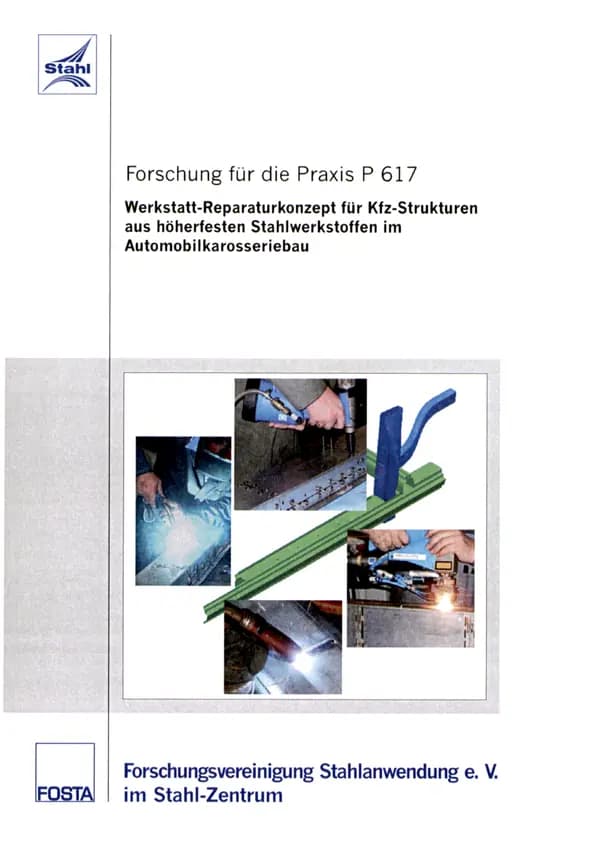
The aim of this research project was to develop a repair strategy for vehicle components made of high-strength steel materials, taking into account practical transferability. A further objective was to achieve the …
The aim of this research project was to develop a repair strategy for vehicle components made of high-strength steel materials, taking into account practical transferability. A further objective was to achieve the component properties before damage occurs in order to guarantee the property profiles with regard to fatigue strength and crash behaviour after a repair. As part of the first and second project phases, various practically relevant repair joining methods were investigated with regard to their use for the repair of vehicle structures made of high-strength steel materials. The results of the load-bearing capacity tests under quasi-static, oscillating and impact loading of these repair joints were compared and evaluated with the corresponding results of the near-series production joints.
Resistance spot welding, resistance spot welding bonding and laser beam welding were used as near-series production joining methods. The repair methods considered were adhesive bonding, blind riveting, blind rivet bonding, MIG soldering, resistance spot welding, MAG welding and hand-held laser beam welding. Parallel to these investigations, the possibilities of using various practical cutting techniques for cutting automotive structures made of high-strength steel materials were analysed. Building on this, the next phase of the project focussed on the development of repair concepts for various structures made of high-strength steel components. Here, a partial cut-out and a partial section repair on component-like Z-profiles were designed and realised using various repair joining methods. The profiles were then crash-loaded using a drop weight tester and the deformation behaviour of the repaired Z-profiles was compared with that of the non-repaired profiles. The repair concept developed for a partial cut-out repair on the Z-profile was verified in the final project phase on a sill with minor damage. verified. The repair joining methods of blind rivet bonding, hand-guided laser welding and MAG welding were used in the investigations on the real component. The repair strategy developed in this project created the basis for the repair of automotive structures made of high-strength steel materials. The results thus obtained already form a comprehensive basis for calculable workshop repairs with regard to the restoration of component properties.
Machine-translated title and description. The document itself is in German.
Payment by card (Stripe) or invoice (DE, AT, CH). Download link by email: automatically after ordering by card, after order approval for invoice (valid for 30 days). Terms
Digital download
Other parts and editions as well as neighbouring documents of the same series.
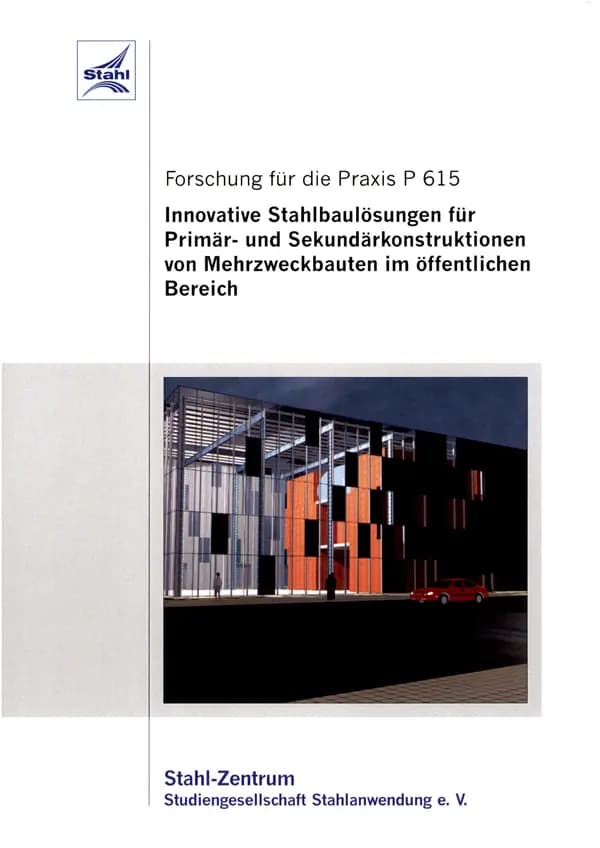
P 615 - Innovative steel construction solutions for primary and secondary structures of multi-purpose buildings in the public sector Particularly in the area of public construction projects, reservations about economical and innovative realisations in the steel sector are noticeable. This is due in particular to unfounded prejudices and a lack of knowledge among users about the current state of the art. Frequently discussed topics originate from the areas of building physics and corrosion protection. However, where steel structures are used, the results of the latest research and development work in the construction industry are rarely or only very inadequately taken into account during realisation. In order to facilitate the decision in favour of the use of steel as early as the preliminary planning stage, this documentation uses a potential specific construction task as an example to illustrate the structural and economic advantages associated with the extensive use of steel for such buildings. The aim here is to demonstrate a sensible use of steel in a concrete realisation. Authors: K. Luig, V. Lenze Publication: 2003
available anytime
€20.00
excl. VAT
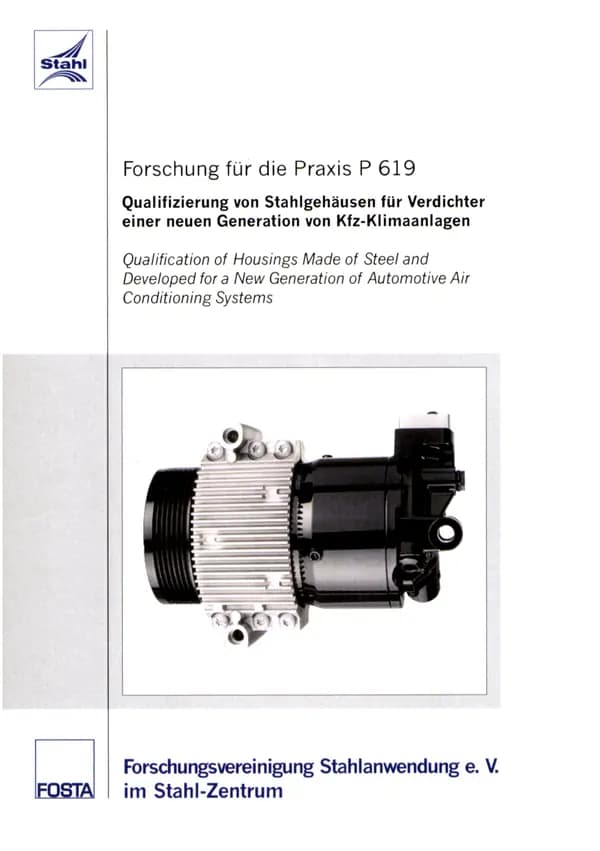
P 619 - Qualification of steel housings for compressors of a new generation of automotive air conditioning systems A compressor whose housing is made of steel has been developed and tested for a new generation of environmentally neutral automotive air conditioning systems operated with CO2 as a refrigerant. All current compressors in motor vehicle air conditioning systems using the conventional refrigerant R134a are designed with a die-cast aluminium housing, as are the compressors built for initial tests as part of feasibility studies on CO2 systems. The housing made of steel was thus a new approach. The reason for this was that the new compressors are expected to have significantly higher internal housing pressures of up to 132 bar and temperatures of up to 150°C for air conditioning systems, which are likely to cause creep stress on the aluminium, resulting in a possible fatigue strength problem and intolerable creep expansion. With steel, on the other hand, creep in the temperature range up to 300°C is negligible. A cylindrical shape was chosen for the steel housing in order to minimise production costs. In order to minimise mechanical processing, this was preformed using cold extrusion. Several development stages of the housing were trialled as part of the project. The final stage was a welded construction. The cylindrical area of the housing with base (housing tube) is cold extruded from material S420NL (1.8912), the so-called insert, which essentially takes over the bearing of the drive shaft, is machined from material S460N (1.8901) and welded into the housing base via a laser circular seam. The strength and service life potential of the housing was investigated both experimentally using burst and vibration tests and numerically using finite element analyses. The characterisation of the housing material, the seam quality and the condition of the housing after the experimental tests was carried out using mechanical-technological, non-destructive, metallographic and fractographic testing methods. At the same time, the compressor manufacturer adapted the proven compressor technology used in the R134a systems to the cylindrical housing shape, redesigned it for the significantly higher operating pressures and temperatures and tested it and and optimised in test bench tests. Two test series of twenty housings each were produced for the final housing tests of the project. Nine of these were analysed non-destructively and metallographically, particularly in the area of the laser circumferential weld, which was the focus of particular attention. Apart from pores, which primarily occurred in the seam outlet, there were no negative findings. The burst and vibration tests carried out did not reveal any failure initiated by the pores. The service life of the housings was assessed on the basis of the results obtained from finite element analyses and component vibration tests. The two operating load cases "extreme operation" (switching on the air conditioning system under very high ambient temperatures) and "AC normal operation" were used for this purpose. For the former, based on the specified operating cycles, a fatigue strength of S 300 was obtained. For "AC normal operation", a housing failure probability of 0.1 to 1.0 % is to be assumed based on the definition of the housing fatigue strength with N 107 fatigue cycles for an operating time of 5000 h. Burst tests were carried out at 150°C and -40°C with two housings that were tested for the load case "extreme operation" and withstood N 107 cycles, which is virtually equivalent to the end of life (EOL). The maximum pressures achieved in each case exceeded the minimum failure pressures required by SAE for the housings in the EOL state. In no case did failure occur due to bursting, but in each case due to leakage at the sealing of the screw connection between the housing and cylinder head. The test results thus describe a status of the steel compressor housing that can be regarded as a good basis for optimising the housing for series production. Compared to aluminium housings, the fact that a possible creep behaviour influencing the service life is not to be expected with steel at the given operating temperatures should prove to be an advantage. Authors: E. Roos, K. Maile, S. Offermanns, X. Schuler, W. Stadtmüller Publication: 2007
available anytime
€30.00
excl. VAT
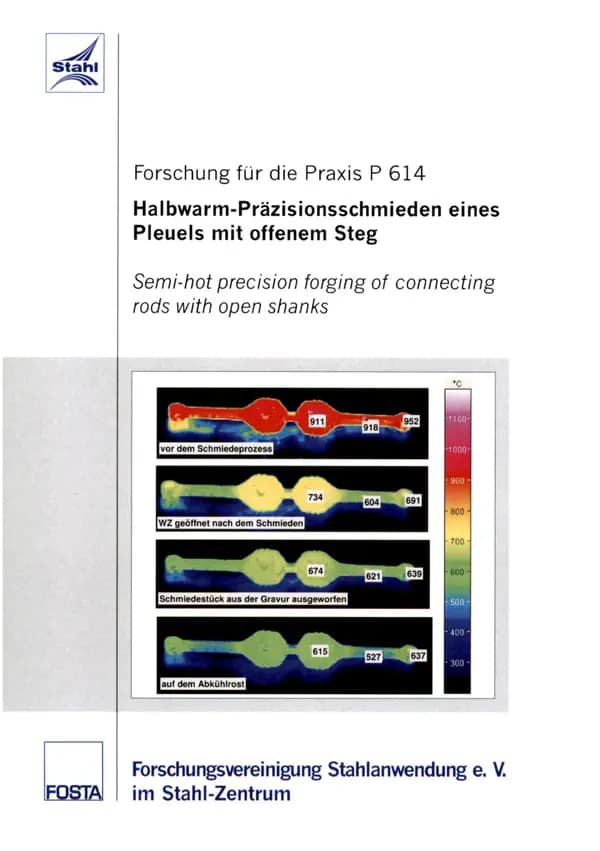
P 614 - Semi-hot precision forging of a connecting rod with open web The research objective of this project was to investigate the precision forging of a connecting rod double piece as a residue-minimised component production and weight reduction in the field of warm forging. Two different materials were selected, C70S6 as a typical crackable material for connecting rod production and an AFP steel 38MnVS6. As a result, material and component analyses were to be carried out. The material properties were determined in the laboratory. The connecting rods were forged using a complex tool specially developed for precision forging with integrated hydraulic volume compensation. The tool can be used in the nominal temperature range of 950 °C to 1200 °C. An essential part of the project was the development of an optimum intermediate mould for precision forging. This development was carried out on two tracks in direct combination with practical testing and simulation. Once the exact geometry of the intermediate mould had been determined, it was produced by conventional die forging (rough/finish forging and trimming) with very tight tolerances. For forging in the area of warm forging, the die inserts and the active parts in the complex mould must be heated to an operating temperature above 200 °C and kept at this temperature for the duration of forging. The forging tests for precision forging were carried out at three different forming temperatures: 950 °C, 1050 °C and 1200 °C. An electric chamber furnace was used to heat the intermediate moulds for precision forging. During the "precision forging" forging process, the forces occurring on the active parts in the die were measured. These forces were used to precisely dimension the hydraulic volume compensation. A chemical analysis of the base material was carried out as part of the evaluation of the material-related investigations and the material-specific characteristic values of yield strength, tensile strength, elongation at break and constriction at break were determined. These characteristic values formed the basis for the fatigue strength tests on the service life of the precision-forged connecting rod doubles. The material analyses also included a structural analysis of the material in the web area of the connecting rod. The evaluation for the C70S6 was based on the practice-relevant values from MAHLE Brockhaus GmbH. The individual connecting rods are tested by a certified test laboratory on the basis of the VW standard "VW 500 30". The evaluation for the material 38MnVS6 was not carried out in comparison with C70S6, as both materials are not comparable due to their The evaluation for the material 38MnVS6 was not carried out comparatively with C70S6, as both materials have very different characteristics due to their composition of their microstructure and the resulting properties. Authors: R. Neugebauer, H. Hartwig, A. Wagner, R. Salomon Publication: 2008
available anytime
€30.00
excl. VAT
P 613 - Laser-MSG hybrid welding of innovative steel materials The aim of the research project was to provide the crane, vehicle and plant construction industry with a tool that can be used to weld high-strength fine-grain structural steels economically and safely using the laser-MSG hybrid process. To this end, suitable welding consumables and the corresponding temperature cycles were qualified together with the process for these steels. The process is particularly interesting for the steel S1300QL, which has only recently been trialled and represents the current upper limit of water-quenched and tempered fine-grain structural steels suitable for welding in terms of strength. Its suitability for hybrid welding was demonstrated for the first time in this project. With the only representative of thermomechanically rolled steels analysed, the steel S700MC (1.8974), joints were produced together with a MoNi-type welding wire that met the requirements in terms of strength and toughness. In the tensile test, fracture occurred in the weld metal as the hardness of the weld metal was lower than that of the base material. The water-quenched and tempered fine-grained structural steels S690QL (1.8928) and S960QL (1.8933) proved to be comparable in terms of the behaviour of the welded joint. As the hardness of the heat-affected zone and weld metal was significantly higher than that of the base material, the fracture occurred in the unaffected sheet. A "hardness sag" in the heat-affected zone could not be observed either with extremely short or longer cooling times. The values for the impact energy required in the delivery conditions were also met at low temperatures down to -40°C. It was demonstrated that laser MAG hybrid welding is suitable for welding high-strength fine-grain structural steels in the sheet thickness range between 5 and 7 mm for vehicle and crane construction with nominal yield strengths of 690 MPa up to 1300 MPa. The solid and metal powder wires developed for MAG welding can be processed with the laser hybrid welding process without any problems. Authors: H. Haferkamp, O. Meier, B. Boese, R. Mittelstädt, G. Kuscher Publication: 2007
available anytime
€30.00
excl. VAT
Payment by card (Stripe) or invoice (DE, AT, CH). Download link by email: automatically after ordering by card, after order approval for invoice (valid for 30 days). Terms