
FOSTA
Composite steel construction has been able to gain considerable market share for road bridges in Germany in recent years. Composite cross-sections are still the exception for railway bridges. Especially in the small and …
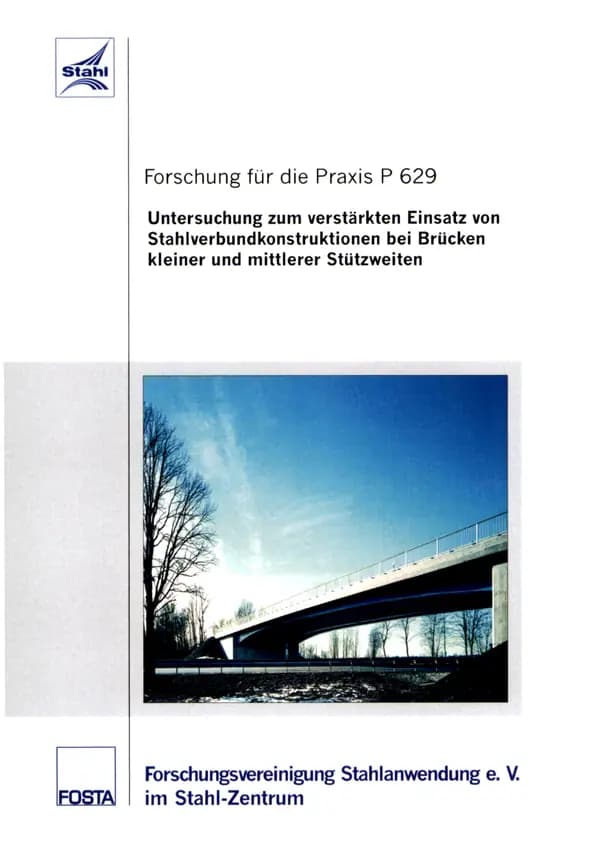
Composite steel construction has been able to gain considerable market share for road bridges in Germany in recent years. Composite cross-sections are still the exception for railway bridges. Especially in the small and medium span range, reinforced concrete structures are being built. This project analyses the existing road and rail bridges in Germany and determines the market potential for composite bridges in the small and medium span range. Taking the market situation into account, new systems will be developed and illustrated using sketches and examples, and their economic viability will be assessed. The results of the research project are listed at the end of the chapter and relate to bridge structures in the small and medium span range: - A considerable competitive advantage results for the composite construction method under the approach of the total economic costs.
These costs, which are made up of the construction of the structure, the user costs incurred during construction and the maintenance costs, are shown. The common construction methods are compared and illustrated with examples. - The possible applications and limits of composite girders in frame systems are calculated and evaluated for the railway mode of transport. On the basis of this investigation, the design sketches produced as part of the project will be made available to the railway for the arch structure, load-bearing bridge and frame bridge systems. - A brochure has been produced to illustrate the advantages of composite structures. It is aimed at clients who are still unfamiliar with the composite construction method. The document summarises the results of the research project with a focus on road bridges and explains the advantages of composite construction using examples.
Machine-translated title and description. The document itself is in German.
Payment by card (Stripe) or invoice (DE, AT, CH). Download link by email: automatically after ordering by card, after order approval for invoice (valid for 30 days). Terms
Digital download
Other parts and editions as well as neighbouring documents of the same series.
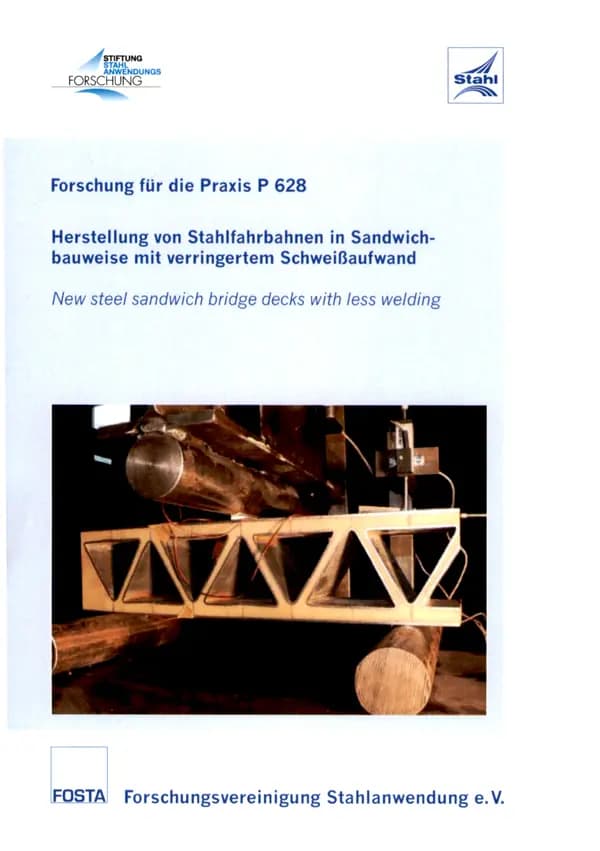
P 628 - Production of steel carriageways in sandwich construction with reduced welding effort When correctly designed and manufactured, orthotropic slabs are the optimum roadway solution for bridge construction with the longest service life. Due to the increased welding effort, however, the question of alternative steel solutions is raised time and again. A steel-polymer sandwich construction, which is already being used successfully in shipbuilding, is an option here. The Sandwich Plate System (SPS) consists of an upper and lower plate with a dense elastomer core layer that guarantees a shear-resistant bond. Initial applications of this sandwich in bridge construction were carried out in the substitution of welded carriageway elements for demountable D-bridge systems and as prefabricated carriageway elements for permanent bridges of smaller spans. In addition, applications for the permanent reinforcement of existing orthotropic slabs are also of interest: In the so-called SPS overlay process, a second cover plate is placed on top of the existing carriageway plate at a distance of 2-3 cm and the cavity is filled with elastomer. This considerably reduces the cover plate bending of conventional orthotropic slabs, which is critical for fatigue. The subject of this report is an extension of the SPS design principle to hollow slabs of greater height for bridge decks with high traffic loads. The cavities are created by inserting profiles in a round, square or triangular shape and only the space between the profiles and the cover plates is filled with the elastomer. This construction method promises larger span widths of the carriageway slabs and, especially with transverse orientation of the profiles, the possibility of prefabrication across the entire width of the carriageway with easy-to-close transverse joints. The report deals in detail with the material properties and limit state descriptions for the various components of the SPS hollow core slab and provides a complete calculation procedure based on this. Initial test calculations show that the solution with round hollow sections in the sandwich core in particular produces very favourable properties. The reliability of the calculation method was verified by measurements on sample components. Authors: M. Feldmann, G. Sedlacek, S. Möller, A. Geßler, D. Ungermann, J. Kalameya Publication: 2010
available anytime
€30.00
excl. VAT
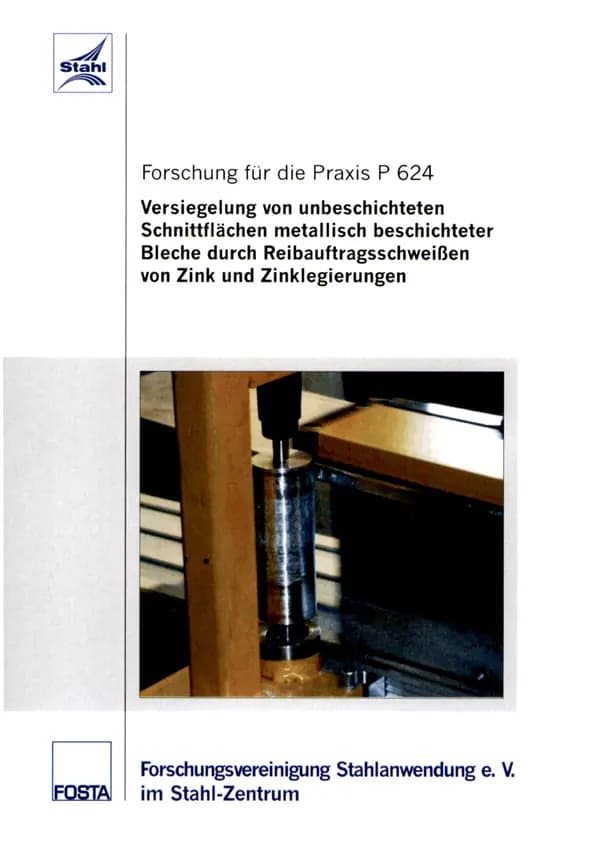
P 624 - Sealing of uncoated cut surfaces of metal-coated sheets by friction cladding of zinc and zinc alloys During the processing of strip galvanised and strip coated sheet metal, uncoated areas can occur, for example on the cut edges. In the sheet thickness range of 2 mm to 3 mm, the so-called cathodic protection effect of the adjacent galvanised surface areas may not always be sufficient in certain applications. In order to be able to offer a solution in such cases, a friction cladding process for edge coating of the cut edges (impact shears and slit strip) of continuously coated steel sheets with a thickness of 4 mm was developed and investigated. In this process, the edges to be coated are guided along a rotating zinc bolt. The resulting frictional heat plasticises the zinc on the surface of the bolt and the contact pressure of the zinc bolt removes it from the edge surface. In order to determine technological parameters for future integration into existing production processes, e.g. in a profiling line, and thus enable a cost-effective application, test sheets were galvanised in a test facility designed for this purpose. This test facility allows an automated process of the test sheets including the infeed movement of the rotating zinc bolt (40 mm diameter) with contact forces of up to 2 kN. The sheets were clamped at an angle in order to abrade the zinc bolt evenly along its length. The fixture was clamped on an NC milling machine. The zinc bolt was driven via the milling head by means of a movable shaft with rotational speeds of up to 2750 rpm. The contact force-time curve of the rotating zinc bolt during the test sequence was recorded at a sampling rate of 10 Hz. In parameter studies with a contact force of up to 2 kN and a rotational speed of the bolt of up to 2750 rpm (circumferential speed of up to 6.4 m/s), it was possible to produce continuously abraded zinc coating thicknesses of between 10 m and 200 m in conjunction with preheating the test edges to approx. 100°C and the zinc bolt to approx. 250°C. By increasing the rotational speed of the zinc bolt to 8500 rpm using a direct drive, the frictional heat increased to such an extent that it was possible to dispense with preheating the sheet edges. Successful coating results were achieved on edges cut with impact shears. Comparative salt spray tests revealed a significantly better corrosion resistance of the coated guillotine shear edges compared to an unprotected edge. In the Kesternich test, the corrosion resistance of coated edges was also found to be better than that of uncoated edges. FOSTA Research Association for Steel Application e. V. Publication: 2007 Authors: Dipl.- Ing. K. Lehmann, Dr.- Ing. A. Richter, Prof. Dr.- Ing. S. Pahl
available anytime
€30.00
excl. VAT
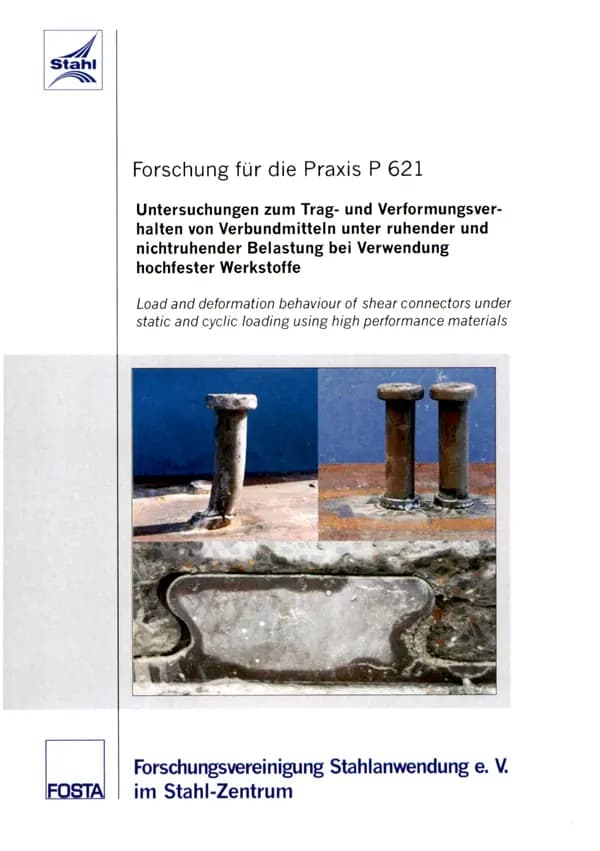
P 621 - Investigations into the load-bearing and deformation behaviour of composite materials under static and non-static loading when using high-strength materials An important aspect in the further development of steel composite construction is the use of high-strength materials, which enable components to absorb higher loads and with larger spans. In particular, the task is to use high-strength materials not only for components that are predominantly subjected to normal forces (columns), but also for components subjected to bending, by further clarifying the load-bearing capacities, deformation characteristics and fatigue strengths in the composite joint that are controlled by the specific ductility properties. The aim of the research project is to further investigate the potential of the selected composite materials on the basis of the previous FOSTA project (P 486) and to develop optimised solutions for a permanently load-bearing and ductile composite joint. In addition to the static load-bearing capacity, investigations under cyclic loading are a focus of the research work as well as the transfer of the results from the shear tests to composite beams. For this purpose, single-span beam tests with partial bonding under static and cyclic loading are carried out and described. The static tests have shown that headed stud anchors with a diameter of 22 and 25 mm can be categorised as ductile according to EC 4. By increasing the weld bead dimensions, both the load-bearing capacity and the ductility are improved. Head studs with cut-in threads and riser studs are analysed as removable composite means. The joint behaves in the same way as a pretensioned bolted connection with both composite materials. The use of demountable bonded joints in high-strength concrete can only be recommended under special circumstances due to the early loss of stiffness. Continuous bonding agents are suitable as bonding agents in high-strength concrete; in addition to high initial stiffness and ductility, high load-bearing capacities are achieved. The design of continuous bonding agents according to Zapfe was confirmed, and a further criterion was formulated for the steel failure of the puzzle strip. Based on the static tests, the service life and static residual load-bearing capacity are determined using force-controlled fatigue tests. The Ø22 mm shear stud dowel and the puzzle strip are used as a bonding agent. Fatigue failure of the shear stud dowels occurs after approx. 2.3 million load cycles, the static residual load-bearing capacity is reduced by approx. 25% after up to 1.0 million load cycles. The results show good agreement with the Hanswille failure models. No failure was observed in the puzzle moulding under cyclic loading up to 2.0 million load cycles. After opening the test specimens, cracks were localised in the moulding recesses. However, these had no influence on the residual static load-bearing capacity. Despite the high utilisation of the composite materials, neither the shear stud dowel nor the puzzle strip failed in the static beam tests and the plastic moment load-bearing capacity according to EC 4 was achieved. The cyclic beam tests show that the fatigue behaviour can be predicted in relatively good agreement with the slip-crack growth laws of Feldmann and Gesella derived from previously used materials. The design proposals derived from the test results provide the planning engineer with a simple and reliable design aid for selecting the type and number of bonding agents as a function of the degree of dowelling. FOSTA Research Association for Steel Application e. V. Publication: 2007 Authors: Prof. Dr.-Ing. M. Feldmann, Prof. Dr.-Ing. Hegger, Dipl.-Ing. O. Hechler
available anytime
€40.00
excl. VAT
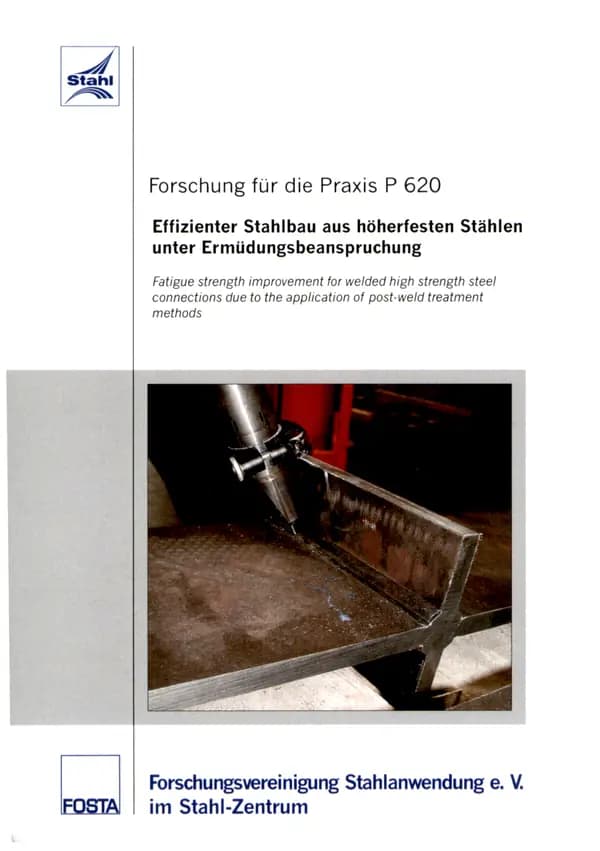
P 620 - Efficient steel construction from high-strength steels under fatigue loading The assessment of the fatigue strength of welded joints in the current standards in bridge construction is limited to the notch drop and the stress range and is independent of the yield strength. The use of higher-strength steels in welded structures therefore often offers no advantages in the case of high fatigue stresses. It is possible to effectively improve the fatigue strength of welded structures, especially those made of high-strength steels, by using post-weld treatment processes. In the construction industry, however, the use of weld post-treatment methods is still very limited, as the currently valid standards and the future European standards do not yet offer the possibility of utilising the advantages of these methods in structural design. The focus of this research project is on improving the fatigue strength of welded joints made of high-strength steels through the use of weld post-treatment processes. As part of a parameter study in composite road bridge construction, it was shown that an effective application of high-strength steels can be achieved through the locally limited use of post-treatment processes on critical construction details. Within the scope of this research project, the post-treatment processes TIG melting and the hitherto little-known post-treatment process "Ultrasonic Impact Treatment" (UIT) were used. Extensive experimental investigations on small and large test specimens demonstrated the effectiveness of both processes for improving fatigue strength on the construction detail of the welded-on transverse stiffener. The UIT process proved to be more effective for the higher-strength steel grade S690. In some cases, the improvement in fatigue strength was so high that the fracture initiation points shifted into the base material. In experimental tests on beams, the effectiveness of the UIT treatment was also demonstrated in components and at high medium stresses. Based on a systematic evaluation of existing test series, the existing regulations for the assessment of fatigue safety for the construction detail of the transverse stiffener left in the welded state and the existing recommendations for the application of the TIG fusion post-treatment process were confirmed. In addition, a design proposal based on the nominal stress concept for the application of the UIT process to the structural detail of the transverse stiffener was derived on the basis of the company's own experimental and numerical investigations. The results of this research project offer the possibility of using higher-strength structural steels in fatigue-stressed welded structures by means of a locally limited This results in a significant improvement in the marketability of welded structures. This results in a significant improvement in the market opportunities for steel construction compared to other construction methods. RESEARCH ASSOCIATION FOR STEEL APPLICATION e.V. Publication: 2006 Authors: Prof. Dr.-Ing. U. Kuhlmann, Dr.-Ing. A. Dürr, Prof. Dr.-Ing. Bergmann
available anytime
€40.00
excl. VAT
Payment by card (Stripe) or invoice (DE, AT, CH). Download link by email: automatically after ordering by card, after order approval for invoice (valid for 30 days). Terms