Matplus LogoMatplus Shop
/
/
Cart (0)
HomeStoreFOSTAFOSTA Documentation
Matplus LogoMatplus ShopFollow us on LinkedIn
FOSTA
  • FOSTA Overview
  • FOSTA Documentation
  • Technical Standards
  • Steel-iron worksheets (SEB)
  • Steel and iron usage lists (SEE)
  • Steel-iron delivery terms (SEL)
  • Steel-iron test sheets (SEP)
  • Steel-iron material sheets (SEW)
Legal
  • FAQ
  • Imprint
  • Cookie Policy
  • Privacy Policy
  • Legal Notice
  • General Terms and Conditions

© 2026 Matplus Shop. All rights reserved.

Header
FOSTA

P 1521 - Integral sheet pile abutments of modular composite bridges for a time-efficient construction process

P 1521 - Integral sheet pile abutments of modular composite bridges for a time-efficient construction process This report summarises investigations to derive a design concept for an integral frame cor

Product Information

Delivery & Access

Inhalt

P 1521 - Integral sheet pile abutments of modular composite bridges for a time-efficient construction process This report summarises investigations to derive a design concept for an integral frame corner for composite bridges with sheet pile abutments. The composite construction method can be used to produce efficient and economical cross-sections that are capable of covering a large proportion of the spans of today's bridges. The integral construction method, which does not require joints or bearings, leads to lower maintenance costs and reduced external costs of the structure over its life cycle. The use of sheet pile abutments, on the other hand, can significantly reduce the construction costs of the structure. To enable application in the construction industry, a design concept for an integral frame corner with sheet pile abutments is being developed in the FOSTA research project P1521. In order to define the scope of application of the design concept, the existing German infrastructure is first analysed. There is a significant need for refurbishment throughout the entire bridge network. Comprehensive statistics are primarily available for the federal trunk road network, where approx. 80% of all bridges have a span of less than 50 m, which can be covered by the planned concept. In contrast, significantly more individual structures are owned by local authorities and municipalities, and here too short and medium spans dominate. After presenting the boundary conditions of the design concept, the report deals with the implementation and evaluation of various test series of the frame corner. The evaluations of these tests provide insights into the load-bearing behaviour of the cross-sections used and the failure of the respective test specimens. The frame corner is separated into an upper and lower part for a targeted investigation. The results of these small-part tests provide high load-bearing capacities with absorbable moments of 1200 kNm (upper part) and 500 kNm (lower part) with acting loads of 1350 kN (upper part) and 400 kN (lower part). With the help of subsequent numerical calculations, the test results can be further analysed and load paths clearly identified. The knowledge gained from this is used in the subsequent derivation of a design concept. The numerical investigations also identified further influencing parameters that can further increase the performance of the frame corner. In a large-scale test, the entire frame corner consisting of the upper and lower parts is tested. The results of this test are consistent with the results of the previous series of tests; in particular, a higher load on the lower composite dowel bar can be demonstrated. With the help of these results, a design concept for integral frame corners with sheet pile abutments is developed in the final step and presented using a design example of a composite bridge with a span of 45 metres. Publication: April 2024 Authors: Prof. Dr.-Ing. M. Feldmann, K. Wolters, N. Rittich, Dr.-Ing. St. Ivanov, Dr.-Ing. J. Rajasingam Main content only available in German language. Title and description automatically translated using Deepl API
P 1521 - Integral sheet pile abutments of modular composite bridges for a time-efficient construction process
Zum Zoomen hovern
€30.00excl. VAT
P 1521 - Integral sheet pile abutments of modular composite bridges for a time-efficient construction process—
€30.00

What's included

✓

Digital download
Related products

You might also want to check out these products.

  • Thumbnail
    FOSTA Dokumentation

    D 707 - Joining by forming - Riveting and clinching - Innovative joining processes for practical application

    D 707 - Joining by forming - Riveting and clinching - Innovative joining processes for practical application Publication: 1996 Main content only available in German language. Title and description automatically translated using Deepl API

    available anytime

    25,50 €

    excl. VAT

    View details →
  • Thumbnail
    FOSTA Dokumentation

    D 761 - Documentation 761 - REFRESH - Extending the service life of existing and new welded steel structures

    D 761 - Documentation 761 - REFRESH - Extending the service life of existing and new welded steel structures Publication: 2010 Main content only available in German language. Title and description automatically translated using Deepl API

    available anytime

    18,00 €

    excl. VAT

    View details →
  • Thumbnail
    FOSTA Dokumentation

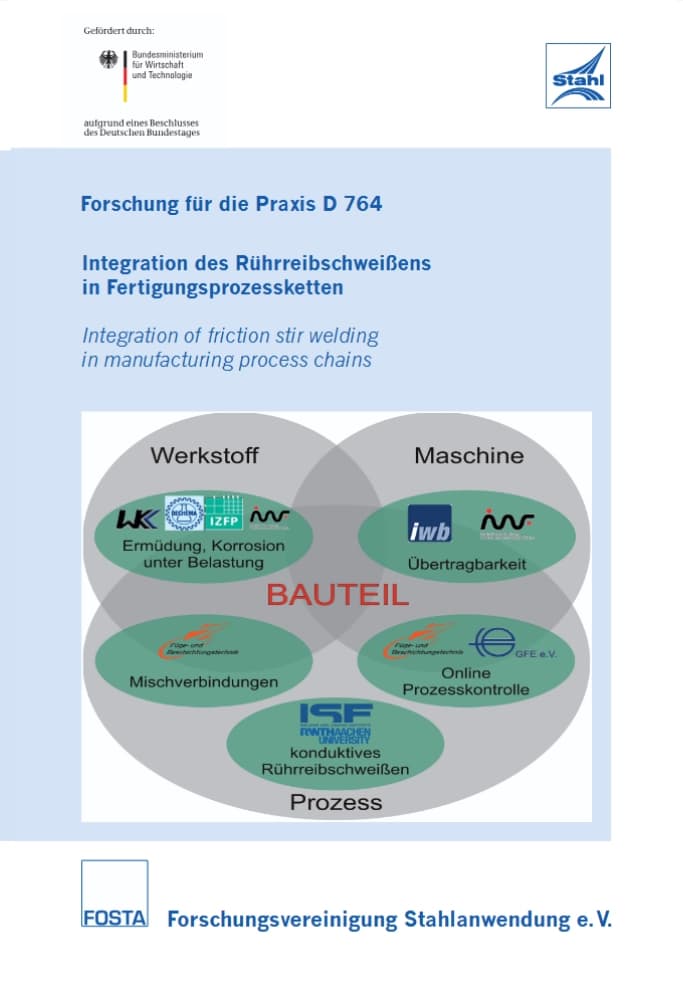
    D 764 - Documentation 764 - Integration of friction stir welding in production process chains

    D 764 - Documentation 764 - Integration of friction stir welding in production process chains Publication: 2011 Main content only available in German language. Title and description automatically translated using Deepl API

    available anytime

    46,00 €

    excl. VAT

    View details →
  • Thumbnail
    FOSTA Dokumentation

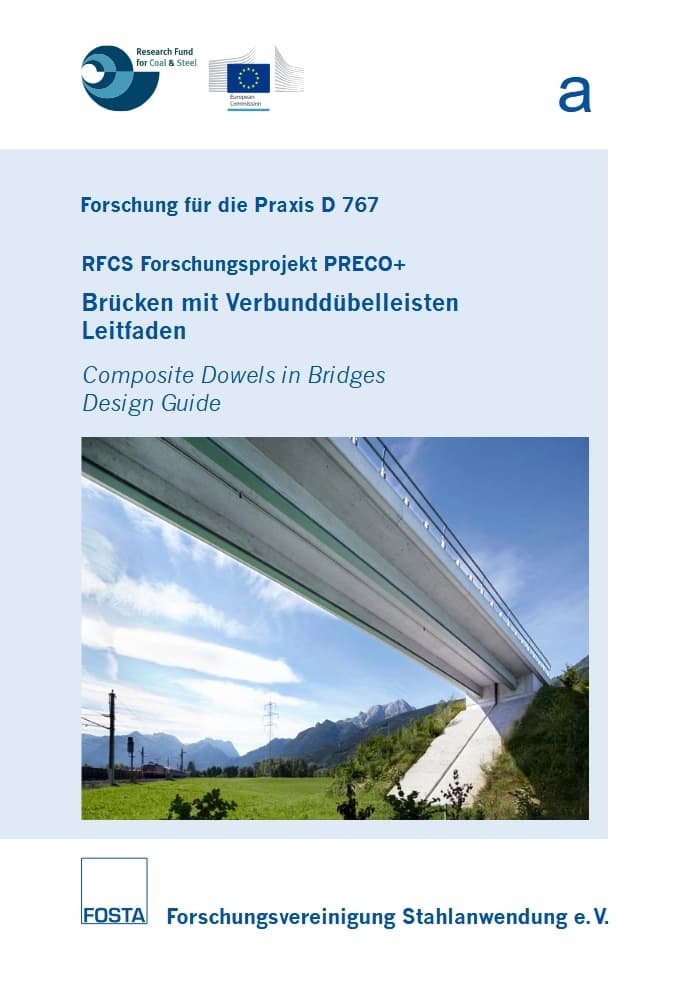
    D 767 - Bridges with bonded dowel bars - Guidelines

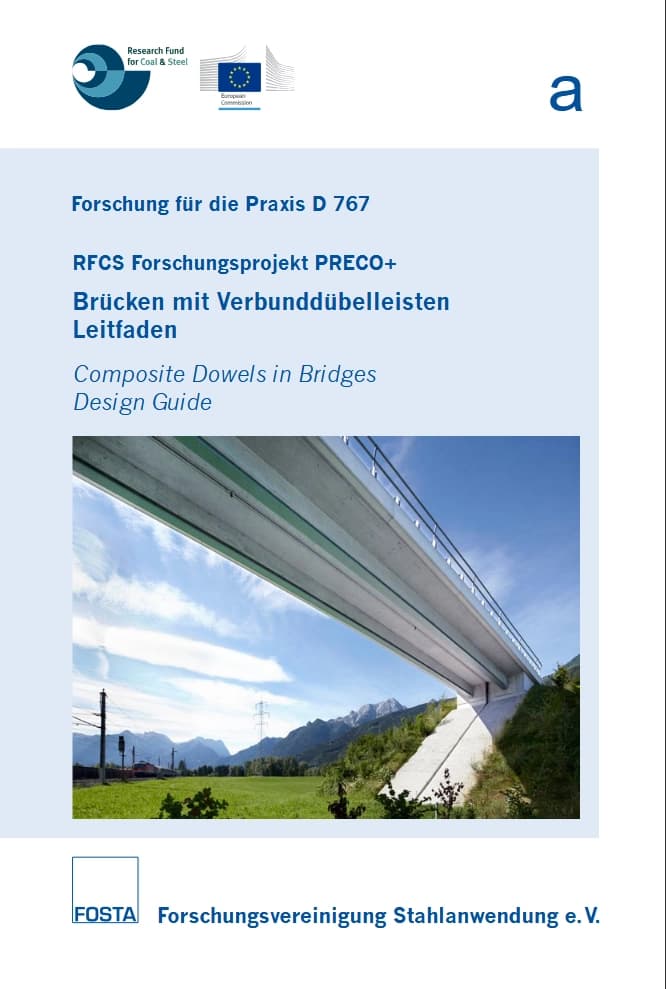
    D 767 - Bridges with composite dowel bars - Guidelines Composite structures are becoming increasingly important in Europe. This growing demand is leading to new innovative solutions that must be technically and economically competitive with existing construction methods. Following the successful introduction of the VFT construction method, the VFT-WIB construction method is an innovative continuation of the prefabricated construction method for composite beams. The key feature of this construction method is the use of halved rolled profiles, which are connected to the structural concrete in a shear-resistant manner using composite dowels. With the VFT-WIB technology, it is possible to realise extremely slender composite structures due to a significantly larger internal lever arm, which also results in significant economic advantages compared to loosely reinforced or prestressed concrete cross-sections. Due to the high fatigue strength of bonded dowels, their use is particularly advantageous in road and railway bridge construction. This guide describes the principles of the VFT-WIB construction method, typical cross-sections, the load-bearing behaviour, the technology of the composite dowels and provides detailed recommendations for design and construction as well as examples. The use of precast composite elements results in a number of significant advantages compared to conventional in-situ concrete solutions. The use of the prefabricated concrete slab eliminates the need for formwork for the carriageway slab and tilt bracing for the steel girders and leads to a significantly accelerated construction process. As a result, traffic interruptions for overpassed railway lines or road sections can be minimised and it is often possible to lay the precast elements during a night or weekend break. If the VFT bridge is designed as a frame construction, spans of up to 60m can be realised without central support, traffic disruptions during construction and during necessary maintenance work on the central supports can thus be avoided. The slenderness of such VFT constructions achievable in the centre of the span is up to L/35, which enables an extraordinarily material-saving construction method with a high aesthetic standard at the same time. This report was produced as part of the research project RFCS-CT-2006-00030 PrecoBeam "Prefabricated Enduring Composite Beams based on innovative Shear Transmission" and the follow-up project RFCS-CT-2011-00026 Preco+. Both projects were financially supported by the Research Fund for Coal and Steel (RFCS). Authors: G. Seidl, O. Hoyer, R. Zanon, N. Popa, W. Lorenc, S. Rowinski, M. Kozuch, J. M. Franssen, T. Fohn, C. H. Carrasco, A. Farhang, J. Ikäheimonen, G. Nüsse Publication: 2012 Main content only available in German language. Title and description automatically translated using Deepl API

    available anytime

    25,50 €

    excl. VAT

    View details →
  • Thumbnail
    FOSTA

    P 01 - Noise-damped steel structures in bridge construction

    P 01 - Noise-damped steel structures in bridge construction The realisation of the complex research project "Noise-damped steel structures in bridge construction" almost inevitably resulted in cooperation with a number of scientists from various disciplines, institutions and companies. Here we found support in many ways to the benefit of the research project. We would like to thank the Studiengesellschaft für Anwendungstechnik von Eisen und Stahl e.V. Düsseldorf for generously funding the project. In particular, we would like to thank Dr H. Witte, Chairman of the Board of Trustees of the Studiengesellschaft at the time, and Ing.Grad. G.K. Wisniewsky, Managing Director of the Studiengesellschaft, for their personal commitment to the realisation of the research project. We would like to thank the working group "Noise-damped steel structures" of the Studiengesellschaft, in particular Dipl.-Ing. A. Fahlbusch, Dr.-Ing. P. Koch and Dr.-Ing. W. Spieker, for their fruitful suggestions and discussions. Without the testing of the sound-absorbing composite systems investigated in the laboratory on a steel bridge, the research project would have remained a piecemeal endeavour. We would like to thank the Deutsche Bundesbahn, represented by the Bundesbahnzentralamt München and the Bundesbahndirektion Hamburg, for their generous support of the project by providing two steel box girder bridges in Hamburg. In particular, we would like to thank Mr Dipl.-Ing. W. Stier, President of the Department, and Mr Dipl.-Ing. E. Landwehr, Head of Department, BZA Munich, for their commitment to this project. Mr Dezernent Dipl.-Ing. H. Spelzhaus and Mr Ing.Grad. W. Klemptner, BD Hamburg, for their support in the realisation of the large-scale test. We would also like to thank Prof. Dr M. Heckl for his advice on sound engineering issues during the research project. We are grateful to Prof. Dr.-Ing. Dr.-Ing. E.H. K. Klöppel for helpful discussions on problems in connection with the fastening element setting bolts and for taking over the examination of the static calculations for the Hammerbrookstraße bridges. The research project was supported to a considerable extent by the companies involved in the project. Publication: 1978 Authors: J. J. Hanel, T. Seeger Main content only available in German language. Title and description automatically translated using Deepl API

    available anytime

    30,00 €

    excl. VAT

    View details →
  • Thumbnail
    FOSTA

    P 02.1 - Ultimate load tests for thin-walled steel tunnelling profiles

    P 02.1 - Ultimate load tests for thin-walled steel tunnelling profiles Publication: 1974 Authors: H. Kessler, H. Duddeck Main content only available in German language. Title and description automatically translated using Deepl API

    available anytime

    30,00 €

    excl. VAT

    View details →
  • Thumbnail
    FOSTA

    P 02.2 - Tables for the calculation of shield-driven tunnels - Theory II. order with longitudinal force deformation

    P 02.2 - Tables for the calculation of shield-driven tunnels - Theory II. order with longitudinal force deformation The stability of a tunnel depends on the interaction between the structure and the ground, provided there is sufficient bonding between the lining and the rock. As the properties of the natural rock mass can only be explored in general terms, the tunnel lining can be designed using a correspondingly simple mechanical model. For tunnels in unconsolidated rock, the calculation model of a flat, flexurally rigid ring can be selected, which is elastically bedded in the area of outward displacements, cf. the recommendations of the German Society for Earthworks and Foundation Engineering. For thicker linings (reinforced concrete), the design diagrams determined according to first-order theory are sufficient. For thinner linings made of high-strength metallic building materials (e.g. steel or GGG5o), the deformation influences in the equilibrium conditions are no longer negligibly small (second-order theory). The investigations at the Institute of Statics, the work of Hain and Horst have shown that the influences from the longitudinal force deformations in thin tunnels can be of the same order of magnitude as the effects resulting solely from the deflection in a second-order theory. order. This Institute report contains the results of a more complete II. order theory in the form of tables and numerical examples. This required a detailed parameter analysis. The dimensionless parameter ß= ksR 4 /EI covers bedding and bending stiffness, the parameter f = I/FR2 the ratio of bending stiffness to elongation stiffness and thus the deformability due to the ring forces. The calculation is based on the theory of elasticity. The economic dimensioning of tunnel linings is an optimisation task because thinner cross-sections can lead to lower stresses. The tables can therefore be used to quickly find a favourable cross-section without having to resort to computer programs. The research and evaluation work for this report is part of a more comprehensive research programme on the elastic and plastic load-bearing behaviour of steel tunnel linings. It was partly financially supported by the Studiengesellschaft für Anwendungstechnik von Eisen und Stahl e.V., Düsseldorf. I would like to thank the Studiengesellschaft for providing these research funds. Publication: 1975 Authors: H. Kessler Main content only available in German language. Title and description automatically translated using Deepl API

    available anytime

    30,00 €

    excl. VAT

    View details →
  • Thumbnail
    FOSTA

    P 02.3 - The design and ultimate load calculation of steel tunnel linings

    P 02.3 - The design and ultimate load calculation of steel tunnel linings Publication: 1976 Authors: H. Kessler Main content only available in German language. Title and description automatically translated using Deepl API

    available anytime

    40,00 €

    excl. VAT

    View details →
  • Thumbnail
    FOSTA

    P 03 - Calculation principles for honeycomb beams

    P 03 - Calculation principles for honeycomb beams Honeycomb beams are produced from standard rolled sections by cutting the webs in a zigzag pattern, offsetting the resulting halves by half a cutting unit and joining the protruding web sections together by welding, either directly or after inserting intermediate plates. The resulting component has horizontal and vertical supporting elements, which are referred to as chords and posts. Honeycomb beams have several advantages over their original profile: (a) If the cut is appropriate, the load-bearing capacity is greater due to the gain in overall height. b) Due to the many web openings, they are better suited for use as main load-bearing elements of storey ceilings, as the main girder webs have to be broken through anyway due to the required installation lines, if the construction height is not to be wasted and the installation lines are to be arranged below the girders. However, there are also some disadvantages to this, which are mainly to be seen in the increased manufacturing costs and the dimensioning, which is too complex for a manual calculation. Both of these could be usefully countered by the following: a) a design method is developed in which the safety against failure of the component is verified. The elastic design method only provides safety against the onset of yielding at a single point and, as the public studies published in /22/ show, leads to extremely different levels of safety (between v = 1.535 and v = 5.53) against failure. The application of the ultimate load method in the design of honeycomb beams can therefore lead to more economical structures. b) Tables are made available from which the most favourable castellated girder that meets the regulations can be taken for a given span, load, yield point, maximum construction height, maximum deflection and minimum hole size for common construction tasks without detailed calculation. The aim of this work is to provide the theoretical basis for this, i.e. to develop a method for determining the load-bearing capacity of honeycomb beams on the basis of the research projects carried out to date and our own experimental and theoretical investigations and, building on this, to carry out a section optimisation (to specify the optimum honeycomb shape in terms of weight for different spans and loads). Publication: 1975 Authors: Dipl. Ing. W. Kanning Main content only available in German language. Title and description automatically translated using Deepl API

    available anytime

    30,00 €

    excl. VAT

    View details →
  • Thumbnail
    FOSTA

    P 04 - Experimental testing of joint constructions of continuously reinforced concrete floors

    P 04 - Experimental testing of joint constructions of continuously reinforced concrete floors Authors: Prof. Dr.-lng. J. Eisenmann, Dr.-lng. U. Lempe Publication: 1975 Main content only available in German language. Title and description automatically translated using Deepl API

    available anytime

    30,00 €

    excl. VAT

    View details →
  • Thumbnail
    FOSTA

    P 06 - Steel construction alternative for the university action programme in NRW

    P 06 - Steel construction alternative for the university action programme in NRW The state of North Rhine-Westphalia is planning to build 5 universities in the cities of Duisburg, Essen, Wuppertal, Siegen and Paderborn. On 4 January 1972, this decision was announced at a press conference by the Minister of Finance, the details of which can be found in the appendix. The planning was entrusted to the State Building Office II - ZPH - in Münster, under the direction of the Government Building Director Dirksmeyer. He and his staff developed ground plan systems, section and elevation systems as well as the associated building services for institutes as multi-storey buildings to be erected in all the university cities mentioned. For the first time, the decision was taken and realised to construct and design a very large volume of buildings in a standardised way. Parliament and the government thus gave the construction industry the opportunity to standardise and optimise building systems. The construction industry will now have to prove to what extent it wants to use this opportunity and whether it was serious in claiming that cataloguing systems is only worthwhile if very large construction volumes are to be processed. Publication: 1973 Authors: o.A. Main content only available in German language. Title and description automatically translated using Deepl API

    available anytime

    30,00 €

    excl. VAT

    View details →
  • Thumbnail
    FOSTA

    P 07 - Use of steel in residential construction

    P 07 - Use of steel in residential construction Publication: 1974 Authors: Prof. Dr.-Ing. H. Weber, Dr.-Ing. A. Eisenblätter, Dipl.-Ing. H. W. Strunck Main content only available in German language. Title and description automatically translated using Deepl API

    available anytime

    50,00 €

    excl. VAT

    View details →
€30.00excl. VAT
P 1521 - Integral sheet pile abutments of modular composite bridges for a time-efficient construction process—
€30.00