As part of this research project, the foundations were laid for an architecturally appealing system construction method for façades made of sandwich elements with innovative fastening technology. The reason for this is …
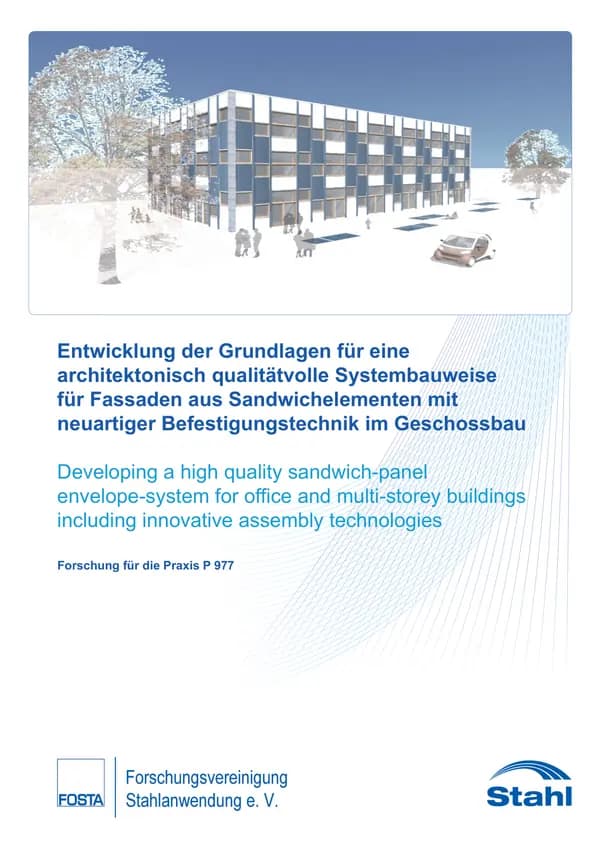
As part of this research project, the foundations were laid for an architecturally appealing system construction method for façades made of sandwich elements with innovative fastening technology. The reason for this is the fact that the sandwich construction method still has further development potential, particularly in multi-storey construction. The work in this project was therefore carried out with a particular technical-architectural focus, which promotes the creation of façades in multi-storey buildings with high architectural quality and socio-cultural acceptance. The tongue-and-groove butt joint used in industrial construction for sandwich façades on the longitudinal edge of the elements enables a solution that is optimised in terms of building physics and economical execution.
Due to the production process, the transverse edges are not profiled when the elements are manufactured continuously. This necessitates the different design of the longitudinal and transverse edge joints and the specification of a horizontal or vertical installation direction for the elements. This means that certain framework conditions for the architectural design are predetermined by the construction. However, the "adapter solution" developed in this research project now allows a visually equivalent joint design and the combination of horizontally and vertically laid sandwich elements in one façade. At the same time, larger window areas can be integrated into the façade and existing element formats can be adapted to the grid dimensions commonly used in office and administrative buildings. The statically favourable, all-round linear support of the elements also optimises the load transfer and fastening of the developed construction variants. As existing panel formats can still be used with this solution, there is no need for a cost-intensive changeover in sandwich production. In addition to the "adapter solution", further innovative fastening concepts were developed. The research results on global load-bearing behaviour contained therein can be used in addition to the objectives of this research project. With the help of the results developed from floor plan and elevation studies, a grid for the use of sandwich panels in office and administrative buildings could be created in this research project and the desired modularised system construction method could be realised. For practical application, this is illustrated and clearly explained in this report using three macroscopic designs. The IGF project 453 ZN of the Forschungsvereinigung Stahlanwendung e.V., Düsseldorf, was funded by the Federal Ministry for Economic Affairs and Energy via the AiF as part of the programme for the promotion of joint industrial research (IGF) on the basis of a resolution of the German Bundestag. The project was carried out by the Chair of Steel Construction at the Technical University of Dortmund and the Department of Architectural Science at Ryerson University Toronto.
Payment by card (Stripe) or invoice (DE, AT, CH). Download link by email: automatically after ordering by card, after order approval for invoice (valid for 30 days). Terms
Machine-translated title and description. The document itself is in German.
Digital download
Other parts and editions as well as neighbouring documents of the same series.

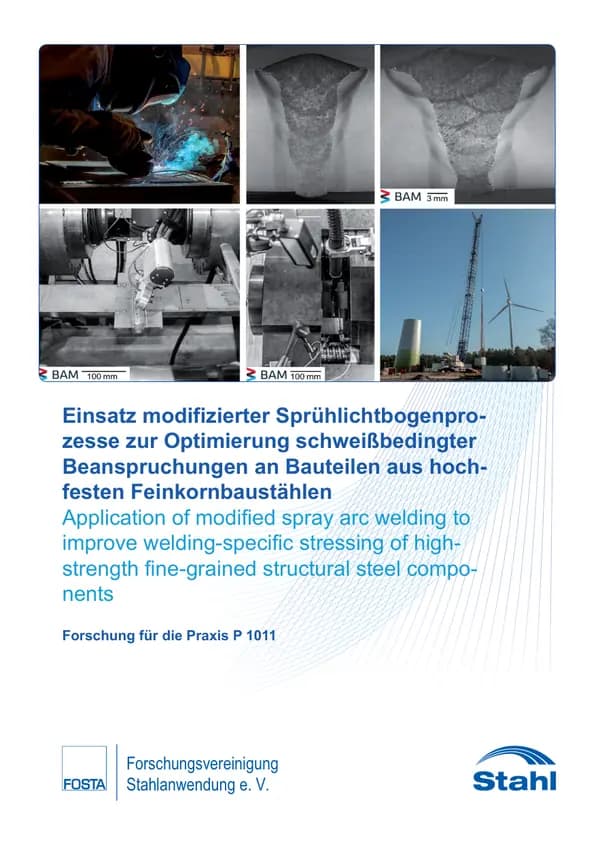
P 1011 - Use of modified spray arc processes to optimise welding-related stresses on components made of high-strength fine-grain structural steels Due to current lightweight construction efforts and demands for energy and resource efficiency, high-strength fine-grain structural steels with yield strengths ≥ 690 MPa are increasingly being used in modern steel structures. These are primarily processed with yield strengths of up to 960 MPa and joined using MAG welding processes. Modern inverter technology has recently enabled numerous company developments (e.g. "DeepARC", "forceArc"), which have led to modified spray arc welding (mod. SLB) with similar properties. In addition to the well-known economic advantages of these mod. SLB, the reduced possible seam opening angles and the lower heat input are expected to have a positive effect on welding-related stresses. Initial residual stress analyses in previous weldability tests with mod. SLB have already shown lower residual tensile stresses in the weld seam in free-shrinking laboratory samples compared to conventionally welded samples. However, the operationally stable design of high-strength welded constructions and the utilisation of high yield strengths require sufficient quantification of welding-related stresses in mod. SLB under defined, component-relevant shrinkage restraint. This concerns both the forces and stresses in the local weld seam area and the overall stress as well as the influence of heat conduction, component geometry, degree of clamping and seam opening angle. There was hardly any knowledge of this in the industry, especially among SMEs, and the aim of this research project was therefore to develop this knowledge. The comparative investigations with conventional arc and mod. SLB with adapted seam configuration were carried out with the aid of special testing equipment that can be used to model real component stiffnesses. With both process variants, weld seams could be realised with the selected parameters while fulfilling the requirements for the mechanical-technological properties. During the analyses, a significant reduction in internal stresses due to reduced heat input was observed when using a seam configuration with a lowered seam opening angle. In particular, the narrower seam gaps proved to be effective in reducing multi-axial stress states due to bending moments in the welds close to the component. The knowledge gained and recommendations made were presented to the relevant standardisation committees in order to facilitate simpler design and safe processing of high-strength fine-grain structural steels in the medium term, especially for SMEs. Standardisation can reduce qualification and approval costs, which are currently often necessary when using high-strength steels. Furthermore, the results will enable companies to utilise the technical and economic advantages of mod. SLB processes and to achieve significant savings in filler metal, welding and set-up time as well as optimised results with regard to the load-bearing capacity of components, taking into account the inherent stresses, and to increase productivity. Publication: 2017 Authors: T. Kannengießer, D. Schröpfer
available anytime
€30.00
excl. VAT

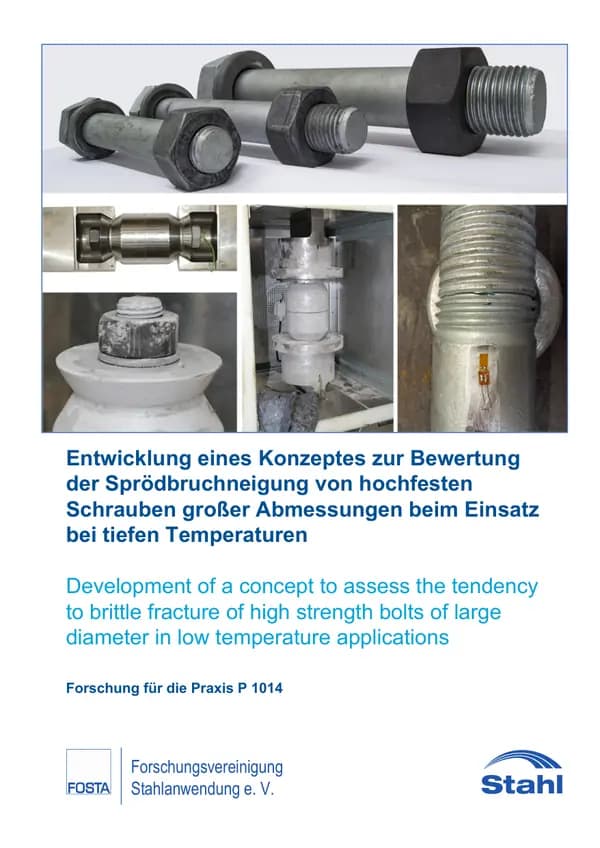
P 1014 - Development of a concept to evaluate the brittle fracture tendency of high-strength bolts of large dimensions when used at low temperatures High-strength HV system bolt assemblies are increasingly being used as prestressed assemblies in large dimensions up to M72 in highly stressed steel structures. In addition to static and cyclical stresses, the connections are also exposed to low temperatures. It is known that the risk of brittle fracture increases with increasing thickness of steel components at low temperatures - in principle, this also applies to larger bolt diameters. In this research project, systematic investigations were carried out into the brittle fracture tendency of high-strength bolts of large dimensions in the diameter range from M24 to M64 at low temperatures. First, the mechanical properties were characterised and the fracture toughness behaviour was described in the form of notched bar impact tests and fracture mechanics tests. The transition temperatures from the notched bar impact test and fracture mechanics test could be correlated with each other using existing correlation approaches. By analysing finite element calculations, it was possible to identify the stress state in the first load-bearing thread as decisive with regard to brittle fracture. In component tests at low temperatures, in which the screws were pre-damaged from a mechanically introduced notch under a fatigue load, it was clearly demonstrated that the screw steels currently used are not at risk of brittle fracture when used at temperatures down to -50 °C. Based on the test results, fracture and damage mechanics calculation models were created in order to define minimum requirements for the material properties to prevent brittle fracture. The damage mechanics model showed very conservative results here, so that it is currently not possible to derive minimum requirements without further development. The fracture mechanics model was able to reproduce the test results, but also delivered conservative results in the derivation of minimum requirements. The fracture mechanics model must be further verified on the basis of a broader database. In the present research project, however, a fundamental evaluation of the brittle fracture tendency of high-strength bolts of large dimensions at low temperatures was carried out. It was shown that the bolt steels currently used are not susceptible to brittle fracture when used at low temperatures. Publication date: April 2019 Authors: Prof. Dr.-Ing. habil. N. Stranghöner, Ch. Lorenz, M.Sc., Prof. Dr.-Ing. M. Feldmann, S. Citarelli, M.Sc., Prof. Dr.-Ing. W. Bleck, Prof. Dr.-Ing. S. Münstermann, Dr.-Ing. Brinnel
available anytime
€40.00
excl. VAT

P 1016 - Self-pierce riveting of high-strength steel materials in mixed structures using self-clinching self-pierce riveting elements The statutory regulations to reduce greenhouse gas emissions are prompting the automotive industry to implement consistent lightweight construction. The reduction of CO2 emissions to an average of 95g CO2/km in passenger car traffic by 2020 has been decided. The vehicle body, which accounts for over 30% of the total weight, offers the greatest potential for implementing lightweight construction, which can be achieved by using high-strength steels and other lightweight materials such as aluminium. In particular, the mixed construction of press-hardened steel and aluminium in combination with adhesive bonding leads to economical lightweight construction solutions. One suitable technology for joining this combination of materials is full-punch rivet bonding. However, full-punch rivet bonded joints lead to gaps between the parts to be joined and thus to poor adhesive bonding, especially when using particularly thin materials for the parts to be joined. The aim of the research project is to develop a modified self-pierce riveting technology for joining high-strength sheet materials with aluminium alloys. This is achieved by modifying the solid self-pierce riveting process so that it works without an embossing ring on the die-side tool. The embossing contour is positioned directly under the setting head of the rivet. Joints produced using the innovative self-clinching self-pierce riveting process should then be characterised by low joining process-related deformations and good adhesive bonding. As part of the research project, geometry optimisations were carried out using simulation, which were validated by experimental investigations. The flexibility of the newly developed process was then determined on the basis of a process analysis. In addition, the joining properties of the process in combination with adhesives were optimised and the property profile recorded as part of investigations into hybrid joining. A joining process was developed with which it is possible to produce efficient and economical joints from 22MnB5 sheets and aluminium sheets in the thin sheet range. Publication: 2017 Authors: Prof. Dr.-Ing. G. Meschut
available anytime
€30.00
excl. VAT

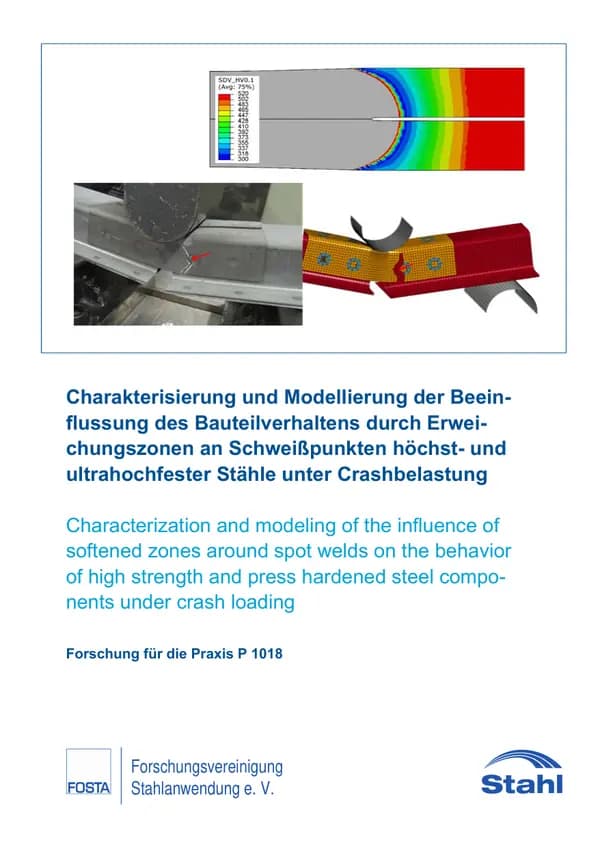
P 1018 - Characterisation and modelling of the influence of softening zones on weld spots of ultra-high and high-strength steels under crash load on component behaviour In automotive engineering, high-strength steels are increasingly being used in thin sheet thicknesses for lightweight construction reasons in order to increase energy efficiency and passive safety while at the same time conserving resources. Currently and in the future, the established and highly automatable resistance spot welding process will be used to join the individual components made from these high-strength steels to form a load-bearing structure. During spot welding, softening zones form in high-strength steels due to tempering effects, which can jeopardise component integrity. The aim of the research project is to establish a generally valid relationship that describes the reduction in the strength of spot-welded high-strength sheets as a function of the geometric dimensions of the softening zone and the strength mismatch of the joint. The influences of the welding parameters on the formation of the softening zone are investigated and experimentally verified by numerical process simulation of spot welding. Spot-welded joints with geometrically different formation of the softening zone are produced and their influence on the mechanical properties of the welded steel sheet is demonstrated. This is investigated on press-hardened 22MnB5 and on complex-phase steel HCT980C. The KS-2 test technique is used to examine the influence of softening zones on the head tension and shear tension load-bearing capacity of the spot welds. With these tests and the characterisation of the softening zone, modelling recommendations for weld spot replacement models for crash simulation are drawn up and validated by simulating the sample component tests and T-impact tests carried out. The hardness measurements in the cross-section of the spot welds in the high-strength steels HCT1180X, HCT980X and HTC980C show all hardness reductions, i.e. softening zones, next to the spot welds. In tensile and puncture tests with samples that contained spot welds with softening zones in the test area, HCT1180X in particular showed the greatest reduction in strength and elongation at break, while the tensile strength of HCT980C and HCT980X was not reduced, but the elongation at break was significantly reduced. If the crack initiation occurs in the softening zone of a weld spot in component tests with bending and superimposed tensile loading, the crack propagates into the base material under further loading. These results are incorporated into a simulation methodology for the evaluation of crack formation in softening zones. This enables steel users in design and calculation to make statements about the load-bearing capacity of spot-welded constructions made of ultra-high-strength and ultra-high-strength steels. This enables the efficient and economical development of spot-welded components made of ultra-high-strength steels and thus contributes to the qualification of these steels for new spot-welded lightweight components. The IGF project 17991 N of FOSTA -Forschungsvereinigung Stahlanwendung e. V., Düsseldorf, was funded by the Federal Ministry for Economic Affairs and Energy via the AiF as part of the programme for the promotion of joint industrial research (IGF) on the basis of a resolution of the German Bundestag. The project was carried out at the Fraunhofer Institute for Mechanics of Materials IWM, Freiburg, at the Laboratory for Materials and Joining Technology (LWF) at the University of Paderborn and at the Materials Testing Institute MPA, Stuttgart. Publication: 2019 Authors: Dr.-Ing. Silke Sommer, Dipl.-Ing. Lilia Schuster, Prof. Dr.-Ing. Gerson Meschut, Dipl.-Ing. Gökhan Tümkaya, Dr.-Ing. David Hein, Prof. Dr.-Ing. Stefan Weihe, Dipl.-Ing. Fabian Schreyer, Dr.-Ing. Ulrich Weber
available anytime
€50.00
excl. VAT
Payment by card (Stripe) or invoice (DE, AT, CH). Download link by email: automatically after ordering by card, after order approval for invoice (valid for 30 days). Terms