Due to current lightweight construction efforts and demands for energy and resource efficiency, high-strength fine-grain structural steels with yield strengths ≥ 690 MPa are increasingly being used in modern steel …
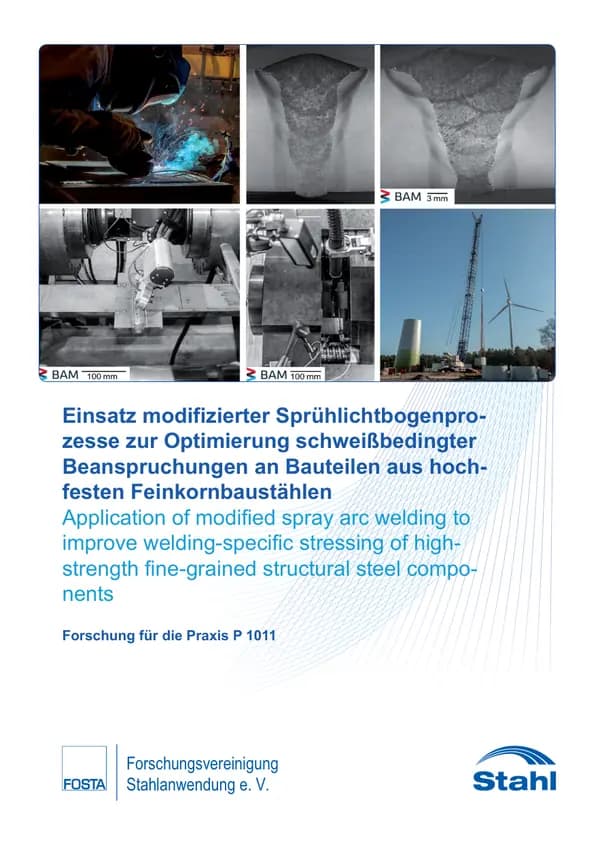
Due to current lightweight construction efforts and demands for energy and resource efficiency, high-strength fine-grain structural steels with yield strengths ≥ 690 MPa are increasingly being used in modern steel structures. These are primarily processed with yield strengths of up to 960 MPa and joined using MAG welding processes. Modern inverter technology has recently enabled numerous company developments (e.g. "DeepARC", "forceArc"), which have led to modified spray arc welding (mod. SLB) with similar properties. In addition to the well-known economic advantages of these mod. SLB, the reduced possible seam opening angles and the lower heat input are expected to have a positive effect on welding-related stresses.
Initial residual stress analyses in previous weldability tests with mod. SLB have already shown lower residual tensile stresses in the weld seam in free-shrinking laboratory samples compared to conventionally welded samples. However, the operationally stable design of high-strength welded constructions and the utilisation of high yield strengths require sufficient quantification of welding-related stresses in mod. SLB under defined, component-relevant shrinkage restraint. This concerns both the forces and stresses in the local weld seam area and the overall stress as well as the influence of heat conduction, component geometry, degree of clamping and seam opening angle. There was hardly any knowledge of this in the industry, especially among SMEs, and the aim of this research project was therefore to develop this knowledge. The comparative investigations with conventional arc and mod. SLB with adapted seam configuration were carried out with the aid of special testing equipment that can be used to model real component stiffnesses. With both process variants, weld seams could be realised with the selected parameters while fulfilling the requirements for the mechanical-technological properties. During the analyses, a significant reduction in internal stresses due to reduced heat input was observed when using a seam configuration with a lowered seam opening angle. In particular, the narrower seam gaps proved to be effective in reducing multi-axial stress states due to bending moments in the welds close to the component. The knowledge gained and recommendations made were presented to the relevant standardisation committees in order to facilitate simpler design and safe processing of high-strength fine-grain structural steels in the medium term, especially for SMEs. Standardisation can reduce qualification and approval costs, which are currently often necessary when using high-strength steels. Furthermore, the results will enable companies to utilise the technical and economic advantages of mod. SLB processes and to achieve significant savings in filler metal, welding and set-up time as well as optimised results with regard to the load-bearing capacity of components, taking into account the inherent stresses, and to increase productivity.
Payment by card (Stripe) or invoice (DE, AT, CH). Download link by email: automatically after ordering by card, after order approval for invoice (valid for 30 days). Terms
Machine-translated title and description. The document itself is in German.
Digital download
Other parts and editions as well as neighbouring documents of the same series.

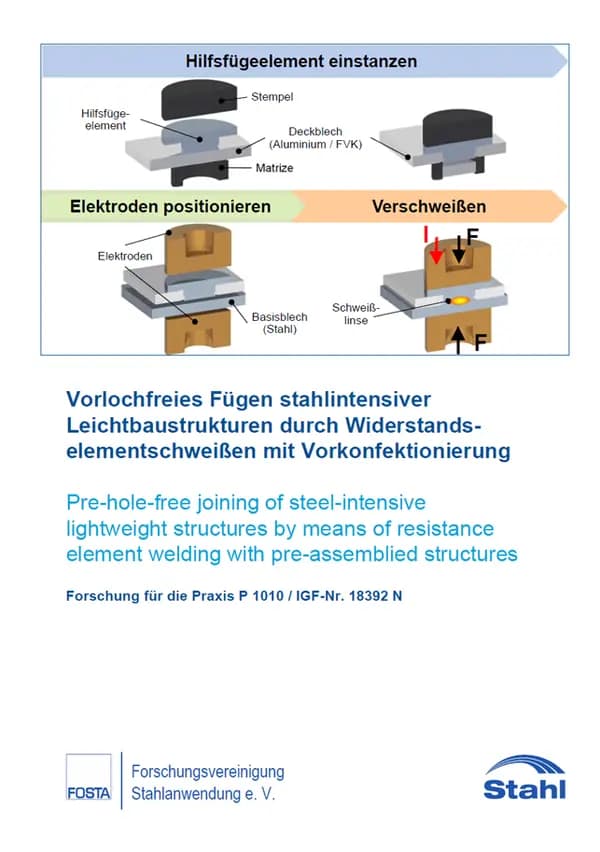
P 1010 - Pre-hole-free joining of steel-intensive lightweight structures by resistance element welding with prefabrication In recent years, due to legal requirements, the automotive industry has increasingly focussed on lightweight construction measures, particularly in the body structure through the load-appropriate use of various lightweight materials. A mixed construction method, in which high-strength and ultra-high-strength, press-hardened sheet steel parts are combined with aluminium materials, is particularly suitable for large-scale production in order to create lightweight, yet rigid and crash-resistant body structures in shell construction. The thermal-mechanical joining processes developed in recent years for series production and not exclusively for this application offer a high application potential and the first series applications have already been realised. Due to the novelty of resistance element welding, the process-related properties and characteristics have so far been insufficiently investigated, so that there is a lack of sufficient knowledge on the welding, strength and failure behaviour of corresponding joints and material combinations. The aim of the research project was to develop and qualify resistance element welding with prefabrication of an aluminium or FRP composite partner as an economical joining process for joining these lightweight construction materials with high-strength and ultra-high-strength steel materials. As resistance element welding is still a relatively new joining process, the requirements were initially adapted on the basis of the investigations carried out to date. This involved analysing the special process-related features of resistance element welding of prefabricated composite partners and characterising the properties of the resulting joints. By analysing the joining process and the joint formation, taking into account the properties of the rivet elements, it was possible to gain important insights into the design of the rivet elements and processes as well as their reliable use. The evaluation of the performance characteristics in terms of joint and handling strength was also part of the project. As a result, industrial users were provided with information on the use of a flexible joining process for the realisation of future lightweight structures. The implementation of the optimisation derived from the results obtained marks an important contribution to the development of resistance element welding and the economic production of future lightweight structures in mixed steel construction. Publication: December 2020 Authors: Prof. Dr.-Ing. G. Meschut , Dipl.-Wirt.-Ing. V. Janzen
available anytime
€30.00
excl. VAT

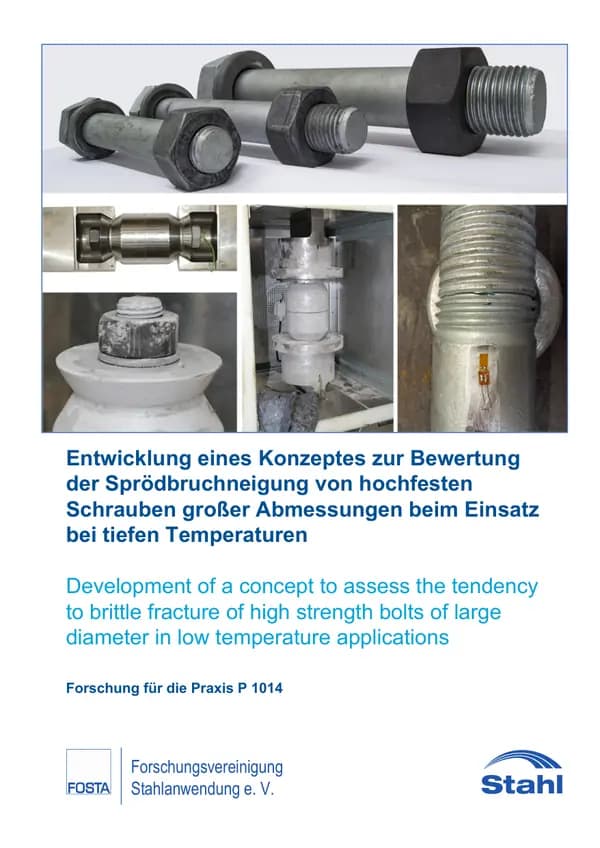
P 1014 - Development of a concept to evaluate the brittle fracture tendency of high-strength bolts of large dimensions when used at low temperatures High-strength HV system bolt assemblies are increasingly being used as prestressed assemblies in large dimensions up to M72 in highly stressed steel structures. In addition to static and cyclical stresses, the connections are also exposed to low temperatures. It is known that the risk of brittle fracture increases with increasing thickness of steel components at low temperatures - in principle, this also applies to larger bolt diameters. In this research project, systematic investigations were carried out into the brittle fracture tendency of high-strength bolts of large dimensions in the diameter range from M24 to M64 at low temperatures. First, the mechanical properties were characterised and the fracture toughness behaviour was described in the form of notched bar impact tests and fracture mechanics tests. The transition temperatures from the notched bar impact test and fracture mechanics test could be correlated with each other using existing correlation approaches. By analysing finite element calculations, it was possible to identify the stress state in the first load-bearing thread as decisive with regard to brittle fracture. In component tests at low temperatures, in which the screws were pre-damaged from a mechanically introduced notch under a fatigue load, it was clearly demonstrated that the screw steels currently used are not at risk of brittle fracture when used at temperatures down to -50 °C. Based on the test results, fracture and damage mechanics calculation models were created in order to define minimum requirements for the material properties to prevent brittle fracture. The damage mechanics model showed very conservative results here, so that it is currently not possible to derive minimum requirements without further development. The fracture mechanics model was able to reproduce the test results, but also delivered conservative results in the derivation of minimum requirements. The fracture mechanics model must be further verified on the basis of a broader database. In the present research project, however, a fundamental evaluation of the brittle fracture tendency of high-strength bolts of large dimensions at low temperatures was carried out. It was shown that the bolt steels currently used are not susceptible to brittle fracture when used at low temperatures. Publication date: April 2019 Authors: Prof. Dr.-Ing. habil. N. Stranghöner, Ch. Lorenz, M.Sc., Prof. Dr.-Ing. M. Feldmann, S. Citarelli, M.Sc., Prof. Dr.-Ing. W. Bleck, Prof. Dr.-Ing. S. Münstermann, Dr.-Ing. Brinnel
available anytime
€40.00
excl. VAT

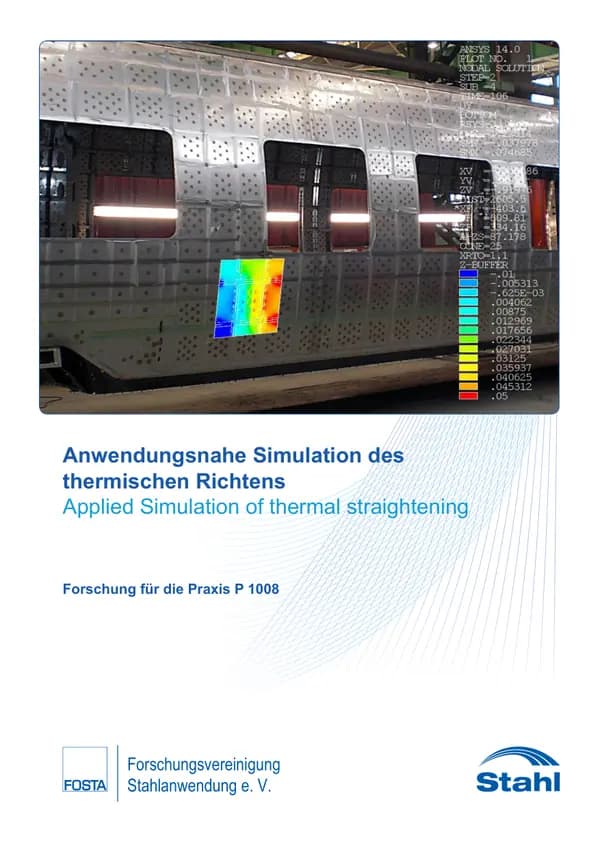
P 1008 - Application-oriented simulation of thermal straightening Particularly in the case of large structures, such as those welded in ship and rail vehicle construction, the remaining distortions are very critical due to their enormous dimensions of up to several centimetres. Post-treatment must therefore be included in the work planning just as much as the welding itself. Thermal straightening has been an established process for decades. The straightening process parameters are currently selected on the basis of practical experience. However, the influence of design conditions, the material and the different straightening processes are extremely difficult to determine in this way. The basics of the analytical model, the realisation for practical application and the coupling with the numerical calculation are presented. The coupled analytical-numerical hybrid model is designed to capture the welding process chain and the subsequent thermal straightening. The analytical model is used to determine the equivalent shrinkage strain for the thermomechanical load of each straightening point, taking into account the significant influencing factors. This is transferred to an FE model of the structure and the deformation of the entire structure is calculated using an elastic analysis. The mutual influence of the existing residual welding stresses and individual alignment points is taken into account iteratively by means of feedback. The calculation is based on the application of the analytical numerical hybrid model for welding distortion simulation. The methodological approach is explained in detail in the report. In addition to the fundamentals of the hybrid model, other important aspects such as the recording of different straightening processes, process conditions and industry-relevant materials are also discussed. In addition, the qualitative interaction between thermal levelling and the welding process was investigated and integrated into the calculation procedure. The hybrid model was initially applied and validated on simple sheet metal specimens. Based on a structure joined by means of eight seams, the consideration of the welding sequence and the straightening sequence in the hybrid model was investigated. in the hybrid model was analysed. This was then applied to a test structure from the railway vehicle construction industry. Four 2 mm thick profiles were joined to a base plate measuring 500 x 400 mm using 16 weld seams and then straightened using two independent scenarios. The CPU time of the numerical calculation on the structures was less than 10 minutes in each case. The validity of the calculations was thus verified experimentally. Publication: 2016 Authors: V. Mikhailov, N. Doynov, F. Kuke
available anytime
€30.00
excl. VAT

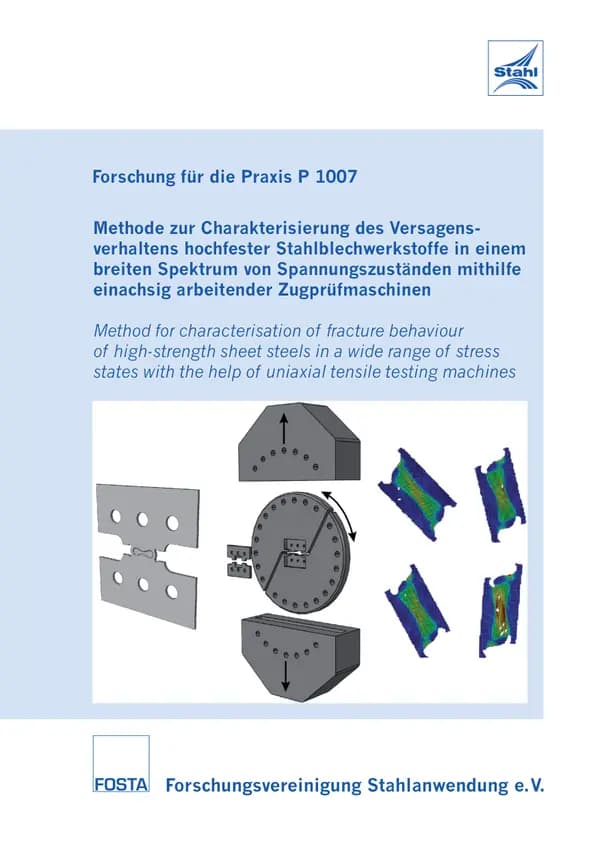
P 1007 - Method for characterising the failure behaviour of high-strength sheet steel materials in a wide range of stress states using uniaxial tensile testing machines The main objective of the project was to develop a new method for characterising the failure behaviour of high-strength sheet steel materials. This method should be based on shear tensile tests on new shear tensile specimens using a new testing module in uniaxial tensile testing machines as well as on hydraulic cupping tests and enable failure characterisation in a wider range of stress states compared to the conventional forming limit curve. The core of the developed approach is the new shear tensile specimen, which is characterised by a localisation of deformation leading to crack initiation inside the material and not at a free edge, regardless of the direction of an external uniaxial load in the specimen plane. A new test module was designed and manufactured for the shear tensile tests on the new shear tensile specimens, which applies a uniaxial test load into the following stresses in the material to be tested: a uniaxial tensile load with a superposition of hydrostatic tension, five different tensile shear loads with a dominant tensile or shear component and a compressive shear load with a dominant shear component. The degree of failure deformation of a dual-phase sheet steel material was experimentally determined using shear tensile tests with five different specimen orientations to the test load using an optical measuring system. In addition, the prevailing stress triaxiality at the material point of crack initiation was determined by numerically modelling the shear tensile tests performed. By combining the respective mean value of the experimentally determined degrees of failure deformation and the respective characteristic value of the numerically determined stress triaxiality, a support point for the fit of the material-specific failure curve was obtained for each tested material stress. In addition to these five support points, a support point from hydraulic cupping tests was also included. From the relative arrangement of the six support points, it can be seen that the dependence of the degree of failure deformation on the stress triaxiality is fundamentally captured using the developed approach. Although the work carried out confirms the fundamental suitability of the approach for characterising the failure behaviour of high-strength sheet steel materials, it also reveals possibilities for its further development. Individual focal points of this further development are an optimisation of the sample geometry to suppress edge cracks, an investigation into the influence of sample production on test results, improvements in recording the time and position of crack initiation and an investigation into the transferability of test results to the numerical simulation of forming processes. In the foreseeable future, these focal points are to be addressed more intensively in newIF UM research projects in order to promote acceptance of the newly developed method in the simulation-based design of sheet metal forming processes in the research landscape and in industrial practice. The research project P 1007 of the Forschungsvereinigung Stahlanwendung e.V., Düsseldorf, was carried out by the Institute of Forming Technology and Machines, University of Hanover, with technical support and financial assistance from FOSTA. Publication: 2015 Authors: B.A. Behrens, M. Vucetic, I. Peshekhodov
available anytime
€20.00
excl. VAT
Payment by card (Stripe) or invoice (DE, AT, CH). Download link by email: automatically after ordering by card, after order approval for invoice (valid for 30 days). Terms