P 885, P 965, P 1048 - DFG / AiF-Cluster Dry Shear Cutting
Research results of P 885, P 965 and P 1048 Hybrid layered composites are characterised by a broad spectrum of functional properties, which can also be adapted to highly qualified stress profiles of new products. They …
Content
- Publication
- April 2020
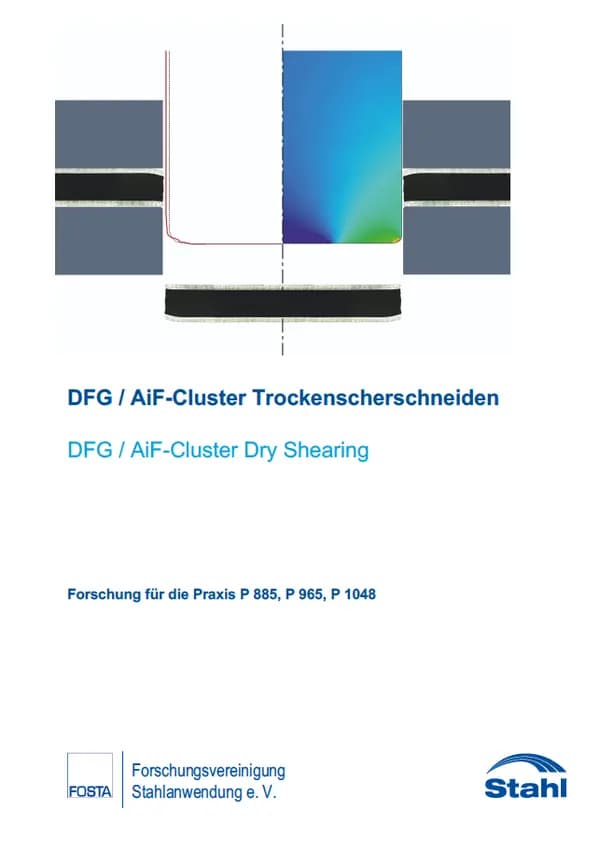
P 885, P 965, P 1048 - DFG / AiF-Cluster Dry Shear Cutting Research results of P 885, P 965 and P 1048 Hybrid layered composites are characterised by a broad spectrum of functional properties, which can also be adapted to highly qualified stress profiles of new products. They are therefore predestined for use in lightweight construction as well as in many other areas of application. To date, however, there has been a lack of processing methods suitable for series production for their use in industrial mass products. As part of this AiF/DFG joint project, the shear cutting process, which is very important for industrial production, has therefore been scientifically investigated and technologically further developed for the cutting of multi-layer, flat laminated composites made of metal and polymers.
Show full description
Particular attention was paid to avoiding delamination, core compression or tearing of the surface layers during cutting so that the function of the composite is not impaired. In order to rule out undesirable interactions between the polymer layers and the lubricants normally used as well as the cleaning agents used for removal, no additive process-improving lubricants were used. The aim of the project was therefore to develop approaches for process and tool design, on the basis of which the dry shearing of different layered composites can be designed to be process-reliable and industrially usable. To solve the overall problem, two basic research-oriented DFG projects (DFG I + II) and three application-oriented AiF sub-projects (AiF 1 - 3) each dealt with different aspects and technological issues relating to dry shear cutting as well as different types of laminate composites. In all sub-projects, extensive parameter studies were initially carried out to expand the understanding of the process with regard to the influence of the cutting forces and the cutting surface qualities. The investigations in AiF 1 showed, among other things, that the retraction forces can be reduced by the use of lubricant, but that neither the cutting force nor the cutting edge quality are affected. This means that the same cutting edge quality can still be expected if no lubricant is used. In AiF 3, it was demonstrated that the semi-finished product temperature and the cutting gap have the greatest influence on the edge indentation height. Overall, the cutting result showed a strong dependence on the respective composite material. For an objective evaluation of the cut surfaces of laminated composites according to optical and other functional requirements, new cut surface parameters were defined in addition to VDI guideline 2906-2. To analyse the cut surfaces, some common methods in AiF 2 have been adapted to the special features of coated sheets. On the one hand, this makes it easy to analyse the corrosion tendency of the open cut edges. On the other hand, optimum material-specific parameter settings (cutting parameters, tool settings) can be determined with little effort. In AiF 3, several test principles for non-destructive delamination detection were qualified for analysing the cut surfaces of sandwich sheets. Another focus of the research work was the analysis of the wear mechanisms as a function of the material type and the process control. The tribo-chemical wear components and their mechanisms of action were determined using a test rig with a gas-tight enclosure developed specifically for this purpose in DFG I. In addition, all sub-projects carried out endurance tests to determine the wear behaviour of the cutting tools under various boundary conditions. As expected, tool wear proved to be strongly dependent on the lubrication condition. However, even the basic lubrication of the sheets (delivery condition) results in a noticeable reduction in wear on the cutting tools. When cutting completely cleaned, dry sheets, a strong tendency to adhere to the cutting punch was detected. Suitable tool coatings - such as a new type of taC coating - can prevent cold welding on the punch edge and significantly increase the service life of the cutting tools. In parallel to the experimental investigations, the DFG sub-projects developed model approaches for the robust design and optimisation of the shear cutting process and the tools. DFG I developed a coupled cutting and wear simulation. The simulation of the cutting process is based on modelling the material separation of the individual components under shear using coupled, continuum mechanical damage models. The numerically calculated load spectra (contact pressure and relative speed) are used as input data for the phenomenological wear simulation, which can predict both the abrasive and tribo-chemical wear components on the basis of the Archard model. As comparisons with experimental investigations in the AiF projects have shown, the software tool enables good qualitative predictions of the punch force for complex material composites. A further improvement in prediction accuracy can be achieved through more complex characterisation and modelling of the polymer materials. The prediction of the software tool for tool edge wear showed good agreement with the experimental results for monolithic sheets. A parameterised analytical model was also developed in DFG II for the shear cutting of sandwich sheets, which can be used to predict the expected process forces and, in particular, their progression over time. The model developed can also be used to analyse the cutting properties of material combinations for sandwich sheets. On the basis of the experimental and simulative results, the tools and process control were finally optimised and adapted so that optimum cutting results and the lowest possible tool wear were achieved during dry shear cutting of the respective layer composite type under consideration. The quality criteria considered included the cutting height and the delamination behaviour of the composite. For coated sheets, a coating over the cut surface is also desirable in order to make the semi-finished product more resistant to corrosion. In the case of sandwich sheets, crushing or pulling out of the soft core material must be prevented. It was shown that an optimised cut surface formation can be achieved for sandwich sheets using the extended counter cutting developed in DFG II with the superimposition of additional compressive stresses in the shear gap. With a view to further developing the concepts close to series production, the research results were summarised in guidelines and methods for the robust design of the dry shear cutting process for hybrid laminated composites at the end of the AiF/DFG joint project. The knowledge gained as part of the research activities makes a highly innovative contribution, as dry shear cutting of various metallic layered composites has been systematically investigated for the first time. The project results provide a sound basis for forcing the introduction of further layered composites into industrially manufactured mass products in subsequent projects. Institutes involved: Dortmund University of Technology, Institute of Forming Technology and Lightweight Construction Technical University of Darmstadt, Institute of Production Engineering and Forming Machines Technical University of Munich, Chair of Forming Technology and Foundry Engineering
Zum Zoomen hovern
€30.00excl. VAT
Payment by card (Stripe) or invoice (DE, AT, CH). Download link by email: automatically after ordering by card, after order approval for invoice (valid for 30 days). Terms
P 885, P 965, P 1048 - DFG / AiF-Cluster Dry Shear Cutting—
€30.00