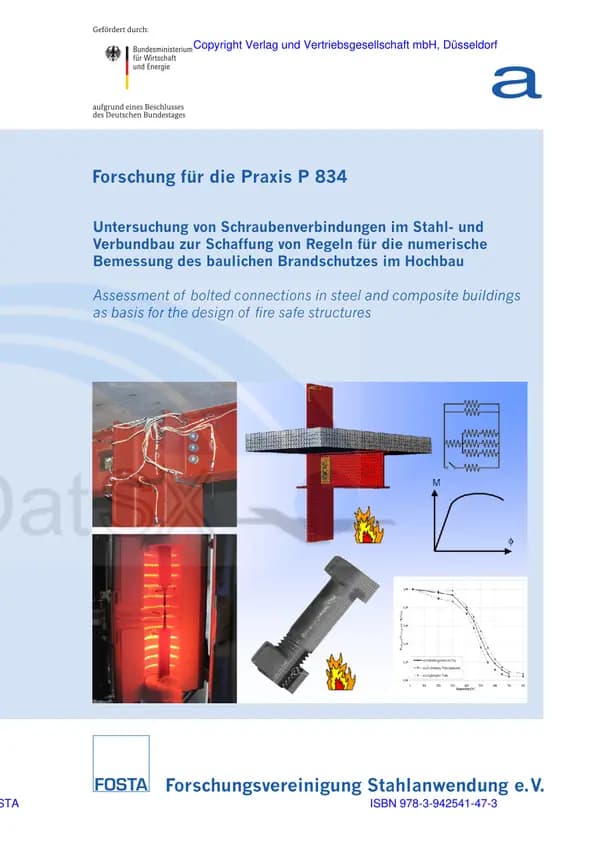
Weld distortion is still one of the main problems in welding technology. It reduces the quality of the welded structure, impedes the smooth execution of the manufacturing process and leads to high post-treatment costs. …
Weld distortion is still one of the main problems in welding technology. It reduces the quality of the welded structure, impedes the smooth execution of the manufacturing process and leads to high post-treatment costs. To find the optimum welding parameters, clamping conditions or pre-deformations for minimising distortion in simple welded constructions, time-consuming and cost-intensive experiments are currently still widely used. Thermomechanical FE simulation is also becoming increasingly popular for this purpose. However, it is reaching its limits in the field of industrially relevant, large structures with multiple weld seams.
Presented here is the analytical numerical hybrid model for weld distortion calculation, which was developed at the Chair of Joining and Welding Technology at BTU Cottbus. Taking into account the significant influencing factors on the plastic deformations occurring during welding, mechanical loads equivalent to the thermomechanical load of each weld seam are determined using the analytical shrinkage force model. These are transferred to a finite element model of the structure and the deformation of the entire structure is calculated using an elastic analysis. The mutual influence of the individual weld seams and different manufacturing steps is taken into account by means of feedback. The methodological approach is explained in detail in the report. In addition to the fundamentals of the hybrid model, other important aspects such as the detection of different types of impact, industry-relevant welding processes and materials, as well as the unstable behaviour of thin-walled structures during welding and curved trajectories in space are also discussed. After verifying the analytical numerical hybrid model on elementary I-joints, application examples are used to demonstrate the procedure. The complexity of the welded constructions considered increases successively, starting with simple I- and T-joints. The model is then applied to a welded construction with eight seams and the recording of different welding scenarios is analysed. This is followed by the calculation of a ship panel which is joined with 88 weld seams in three production steps. The calculated welding distortions of each production step are compared with experimentally determined distortions.
Payment by card (Stripe) or invoice (DE, AT, CH). Download link by email: automatically after ordering by card, after order approval for invoice (valid for 30 days). Terms
Machine-translated title and description. The document itself is in German.
Digital download
Other parts and editions as well as neighbouring documents of the same series.

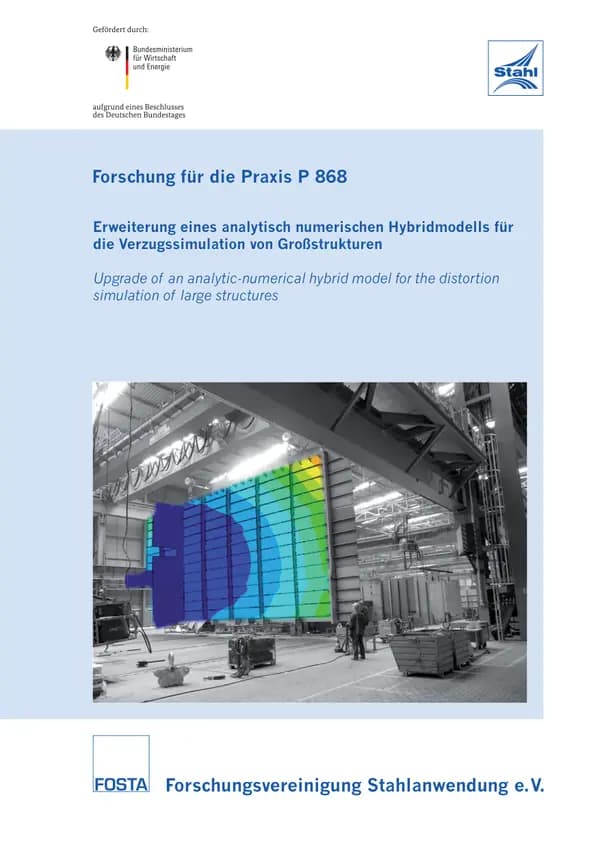
P 834 - Investigation of bolted connections in steel and composite construction for the creation of rules for the numerical design of structural fire protection in building construction In this research project, connections in steel and composite construction with high-strength bolts of strength class 10.9 are investigated in the event of fire. With the introduction of the component method, it is now possible to simulate entire structures at room temperature, taking into account the connection behaviour. This is not yet possible in the case of fire, as on the one hand there is no implementation of the component method or a comparable numerical model for the case of fire and on the other hand there are no validated material laws available for high-strength bolts in the case of fire. For this reason, material parameters for high-strength bolts of strength class 10.9 during and after a fire are initially developed on the basis of test series. This includes both the investigation of the pure bolt material by means of stationary and transient hot tensile tests and the investigation of bolt assemblies in tensile and shear tests. In the latter, not only the material but also the bolt geometry has a major influence on the behaviour. The tests show that the screws fail in the temperature range up to 420°C due to the usual thread stripping. In the temperature range from 420°C to 650°C, however, the screws fail due to a crack in the thread base. It can be shown that this crack is due to liquid metal induced stress corrosion cracking (LME). Above 650°C, the screws fail due to flank bending. As a result of the material investigations, validated material parameters will be available in future for modelling bolts within connection simulations, which take into account the various forms of failure at different temperatures. In addition, thermal and mechanical numerical models will be developed to describe the behaviour of head plate and flag plate connections in steel and composite construction. The models are validated by fire tests on two standard structural connections. Within the tests and the numerical models, a temperature field is taken into account, which is based on the unit temperature-time curve and a typical fire protection coating with an intumescent coating. A head plate connection in steel construction and a flag plate connection in composite construction are analysed. In the case of the flag plate connection, it is assumed that it is a hinged connection at room temperature. It is shown that a moment resistance can occur in the event of fire, provided that the premature failure of the continuous reinforcement is prevented. Finally, simplified spring models are developed for the two connection types on the basis of the component method, which can be used to determine the stiffness and load-bearing capacity of the connections in the event of fire. In summary, it will be possible in future to describe the behaviour of connections in the event of fire on the basis of validated bolt properties using finite element or spring models and to take this into account in structural calculations. The IGF project 16586 N of the Forschungsvereinigung Stahlanwendung e.V., Düsseldorf, was funded via the AiF within the framework of the programme for the promotion of joint industrial research (IGF) by the Federal Ministry for Economic Affairs and Energy on the basis of a resolution of the German Bundestag. The project was carried out at the Gottfried Wilhelm Leibniz University of Hanover by the Institute of Steel Construction and at the Technical University of Darmstadt by the Institute of Steel Construction and Mechanics of Materials. Publication: July 2014
available anytime
€60.00
excl. VAT
Payment by card (Stripe) or invoice (DE, AT, CH). Download link by email: automatically after ordering by card, after order approval for invoice (valid for 30 days). Terms