This research project investigated ways of optimising the energy efficiency of building envelopes in lightweight steel construction. The focus was on the possibility of using incident solar radiation to generate energy …
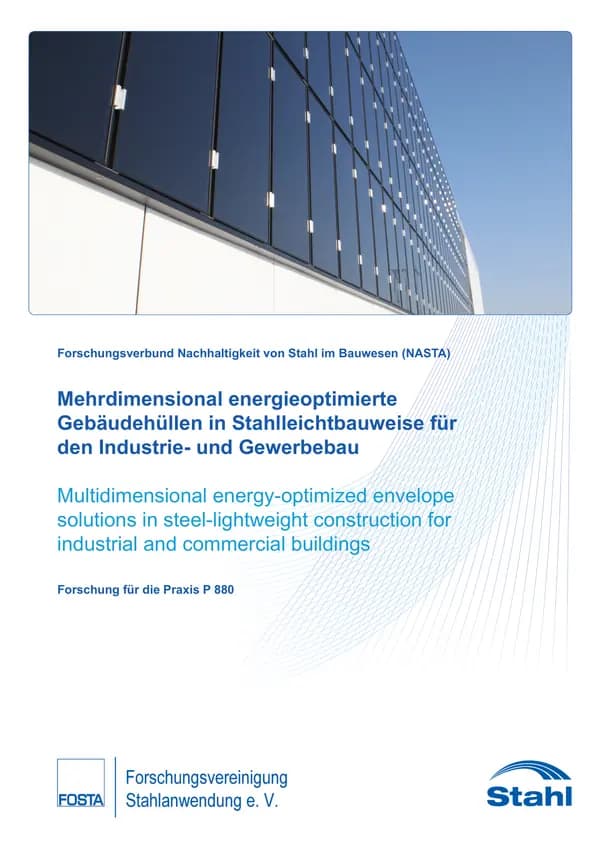
This research project investigated ways of optimising the energy efficiency of building envelopes in lightweight steel construction. The focus was on the possibility of using incident solar radiation to generate energy and minimising energy losses. As industrial and commercial buildings have large surface potentials, the active use of solar gains is particularly promising in this area and there is also great potential for savings by optimising the (passive) physical properties of the building. In order to minimise energy losses, the aspects determining heat transfer (cross-section, thermal bridges, airtightness, structural details) and durability (moisture protection) were analysed and researched with regard to energy optimisation.
Using numerical and experimental methods, conventional and improved building systems in lightweight steel construction (sandwich and multi-shell constructions) were analysed and evaluated. In addition to the reduction of ventilation and transmission heat losses, the avoidance of condensation on and in building components was the subject of research. Innovative PV technology (flexible spherical solar cells) was applied to conventional sandwich elements to generate electricity. The influence of the profiling and possibilities for integrating the module interconnection into the component were investigated. The results achieved were compared with the use of a sandwich element with a commercially available additive PV module in technical, energy and economic terms. Further benefits were achieved by integrating solar thermal components. The outer cover sheet of the sandwich elements served as a solar collector to heat a fluid in pipes installed behind the cover sheet. The FluidBox developed made it possible to continuously connect several "solar sandwiches" in series. Influencing parameters such as colour design, profiling and pipe and connection routing were investigated numerically and experimentally. The combination of the approaches made it possible to optimise interventions in the component structure as a result of the integration of active components directly taking into account possible (passive) energy losses. The energy quality of building envelopes in lightweight steel construction was assessed holistically using sustainability criteria on a reference hall. It was shown that significant savings can be realised through thermally improved sandwich constructions in terms of transmission and ventilation heat transfer. In the passive area, it was shown that some construction types can no longer be used without restriction with regard to the current energy requirements (transmission heat loss). A conventional cassette construction with 3 mm separating strips, for example, no longer represents the state of the art in terms of energy efficiency. With these conventional constructions, a large proportion of the insulation material used is lost thermally as a result of thermal bridging effects; possible more energy-efficient alternatives have been conceptualised, but require further research. The influence of leaks in the building envelope on energy loss was emphasised. With lightweight steel construction systems, it is possible to create an airtight layer free of defects, but this requires precise theoretical planning and proper practical implementation. On the active side, sample components were used to illustrate how incident solar radiation can be utilised to generate energy. The PV technology investigated and the solar sandwich designed represent solutions that can be used on a large scale once integrated into the manufacturing process. Electricity generation using innovative PV components is less efficient than conventional additive systems, but can compensate for this deficit thanks to the larger surface area and the elimination of additional assembly. By utilising solar radiation to heat fluids, the solar sandwich can make a contribution to manufacturing processes in industry and commerce and also provide a share of indoor temperature control. The IGF project 16936 N of the Forschungsvereinigung Stahlanwendung e.V., Düsseldorf, was funded via the AiF within the framework of the programme for the promotion of joint industrial research (IGF) by the Federal Ministry for Economic Affairs and Energy on the basis of a resolution of the German Bundestag. The project was carried out at the Chair of Steel Construction and Light Metal Construction at RWTH Aachen University, the Department of Architecture and Metal Construction at Dortmund University of Applied Sciences, the Department of Environmental Technology and Climate-Friendly Building, the Department of Environmental Informatics and Environmental Management at HTW Berlin and the Research Centre for Steel, Wood and Stone at the Karlsruhe Institute of Technology
Payment by card (Stripe) or invoice (DE, AT, CH). Download link by email: automatically after ordering by card, after order approval for invoice (valid for 30 days). Terms
Machine-translated title and description. The document itself is in German.
Digital download
Other parts and editions as well as neighbouring documents of the same series.

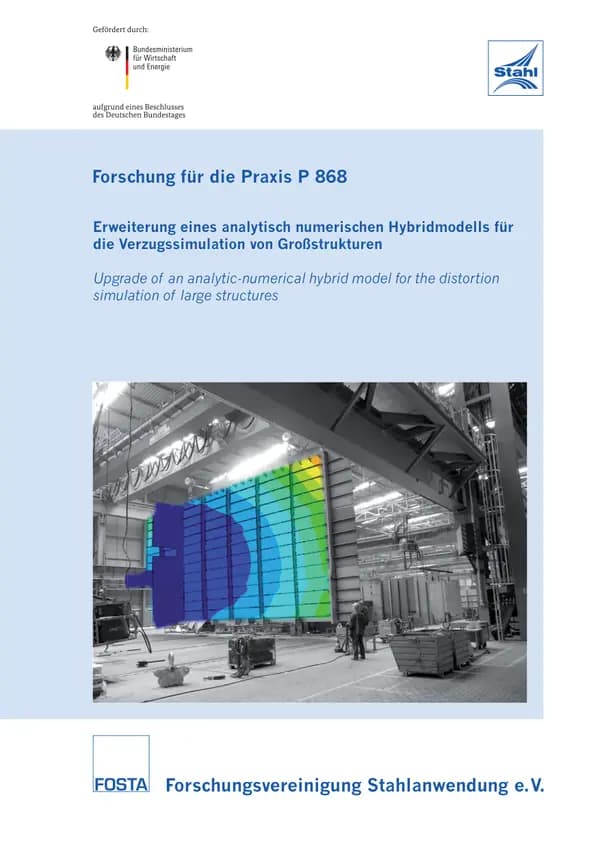
P 868 - Extension of an analytical numerical hybrid model for the warpage simulation of large structures Weld distortion is still one of the main problems in welding technology. It reduces the quality of the welded structure, impedes the smooth execution of the manufacturing process and leads to high post-treatment costs. To find the optimum welding parameters, clamping conditions or pre-deformations for minimising distortion in simple welded constructions, time-consuming and cost-intensive experiments are currently still widely used. Thermomechanical FE simulation is also becoming increasingly popular for this purpose. However, it is reaching its limits in the field of industrially relevant, large structures with multiple weld seams. Presented here is the analytical numerical hybrid model for weld distortion calculation, which was developed at the Chair of Joining and Welding Technology at BTU Cottbus. Taking into account the significant influencing factors on the plastic deformations occurring during welding, mechanical loads equivalent to the thermomechanical load of each weld seam are determined using the analytical shrinkage force model. These are transferred to a finite element model of the structure and the deformation of the entire structure is calculated using an elastic analysis. The mutual influence of the individual weld seams and different manufacturing steps is taken into account by means of feedback. The methodological approach is explained in detail in the report. In addition to the fundamentals of the hybrid model, other important aspects such as the detection of different types of impact, industry-relevant welding processes and materials, as well as the unstable behaviour of thin-walled structures during welding and curved trajectories in space are also discussed. After verifying the analytical numerical hybrid model on elementary I-joints, application examples are used to demonstrate the procedure. The complexity of the welded constructions considered increases successively, starting with simple I- and T-joints. The model is then applied to a welded construction with eight seams and the recording of different welding scenarios is analysed. This is followed by the calculation of a ship panel which is joined with 88 weld seams in three production steps. The calculated welding distortions of each production step are compared with experimentally determined distortions. Authors: V. G. Michailov, C. Stapelfeld, N. Doynov Publication: 2014
available anytime
€30.00
excl. VAT

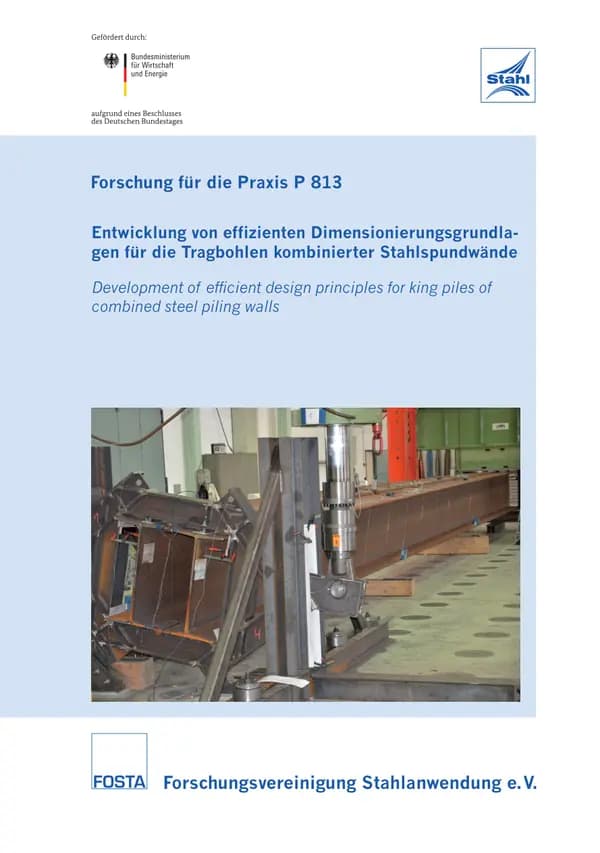
P 813 - Development of efficient dimensioning principles for the bearing piles of combined steel sheet pile walls As world trade has been steadily increasing for decades, the number of containers transported and the size of ships has also increased the demands on the size of quay walls in harbour facilities. The most common steel construction solution for this in deep-water harbours is the combined steel sheet pile wall, which consists of up to 45 m long H-shaped H-shaped load-bearing piles and Z-shaped intermediate piles. Proof of stability must be provided for this construction. With the conversion of the standards from the national DIN 18800 (2008) to the European DIN EN 1993-1-1 (2010), the stability verifications in steel construction have changed. Whereas previously separate verifications could be performed for flexural buckling and lateral-torsional buckling, there is now a combined stability verification. Comparative calculations in harbour construction have shown that the new verification leads to more solid structures. What is currently not taken into account in the design is the structure-soil interaction. This project therefore served to estimate the influence of the soil and to develop ways of recognising previously unconsidered bedding. To this end, a parameter field was first defined that takes into account the current situation and developments in Europe in the near future. The depth of the basin and the nature of the soil were taken into account, as were variations in the design of the sheet pile wall and its loading. The deformation behaviour of an embedded single soldier pile and the behaviour and stiffness due to the flushing sand soil were determined experimentally. The values were used to create a framework model, which led to a parameter analysis and the determination of applicable soil parameters. At the same time, the influence of imperfections and soil bedding on the stability behaviour of soldier piles was investigated using framework models. Single and double bearing piles, different bearing conditions (especially bedding of the pile over the full length or over a partial length) and flexural buckling and lateral-torsional buckling behaviour were considered. In addition, the influence of the welding pattern and degree of welding on the torsional stiffness of partially welded double bearing piles was investigated experimentally and numerically. Based on the findings, solutions were developed to take soil bedding into account in the stability analysis. Finally, simplified criteria were derived from the soil properties, the formulae for incorporating the values into the stability analysis and the verification formulae from DIN EN 1993-1-1, Section 6.3.3 (2010), with which buckling around the weak axis and lateral-torsional buckling can be completely excluded. In summary, it can be said that the soil-structure interaction of combined steel sheet pile walls was investigated with the aid of extensive experimental and numerical investigations and approaches and simplified criteria were developed with which the influence of the soil can be taken into account in the stability analysis. The IGF project 16493 N of the Forschungsvereinigung Stahlanwendung e.V., Düsseldorf, was funded via the AiF within the framework of the programme for the promotion of joint industrial research and development (IGF) by the Federal Ministry for Economic Affairs and Energy on the basis of a resolution of the German Bundestag. The project was carried out at the University of Stuttgart by the Institute for Construction and Design and at the Technical University of Hamburg-Harburg by the Institute for Geotechnics and Construction Management. Authors: U. Kuhlmann, B. Leitz, A. Just, J. Grabe, C. Schallück Publication: 2014
available anytime
€40.00
excl. VAT
Payment by card (Stripe) or invoice (DE, AT, CH). Download link by email: automatically after ordering by card, after order approval for invoice (valid for 30 days). Terms