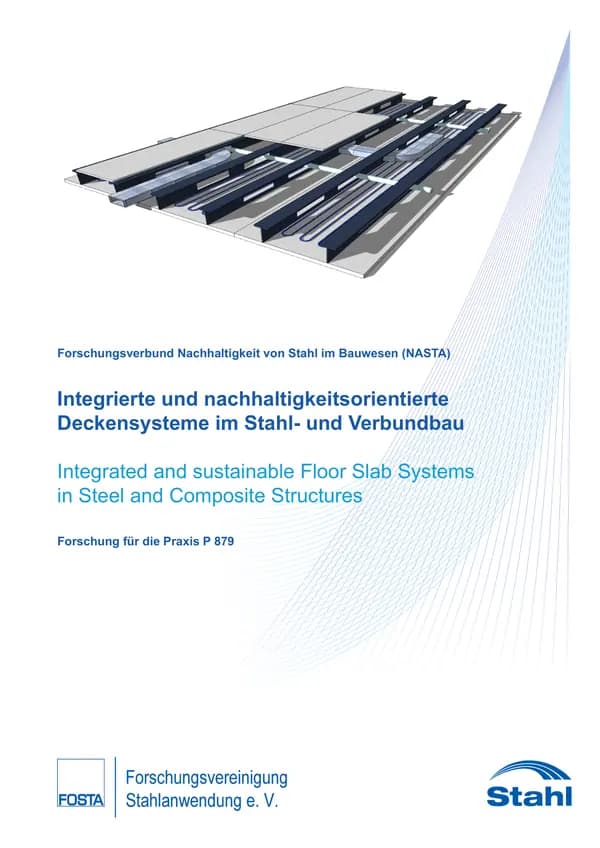
P 879 - Integrated and sustainability-orientated ceiling systems in steel and composite construction
In this research project, an integrated ceiling system was developed that enables flexible building utilisation over the entire life cycle. The task was carried out according to practical requirements by a project team …
Content
- Authors
- J. Hegger, M. Claßen, M. Feldmann, D. Pyschny, P. Schaumann, W. Weisheim, D. Bohne, S. Hargus
- Publication
- 2016
In this research project, an integrated ceiling system was developed that enables flexible building utilisation over the entire life cycle. The task was carried out according to practical requirements by a project team with complementary research areas. In the structural design research area, the load-bearing and deformation behaviour of the filigree, prestressed composite floor beams with web openings and composite dowel bar was investigated. Experimental and numerical investigations were carried out for this purpose. The disturbed shear force transfer in the area of the large web openings posed a particular investigation problem.
Show full description
On the basis of the investigations carried out, an engineering model was derived to determine the shear force bearing capacity of the floor system with web openings. In addition, structural dynamic investigations were carried out on the ceiling element in order to assess the effects of pedestrian-induced vibrations. The fire protection research area included investigations into the load-bearing and deformation behaviour of the ceiling system in the event of fire. Two different fire scenarios were analysed in experimental and numerical studies: A fire below the ceiling system and a cable fire in the ceiling cavity. In order to reduce the number of potential failure mechanisms in the experimental investigations, the ceiling system was designed with a composite dowel strip, but without large web openings. In particular, the influence of thermal expansion on the prestressing forces and the deformation behaviour was investigated. The observed effects were also analysed on a numerical level in parameter studies. In order to optimise the thermal properties of the ceiling system (particularly in the case of cooling), two technical principles were pursued in the Building Physics research area: On the one hand, passive cooling, in which the natural temperature fluctuations between day and night are utilised to keep the summer room temperatures within the target range. On the other hand, component activation is another option for optimising the indoor climate, in which pipes are integrated into the ceiling system in order to dissipate heat in a targeted manner via a water circuit. Based on typical spatial arrangements in office and administrative buildings, three different load cases were identified in the Building Technology research area. A ventilation concept was developed to determine the necessary support openings for the developed ceiling system and a duct design was proposed for the variants. Finally, a sustainability assessment of the developed ceiling system was carried out. Using the DGNB criteria catalogue, relevant criteria for steel composite ceilings were selected and the ceiling system was assessed in terms of its ecological, economic, socio-cultural and functional quality. At the "component", "supporting structure" and "overall building" levels and taking into account specific usage scenarios, the possible influencing factors of steel composite construction on the life cycle assessment of a building were identified and optimisation options worked out. Overall, the research results lead to a sustainable steel composite ceiling system that integrally and holistically takes into account the requirements resulting from building technology and sustainability aspects and can be used in building construction. With spans of up to 16 m, payloads of up to 5 kN/m² and excellent vibration behaviour, the sustainable steel composite ceiling system makes it possible to completely dispense with load-bearing internal walls and internal supports, so that variable floor plan arrangements, a high degree of adaptability to dynamic user profiles and permanently flexible building use with residential, office and mixed use in any chronological order can be achieved. The IGF project 371 ZN of the Forschungsvereinigung Stahlanwendung e.V., Düsseldorf, was funded via the AiF within the framework of the programme for the promotion of joint industrial research (IGF) by the Federal Ministry for Economic Affairs and Energy on the basis of a resolution of the German Bundestag. The project was carried out by the Institute and Chair of Solid Construction at RWTH Aachen University, the Institute of Steel Construction at RWTH Aachen University, the Institute of Steel Construction at Leibniz Universität Hannover and the Institute of Design and Construction at Leibniz Universität Hannover
Zum Zoomen hovern
€50.00excl. VAT
Payment by card (Stripe) or invoice (DE, AT, CH). Download link by email: automatically after ordering by card, after order approval for invoice (valid for 30 days). Terms
P 879 - Integrated and sustainability-orientated ceiling systems in steel and composite construction—
€50.00