Matplus LogoMatplus Shop
/
/
HomeStoreFOSTAFOSTA Documentation
Topics
Matplus LogoMatplus ShopFollow us on LinkedIn
FOSTA
  • FOSTA Overview
  • FOSTA Documentation
  • Topics
  • Technical Standards
  • Steel-iron worksheets (SEB)
  • Steel and iron usage lists (SEE)
  • Steel-iron delivery terms (SEL)
  • Steel-iron test sheets (SEP)
  • Steel-iron material sheets (SEW)
Legal
  • FAQ
  • Imprint
  • Cookie Policy
  • Privacy Policy
  • Legal Notice
  • Withdrawal policy
  • Withdraw from contract
  • General Terms and Conditions

Payment by card (Stripe) or invoice (DE, AT, CH) · Digital delivery: download link to your PDFs by email, automatically after ordering by card, after order approval for invoice; valid for 30 days.

© 2026 Matplus Shop. All rights reserved.

Header
FOSTA

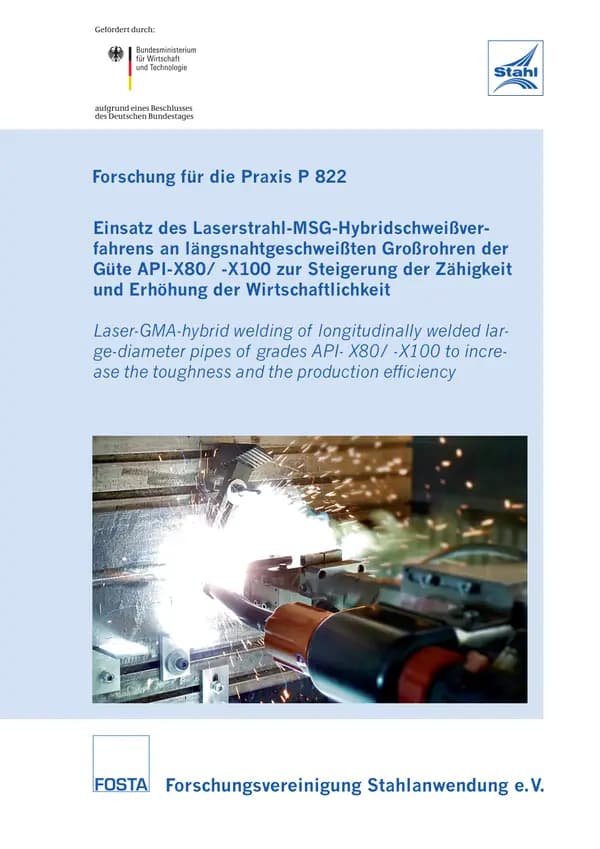
P 822 - Use of the laser beam-MSG hybrid welding process on longitudinally welded large-diameter pipes of grade API-X80/ -X100 to increase toughness and efficiency

A significant proportion of modern oil and gas pipelines are made from longitudinally welded large-diameter pipes in API steel grades X65 (L450, 1.8726) and X70 (L485, 1.8727). Constantly increasing natural gas and …

Content

Authors
M. Rethmeier, S. Gook, A. Gumenyuk
Publication
2013

A significant proportion of modern oil and gas pipelines are made from longitudinally welded large-diameter pipes in API steel grades X65 (L450, 1.8726) and X70 (L485, 1.8727). Constantly increasing natural gas and crude oil production rates in conjunction with minimising wall thickness or increasing operating pressure will in future require corresponding material substitutions with modern higher-strength materials, such as API-X80 (L555, 1.xxxx), X100 (L690, 1-xxxx) and X120, with sufficient strength and toughness. The submerged arc welding process is used to weld these pipes. The entire pipe length is first welded with a continuous MSG tack weld.

Show full description

To increase economic efficiency, this process step is to be replaced by the laser beam-MSG hybrid welding process. For the safe operation of large-diameter pipes, the required impact strength of the welded joint must be observed in addition to the strength properties. Against this background, the primary research objective of this research project was to define and systematically investigate the achievement of sufficient toughness in the temperature range of -60°C and -40°C with economic process parameters. Suitable filler materials (solid wire and flux-cored wire electrodes) were identified for the laser-MSG hybrid welding of the aforementioned high-strength pipeline materials and systematic studies were carried out on the dependence of toughness on solidification behaviour and the achievable mixing depth. Increased economic efficiency when using laser hybrid technology is seen primarily in the modified seam preparation. A constructive change in the joint shape leads to a reduction in the seam volume and thus to a considerable reduction in production costs, because in this case the amount of filler material required to fill the seam is reduced. Based on demonstrators produced, an approx. 2.7-fold reduction in the seam cross-section and thus the required quantity of filler material is demonstrated. The IGF project 16415 N of FOSTA -Forschungsvereinigung Stahlanwendung e.V., Düsseldorf, was carried out at the Federal Institute for Materials Research and Testing (BAM), Department 9.3 "Welding Manufacturing Processes", Berlin, and funded by the Federal Ministry of Economics and Technology via the AiF as part of the programme for the promotion of joint industrial research and development (IGF) on the basis of a resolution of the German Bundestag.
P 822 - Use of the laser beam-MSG hybrid welding process on longitudinally welded large-diameter pipes of grade API-X80/ -X100 to increase toughness and efficiency
Zum Zoomen hovern
€30.00excl. VAT

Payment by card (Stripe) or invoice (DE, AT, CH). Download link by email: automatically after ordering by card, after order approval for invoice (valid for 30 days). Terms

P 822 - Use of the laser beam-MSG hybrid welding process on longitudinally welded large-diameter pipes of grade API-X80/ -X100 to increase toughness and efficiency—
€30.00
Machine-translated title and description. The document itself is in German.

What's included

✓

Digital download

Similar documents

Other parts and editions as well as neighbouring documents of the same series.

  • Thumbnail
    FOSTA

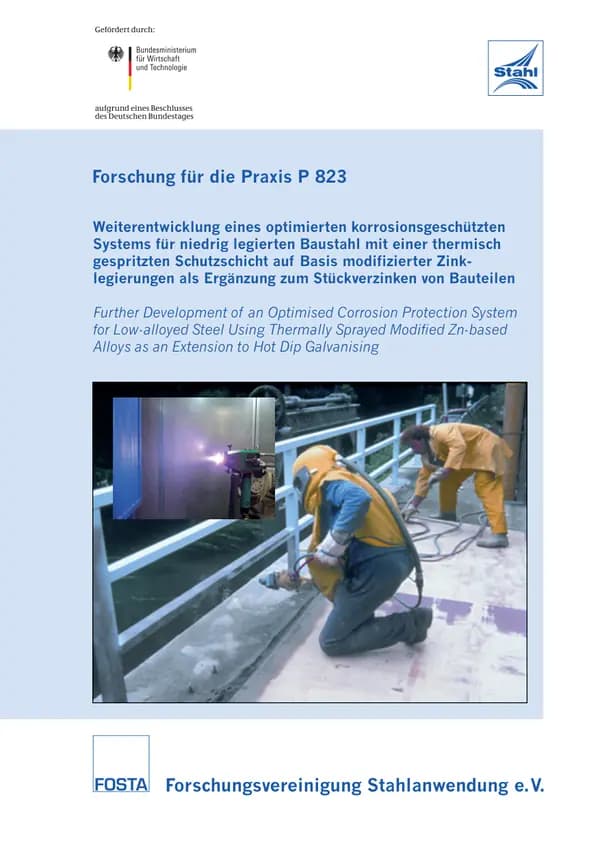
    P 823 - Further development of an optimised corrosion-protected system for low-alloy structural steel with a thermally sprayed protective coating based on modified zinc alloys as a supplement to batch galvanising of components

    P 823 - Further development of an optimised corrosion-protected system for low-alloy structural steel with a thermally sprayed protective coating based on modified zinc alloys as a supplement to batch galvanising of components Thermal spraying is an alternative process for the cathodic corrosion protection of steel structures that cannot be batch galvanised. In this research project, new thermally sprayed coating materials based on ZnCr, ZnSnAl and ZnMgAl were developed as a supplement to hot-dip galvanised coatings, with the latter alloy exhibiting corrosion protection properties that are better than those of ZnAl15 (currently frequently used). The developed coatings and relevant reference materials were first subjected to a basic characterisation to determine porosity, microhardness, chemical composition and adhesion strength. Electrochemical corrosion tests, the salt spray test and the VDA alternating test were carried out to evaluate the corrosion resistance of the analysed systems. The electrochemical corrosion tests showed that the corrosion rates of ZnMgAl and ZnAl15 are the lowest. In the salt spray test, sheets without an organic coating and with two organic top coats were exposed for up to 2,448 h and then analysed macro/microscopically. With an organic coating, no metallic coating system showed any failure during the test period. In the salt spray tests without organic coating, the ZnMgAl alloy showed the least corrosive attack. A chemical analysis of the corrosion products formed showed analogies to strip-galvanised ZnMgAl alloys. In the VDA alternating test, the thermally sprayed systems with a low Al content had the lowest corrosion infiltration on an artificially introduced crack. Parallel to the corrosion tests, the sustainability of the coating systems under consideration was evaluated, with a cost comparison also being carried out in order to assess the potential of the respective technologies (hot-dip galvanising / thermal spraying) and materials used. If a service life of more than 40 years is aimed for, then the coating systems with TS layers of ZnAl15 and ZnMgAl represent the most sustainable solutions for corrosion protection in the overall assessment. A 2-year outdoor weathering of selected coating systems since June 2012 is intended to substantiate the findings from the laboratory tests carried out. The IGF project 16434 N of FOSTA -Forschungsvereinigung Stahlanwendung e.V., Düsseldorf, was funded via the AiF as part of the programme for the promotion of joint industrial research and development (IGF) by the Federal Ministry of Economics and Technology on the basis of a resolution of the German Bundestag. The project was carried out at the Chair of Surface Technology in Mechanical Engineering, RWTH Aachen University, at the Institute of Ferrous Metallurgy, RWTH Aachen University, and at the Institute and Chair of Steel Construction and Light Metal Construction, RWTH Aachen University. Authors: K. Bobzin, C. Schulz, W. Bleck, T. Ingendahl, M. Feldmann, C. Heinemeyer Publication: 2013

    available anytime

    €30.00

    excl. VAT

    View details →
  • Thumbnail
    FOSTA

    P 820 - Development of solar absorbers in steel construction based on partially clad hybrid semi-finished products

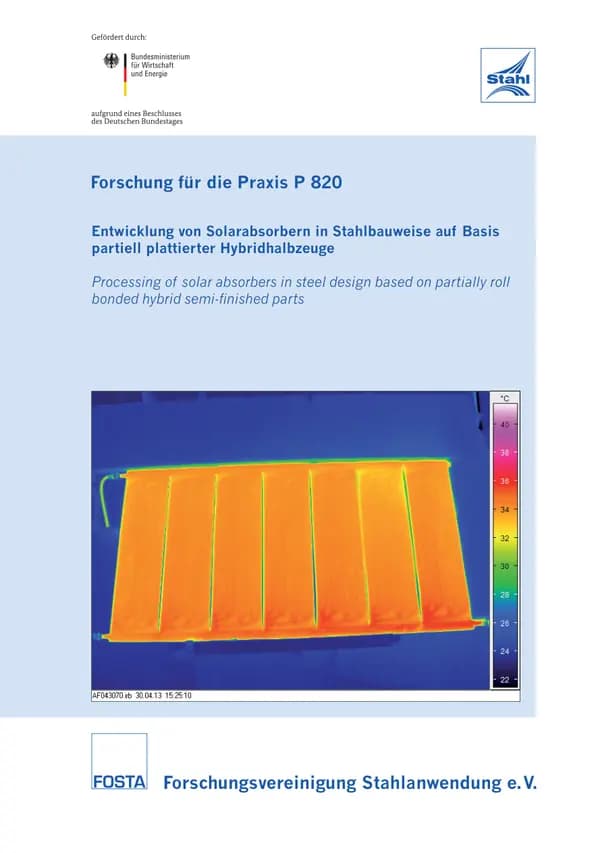
    P 820 - Development of solar absorbers in steel construction based on partially clad hybrid semi-finished products In the project, a demonstrator solar absorber with a full-surface flow was produced, which has a bionic channel design (FracTherm®). The structure of the absorber was kept modular, so that this concept offers the possibility of flexible collector sizes and thus an additional architectural benefit. This was made possible by the process chain of partial cold roll cladding and subsequent hydroforming. In this process, two sheet metal strips are rolled together to form a partially clad semi-finished product. Taking into account the elongation caused by the rolling process, a release agent is applied to the strip, which prevents the sheets from cladding along the channel structure that will later form. The semi-finished product produced in this way consists of a three-layer material composite (copper-steel-copper) on the upper side and pure steel on the underside. There are significant cost advantages for a pure steel-steel composite. A special sealing concept is required for the subsequent forming with internal high pressure. This was solved here with a conical docking nozzle and elastomer seal. Welding on connection points is not possible due to the steel-copper material pairing. The semi-finished products were formed using a forming tool in a high-pressure sheet metal forming press with a clamping force of 22.5 MN and an effective medium pressure of 65 MPa. The measurement of the flow through the demonstrator absorber by thermographic measurement shows good distribution. The pressure loss is comparatively low. The collector efficiency factor F', a key factor influencing thermal efficiency, is very good despite the low thermal conductivity of steel thanks to a suitable channel design: the performance measurements indicate a collector efficiency factor F' in the technical range or slightly above. Steel has so far only been used to a limited extent in solar absorbers. With the help of the innovative process chain shown here, the use of steel can be increased. In combination with the bionic design, there are further advantages for increasing the utilisation of solar thermal energy. The modular concept also opens up previously untapped utilisation potential for better integration of solar thermal energy in architecture. The IGF project 339 ZN of the Forschungsvereinigung Stahlanwendung e.V., Düsseldorf, was funded via the AiF as part of the programme to promote joint industrial research (IGF) by the Federal Ministry for Economic Affairs and Energy on the basis of a decision by the German Bundestag. The project was carried out at the Institute for Forming Technology and Lightweight Construction, TU Dortmund and the Fraunhofer Institute for Solar Energy Systems, Freiburg. Authors: A. E. Tekkaya, F. Steinbach, L. Koch, M. Hermann Publication: 2015

    available anytime

    €20.00

    excl. VAT

    View details →
  • Thumbnail
    FOSTA

    P 827 - Development of a Eurocode-based design concept for bonded joints in steel construction (based on DIN EN 1990)

    P 827 - Development of a Eurocode-based design concept for bonded joints in steel construction (based on DIN EN 1990) Despite the many advantages of adhesive bonding as a joining method, this technology has not yet been able to establish itself in the construction industry in general and in steel construction in particular. The reason for this is that structural engineers, architects and building owners have doubts about the verifiability, durability and load-bearing capacity of bonded steel structures. In order to make this innovative bonding technology usable in the construction industry, it is necessary to process bonded joints in a standardised manner. The aim of the research project is to develop design concepts for bonded joints in steel façade construction. Publication: 2013 Authors: Prof Dilger, Prof Pasternak

    available anytime

    €30.00

    excl. VAT

    View details →
  • Thumbnail
    FOSTA

    P 828 - Robustness and reliability of calculation methods of bonded joints with high-strength steel sheets under crash conditions

    P 828 - Robustness and reliability of calculation methods of bonded joints with high-strength steel sheets under crash conditions The previous project "Development of methods for the calculation of high-strength steel adhesive joints in vehicle construction under crash load" (P676) was completed in spring 2007. The work carried out is used in industrial applications as a basis for the crash calculation of vehicle (part) models and components. A total of five material models for adhesives and adhesive layers emerged from the project. It was not possible to select a model to be favoured on the basis of the project results at that time. The question of the robustness of the methods and the reliability of the predictions also remained unanswered. The current project addressed these issues. The models focussed on two fundamentally different approaches and their further development. The experiments were extended in their range of load cases and load velocities compared to the previous project and their measurement technology was improved. Both the measurement uncertainty and the scatter of the results were analysed. This information was included in the parameter identification in order to determine the reliability and sensitivity of the parameters. The effect of the uncertainty of the parameters was in turn analysed in the simulations of the validation tests. Overall, this provided a picture of the accuracy of the advanced modelling and parameter identification methods. Furthermore, the analyses show for which experiments a reduction of the scattering would particularly contribute to increasing the predictive accuracy of the models and to what extent the experimental database suggests a model reduction. The choice of experiments for parameter identification had at least as great an influence as the scattering of the experiments, for example the use of the tensile shear or compressive shear test to characterise the shear behaviour. Various validation tests were simulated with several parameter sets, from which the tests for parameter identification were determined which led to the best agreement with the experiments. However, it could not be conclusively clarified why not all tests can be simulated equally well with one parameter set. Therefore, the differences between simulations with different parameter sets are to be understood as the current uncertainty of the crash simulation of bonded structures. On average, agreement between tests and simulations was achieved to within 20 %. Publication: 2016 Authors: Dr M Brede, Dr.-Ing. O. Hesebeck, Dr.-Ing. St. Marzi, Dipl.-Math. Techn. N. Nörenberg, Dr. M. May, Dipl.-Ing. S. Kilchert, M.Sc. H. Voß, Prof. Dr.-Ing. A. Matzenmiller, Dr.-Ing. F. Burbulla, Dr. D. Memhard, Dr. W. Böhme, M.Sc. J. Lienhard, Dipl.-Ing. (FH) C. Fehrenbach

    available anytime

    €30.00

    excl. VAT

    View details →
€30.00excl. VAT

Payment by card (Stripe) or invoice (DE, AT, CH). Download link by email: automatically after ordering by card, after order approval for invoice (valid for 30 days). Terms

P 822 - Use of the laser beam-MSG hybrid welding process on longitudinally welded large-diameter pipes of grade API-X80/ -X100 to increase toughness and efficiency—
€30.00