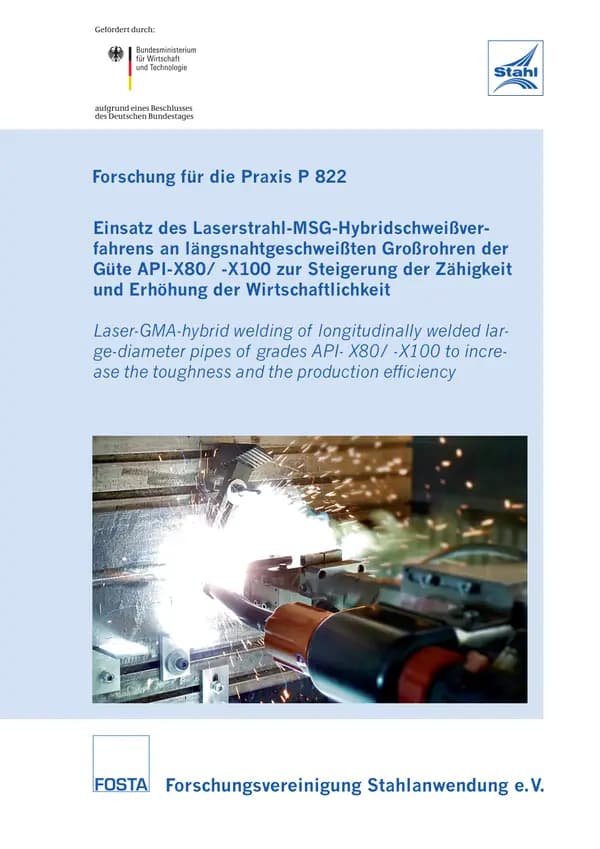
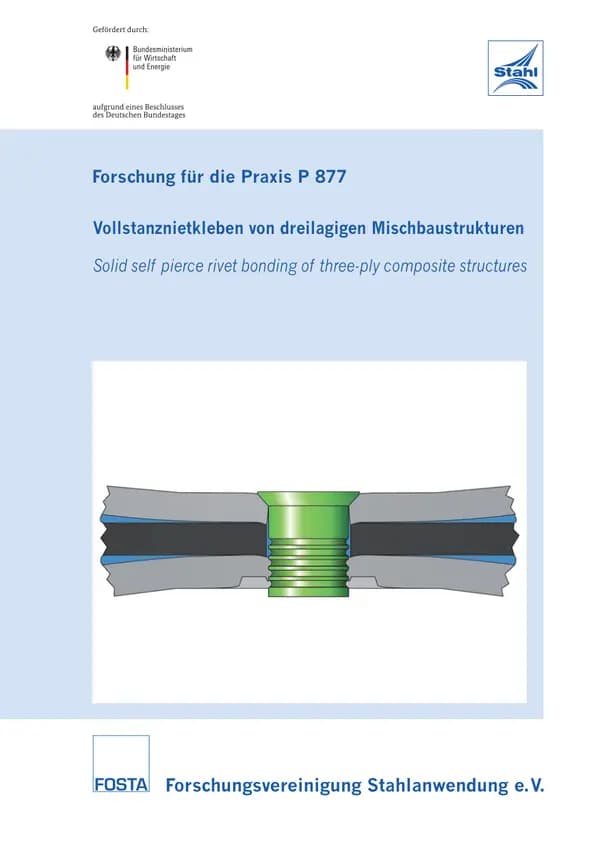
P 877 - Full-punch rivet bonding of three-layer mixed structures
Full self-pierce riveting in combination with an adhesive joining process has great potential for the joining of high-strength mixed construction joints. The focus of this project is on the full-punch rivet bonding of …
Content
- Authors
- G. Meschut, O. Hahn, M. Bergau
- Publication
- 2015
Full self-pierce riveting in combination with an adhesive joining process has great potential for the joining of high-strength mixed construction joints. The focus of this project is on the full-punch rivet bonding of three-layer mixed joints with the aim of determining the performance of the joining system. As part of this research project, investigations were carried out into the elementary processes of self-pierce riveting and adhesive bonding as well as the hybrid process of these joining techniques. As a result, both the starting point of the elementary joining processes and the extraordinary application potential and development requirements of the hybrid joining technology of self-pierce riveting and adhesive bonding were identified.
Show full description
On the basis of the knowledge gained, it was then possible to the knowledge gained, approaches for process optimisation could be derived and their influence on the joint formation and the load-bearing behaviour behaviour of the joints. Furthermore, these optimisation steps were used to further develop the process. With regard to the hybrid joining process of full-punch rivet bonding, problems are presented that result from the high process forces in interaction with the tribological system. Based on the existing interactions, changing the functional principle of the self-pierce riveting tools was a significant aspect of the investigations. The redesign of the tools led to the avoidance of critical joining part deformations and optimised adhesive bonding as well as homogeneous adhesive layer formation. A one-piece die concept was retained and reworked with an adapted basic shape. The performance of the optimised joining technology was The performance of the optimised joining technology was demonstrated by comparative tests with a multi-part die concept. The optimised tool concepts were also demonstrated by means of load-bearing capacity tests of elementary and hybrid joints under static and dynamic load application. Compared to the initial situation of the elementary joining processes, the maximum force and work absorption of the joints could be significantly increased. Finally, the findings of the hybrid joining process gained from the research project are derived as manufacturing recommendations. The IGF project 16820 N of the Forschungsvereinigung Stahlanwendung e.V. - FOSTA, Düsseldorf, was funded by the AiF. funded via the AiF as part of the programme to promote joint industrial research (IGF) by the Federal Ministry for Economic Affairs and Energy on the basis of a resolution of the German Bundestag. The research project was carried out at the Laboratory for Materials and Joining Technology at Paderborn University.
Zum Zoomen hovern
€30.00excl. VAT
Payment by card (Stripe) or invoice (DE, AT, CH). Download link by email: automatically after ordering by card, after order approval for invoice (valid for 30 days). Terms
P 877 - Full-punch rivet bonding of three-layer mixed structures—
€30.00