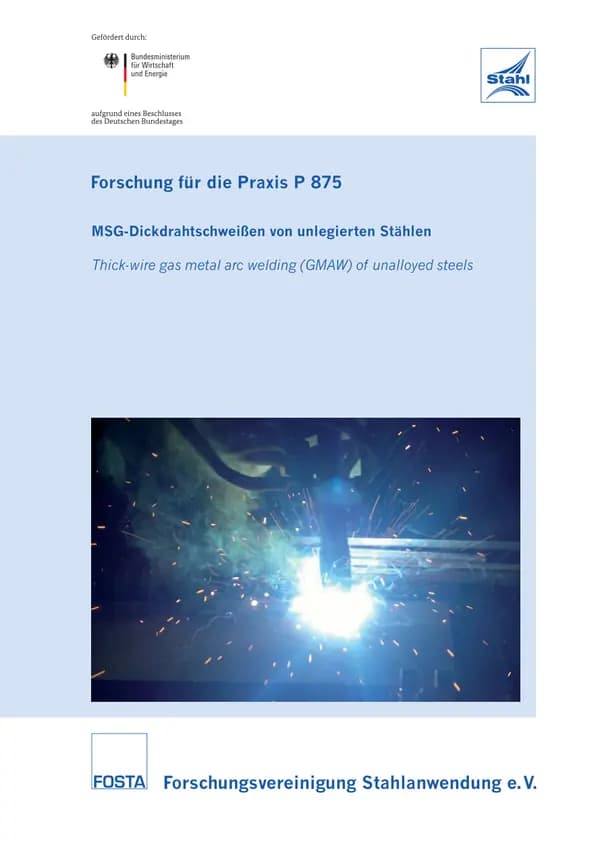
P 875 - MIG thick-wire welding of unalloyed steels
As part of the project, fundamental investigations were carried out on MSG welding with "thick" wire electrodes up to 4 mm. The test welds to investigate the process were carried out with solid wire electrodes on a …
Content
- Authors
- R. Agsten, S. Brumm
- Publication
- 2015
As part of the project, fundamental investigations were carried out on MSG welding with "thick" wire electrodes up to 4 mm. The test welds to investigate the process were carried out with solid wire electrodes on a tubular test specimen made of low-alloy steel as build-up beads with CV and CC characteristics. During the welds, the current and voltage values were recorded and synchronised high-speed recordings were made. These were used to observe and assess droplet formation, detachment and arc formation. The evaluation of the high-speed recordings showed that it is not possible to categorise the welding power, as is known from GMAW welding with wire diameters up to 1.6 mm, into short, transition and spray arcs with wire diameters > 3 mm.
Show full description
A very short arc that burns below the sheet surface has proven to be advantageous in all power ranges. This reduces spatter formation. With long arcs that emerge from the sheet surface, the weld metal is displaced from the joining zone and a cutting effect occurs. It was also found that both current source characteristics can be used in principle. When comparing the characteristic curves, the CC characteristic curve produces a much more stable process. In addition, spatter formation is lower than when using the CV characteristic curve. The arc length changes with each droplet detachment, which is compensated for by controlling the current source. A ΔU control causes a voltage change, which has a positive effect on low-spatter droplet detachment. In contrast, ΔI control causes current fluctuations of up to 400 A when the arc length changes due to droplet detachment, which leads to the droplet being blown away. The CC characteristic curve was therefore used for the joint welds. By adding 30 % Ar to the CO2, it was possible to further reduce spatter formation. Higher proportions of Ar were not effective. Due to the short arcs burning below the sheet surfaces, the arc plasma is dominated by metal vapour. It determines the penetration shape and droplet detachment. The penetration can be influenced by changing the line energy. With the same welding power, penetration and deposition rate can be increased by reducing the wire diameter. This is due to the higher current density. As a rule of thumb: wire diameter times 200 is the adjustable welding current intensity at which a stable process and acceptable weld seams are produced (3.2 mm wire corresponds to approx. 640 A). As a result, deposition rates of over 8 kg/h can be achieved. Joint welds were carried out on sheets with thicknesses of 12, 15 and 20 mm. A 4.0 mm electrode of grade G3Si1 was used for this purpose. As no other wire grades were available, welding with the materials S460M and S690QL was dispensed with in consultation with the pbA. Instead, more work was done to analyse and assess the process. The visual inspections and dye penetrant tests revealed that the weld seams were of high quality in terms of the surface with regard to penetration notches, surface pores and cracks, with a few exceptions. The radiographic testing revealed that pores had formed inside the seam due to discontinuous wire feeding. Nevertheless, the project was able to produce pore-free seams. Hardness measurements, tensile tests and notched bar impact tests were carried out to determine the mechanical-technological quality values. The results showed excellent properties of the weld metal. The hardness peaks in the area of the heat-affected zone at the fusion line reached maximum values of 326 HV10. In addition, the notched impact strength of the weld metal proved to be far better than that of the base material. In the tensile tests of the joint welds, the fracture occurred in the base material with one exception. The cause of the failure in the joining zone was a pore nest at the end of the weld, which was caused by process instabilities. In comparison with submerged arc welding, it can be seen with regard to the seam formation that the surface scaling and shaping of the seam exterior is significantly better with submerged arc welding. Adjusting the seam width via the arc voltage, as is possible with submerged arc welding, cannot be realised with thick wire welding due to the very short arcs to be set. The seam width can only be adjusted slightly via the welding speed. It must also be mentioned that, in contrast to UPS welding, GMAW thick wire welding is a very sensitive process in which the smallest process instabilities, such as discontinuous wire feeding and stagnation in the welding movement, lead to pores and pockets. Continuous feeding of the wire and the welding movement is therefore absolutely essential. At present, it is not possible to speak of a robust MSG thick wire technology. The wire feeding system used must be fundamentally revised for this purpose. In conclusion, it can be said that GMAW thick-wire welding can be carried out reliably if all process-related features are observed. The tests showed that the position-counterposition technique is recommended. Welds on 20 mm sheets could be carried out reliably at welding speeds of 90 cm/min. The IGF project 16938 BR of the Forschungsvereinigung Stahlanwendung e.V., Düsseldorf, was funded via the AiF within the framework of the programme for the promotion of joint industrial research (IGF) by the Federal Ministry for Economic Affairs and Energy on the basis of a resolution of the German Bundestag. The project was carried out at Chemnitz University of Technology at the Institute for
Zum Zoomen hovern
€30.00excl. VAT
Payment by card (Stripe) or invoice (DE, AT, CH). Download link by email: automatically after ordering by card, after order approval for invoice (valid for 30 days). Terms
P 875 - MIG thick-wire welding of unalloyed steels—
€30.00