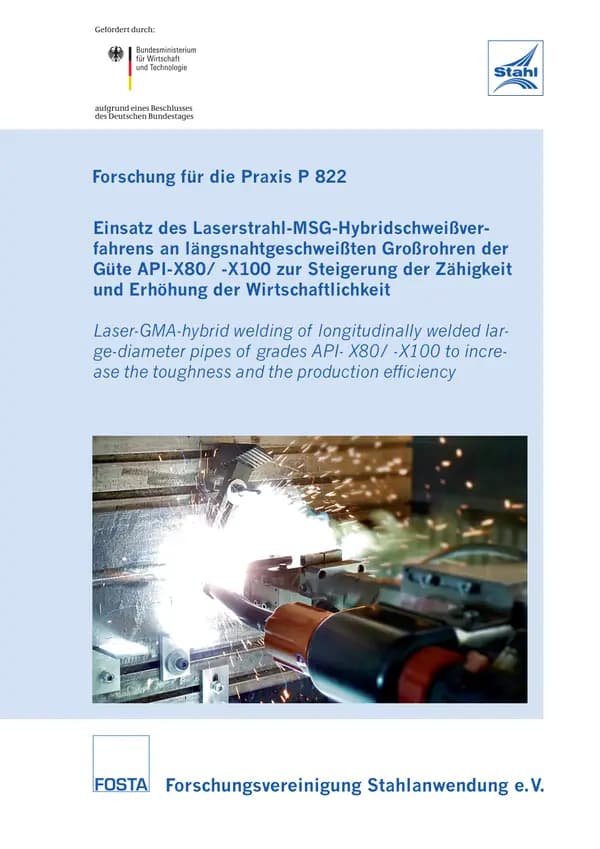
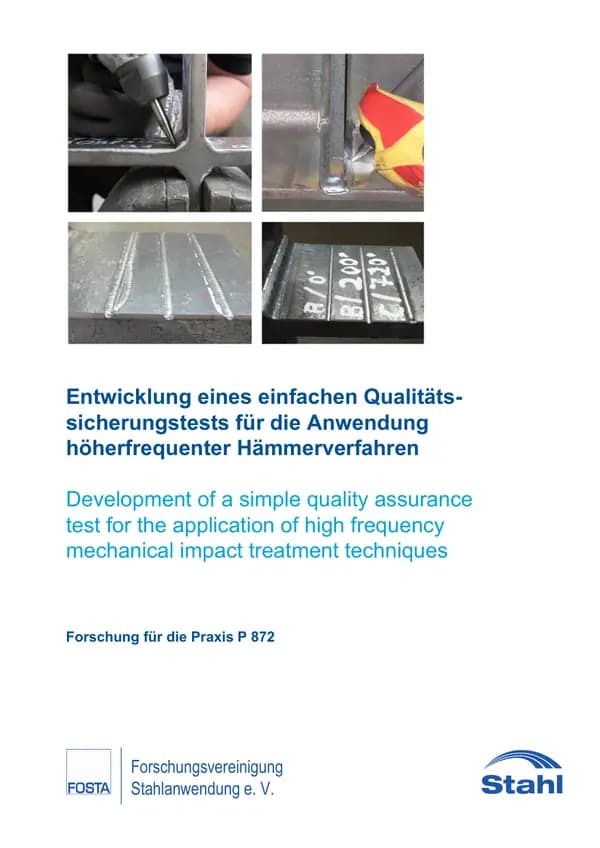
P 872 - Development of a simple quality assurance test for the application of high-frequency hammering processes
1. analogue to the Almen test in shot peening, a test strip adapted to HFH procedures was to be developed. After HFH treatment of the test strip, it should be possible to determine or check the intensity of the …
Content
- Publication
- March 2020
- Authors
- Prof. Dr.-Ing. T. Ummenhofer, Dipl.-Ing. P. Weidner, Prof. Dr.-Ing. U. Kuhlmann, Dr.-Ing. K. Kudla, SFI, Dipl.-Ing. St.Breunig
P 872 - Development of a simple quality assurance test for the application of higher-frequency hammering processes The fatigue-strengthening effect of high-frequency hammering (HFH) has been demonstrated on a large number of construction details suitable for post-treatment. In addition to recognised rules for dimensioning and the qualification of users, the reliable use of HFH methods also requires the qualification and quality assurance of the device and its operating settings. In addition, proof of sufficient post-treatment quality on the component is required. Three different approaches initially appear possible here, which were investigated as part of this brief study and a parallel DASt research project.
Show full description
In particular, the following approaches were tested for their effectiveness and ease of implementation: 1. analogue to the Almen test in shot peening, a test strip adapted to HFH procedures was to be developed. After HFH treatment of the test strip, it should be possible to determine or check the intensity of the post-treatment based on the deflection of this test strip. 2. determination of the penetration depth. The penetration depth can be determined by comparing a 3D laser measurement before and after post-treatment. The penetration depth should serve as a parameter for estimating the intensity of the post-treatment. 3. investigations with hardness measurements on post-treated and untreated weld seam transitions have shown differences in hardness. The quality of the post-treatment can possibly be assessed on the basis of the hardness comparison. The aim of this short study is to develop a simple and practical quality assurance procedure that can be used under normal manufacturing conditions. The effectiveness of the application of the HFH methods should also be guaranteed. As a result, a combination consisting of a simple visual inspection of the post-treatment track on the structure and a random sample with defined hardness testing is proposed for the quality assurance of the higher-frequency hammering processes. Appropriate gauges for measuring and documenting the indentation depths must then be used as part of the visual inspection. Further residual stress measurements could, if necessary, contribute to the verification of permissible hardness values and provide information on the residual compressive stresses introduced as a result of varying intensities.
Machine-translated title and description. The document itself is in German.
Zum Zoomen hovern
€20.00excl. VAT
Payment by card (Stripe) or invoice (DE, AT, CH). Download link by email: automatically after ordering by card, after order approval for invoice (valid for 30 days). Terms
P 872 - Development of a simple quality assurance test for the application of high-frequency hammering processes—
€20.00
What's included
✓
Digital download