Cold forming is particularly suitable in large-scale production for the manufacture of a wide range of parts with high quality requirements. In particular, steel materials are used that are characterised by very high …
Cold forming is particularly suitable in large-scale production for the manufacture of a wide range of parts with high quality requirements. In particular, steel materials are used that are characterised by very high mechanical strength and a high-quality surface finish after cold forming. In the automotive industry in particular, there is an immense demand for components manufactured using forming technology, where safety, reliability and durability are important. During the production phase of these cold-formed cold-formed components can often lead to production downtime due to workpiece damage, which reduces economic efficiency.
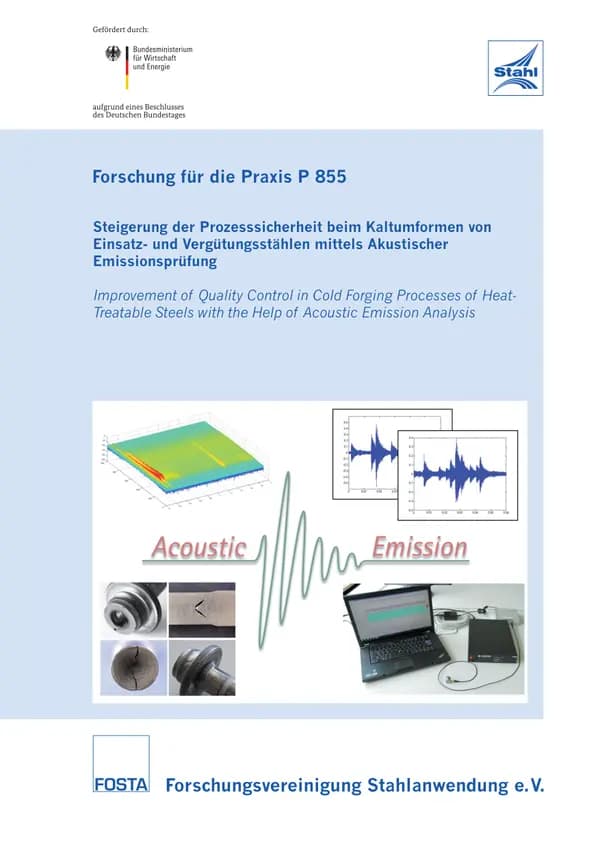
Due to the lack of workpiece heating prior to forming, the deformation capacity of the materials used is limited and can lead to possible crack initiation in the workpiece. At the same time, the higher yield stresses of the workpiece materials in conjunction with the increasing work hardening depending on the degree of forming result in increased tool stress. The quality control of cold-formed components with regard to component defects caused by material failure is usually carried out after production due to the lack of component accessibility during the process. Subsequent testing of the workpieces is often very time-consuming. In this research project, a cost-effective system for online crack detection during the cold forming of steel materials has been developed. The system is based on acoustic emission technology (AE technology) and was validated using the example of the detection of chevron cracks on extruded components in an industrial environment. The AE technique makes it possible to measure the spontaneous release of energy in the form of elastic waves resulting from the component load during the forming process. As part of several basic investigations, possible process influences (e.g. forming speed) on the resulting AE signals (sound waves) were analysed and the general applicability of the method for crack detection in various processes for cold massive forming of steel materials was demonstrated. With the aim of providing a method for online monitoring of cold forming processes, the relationship between damage during forming and the resulting measured acoustic emissions was investigated. The design of the measurement chain and identification of suitable recording parameters with regard to the process boundary conditions were also undertaken. The focus was on clearly identifying the formation of cracks in the component during forming. The IGF project 16821 N of FOSTA - Forschungsvereinigung Stahlanwendung e.V., Düsseldorf, was funded via the AiF as part of the programme for the promotion of industrial community research and development (IGF) by the Federal Ministry for Economic Affairs and Energy on the basis of a resolution of the German Bundestag. The project was carried out at the Institute of Forming Technology and Forming Machines at Leibniz Universität Hannover.
Payment by card (Stripe) or invoice (DE, AT, CH). Download link by email: automatically after ordering by card, after order approval for invoice (valid for 30 days). Terms
Machine-translated title and description. The document itself is in German.
Digital download
Other parts and editions as well as neighbouring documents of the same series.

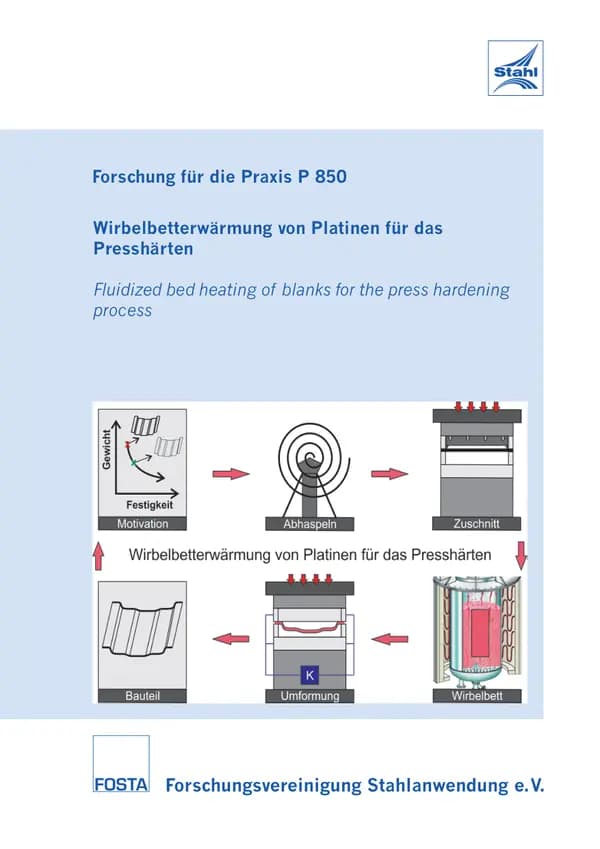
P 850 - Fluidised bed heating of blanks for press hardening The careful use of resources and the avoidance of environmentally harmful emissions, e.g. in production, energy generation and mobility processes, are globally recognised tasks of the international community. In this context, lightweight construction of moving masses is one of the leading technology drivers. A significant reduction in resource and energy consumption can be achieved through the increased use of lightweight products. The material steel will therefore only be able to assert itself in the future if the aspects of lightweight construction become even more important. In fact, steel offers an excellent option here, namely to achieve a considerable improvement in the strength-to-density ratio by increasing strength. The press hardening process offers a prominent possibility for realising this. The press hardening process for manganese-boron steels can be used to produce high-strength, complex component geometries that are already used in many structural areas of vehicles. One disadvantage of these press-hardened components is currently the relatively high process costs, which are caused, among other things, by high investments and the high space requirements of the corresponding roller hearth furnaces for heating the blanks. There is a need here to identify more cost-effective and space-saving heating options. The aim of the research project is therefore to develop and investigate the fluidised bed heating of steel blanks for press hardening. This alternative heating process is already used today, for example, for the industrial heating of solid components and, due to the process parameters, also offers great potential for heating in the press hardening process. Experimental investigations were therefore carried out on corresponding fluidised bed furnaces as part of the research project. This included the determination of heating gradients as well as tests on the use of different coating systems. Finally, the aspect of partial press hardening was examined in more detail, so that the heating behaviour of the blanks during partial heating in the fluidised bed was investigated. The tests carried out in this research project demonstrate the general suitability of fluidised bed heating of blanks for the press hardening process. Blanks made of press-hardenable steels can be heated to the required process temperatures using this heating method. The coating systems currently in use can also be utilised for the press hardening process, subject to certain restrictions. In addition, the production of graded component structures by partially heating the initial blanks before forming can, in principle, be realised using fluidised bed heating. The research project was carried out at the Chair of Lightweight Automotive Design (LiA), Paderborn University, together with Benteler Automobiltechnik GmbH, Paderborn and Schwing Fluid Technik GmbH, Neukirchen-Vluyn, with technical support and financial assistance from the Forschungsvereinigung Stahlanwendung e. V., Düsseldorf, with funds from the Stiftung Stahlanwendungsforschung, Essen. Authors: T. Tröster, T. Marten, S. Adelbert, A. Kadim Publication: 2012
available anytime
€20.00
excl. VAT

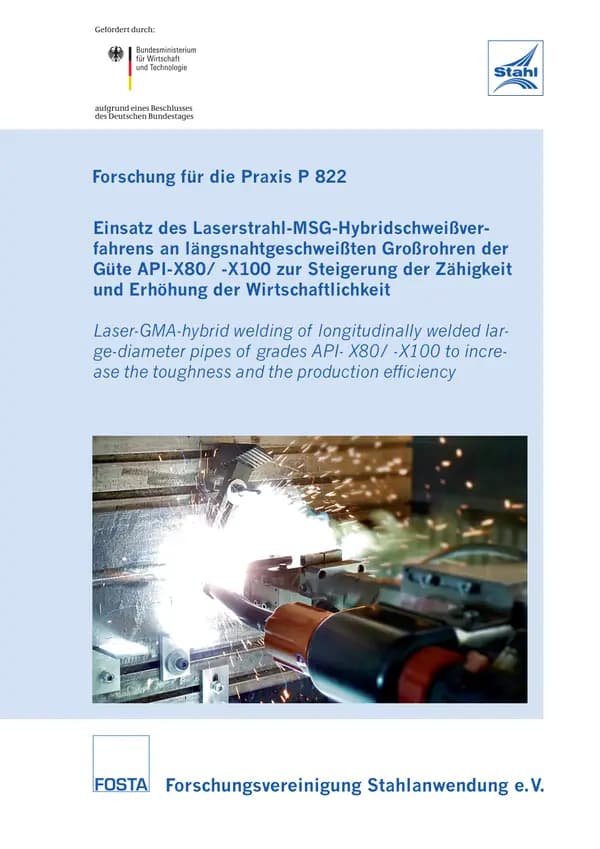
P 822 - Use of the laser beam-MSG hybrid welding process on longitudinally welded large-diameter pipes of grade API-X80/ -X100 to increase toughness and efficiency A significant proportion of modern oil and gas pipelines are made from longitudinally welded large-diameter pipes in API steel grades X65 (L450, 1.8726) and X70 (L485, 1.8727). Constantly increasing natural gas and crude oil production rates in conjunction with minimising wall thickness or increasing operating pressure will in future require corresponding material substitutions with modern higher-strength materials, such as API-X80 (L555, 1.xxxx), X100 (L690, 1-xxxx) and X120, with sufficient strength and toughness. The submerged arc welding process is used to weld these pipes. The entire pipe length is first welded with a continuous MSG tack weld. To increase economic efficiency, this process step is to be replaced by the laser beam-MSG hybrid welding process. For the safe operation of large-diameter pipes, the required impact strength of the welded joint must be observed in addition to the strength properties. Against this background, the primary research objective of this research project was to define and systematically investigate the achievement of sufficient toughness in the temperature range of -60°C and -40°C with economic process parameters. Suitable filler materials (solid wire and flux-cored wire electrodes) were identified for the laser-MSG hybrid welding of the aforementioned high-strength pipeline materials and systematic studies were carried out on the dependence of toughness on solidification behaviour and the achievable mixing depth. Increased economic efficiency when using laser hybrid technology is seen primarily in the modified seam preparation. A constructive change in the joint shape leads to a reduction in the seam volume and thus to a considerable reduction in production costs, because in this case the amount of filler material required to fill the seam is reduced. Based on demonstrators produced, an approx. 2.7-fold reduction in the seam cross-section and thus the required quantity of filler material is demonstrated. The IGF project 16415 N of FOSTA -Forschungsvereinigung Stahlanwendung e.V., Düsseldorf, was carried out at the Federal Institute for Materials Research and Testing (BAM), Department 9.3 "Welding Manufacturing Processes", Berlin, and funded by the Federal Ministry of Economics and Technology via the AiF as part of the programme for the promotion of joint industrial research and development (IGF) on the basis of a resolution of the German Bundestag. Authors: M. Rethmeier, S. Gook, A. Gumenyuk Publication: 2013
available anytime
€30.00
excl. VAT
Payment by card (Stripe) or invoice (DE, AT, CH). Download link by email: automatically after ordering by card, after order approval for invoice (valid for 30 days). Terms