New, innovative materials are a key factor in the development of new products that can contribute to improving people's quality of life and conserving energy and resources. This applies in particular to the new …
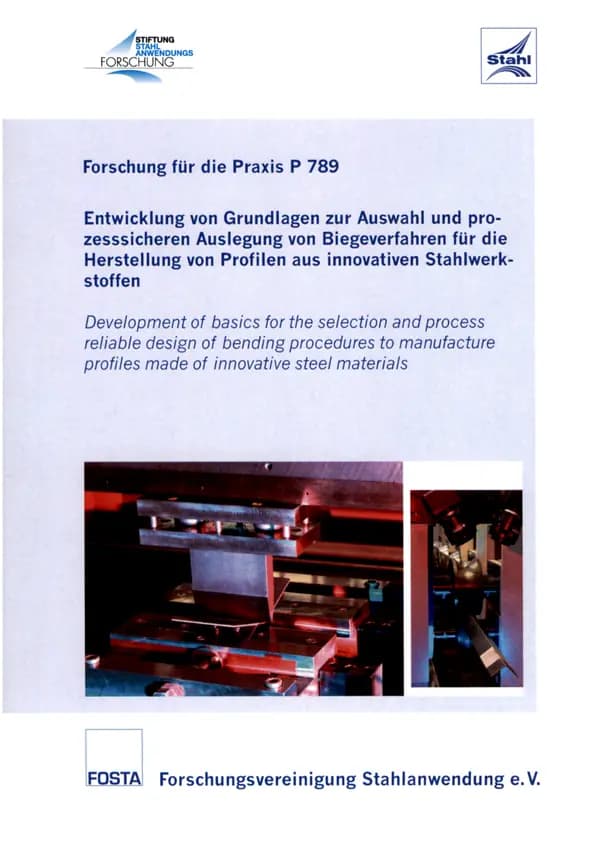
New, innovative materials are a key factor in the development of new products that can contribute to improving people's quality of life and conserving energy and resources. This applies in particular to the new generations of high-strength and ultra-high-strength steel materials, whose properties can be precisely customised to the respective requirements and thus open up a wide range of possible uses. However, the application potential of these materials is currently far from being fully utilised in industry. This is partly due to their lower ductility compared to softer steel grades. The more limited formability of these materials often results in premature material failure due to cracking during bending.
Particularly in the frequently used die bending process, this means that it is not possible to produce the small radii required for the rigidity of the components. A possible alternative to the die bending process is roll forming, which is used specifically for profile production for larger batch sizes. Die bending and roll forming are of great industrial relevance. However, they have not yet been scientifically researched, or only to a limited extent, particularly in connection with high-strength and ultra-high-strength steel materials. For example, knowledge of the process limits for bending forming of sheet metal materials is still very inadequate, particularly in view of the fact that experience with conventional sheet metal materials cannot be transferred to the new high-strength materials. For this reason, the basic principles for the reliable design of the production processes of free bending and roll forming for the manufacture of profiles from high-strength steel materials were developed as part of this project. To this end, both processes were analysed systematically, experimentally and numerically. The aim of the investigations was to determine the significant differences between the two processes and, in particular, the process-specific process limits. At the beginning of the investigations, a detailed material characterisation was first carried out in order to determine flow location curves and deformation diagrams for the high-strength steel materials investigated as part of this project. Different test methods were used to map different load directions. The data obtained during the material characterisation formed the basis for the assessment of the material behaviour and for the selection of suitable material models for the numerical calculations. A detailed 3D FE model was created for both processes, which reproduces the process as realistically as possible while still maintaining moderate running times. Due to the complexity of the process, this placed particular demands on the modelling for roll forming. Furthermore, various material models were implemented to describe the material behaviour of the high-strength steels, validated experimentally and evaluated for their suitability for the various bending processes. In preparation for the experimental investigations, appropriate test rigs were set up for both methods. In addition to the design and realisation of special test tools, one focus of the work was the implementation of appropriate measurement technology. It was important to measure as many variables as possible online in order to precisely determine the deformation limits and the process-specific differences between the processes. Measuring the strains in the forming zone (at the beginning of the failure) posed a particular problem because they are very small. Various measurement approaches and systems were therefore tested and evaluated in order to find a suitable measurement method for this application that could record meaningful measurement data with sufficient accuracy. For free bending, it was possible to measure the strains online. For roll forming, only offline measurement was possible for space reasons. Using the experimental and numerical methods developed, the bending processes of roll forming and free bending were analysed systematically and in detail. As part of a parameter variation, the influence of individual parameters on the forming result and the deformation limits as well as the occurrence of failure were fundamentally analysed. This made it possible to determine characteristic causes of failure in both processes for various high-strength steel grades from different manufacturers. By comparing the process-specific forming effects, initial indications of a positive influence on the process limits could be derived. In the course of extended investigations, it was possible to show by way of example how the forming limits in free bending could be significantly extended by two different strategies. Firstly, the process control strategy was changed in analogy to the roll forming process and the workpiece was reshaped by cyclic loading and unloading. Secondly, the friction on the tool elements was reduced, which also delayed the formation of cracks. Furthermore, the forming forces during roll forming were measured in order to investigate the stress when using high-strength steels in more detail and to analyse the influence of the sheet width and the individual roll forming stage. To validate the findings in an industrial environment, a sample component was manufactured on production machines. This allowed the causes of failure and the analytical findings regarding the different behaviour of the high-strength steel materials investigated to be validated. The transferability and applicability of the findings on the special bending properties of modern, high-strength steel materials was demonstrated, particularly with regard to the causes of failure. This emphasises the practical relevance of the project and shows that the knowledge gained can be used directly in an industrial environment. In particular, the contents of this report are recommended for the preliminary assessment and simulation of feasibility and the design of process control and mould design for the various processes and the different high-strength materials investigated. The research project was carried out at the Institute for Forming Technology and Lightweight Construction at the Technical University of Dortmund and Tata Steel IJmuiden B.V., Netherlands, with technical support and financial assistance from the For-schungsvereinigung Stahlanwendung e. V., Düssel-dorf, with funds from the Stiftung Stahlanwendungsforschung, Essen.
Payment by card (Stripe) or invoice (DE, AT, CH). Download link by email: automatically after ordering by card, after order approval for invoice (valid for 30 days). Terms
Machine-translated title and description. The document itself is in German.
Digital download
Other parts and editions as well as neighbouring documents of the same series.

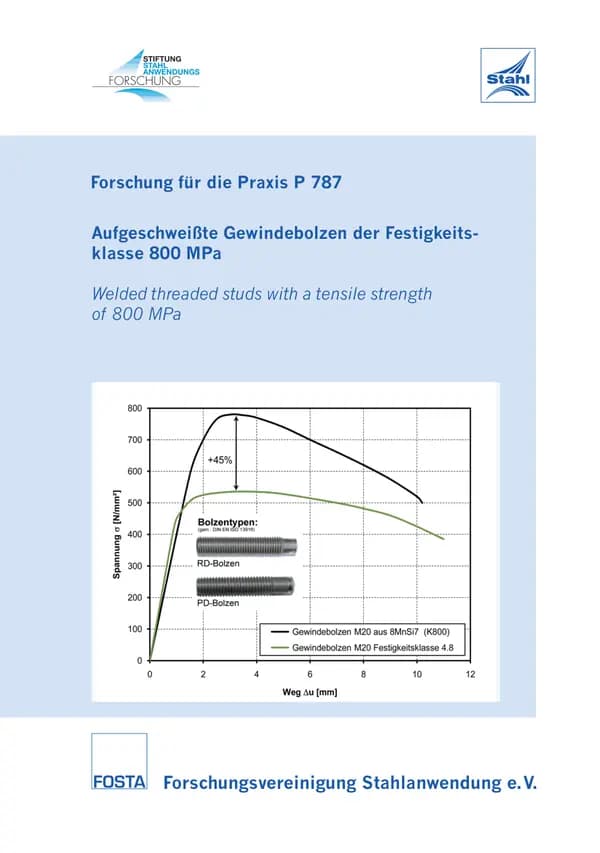
P 787 - Welded-on threaded studs of strength class 800 MPa Due to the joining process, welded-on threaded studs must be made of a material suitable for welding. For this reason, in addition to some austenitic steels, only steels of strength class 4.8 according to ISO 898-1 with a maximum carbon mass fraction of C = 0.20% are currently permitted for threaded studs. Steels of higher strength classes generally have a carbon mass fraction of C ≥ 0.20% and are therefore only conditionally weldable. In order to satisfy the market demand for threaded studs with higher strengths, stud manufacturers are currently turning to the cold heading steel 20MnB4 (1.5525), which roughly fulfils the requirements of strength class 8.8 thanks to thermal post-tempering. From a welding point of view, 20MnB4 with a carbon mass fraction of up to C = 0.23% can only be classified as conditionally weldable and, due to the additional costs for thermal tempering, bolts made of 20MnB4 have not been able to establish themselves on the market. Another alternative material is 8MnSi7 (1.5113), which also comes from the group of cold heading steels and which, with a carbon mass fraction of C = 0.10%, suggests good welding properties. The tensile strength of wire rod made from 8MnSi7 is between 520 and 620 MPa, but achieves tensile strengths of over 800 MPa due to the drawing process and the associated work hardening. This material therefore has the potential for the economical production of higher-strength threaded bolts. The aim of this research project was to verify the weldability and classification of threaded studs made of 8MnSi7 in accordance with the strength classes according to ISO 898-1. A total of 91 test studs of types PD and RD with nominal diameters M8 and M20 were welded onto high-strength base materials (fy ≥ 680MPa) and subjected to centric tensile tests with static loading to fracture. Sheet thicknesses between 2 and 40 mm were used. The suitability of the 8MnSi7 threaded studs for welding was proven in the tests. Material tests showed that the threaded studs could not be fully categorised in strength class 800 (8.8). The research project therefore used statistical analyses of the test results to derive characteristic load-bearing capacities and associated partial safety factors γ* M2 in accordance with DIN EN 1990, which allow the threaded studs to be safely designed using the nominal tensile strength of 800 MPa and enable the economical use of higher-strength threaded studs made of 8MnSi7. The use of welded threaded studs made of the material 8MnSi7 (1.5113) is therefore possible. The associated verification rules have been developed and allow safe and economical use. The research project was carried out at the Technical University of Dortmund by the Chair of Steel Construction with technical support and financial support from the Forschungsvereinigung Stahlanwendung e. V., Düsseldorf, with funds from the Stiftung Stahlanwendungsforschung, Essen Authors: D. Ungermann, S. Schneider Publication: 2014
available anytime
€30.00
excl. VAT

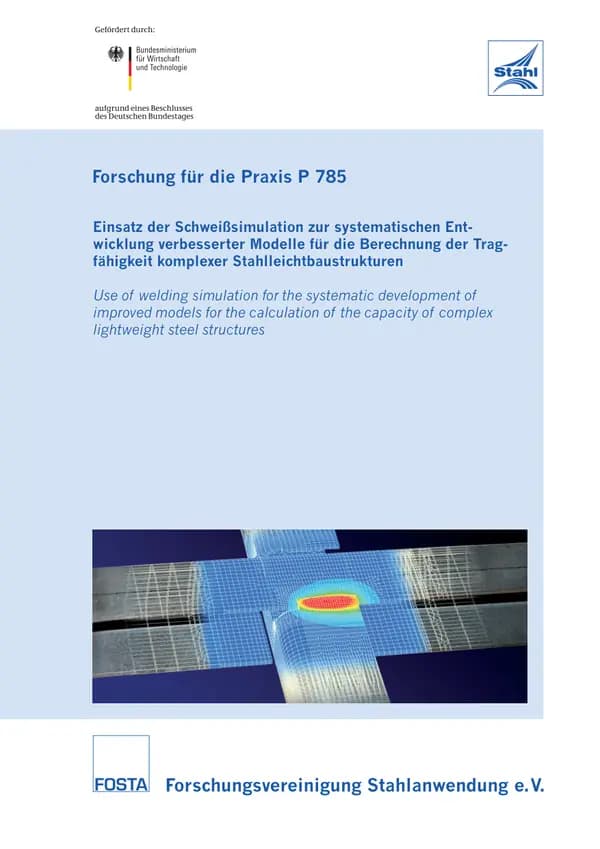
P 785 - Use of welding simulation for the systematic development of improved models for the calculation of the load-bearing capacity of complex lightweight steel structures Lightweight construction is also becoming increasingly important in the construction industry. The aim is to improve load-bearing functions without increasing weight. Improved load-bearing capacity can be achieved primarily through the skilful design of complex lightweight steel structures. The aim of the research project was to improve the calculation of the load-bearing capacity of complex lightweight steel structures using the example of truss and corrugated web beams. For this purpose, extensive geometric and physically non-linear FE load-bearing capacity analyses were carried out in the project. The derivation of engineering models and the development of proposals for practical design were a key focus of the investigations. Furthermore, load-bearing and deformation analyses as well as optimisation processes could be carried out on the virtual component, which saves costs for component tests and leads to significantly shorter development times. The basis for an improved load-bearing capacity verification is formed by the use of welding simulation and the consideration of local component properties that this makes possible. Welding simulations of the seams on the selected components were carried out at the Institute of Joining and Welding Technology at the TU Braunschweig. The results, such as the size of the heat-affected zone or the resulting residual stresses, were handed over to the Chair of Steel and Timber Construction at the BTU Cottbus for integration into the numerical load-bearing capacity calculation of large component structures. The results were used to derive simplified analytical formulae that enable a more precise calculation. The IGF project 287 ZBG of FOSTA -Forschungsvereinigung Stahlanwendung e.V., Düsseldorf, was funded by the Federal Ministry of Economics and Technology via the AiF as part of the programme for the promotion of joint industrial research and development (IGF) on the basis of a resolution of the German Bundestag. The project was carried out at the Institute for Joining and Welding Technology at the Carolo-Wilhelmina University of Technology in Braunschweig and at the Chair of Steel and Timber Construction at the Brandenburg University of Technology in Cottbus. Authors: K. Dilger, M. Vogt, M. Umer, H. Pastemak, V. Bachmann, G. Kubieniec Publication: 2013
available anytime
€40.00
excl. VAT

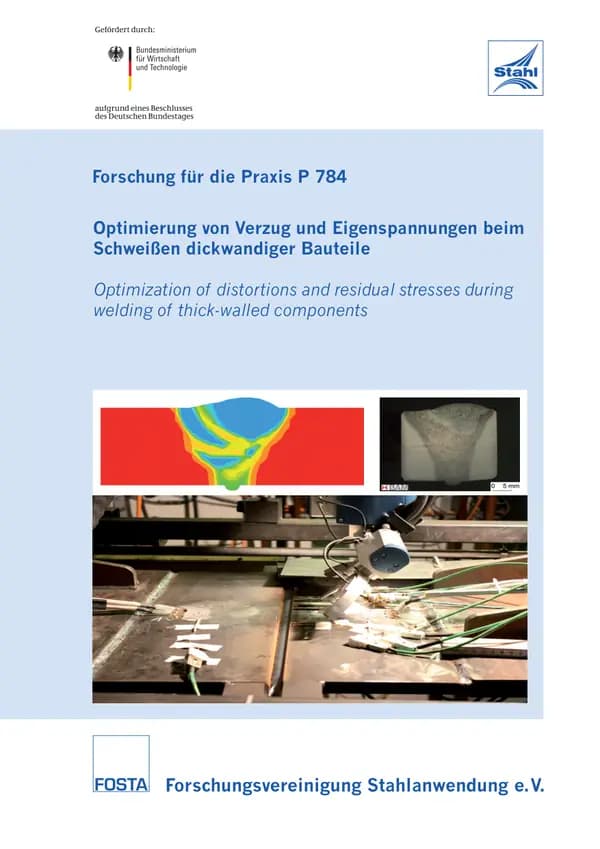
P 784 - Optimisation of distortion and residual stresses when welding thick-walled components The welding simulation of thick-walled components places high demands on commercially available welding simulation software due to the increased complexity of the thermophysical and thermomechanical processes involved in multi-layer welding. This includes the distortions and residual stresses induced in the finished component during the joining process, which are of great importance for assessing the production quality. In thick-walled components in particular, the stress state is extremely complex due to the structural rigidity of the individual components and the entire assembly as well as due to additional external clamping devices during production. In addition, in the case of materials with phase transformation, there are the metallurgically induced stress states and, in the case of multi-layer welded joints, the repeated thermal and transformation-related stress formation, so that a rough estimate of the overall deformation and stress state is generally no longer possible, even for experts. However, the prevailing deformations and stresses significantly determine the inherent stress of the welded structure and thus its load-bearing capacity in operation. Precise knowledge of this data would provide valuable information for optimising the quality of the end product. The aim of the project was to investigate, evaluate and predict welding-related distortions and residual stresses in multi-layer welds on unalloyed structural steel S355J2+N. The aspects of phase transformation and tempering behaviour were at the heart of the numerical investigations. The results of the analyses carried out were to be used to optimise distortion and residual stresses when welding thick-walled components. Furthermore, the practicability and applicability of the finite element software used with regard to realistic modelling of the processes taking place, computing time and user requirements were always the focus of the project. The increasing complexity of the investigations, from the single-layer weld sample to the four-layer welded test sheet with high component analogy, ensured the analysis of geometric influences (sheet length, tacking points, lead-in and lead-out sheets) and phase transformations on the numerical calculation of welding-induced residual stresses and distortions. Potentials for optimising the calculation of residual stresses and distortions in connection with the transformation behaviour were shown. In addition, the possibilities of welding simulation for the prediction of residual stresses and distortion as well as for the sensitivity analysis of relevant process variables, e.g. preheating or interpass temperature, are presented with the aid of a multi-layer model. The IGF project 15746 N of FOSTA - Forschungsvereinigung Stahlanwendung e. V., Düsseldorf, was funded at the Federal Institute for Materials Research and Testing (BAM), Berlin, via the AiF within the framework of the programme for the promotion of joint industrial research and development (IGF) by the Federal Ministry of Economics and Technology on the basis of a resolution of the German Bundestag. Authors: M. Rethmeier, C. Schwenk, C. Heinze, R. Salomon Publication: 2011
available anytime
€30.00
excl. VAT

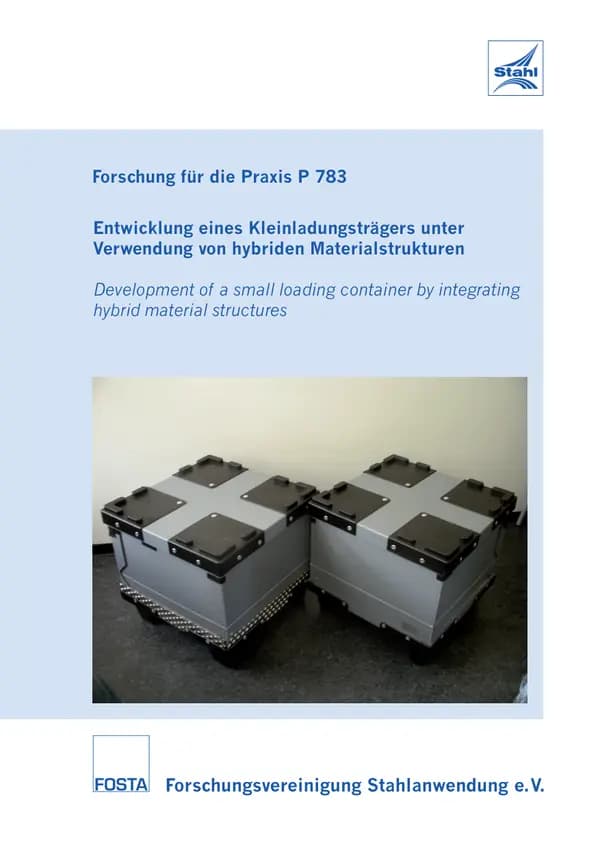
P 783 - Development of a small load carrier using hybrid material structures Increasingly stringent regulations on work ergonomics, rising transport costs and general efforts to reduce logistics costs mean that lightweight materials must be used in load carrier construction. The aim of the project was therefore to combine conventional load carriers, which have high requirements for lightweight construction and stability, with the help of the new honeycomb panels made of sheet steel, which fulfils the two generally divergent requirements (weight reduction and stability). In a further step, the use of honeycomb panels in general logistics applications was also investigated in order to determine possible optimisation approaches using lightweight materials. The following criteria were identified in the project, which are required for the use of honeycomb panels in load carrier construction. The target system consists of maximum flexibility in handling, processing and size while minimising costs. In particular, the limited panel size is currently the biggest obstacle to further optimisation approaches in logistics through the use of honeycomb panels. The construction of a model prototype carried out in the project clearly demonstrated that honeycomb panels can physically compensate for the weak points of current materials in lightweight load carriers, particularly through hybrid solutions, and can therefore clearly lead to optimisation. The use of honeycomb panels in existing standard load carriers - without physical weaknesses - could also lead to optimisations in these, in that stable but heavy solutions can be optimised to the extent that they could be "lightened" by a significant amount while maintaining the same stability (example: lattice box, steel GLT of the Institute of Materials Handling and Logistics, etc.). In addition, the use of honeycomb panels as a substitute for Apitong wooden flooring in container construction can offer considerable potential, provided honeycomb panels can withstand the stability requirements of ISO containers. The two logistics sectors of air freight containers and swap bodies could provide further fields of application. With all the optimisation potentials described, a profitability calculation must be carried out in each individual case to determine the extent to which the use of honeycomb panels instead of the previous solution would lead to a cost improvement for the user. In many cases, higher material costs for the honeycomb panels could be offset by savings, for example through a reduction in weight (in air and land transport, where transport prices are generally based on the weight of the consignment) or, for example, by increasing stability (reduction in maintenance costs, reduction in repair costs, increase in process reliability - less costly safety infrastructure required) or even generate a positive ROI compared to previous solutions. In conclusion, it can be stated that the practical usability of honeycomb panels - in particular the limited dimensions of the panel size - must be further advanced in order to be able to tap optimisation potential in logistics - ultimately also proven by economic efficiency calculations. The research project was carried out at the Institute for Materials Handling and Logistics at the University of Stuttgart with technical support and financial assistance from FOSTA - Forschungsvereinigung Stahlanwendung e. V., Düsseldorf. Authors: D. Neuhäuser, R. Salomon Publication: 2011
available anytime
€20.00
excl. VAT
Payment by card (Stripe) or invoice (DE, AT, CH). Download link by email: automatically after ordering by card, after order approval for invoice (valid for 30 days). Terms