High-speed shearing (HGSS), the industrial application spectrum of which is currently mainly limited to the cutting of bar material, is to be utilised for sheet metal processing in the future. The starting point for the …
High-speed shearing (HGSS), the industrial application spectrum of which is currently mainly limited to the cutting of bar material, is to be utilised for sheet metal processing in the future. The starting point for the research project was the known advantages of HGSS compared to conventional cutting processes. The use of high cutting speeds enables a significant improvement in the cutting result: - high dimensional accuracy and low component deformation, - low-burr, flat cutting surface with a predominantly (with a particularly fine-grained surface) surface), - reduction of the deformation zone, more even hardness distribution hardness distribution, - material savings due to small web widths, - lubricant-free cutting process and - Savings in reworking steps. Based on a scientific analysis of the process, the aim of the research project was to extend the fields of application of the HGSS to the cutting and punching of tubes and flat components of different strengths and sheet thicknesses.
Following the design, construction, manufacture, testing and optimisation of suitable test equipment, extensive experimental investigations were carried out in which the workpiece material, the sheet thickness, the cutting gap, the cutting speed and the punch contour were varied. The cutting results achieved were then analysed as a function of the cutting parameters influencing them, i.e. the quality of the cut surface on the cut parts produced was examined. The main results are summarised below. As with NGSS, the tool design (cutting gap and cutting edge geometry) is also decisive for the cutting result with HGSS. For a high cutting surface quality, small related cutting gaps up to u/s = 2...3 % and a full-edged cut have proven to be optimal. With the bevelled and hollow ground punch designs, both deformations on the cut parts and significant deviations from perpendicularity occurred. While the NGSS usually aims for a high proportion of smooth cuts, the opposite is the case with the HGSS. The HGSS cutting surfaces consist mainly of fracture surfaces, which have a much finer-grained surface than conventionally produced fracture surfaces. The stainless steel X5CrNi18-10, for example, showed a particularly fine-grained fracture surface, which resulted in a predominantly lower roughness of the fracture surface compared to the smooth cut surface. The edge indentation heights clearly showed the influence of the workpiece material and the related cutting gap; within the respective sheet material variant, this parting surface proportion was almost constant overall with the same cutting gap. The parting surfaces produced using HGSS exhibited little or no burr. In some cases, a tendency towards a reduction in the cutting burr with a reduction in the related cutting gap was observed. The steel grade X5CrNi18-10 was also characterised by almost right-angled cut surfaces that deviated from the ideal contour by a maximum of one degree. The type and extent of the cutting process-related hardening of the edge area close to the cut, in particular the width of this affected edge zone, can be determined with greater accuracy using microhardness mapping than using micrographs. Depending on the test material, comparable edge hardening depths were determined on the flat samples and on the pipe sections. In the tests on the HGSS of pipes with internal mandrel, the maximum form and position deviations occurred in the cutting direction. Finally, a qualitative comparison of the NGSS and HGSS was made with regard to the achievable cutting quality. The IGF project 15319 BG of the Forschungsvereinigung Stahlanwendung e.V. was carried out at the Fraunhofer Institutes for Machine Tools and Forming Technology (IWU) in Chemnitz and for Production Engineering and Automation (IPA) in Stuttgart and funded via the AiF as part of the programme for the promotion of joint industrial research and development (IGF) by the Federal Ministry of Economics and Technology on the basis of a resolution of the German Bundestag.
Payment by card (Stripe) or invoice (DE, AT, CH). Download link by email: automatically after ordering by card, after order approval for invoice (valid for 30 days). Terms
Machine-translated title and description. The document itself is in German.
Digital download
Other parts and editions as well as neighbouring documents of the same series.

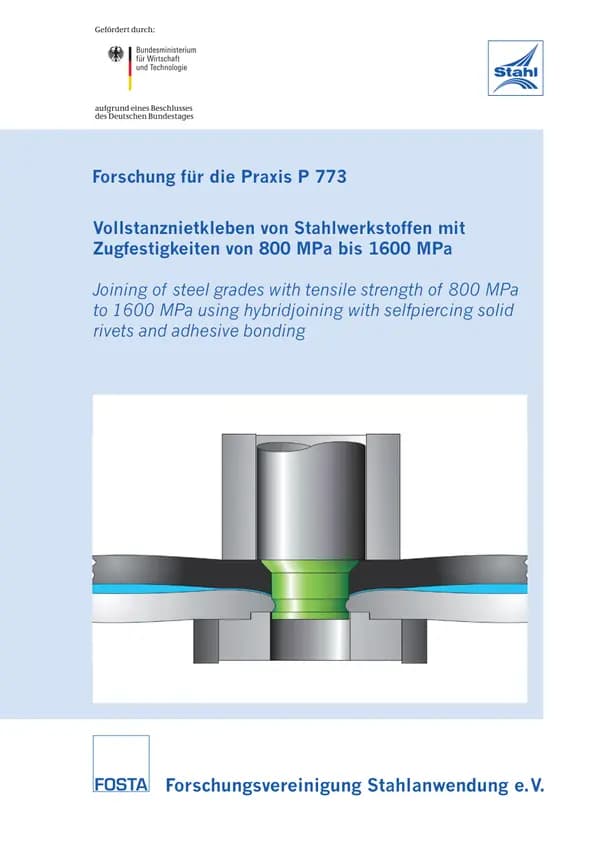
P 773 - Full self-pierce rivet bonding of steel materials with tensile strengths from 800 MPa to 1600 MPa Full-punch rivet bonding is a process combination that stands out from a large number of alternative joining techniques due to its particular potential for joining high-strength materials, among other things. With the aim of qualifying an economical process for joining semi-finished sheet metal products made of differently coated, high-strength steel materials with tensile strengths of 800 MPa to 1600 MPa for practical application, investigations into the elementary processes of self-pierce riveting and adhesive bonding as well as the combined application of these joining techniques were carried out as part of this research project. Approaches for process optimisation were derived from the knowledge gained, the effects of which on the joint formation and the load-bearing behaviour of the joints were verified by tests as part of the project and used to further develop the process. This report describes the initial situation by presenting the process-specific properties of elementary adhesive bonding and mechanical joining processes and emphasises the particular potential and need for development of hybrid full-punch rivet bonding technology for joining high-strength to ultra-high-strength steel materials. By determining the application limits of elementary self-pierce riveting, a basis of knowledge is then formed that reflects the performance of the process under consideration and at the same time represents the starting point and reference for investigation and optimisation measures. In order to identify suitable approaches for expanding the possible range of applications, various interdependencies were analysed. In this context, for example, the influences of modified rivet geometries on the joining forces in elementary self-pierce riveting were analysed. By investigating the influence of the rivet head end position on the load-bearing and failure behaviour of full-punch riveted joints of high-strength sheet steel, important findings were obtained that led to optimisations that improved the load-bearing behaviour of the joints. The contents also include the verification of joint damage caused by hydrogen-loaded joining parts as well as stab tests on the full-punch riveting of 3-layer mixed construction joints with high-strength steel sheets. Here it was shown how significant increases in joint strength can be achieved by selecting the optimum joining direction. The analysis of elementary bonded, differently coated 22MnB5 parts revealed different failure mechanisms. Investigations into the process compatibility of full-punch rivet bonding revealed the potential for optimising full-punch rivet bonding of ultra-high-strength steel materials. Based on the knowledge gained in this way, further steps were taken to optimise the process. Tests with geometrically varied self-pierce riveting tools, modified adhesives and a modified self-pierce riveting process were used to pursue various approaches to optimise the self-pierce rivet bonding technique and achieve improvements in the joint formation. The performance of the optimised joining technology is then presented in the form of investigations into the load-bearing behaviour of elementary and hybrid-joined joints under static and dynamic force application, as well as the behaviour of differently coated test specimens under corrosive stress. Finally, recommendations for the design and production handling of the process are derived from the findings. Authors: O. Hahn, C. Schübeler Publication: 2010
available anytime
€40.00
excl. VAT

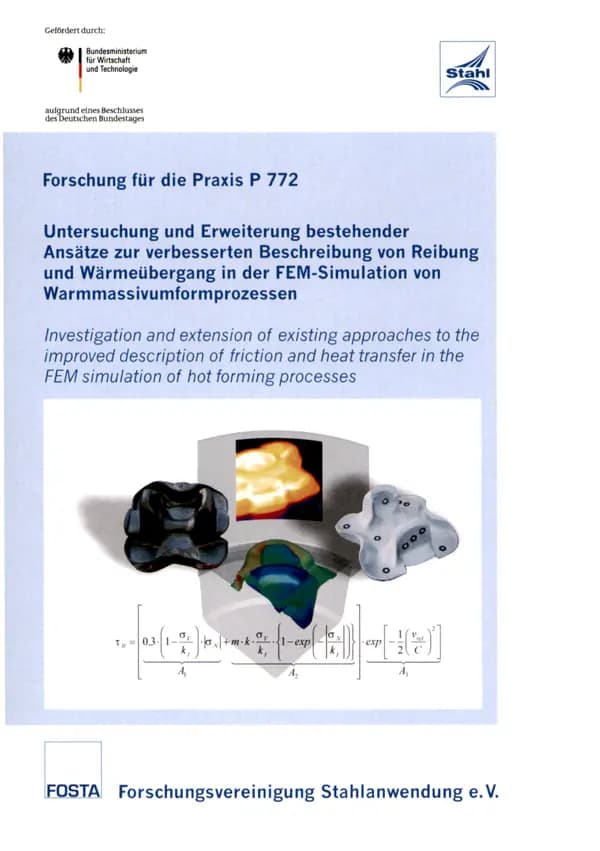
P 772 - Investigation and extension of existing approaches for the improved description of friction and heat transfer in the FEM simulation of hot massive forming processes The finite element method (FEM) is a powerful tool for the design and optimisation of hot forging processes. Precise knowledge of the process boundary conditions is a prerequisite for high accuracy of the simulation results. As the friction in the contact surface and the heat transfer from the workpiece to the tool have a significant influence on the entire forming process, the description of these two boundary conditions in the FE simulation is crucial for the usability of the simulation results in practice. Among other things, the contact pressure, the temperature at the surface layer, the roughness of the contact surfaces, the sliding speed and the flow behaviour of the material are the main influencing variables. In most of the available FE programmes, the mapping of the friction and heat transfer phenomena is based on the assumption of constant coefficients for the model equations. As a result, local influencing variables are not captured with the required accuracy and taken into account in the FE simulation. An improvement in simulation accuracy is of fundamental importance for the forming industry, whereby the rigid modelling of tools, which is considered the industry standard, should not be disregarded. The research objective of the project was to develop a law for the numerical modelling of friction and heat transfer for forging-like conditions in order to increase the accuracy of the process simulation of hot forging processes using commercial FE programs. The influences of different process conditions on friction were initially investigated in a further developed pipe cone upsetting test as a basic test in which relative displacement, relative speed, temperature, lubricants and roughness can be varied in a targeted manner. The friction model must take these influences into account to improve the description. The influences of lubrication, workpiece and tool material, temperature and forming speed were analysed using an effect analysis. The greatest influencing factors on friction were found to be the forming speed and lubrication. When developing the friction model, these influences of the friction condition in the effective joint between tool and workpiece are taken into account. In addition, existing multi-stage hot forming processes were used in the research project. The processes were recorded using a thermographic camera, the components were optically measured and in some cases the forming forces were measured. Extensive numerical calculations of the processes were carried out with the commercial FE programmes Forge (Transvalor S.A.) and simufact.forming (Simufact Engineering GmbH) using different friction models. A newly developed friction model presented here is able to take into account the friction under different conditions during the forming process. In addition, the true contact area according to Neumaier is taken into account during forging. In addition, a suitable function was used to realistically take into account adhesion and sliding via the influence of the sliding speed. This means that the main influencing variables, as determined in the basic test, are taken into account in the formulation. The validation was carried out on model processes. FE calculations were carried out on the industrial processes using various friction models. The process simulation, based on the newly developed friction model, delivers better results. By using the improved models for friction and heat transfer, forging processes can be modelled and designed more accurately. The resulting improved material flow description during forming enables a more precise calculation of the component geometry. In addition, a more precise prediction of the required forming force and the thermal shrinkage of the component after forming is possible. The precise description of friction and heat transfer also enables improved prediction of the mechanical and thermal stress on the forging dies. The improvement of the FE systems by implementing the newly developed friction model of this project is of particular benefit to small companies in the forging industry and thus ensures the extended use of these established tools in process simulation. Authors: B. A. Behrens, A. Bouguecha, J. Mielke, G. Hirt, M. Bambach, A. Demant Publication: 2010
available anytime
€30.00
excl. VAT

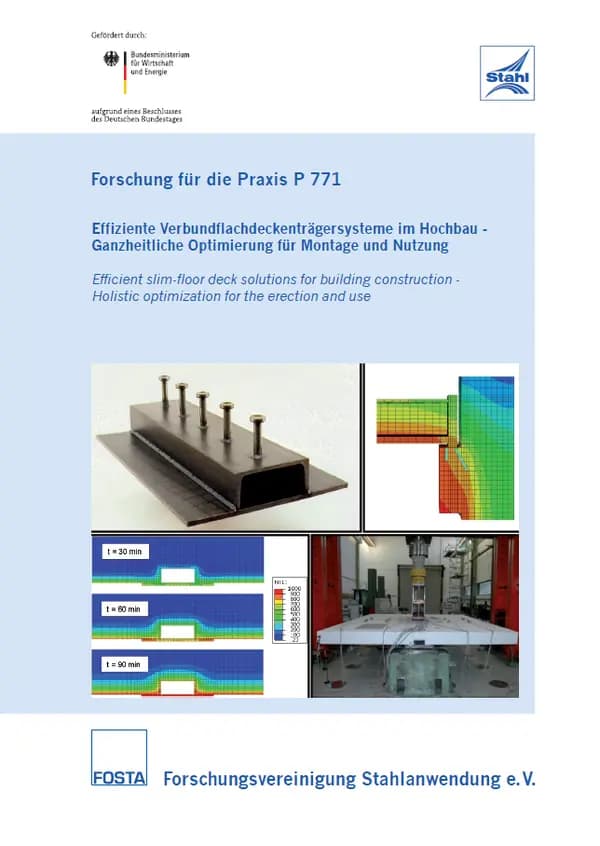
P 771 - Efficient slim-floor deck solutions for building construction - Holistic optimisation for the erection and use Until now, composite beams have mainly been treated as isolated construction elements. It was left to practice to decide how they should be integrated into the overall construction. This includes in particular the design of the composite nodes and the connections of the composite beams to other structural elements such as columns. The aim of this project was the integrated consideration of the economic design of the composite beams on the one hand and suitable node design on the other. The investigations carried out focussed on questions of serviceability, in particular the necessary fulfilment of deformation criteria and questions relating to the design of the composite nodes for installation. Fire protection also plays a decisive role in composite construction solutions. In this context, solutions were developed for the fire protection design of the beams as well as for the connecting structures. A non-linear calculation approach was derived for the deformation behaviour of composite flat slab girder systems on the basis of an extensive analytical investigation and the so-called deformation-related co-supporting width was introduced. In a second step, this calculation approach was further developed into a linear approach, which now allows the non-linear load-bearing behaviour of slim floor beams to be calculated very easily using linear deformation approaches. In contrast to the existing standards, which greatly overestimate the deflection due to conservative approaches, the cross-sections can now be dimensioned more economically based on realistic deformations. For the connections and the design of the nodes, design solutions were shown for typical cross-sections that allow these structural steel connections to be used very economically. In addition to articulated connections, examples of a rigid (continuous) beam joint are also shown, which can be activated with regard to the load-bearing reserves in the event of fire. The system solutions presented show that the consistently efficient system solution can be continued from the beam to the connection. The aim of a further work package was to analyse the fire resistance of typical slim floor systems and, if necessary, to improve it by means of design measures. The analytical solutions show that all beams have a fire resistance time of F30 without any additional effort. A significant increase in fire resistance can be achieved by designing continuous systems. Here, load-bearing reserves can be activated, which offer a decisive advantage for the design in the event of fire. Thanks to the results, composite floor solutions are now possible that offer additional benefits in addition to cost-effectiveness: These include reductions in construction time thanks to suitable prefabrication, node connections suitable for assembly, comfort in use due to deflection limitation and safety with regard to fire protection. FOSTA Research Association for Steel Application e.V. Publication: 2014 Authors: Prof. Dr.-Ing. U. Kuhlmann, Dr.-Ing. G. Hauf, Prof. Dr.-Ing. P. Schaumann, ]}, Dr.-Ing. N. Sauerborn
available anytime
€50.00
excl. VAT

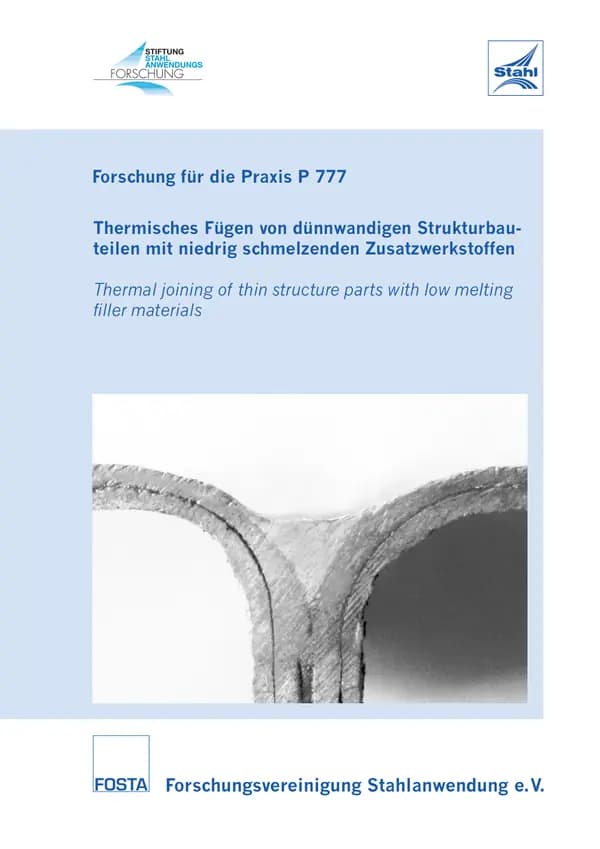
P 777 - Thermal joining of thin-walled structural components with low-melting filler materials Lightweight construction efforts and the preservation of metallic coatings as a basis for corrosion resistance in the automotive industry require new joining processes. One way of meeting these requirements is the use of low-melting filler materials. A reduction in energy input compared to copper soldering is achieved by using zinc-based solders. This results in joints of the same type with the advantages of low distortion and the preservation of the coating and thus corrosion resistance. The aim of the research project was to qualify MIG brazing with zinc-based brazing alloys (ZnAl4, ZnAl15 and ZnAl4Cu1.5) for unalloyed deep-drawing steels with various coatings and for high-alloy Cr-Ni steels. The arc process was to be optimised so that even thin sheets (d=0.5 mm) could be joined reliably while retaining the coating. For this purpose, extensive experimental investigations were carried out on the wetting behaviour of different coatings (hot-dip galvanised, electrolytically galvanised), the strength behaviour and the corrosion behaviour of lap joints and flanged seams. When analysing the interactions of different types of arcs, the focus was on the wetting behaviour of the solders and their effects on the strength of the joint as well as on the description of reactions close to the surface. It was thus possible to produce joints in the sheet thickness range from d= 0.5 mm to 1.5 mm on the unalloyed deep-drawing steels (DX56D+Z100; HP260P), which achieve the base material properties. Furthermore, brazed joints with good wetting behaviour were produced on high-alloy steels (X5CrNi18-10; X2CrTiNb18; X6Cr17) as part of the research project. In addition, joints were brazed on steel sandwich sheets and between these and deep-drawing steels. Highly accurate current-voltage-time measurements were carried out so that the soldering parameters are reproducible. The data obtained provides a basis for determining the specific energy input. Temperature-time measurements were carried out for the analysed arc types. All project results are summarised in a database system. The results are available to the user in the form of process instructions. This facilitates the transfer and application of the results. The research results obtained improve the understanding of MIG soldering with zinc-based solders and illustrate the application potential for joints on thin coated and corrosion-resistant components. This is a contribution to lightweight construction with all the associated advantages. The corrosion protection effect of the coating on the deep-drawing steels and on the sandwich sheet is not affected by the joining process. It remains intact and is reinforced in the joining zone. The research project was carried out at the Günter-Köhler-Institut für Fügetechnik und Werkstoffprüfung, Jena and the Hochschule Lausitz (FH), Senftenberg, with expert supervision and financial support from the Forschungsvereinigung Stahlanwendung e.V., Düsseldorf, with funds from the Stiftung Stahlanwendungsforschung, Essen Authors: R. Winkelmann, T. Ebersbach, R. Salomon Publication: 2010
available anytime
€30.00
excl. VAT
Payment by card (Stripe) or invoice (DE, AT, CH). Download link by email: automatically after ordering by card, after order approval for invoice (valid for 30 days). Terms