
FOSTA
In vehicle construction, the requirements for the greatest possible weight reduction combined with maximum strength can be met by using press-hardened boron-alloyed steels. Until now, these materials have mainly been …
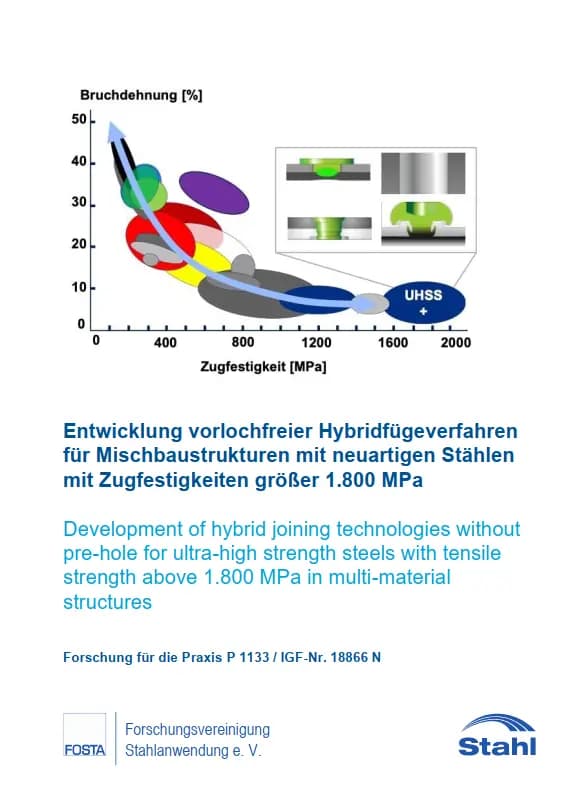
In vehicle construction, the requirements for the greatest possible weight reduction combined with maximum strength can be met by using press-hardened boron-alloyed steels. Until now, these materials have mainly been joined by spot welding. As this joining method leads to thermal stresses on the one hand and does not permit mixed construction with aluminium on the other, the aim of the following work is to qualify other methods for joining these steels and to determine the potential of functional elements in combination with high-strength steel sheet. Involved research centres: Dresden University of Technology - Chair of Joining Technology and Assembly University of Paderborn - Laboratory for Materials and Joining Technology
Machine-translated title and description. The document itself is in German.
Payment by card (Stripe) or invoice (DE, AT, CH). Download link by email: automatically after ordering by card, after order approval for invoice (valid for 30 days). Terms
Digital download
Other parts and editions as well as neighbouring documents of the same series.
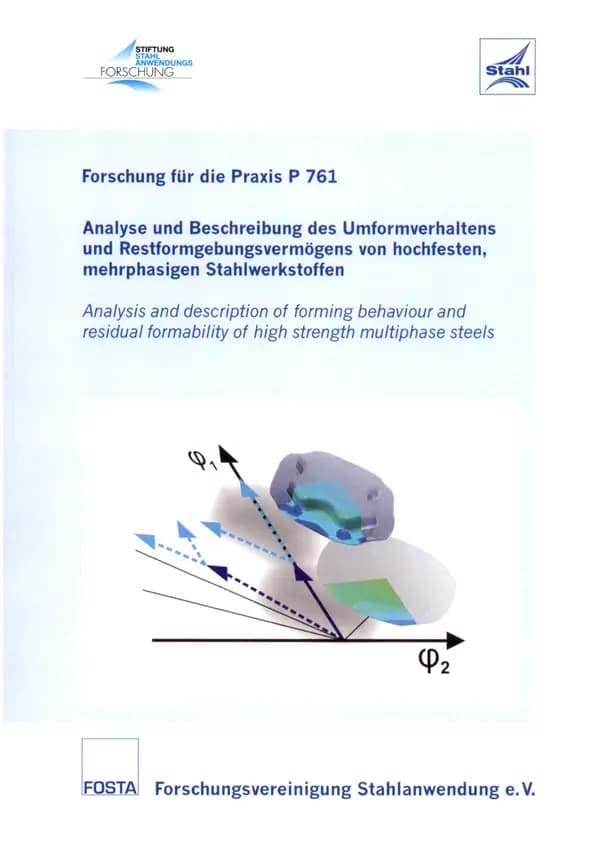
P 761 - Analysis and description of the forming behaviour and residual forming capacity of high-strength, multiphase steel materials The aim of the research project was to fundamentally investigate the forming behaviour and residual forming capacity of high-strength, multiphase steel materials with regard to the forming production of safety-relevant structural components in the automotive sector. Due to their high application potential, the complex-phase steels HCT780C (CP-K60/80), 1.0954, and HDT780C (CP-W800), 1.0957, as well as the retained austenite steel HCT690T (TRIP700), 1.0947, were selected for this purpose. The main focus was on analysing the strain-path-dependent forming capacity and the forming limits. First, the plastic behaviour of the test materials was investigated as part of the material characterisation depending on the stress state acting during forming. Based on the experimental data regarding the flow and hardening behaviour as well as the forming limit curve under uniform load, a numerical illustration of the achievable forming limit change is realised using the CrachLAB software (MATFEM, Munich), taking complex load paths into account. In the second step, specific forming sequences and strain paths were defined in collaboration with the industrial partners based on real components with complex geometries. These were first analysed on a laboratory scale with regard to the strain paths occurring during forming. For this purpose, a test plan was developed, with the help of which conditions comparable to the real processes can be simulated in model tests. Parallel to the experimental investigations, the forming sequences and the resulting residual forming capacity are calculated using CrachLAB and compared. In the investigations carried out, all materials show ductile failure behaviour with considerable residual formability in the second forming step under plane stress, irrespective of the selected forming history, which can be regarded as positive. Finally, the transferability of the findings from the material characterisation and model tests was investigated using a real component in the form of a cross-shaped cup. The forming capacity and failure behaviour were mapped numerically in the FE forming simulation and the influence of tool parameters and blank geometry was analysed in the context of the local forming history. Based on the numerical investigations, a conservative approach is recommended for the process-reliable design of the components. The results of the experimental investigations indicated that a design based on time-evaluated FLC is applicable in the critical areas and that improved shaping and a reduction in the residual forming capacity can therefore be realised. Both single-stage forming tests on the demonstrator component and multi-stage forming with the formation of non-linear strain paths showed analogies to the model tests with regard to the forming history and the corresponding failure behaviour. Overall, the research project led to a deeper understanding of the forming processes of multiphase materials. This enables a fundamental evaluation of the failure mechanisms of such materials in the finite element simulation and thus a material and process-orientated design of forming processes. The research project was carried out at the Chair of Production Technology at the University of Erlangen-Nuremberg with technical support and financial assistance from the Forschungsvereinigung Stahlanwendung e. V., Düsseldorf, with funds from the Stiftung Stahlanwendungsforschung, Essen. Authors: M. Merklein, T. Gnibl, M. Kaupper, A. Kuppert, R. Lupino Publication: 2012
available anytime
€20.00
excl. VAT
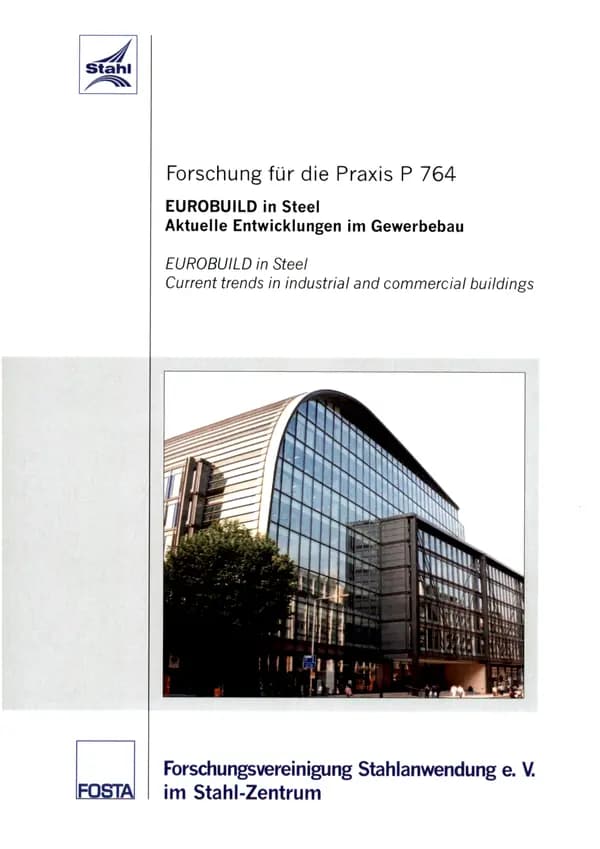
P 764 - EUROBUILD in Steel Current developments in commercial construction The aim of this European research project "EUROBUILD in Steel" is to improve the level of information on the use of steel in building construction and thus to promote its increased use. To this end, both European and national construction methods were presented and analysed, particularly in the areas of office and administrative buildings and industrial construction. Furthermore, realised projects were selected that represent exemplary use of steel in the construction industry. The results of the research project were presented at the event "Presentation of new results from steel application research in the construction industry - current developments in commercial construction" on 27 November 2008 in Dortmund. This research report contains the "best practice documents" produced as part of the project for the areas of office and administrative construction and industrial construction. These documents illustrate the state of the art in Europe and are intended to serve as guidelines for architects and structural engineers. The most suitable and economical systems for certain building types are highlighted. Architects and engineers who are less familiar with steel and steel composite structures should be given a quick introduction to the use of steel in construction. The documents are organised as follows: Firstly, the most important design parameters are defined, taking into account special requirements from building utilisation as well as architectural aspects. This is followed by a discussion of design aspects, including both the main structure and the secondary components, the building envelope and the connecting elements. National specialities are then presented. In this way, for example, special systems that are currently only available nationally can also be publicised in other European countries. To illustrate the previously described constructions and design principles in realisation, a selection of case studies is presented in the final section. section presents a selection of case studies. These cover a range of designs and locations across Europe. This report is also available in English. Authors: M. Haller, N. Popa, M. Barendsz, P. Beguin, G. Nüsse, S. M. Iglesias, J. A. Chica, B. Åstedt, M. Lawson, N. Baddoo, D. Ungermann, J. Kalameya, I. Strohmann Publication: 2008
available anytime
€30.00
excl. VAT
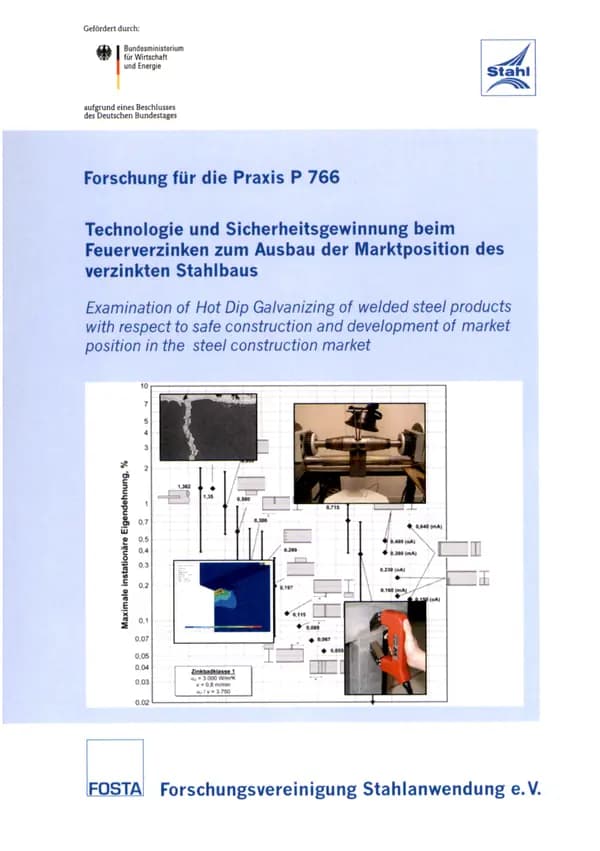
P 766 - Technology and safety gains in hot-dip galvanising to expand the market position of galvanised steel construction In steel construction, structures are particularly economical and sustainable if they are hot-dip galvanised. In order to meet the growing demands of the market, further developments and economic efficiency measures have been implemented in the industrial sectors of steel production, steel construction and galvanising. These include in particular - the development of modern high-strength fine-grain steels in the sheet and profile area, - the realisation of complex component geometries in architecturally buildings and structures with large spans, - the use of larger boiler dimensions and improved processes in the galvanising process chain galvanising process chain, - the use of new zinc melts with modified composition for better control of the coating layer thickness and layer appearance. As a result of these further developments, the steel construction and galvanising industry suffered setbacks, as considerable crack damage was observed from 2000 onwards, particularly in structures galvanised with the new zinc melts mentioned above and mostly made of structural steels with strengths of 355 MPa and above. Investigations of damaged structures showed that the mechanism of liquid metal-induced stress corrosion cracking is the cause of the cracks. Although cracking due to liquid metal-induced stress corrosion cracking has been known for many decades, further research activities were required to clarify the problems at hand, and the large number and extent of damages observed since 2000 made new interdisciplinary investigations necessary. In particular, because it was found that interdisciplinary guidelines for crack-free galvanisation did not exist or were still under development. This research project was initiated against this background. The issues to be clarified were in particular the influence of pre-treatment (pickling), the material (toughness, strength), processing (welding, cold forming, drilling, cutting), the zinc alloy and the dipping speed on the formation of cracks as well as issues relating to the design of the construction (e.g. zinc pass-through openings). The results contributed to the development of new guidelines of the German Committee for Steel Construction DASt and the Association of German Engineers (VDI) for crack-free hot-dip galvanising and damage analysis. As a result, further developments of laboratory tests to determine the criticality of melts, the creation of input values for the numerical simulation of galvanising and for new metallographic preparation methods were also created for the practical implementation of the aforementioned guidelines. In addition, magnetic particle testing was further developed for constructions where cracks cannot be ruled out. The IGF project 265 ZBG of the Forschungsvereinigung Stahlanwendung e.V., Düsseldorf, was funded via the AiF as part of the programme for the promotion of joint industrial research and development (IGF) by the Federal Ministry for Economic Affairs and Energy on the basis of a resolution of the German Bundestag. The project was carried out at RWTH Aachen University by the Chair and Institute of Steel Construction and Light Metal Construction and the Institute of Ferrous Metallurgy, at Ruhr University Bochum, Institute for Materials, Department of Materials Testing, at the Institute for Corrosion Protection Dresden GmbH, at the Technical University of Darmstadt, Institute for Steel Construction and Materials Technology, Department of Materials Mechanics and at the State Materials Testing Institute Darmstadt, Department and Institute of Materials Science as well as by the Schweißtechnische Lehr- und Versuchsanstalt Duisburg GmbH. Authors: M. Feldmann, D. Schäfer, W. Bleck, A. Durst, M. Pohl, A. Luithle, A. Schütz, J. Triebert, M. Vormwald, C. Versch, C. Berger, R. Landgrebe, J. Adelmann, D. Körber, S. Keitel, H. Schmeink Publication: 2010
available anytime
€40.00
excl. VAT

P 767 - Residential and commercial buildings in modular construction - Design aids "Planning and building in existing buildings" is one of the fields of activity of the future. Urban remodelling in particular will be a central task in the coming years, as the ageing and declining population in the Federal Republic of Germany will be accompanied by changes in demand and supply in all areas of life. This will also have far-reaching consequences for urban development and represent an unprecedented challenge for urban planning. Concepts must be found that allow the revitalisation and reorganisation of city centres as essential places of social life to be realised on the basis of forward-looking ideas. In the meantime, there is a growing movement back into the city centre. Constantly rising mobility costs and the progressive thinning out of technical and social infrastructure in rural areas are heralding a paradigm shift. However, city centres are often not prepared for the complex requirements and needs of potential residents. In most German cities, the development of city centre areas requires new approaches to the use of existing properties. In many places, especially in small and medium-sized towns, attractive and interesting sites are no longer being built on because the given boundary conditions, such as accessibility, neighbourhood situation, monument preservation requirements, etc., can hardly be met cost-effectively using standard planning and construction methods. In the administration of small and medium-sized towns, the view is still widespread that the old town centres should be restored to the way they looked 200 years ago. However, the reality is quite different. The potential new or re-inhabitants of these neighbourhoods demand parking spaces close to their homes, light, air and a zoned open space concept. Private open spaces, semi-public areas and even public playgrounds and recreational areas need to be created. Traffic and technical infrastructure require optimisation. The existing potential of social and open space structures, such as childcare, art, culture, healthcare, commerce, sport, etc., must be upgraded. Developing city centre areas means first and foremost building in a problem-adapted way. This requires a holistic view of the location with its specific conditions, structural, design and construction possibilities and sustainable utilisation. The future belongs to flexible system construction methods, which have an industrial basic structure and, based on constructive basic systems, are able to be used very individually without giving up the advantages of a reusable, tried and tested concept. Years ago, the use of standardised constructions was still being considered, but today we know that, particularly in the field of inner-city construction, true standardisation is not practical or technically possible due to the diversity of situations and user requirements. This research report is to be seen as a design catalogue that demonstrates a holistic and consistent planning system for high-quality, sustainable buildings in inner-city areas with complicated boundary conditions. The quality of the product "house = building" includes the design value, taking into account the existing buildings, the utility value as an inner-city property and the sustainability of the building with the use of sustainable, energy-saving equipment. The focus of the design aid is less on the development of innovative individual aspects and more on the interaction of different requirements from the disciplines of design, construction and technology, i.e. the integrative development of architecture, supporting structure, building technology and building climate control. Professionals will find a planning aid for the rational and planning-safe development of sustainable residential and commercial buildings - interested building owners can find out how their design wishes can be flexibly realised. The IGF project 15446 BR of FOSTA was carried out at the Institute of Structural Engineering (Chair of Steel Construction), at the Faculty of Architecture (Chair of Building Technology and Chair of Building Climatology) and funded by the Federal Ministry of Economics and Technology via the AiF as part of the programme for the promotion of joint industrial research and development (IGF) on the basis of a resolution of the German Bundestag
available anytime
€25.00
excl. VAT
Payment by card (Stripe) or invoice (DE, AT, CH). Download link by email: automatically after ordering by card, after order approval for invoice (valid for 30 days). Terms