The springback behaviour of deep-drawn and trimmed sheet metal components made of high-strength steels cannot yet be simulated with sufficient accuracy. An exact determination of the springback values is often only …
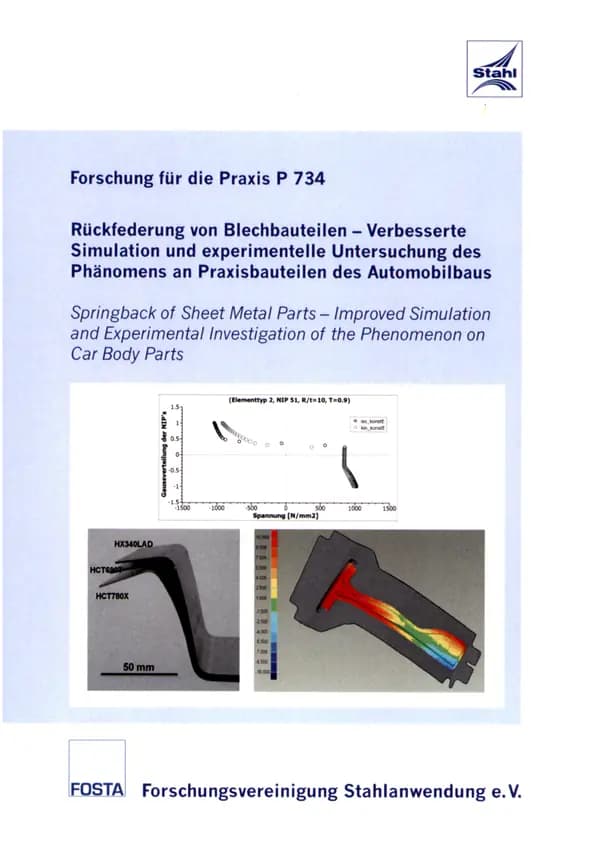
The springback behaviour of deep-drawn and trimmed sheet metal components made of high-strength steels cannot yet be simulated with sufficient accuracy. An exact determination of the springback values is often only possible for classic deep-drawing grades; high-strength materials and complex component geometries make the calculation even more difficult. The choice of finite element type (FE), the material and friction law as well as the elasticity of the workpiece are decisive factors influencing the simulated springback result. In the course of this research project, the element and material model influence on the springback result in the FE simulation was investigated.
Element and material model-specific parameters were optimised with a view to improving the prediction accuracy of the springback simulation. The influence of the elements on the springback result has already been investigated in previous studies, whereby the results of the simulation were compared with a real test. As a result, the influence of friction, material elasticity and material behaviour on the test results is included in the element analysis. The modelling of the material behaviour of high-strength and ultra-high-strength steels, such as anisotropy, kinematic hardening, E-modulus as a function of strain and strain rate sensitivity, cannot be mapped with sufficient accuracy in existing material models. Similarly, the possibilities for modelling tool elasticity and friction, which is dependent on surface properties, lubrication, surface pressure and drawing speeds, are limited. The investigation of the sole element influence on the springback result is therefore carried out in the first step by means of a comparison with an "ideal" simulation - high-resolution mesh partly consisting of volume elements - whereby the element type and the integration method are varied. In a second step, the parameter study carried out is evaluated using a simple test component. For this purpose, trough profiles are deep-drawn and the springback behaviour is determined by optical measurement. The FE modelling of the forming and springback process is carried out with the previously determined element types and element parameters, taking into account anisotropy, kinematic hardening and E modulus as a function of strain. strain. In the final step, the findings are applied to the modelling of a practical component, a B-pillar, and evaluated by comparing the experimental and numerical results. The result of this project is a list of recommendations for the modelling of a forming process with regard to element type, integration method, discretisation and material modelling in order to increase the prediction accuracy of the subsequent springback simulation. The research project was carried out at the Competence Centre - Das virtuelle Fahrzeug Forschungsgesellschaft mbH, Graz, at the Institute for Tool Technology and Chipless Production, Graz University of Technology and at the Institute for Forming Technology and Forming Machines, Leibniz University of Hanover, with technical support and financial assistance from the Forschungsvereinigung Stahlanwendung e. V., Düsseldorf.
Payment by card (Stripe) or invoice (DE, AT, CH). Download link by email: automatically after ordering by card, after order approval for invoice (valid for 30 days). Terms
Machine-translated title and description. The document itself is in German.
Digital download
Other parts and editions as well as neighbouring documents of the same series.

P 735 - Bonding Fresenel collectors to sheet steel substructure The NOVATEC BioSol solar power plant technology is based on the principle of Fresnel collector technology. It uses flat glass mirrors instead of parabolically curved mirror surfaces. 16 parallel rows of mirrors are arranged in such a way that they bundle the reflected solar energy into a caustic curve. A receiver is installed in this caustic curve, in which water is vaporised and then fed to a steam turbine. During production, the flat mirrors are to be bonded to a sheet metal construction. construction. This FOSTA project was carried out to investigate the durability of bonded mirror-sheet metal joints. Therefore, different types of coated and stainless steel sheets were selected to perform strength and durability tests in combination with moisture-curing flexible adhesives and flat glass mirrors. Publication: 2007 Authors: Prof Kötting
available anytime
€30.00
excl. VAT

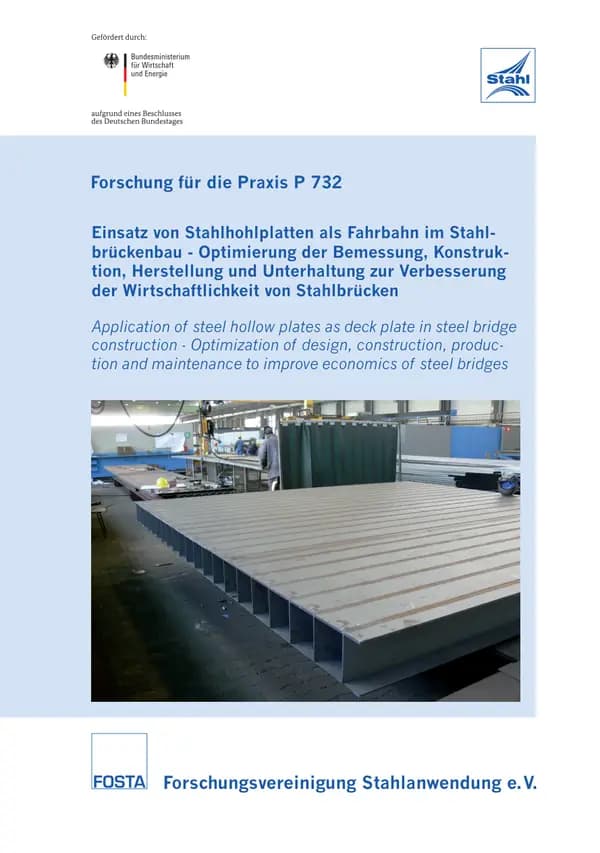
P 732 - Use of hollow steel plates as carriageway in steel bridge construction Optimisation of design, construction, manufacture and maintenance to improve the economic efficiency of steel bridges Compared to orthotropic deck slabs in steel bridge construction, hollow slabs, consisting of an upper and lower cover plate with webs in between, have a more favourable load-bearing behaviour due to a higher transverse load-bearing effect. Until now, however, it has not been possible to manufacture such structures cost-effectively using conventional welding processes. With the help of modern laser welding processes, hollow plates can now be produced economically. These are already being used in shipbuilding as assemblies with a subordinate load-bearing function and small cross-sectional dimensions as well as low sheet thicknesses. For the use of hollow steel plates in steel bridge construction, the existing theoretical principles for the load-bearing effect must be checked for applicability with corresponding plate thickness ranges, cross-sectional dimensions and the load models according to the DIN technical reports and, if necessary, optimised for practical application. The structural design, the information on minimum production standards and the statements on inspection possibilities in the course of routine testing of carriageways made of hollow steel plates are to be scrutinised and possible solutions provided. In the present research project, the load-bearing behaviour of hollow steel slabs was analysed with the aid of numerous experimental and theoretical numerical investigations. Both large component tests to determine the overall load-bearing behaviour and tests on panel strips to verify the transverse load-bearing effect as well as numerous small component tests to explicitly analyse the individual failure mechanisms were carried out. The results obtained were used to check, extend and optimise existing design methods with regard to simple application in engineering practice, so that a design concept could be developed for the cross-section geometries and load situations commonly encountered in steel bridge construction. The results show that, due to their cross-sectional geometry, hollow slabs have high static load-bearing capacities, which are advantageous for use in surface structures subject to bending loads, while at the same time being economical to manufacture. Investigations into the fatigue strength of the relevant laser-welded connection between the cover plate and web were carried out for the existing plate thickness combinations. It was found that the fatigue strength of the current connections is not sufficient for the use of hollow steel plates in dynamically stressed structures. However, due to the increased laser power, it can be assumed that improvements in fatigue strength can be achieved in the future. Various solutions for the connection of hollow plates were also developed and analysed for their applicability in steel bridge construction. The concept developed was successfully tested in component tests. The basic inspectability of the closed hollow steel slabs was also analysed in the course of carrying out bridge tests in accordance with DIN 1076 and ensured by appropriate solutions. The IGF project 15024 N of the Forschungsvereinigung Stahlanwendung e.V., Düsseldorf, was funded via AiF as part of the programme for the promotion of joint industrial research and development (IGF) by the Federal Ministry for Economic Affairs and Energy on the basis of a decision by the German Bundestag. The project was carried out at the Technical University of Dortmund by the Chair of Steel Construction and the Chair of Materials Technology. Authors: D. Ungermann, O. Klostermann, P. Dissel, W. Tillmann, A.M. Osmanda, R. Zielke, G. Nüsse Publication: 2014
available anytime
€50.00
excl. VAT

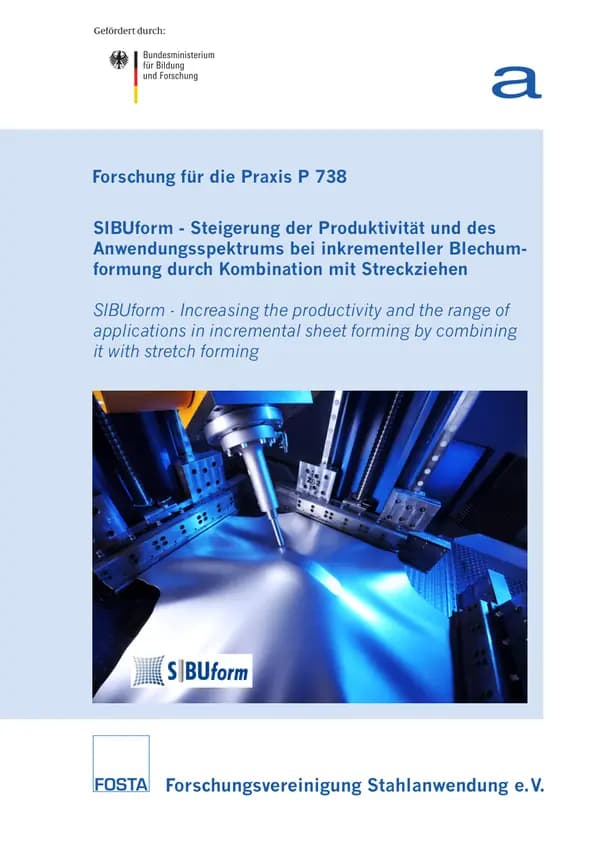
P 738 - SIBUform - Increasing productivity and the range of applications for incremental sheet metal forming by combining it with stretch forming The desire for a greater variety and individualisation of goods and consumer goods is becoming increasingly important both now and in the future. For the manufacturers of products, this also means that production must be highly flexible and cost-effective, while at the same time ensuring rapid availability of both the raw materials and the end products. Accordingly, this change also influences the way in which products are manufactured. New production strategies combined with new developments in the field of process technology are essential. The economical production of goods in small quantities is becoming more important than ever. Particularly in industrial sectors such as aerospace, where traditionally only small quantities are produced, this trend towards individualisation and increased flexibility is in some cases leading to a restructuring of the manufacturing landscape, combined with a very high degree of automation, which was previously only known in industries such as the automotive industry. Characterised by buzzwords such as "rapid tooling", "rapid prototyping" or "reduction of time to market", these new manufacturing approaches are being driven forward. Such an approach to increasing flexibility and reducing costs can also be transferred to the field of sheet metal processing. A production system with low tool costs, high flexibility with regard to the components to be manufactured and a high output rate is desirable. Such an approach is being pursued in the SIBU-form joint project, which is described in detail in this report. The interest in such flexible manufacturing solutions, in the case of SIBUform in the sheet metal processing sector, is also reflected in the project consortium. Representatives from the automotive and aerospace industries worked hand in hand with system integrators, software houses and universities to create a highly flexible manufacturing technology that can also be used profitably in high-wage countries such as Germany. This research and development project no. 02PU2100 was carried out at the Institute for Image Forming (IBF) at RWTH Aachen University, at the Machine Tool Laboratory (WZL) at RWTH Aachen University, Chair of Machine Tools and Chair of Production Systems, at Audi AG, Ingolstadt, at EADS Deutschland GmbH, EADS Innovation Works Germany, Munich, at EiMa Maschinenbau GmbH, Frickenhausen, at iCASOD GmbH, Germering and at Mubea Tailor Rolled Blanks GmbH, Attendorn and funded by the Federal Ministry of Education and Research (BMBF) within the framework concept "Research for the production of tomorrow" and supervised by the Karlsruhe Project Management Organisation (PTKA). Authors: G. Hirt, M. Bambach, B.T. Araghi, A. Malik, M. Vitr, D. Bender, J. Hieber, V. Huthmacher, J. Zettler, H. Gras, G. Nagel, P. Krumbacher, T. Hofbauer Publication: 2011
available anytime
€30.00
excl. VAT

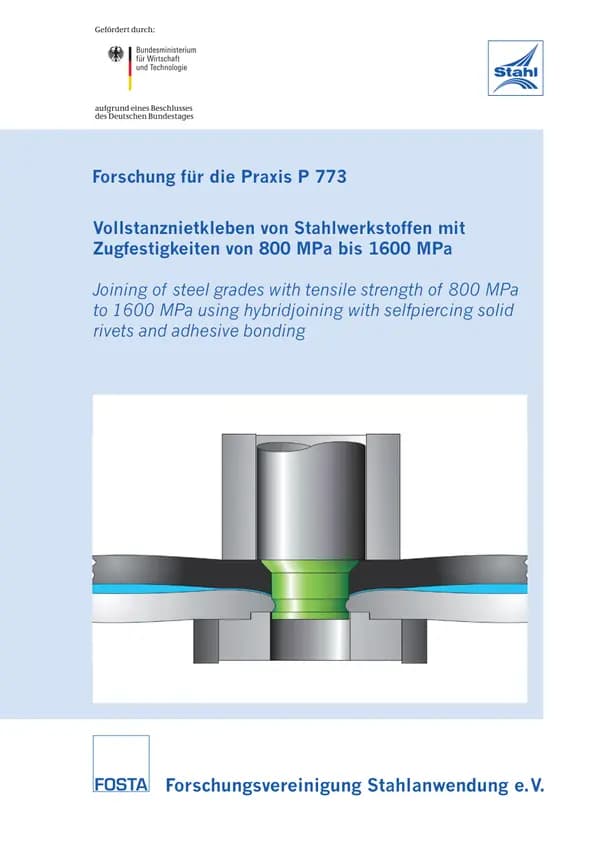
P 773 - Full self-pierce rivet bonding of steel materials with tensile strengths from 800 MPa to 1600 MPa Full-punch rivet bonding is a process combination that stands out from a large number of alternative joining techniques due to its particular potential for joining high-strength materials, among other things. With the aim of qualifying an economical process for joining semi-finished sheet metal products made of differently coated, high-strength steel materials with tensile strengths of 800 MPa to 1600 MPa for practical application, investigations into the elementary processes of self-pierce riveting and adhesive bonding as well as the combined application of these joining techniques were carried out as part of this research project. Approaches for process optimisation were derived from the knowledge gained, the effects of which on the joint formation and the load-bearing behaviour of the joints were verified by tests as part of the project and used to further develop the process. This report describes the initial situation by presenting the process-specific properties of elementary adhesive bonding and mechanical joining processes and emphasises the particular potential and need for development of hybrid full-punch rivet bonding technology for joining high-strength to ultra-high-strength steel materials. By determining the application limits of elementary self-pierce riveting, a basis of knowledge is then formed that reflects the performance of the process under consideration and at the same time represents the starting point and reference for investigation and optimisation measures. In order to identify suitable approaches for expanding the possible range of applications, various interdependencies were analysed. In this context, for example, the influences of modified rivet geometries on the joining forces in elementary self-pierce riveting were analysed. By investigating the influence of the rivet head end position on the load-bearing and failure behaviour of full-punch riveted joints of high-strength sheet steel, important findings were obtained that led to optimisations that improved the load-bearing behaviour of the joints. The contents also include the verification of joint damage caused by hydrogen-loaded joining parts as well as stab tests on the full-punch riveting of 3-layer mixed construction joints with high-strength steel sheets. Here it was shown how significant increases in joint strength can be achieved by selecting the optimum joining direction. The analysis of elementary bonded, differently coated 22MnB5 parts revealed different failure mechanisms. Investigations into the process compatibility of full-punch rivet bonding revealed the potential for optimising full-punch rivet bonding of ultra-high-strength steel materials. Based on the knowledge gained in this way, further steps were taken to optimise the process. Tests with geometrically varied self-pierce riveting tools, modified adhesives and a modified self-pierce riveting process were used to pursue various approaches to optimise the self-pierce rivet bonding technique and achieve improvements in the joint formation. The performance of the optimised joining technology is then presented in the form of investigations into the load-bearing behaviour of elementary and hybrid-joined joints under static and dynamic force application, as well as the behaviour of differently coated test specimens under corrosive stress. Finally, recommendations for the design and production handling of the process are derived from the findings. Authors: O. Hahn, C. Schübeler Publication: 2010
available anytime
€40.00
excl. VAT
Payment by card (Stripe) or invoice (DE, AT, CH). Download link by email: automatically after ordering by card, after order approval for invoice (valid for 30 days). Terms