Due to its typical properties, such as good formability combined with high component strength, steel offers excellent potential for architectural expression. As part of this project, the Chair of Forming Technology at …
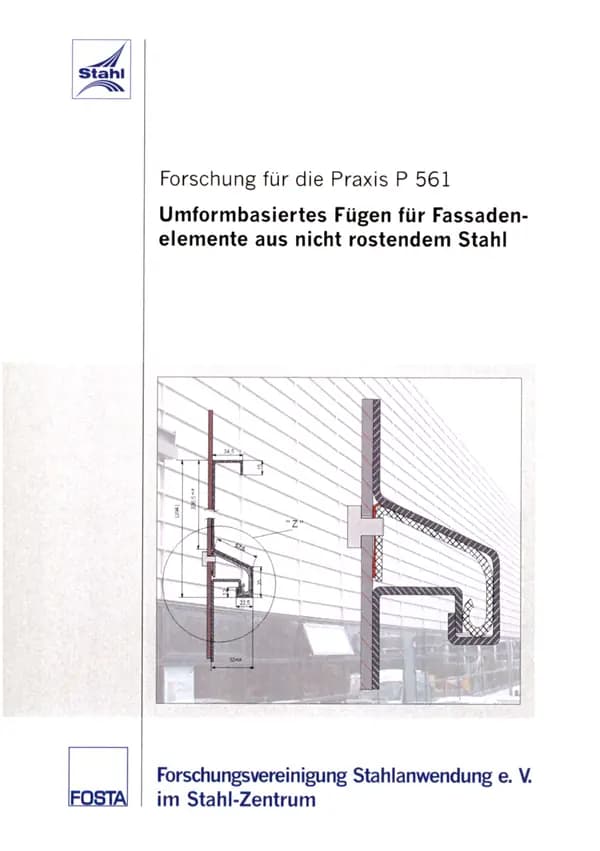
Due to its typical properties, such as good formability combined with high component strength, steel offers excellent potential for architectural expression. As part of this project, the Chair of Forming Technology at the University of Dortmund used a new type of stainless steel façade system as an example for a new test hall, focussing in particular on questions relating to assembly technology, corrosion resistance and design. A key focus was the development and optimisation of the element geometry for this façade cladding. The individual elements had to be installed in such a way as to minimise surface damage and ensure all the relevant structural properties.
At the same time, cost-effectiveness was to be improved through a quick, simple and functional installation technique. This objective was to be achieved through an assembly system with a high degree of prefabrication in the workshop to minimise on-site assembly times and the on-site use of a forming joining technique such as clinching. Construction and assembly of the realised stainless steel façade ultimately had to be carried out in a more conventional manner, as hand-guided setting equipment was not available for use on site during the construction phase. This restriction was primarily due to the system dimensions, which precluded the use of a non-stationary, hand-guided setting unit. With the specified geometric dimensions of the parts to be joined - especially the panels - accessibility to all the required joining points would only be possible with increased design and technical equipment - and therefore only with increasing mould masses. This meant that the use of a forming joining process was only possible to a limited extent in terms of the objective. As an alternative, the assembly technique - adapted to the selected panel geometry - was modified in such a way that concealed assembly points were used to prevent penetration of the façade surface. This surface-friendly installation technique is based on internal clamping elements that fulfil all the necessary static boundary conditions. It fulfils the requirement for shorter installation times on the construction site. The clamping elements are fastened quickly and easily using riveting technology with lightweight hand-held tools. The concealed mounting points significantly characterise the sophisticated visual appearance of the façade, especially in the stainless steel version presented here. The investigations show extended possibilities for the use of large-area elements as façade cladding. The assembly technique presented here was developed as an example for the construction of an external façade cladding made of stainless steel and can be transferred to other sheet materials with corresponding formability. This development work thus characterises the outstanding properties of steel as a material. In addition to the mechanical and technical requirements, the use of stainless steel also fulfils further requirements in terms of appearance and design. RESEARCH ASSOCIATION FOR STAHLANWENDUNG e.V.
Payment by card (Stripe) or invoice (DE, AT, CH). Download link by email: automatically after ordering by card, after order approval for invoice (valid for 30 days). Terms
Machine-translated title and description. The document itself is in German.
Digital download
Other parts and editions as well as neighbouring documents of the same series.

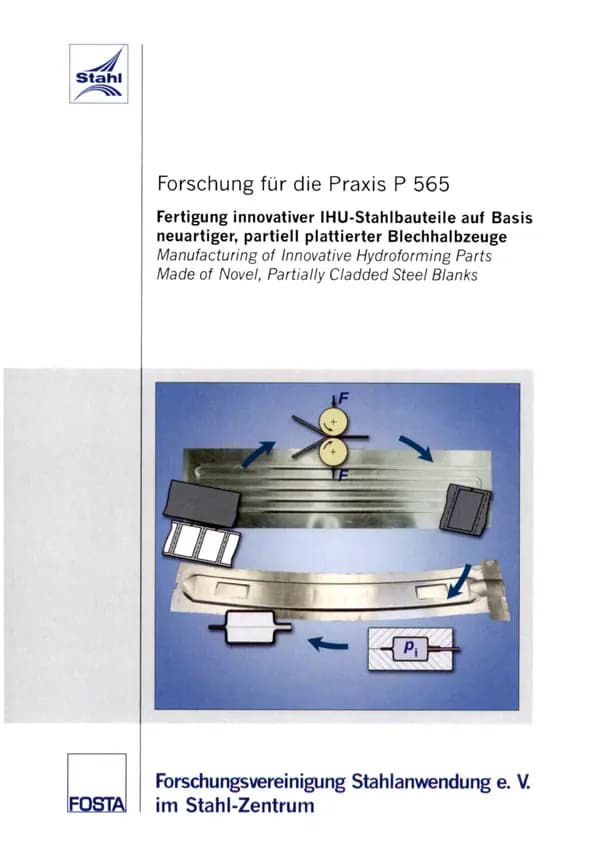
P 565 - Production of innovative hydroformed steel components based on novel, partially clad semi-finished sheet metal products As part of this research project, the technology of partial cladding for steel materials has been developed and the process chain "Partial cladding - hydroforming (hydroforming)" has been comprehensively investigated. Partially clad blanks are new types of double-sheet or multi-sheet semi-finished products that are joined together over their entire surface in defined sheet areas using a roll cladding process so that they partially form a solid material composite. By applying pressure to the unjoined areas of the double-sheet composite, sheet metal moulded parts with complex geometries can be produced using innovative hydroforming processes. Compared to thermal joining processes, roll cladding of double-sheet composites offers a number of important economic and technological advantages. As a continuous joining process, roll cladding enables a high output. Furthermore, a wide variety of metal combinations can be realised by cladding, which can also be multi-layered. The possibility of joining metals with different physical, chemical, mechanical or optical properties to form double-sheet composites opens up the possibility of new types of multifunctional integral components. One area of application for partially clad double sheets is the production of moulded sheet metal parts in the structural area of motor vehicles. In addition to such applications in automotive engineering, there are other potential areas of use, for example in rail and aircraft construction, apparatus engineering, air conditioning and sanitary engineering or the household appliance industry. The experimental and FE-based investigations presented in this report focus on - the production of partially clad sheet steel semi-finished products, - the resulting semi-finished product properties - and the hydroforming of partially clad sheet steel semi-finished products using selected example geometries. The application potential of partially clad hydroformed steel components for the application area of automotive body construction has been demonstrated on the basis of the production of a roof beam geometry and by means of investigations into its application behaviour. A supplementary economic evaluation of the semi-finished product and the "partial cladding - hydroforming" process chain also demonstrates the economic potential of this new technology. Authors: M. Kleiner, W. Homberg, B. Rauscher, M. Trompeter, H. Karbasian, M. Gösling, M. Köhler, T. Langhammer, F. J. Lenze, S. Schwarz Publication: 2007
available anytime
€20.00
excl. VAT

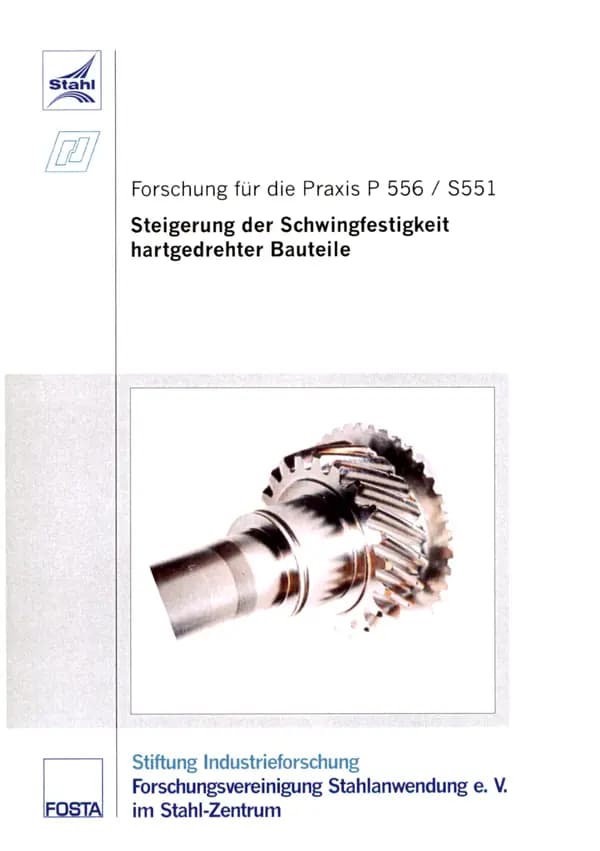
P 556 - Increasing the fatigue strength of hard-turned components Hard turning is a machining process that has increasingly found its way into industrial practice. Hard turning can achieve surface qualities comparable to grinding. However, the results of the research project SIF No. 406 "Fatigue strength of hard turned / ground components" have shown that increasing tool wear during hard turning leads to a decrease in fatigue strength. The aim of the present project is therefore to investigate the transferability of the findings obtained on the steel grade 16MnCr5 (1.7131) to other materials. To this end, investigations are planned on notched round samples of the case-hardened steel grade 18CrNiMo7-6 (1.6587) and the induction surface hardened material 42CrMo4 (1.7225). The potential for increasing the fatigue strength after hard turning with worn tools is to be tested for the post-treatment processes of hard burnishing and high-pressure water jetting. At the beginning of the project, the optimum process parameters for hard machining are determined. After hard machining, the analysed components exhibit similar roughness depths Rz for all machining conditions of the three materials, which lie in a range of Rz = 2 to 3μm. The grinding machining process also resulted in comparable surface qualities for all materials analysed. The fatigue strength tests confirm a drop in fatigue strength for the steel grades 16MnCr5 and 18CrNiMo7-6 in the fatigue and endurance strength range when hard turning is performed with worn tools. The strength of the ground samples of 18CrNiMo7-6 and 16MnCr5 is below that of the hard-turned test series. The 42CrMo4 samples are obviously affected by other effects. Increasing wear of the tool during hard turning does not cause a drop in fatigue strength in either the creep rupture strength or the fatigue strength range. Grinding provides the highest fatigue strength for the 42CrMo4 in the induction edge-hardened condition. When comparing the fatigue strength values of the analysed steel grades analysed, it can be seen that the 16MnCr5 has the highest fatigue strength and the 42CrMo4 the lowest. After hard turning with high tool wear (VBc = 200 μm) and subsequent high-pressure water blasting, there is a significant increase in the fatigue strength to the initial level of the samples made from case-hardened 16MnCr5 using a new tool. After hard burnishing, there is a significant increase in fatigue strength above the initial level of the samples produced with the new tool. The application of a new surface form number according to Liu to the test results shows that the surface form number can differentiate between turned and ground surfaces. Thus, a differentiated consideration of the different surface surface topographies of the manufacturing processes. FE process simulations carried out for hard turning show that the influence of tool wear on the temperatures and stresses in the workpiece edge zone can be modelled. Thus, by selecting a suitable material and machining process and, if necessary, a suitable post-treatment, hard turning or grinding can be used specifically as a final finishing process - a finding that benefits small and medium-sized industry in particular. Authors: M. Köhler, H. Zenner, A. Esderts, C. Müller, H. K. Tönshoff, B. Denkena Publication: 2005
available anytime
€25.50
excl. VAT

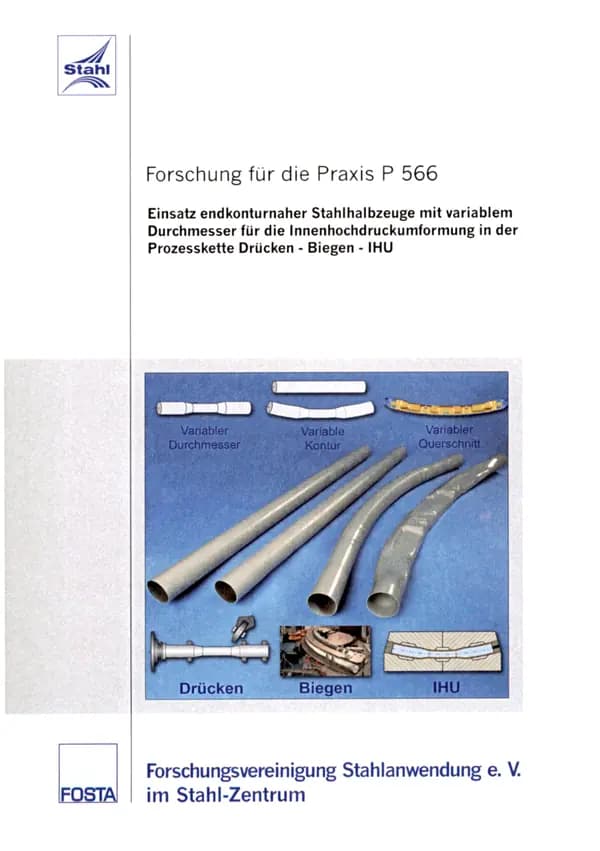
P 566 - Use of near-net-shape semi-finished steel products with variable diameters for hydroforming in the spinning - bending - hydroforming process chain The aim of the research project was to further develop hydroforming (hydroforming) for the production of complex lightweight steel components with highly varying cross-sections along the component's longitudinal axis. Until now, these components have usually only been achievable at great expense by utilising many process steps, such as intermediate heat treatments. The combination of the process steps spinning - bending - hydroforming investigated in this research project can achieve a significant reduction in costs, which represents a significant improvement with regard to the economical production of such components. As part of the investigation of the spinning process step, the so-called tube drawing was investigated for pre-contouring, whereby clamping devices and support devices in the form of special steady rests were developed. In this way, tubes could be tubes could be adapted to the cross-sectional profiles of a hydroforming mould with a high degree of accuracy. As a productivity-enhancing measure, a rotating spinning tool with several simultaneously engaged work rolls was developed and tested. In the area of bending technology, further developments had to be made due to the inconsistent bending properties of drawn-in pipes. On the one hand, a new rapid tooling concept for mould-based bending processes was developed, which is capable of producing the required contours with high accuracy and reproducibility. On the other hand, a second option for bending pre-contoured hydroformed semi-finished products was investigated based on three-roller bending using special elastomer rollers. The positive results, which were characterised by high contour quality and good process stability during the subsequent, very successful testing in the hydroforming process step, demonstrate the efficiency of the process chain pressing - bending - hydroforming and thus open up the possibility of manufacturing hydroformed components with cross-sectional jumps that cannot be produced with conventional semi-finished pipe products. The area of application for this new process chain is complex hydroformed structural components, for example in a steel spaceframe. In addition to such applications in automotive engineering, there are other potential areas of use, for example in rail and aircraft construction, apparatus engineering, sanitary engineering and the household appliance industry. Authors: M. Kleiner, S. Chatti, R. Ewers, M. Hermes, W. Homberg, R. Shankar Publication: 2006
available anytime
€30.00
excl. VAT

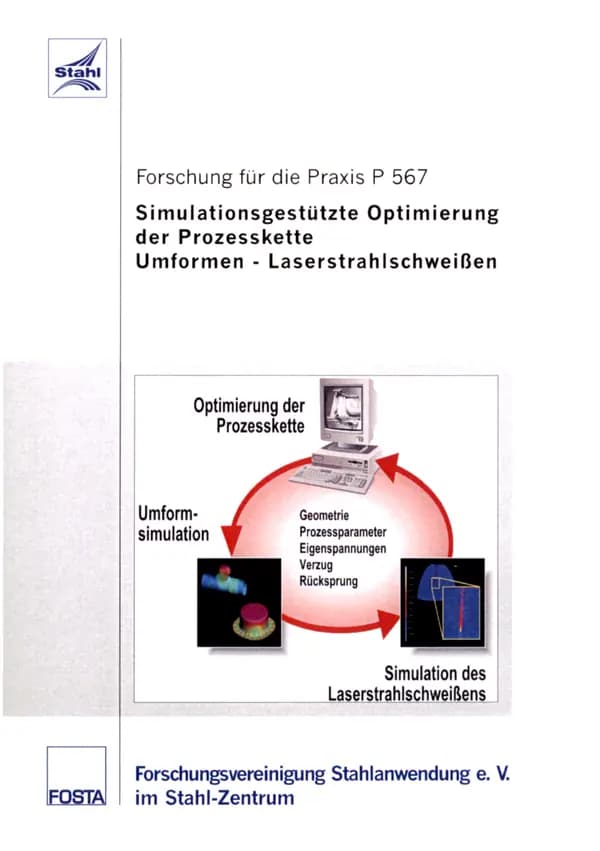
P 567 - Simulation-based optimisation of the forming - laser beam welding process chain Innovative production technologies in the field of forming technology, e.g. hydroforming (hydroforming), and in the field of joining technology, e.g. laser beam welding, enable the production of functional structural elements in lightweight construction. The advantages of these processes, such as an increase in rigidity despite a reduction in weight, are particularly evident when using high-strength and higher-strength steels. The industry's requirements in terms of manufacturing efficiency, load-bearing capacity and weight reduction of component structures require further innovations in the field of manufacturing technologies. In this context, the combination of the aforementioned processes offers the possibility of utilising the specific advantages of the individual production steps, such as the high level of automation, within a process chain. Numerical simulation based on the finite element method (FEM) serves as a tool for analysing the effects of the process on the machined component. The main objective of forming simulation is to investigate the process parameters and analyse the feasibility of the individual forming steps. Welding simulation is used to determine component distortion as a result of heat input into the component. Up to now, there have been no integration possibilities due to the different objectives and methods of the respective process simulations, making it difficult to take a holistic view in the simulation. The high stresses that are present as residual stresses in a formed semi-finished product after the forming process have a considerable influence on the behaviour of the component in the further course of the production chain. During laser beam welding, the internal equilibrium of the residual stresses is disturbed by the beam-substance interaction of the component with the laser beam. As a result, the internal energy is partially converted into a deformation of the material. This deformation has a major influence on the distortion caused by welding. As part of this research project, a methodology was developed to transfer the results of the simulation of the hydroforming process to the simulation of laser beam welding. For this purpose, the result of the forming simulation is implemented as the initial state in the welding simulation. In order to obtain a stable stress state as the initial state in the welding simulation, a strain tensor was generated based on the stress state in the last step of the forming simulation, which produces the required stress state. The results of exemplary simulation calculations show a significant improvement in accuracy through the integrated consideration of the two processes of hydroforming and laser beam welding in contrast to a mere distortion simulation of welding. In the case of complex structures, some tendencies only become apparent when the integration method is used. However, quantitative statements on the deformation of the structure due to the laser energy applied using numerical methods and highly abstracted models, such as modelling the clamping or the heat source, are not yet possible. Authors: M. F. Zäh, F. Auer, S. Roeren, H. Hoffmann, S. Häußinger Publication: 2004
available anytime
€20.00
excl. VAT
Payment by card (Stripe) or invoice (DE, AT, CH). Download link by email: automatically after ordering by card, after order approval for invoice (valid for 30 days). Terms