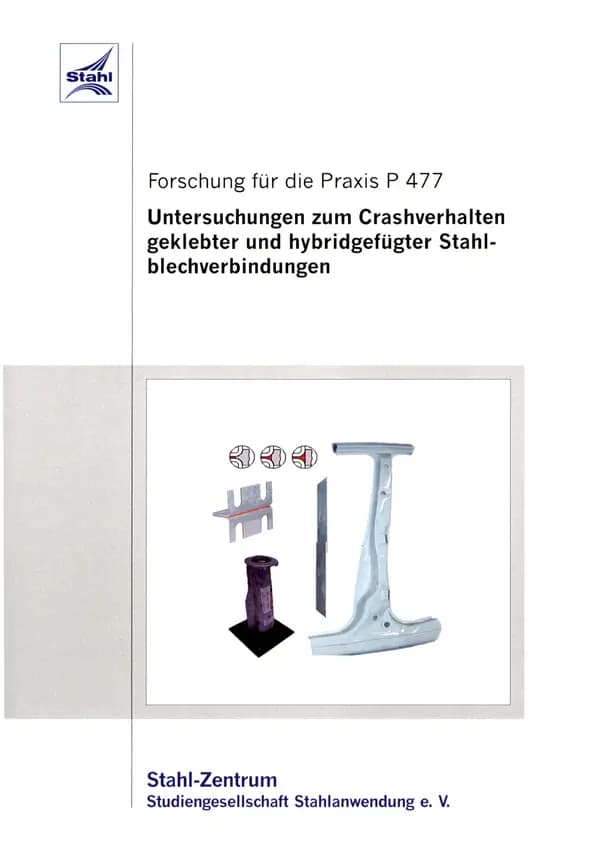
The aim of the research project was to analyse and compare different test concepts in accordance with the state of the art and to use the results to develop a practice-relevant test methodology for the safe evaluation …
The aim of the research project was to analyse and compare different test concepts in accordance with the state of the art and to use the results to develop a practice-relevant test methodology for the safe evaluation of the crash behaviour of bonded and hybrid-joined sheet steel joints. This test methodology was then to be used to determine the crash behaviour of sheet steel joints, taking into account different adhesive-specific boundary conditions. As a basis for the development of a simple test methodology, extensive tests were carried out on different specimen shapes in order to determine their suitability for determining crash parameters for predicting component behaviour.
The KSII peel tensile test specimen proved to be suitable for determining characteristic values under impact load with significance for the component. This applies in particular to hybrid joints, where adhesive bonding is combined with a mechanical joining process or spot welding. A single overlapped tensile shear specimen was selected to determine the characteristic values for the case of an impact-type tensile shear load. Based on the test methodology, several test and adhesive-specific parameters were systematically varied in a comprehensive test programme in order to investigate their influence on the behaviour of the bonded and hybrid-joined joints at high loading speeds and to obtain information for the structural design. With regard to the influence of the test speed, it was found that higher strain rates lead to an increase in the material, adhesive and joint strengths. The material of the parts to be joined only has a major influence on the load-bearing behaviour under peel tensile load if plastic deformation of the parts to be joined occurs. In contrast to the quasi-static tests, the peel tensile tests at high speed showed an increase in the maximum force with the sheet thickness. The influence of temperature is even more pronounced under impact loading than in the quasi-static case and must therefore be taken into account in the design. A possible reduction in joint strength due to ageing could be demonstrated to the same extent under impact loading as under quasi-static loading. With regard to the influence of the joint zone geometry, it was determined, among other things, that an increase in the joint filling leads to an increased peel tensile force under both quasi-static and impact loading. In contrast, the influence of a small variation in the adhesive layer thickness on the tensile shear strength can be neglected. The transferability of the investigations was comprehensively verified by accompanying experiments on Z-profiles and real components. This also demonstrated the performance of the adhesives used in comparison to conventional spot welding. The combination of spot welding and adhesive bonding, for example, reduced the permanent deformation of a B-pillar by more than 25% compared to the purely spot-welded reference samples. Even when the number of spot welds was reduced to approx. 45% of the number used in the series, the permanent deformation of the combined joined samples was still 20% lower than that of the purely spot-welded B-pillars. The characteristic values determined with the KSII peel tensile test showed a uniform order of evaluation of the adhesives regardless of the variation in test speed, joining part materials, sheet thickness and joining part material coating. This sequence is consistent with the results of the component tests. The cost-effective laboratory test on the peel tensile test, which was further developed in the project, therefore represents an efficient method for This means that the low-cost laboratory test on the peel tensile specimen developed in the project is an efficient method for assessing the crash suitability of adhesives when the adhesive layer failure in the component is determined by peeling stress. The test methodology developed in this project created the basis for a standardised assessment of high-strength adhesives for use in crash-loaded sheet steel structures. The results thus obtained already form a comprehensive basis for the design of such structures and the future integration of FE simulation of bonded joints under crash load into the development process.
Payment by card (Stripe) or invoice (DE, AT, CH). Download link by email: automatically after ordering by card, after order approval for invoice (valid for 30 days). Terms
Machine-translated title and description. The document itself is in German.
Digital download
Payment by card (Stripe) or invoice (DE, AT, CH). Download link by email: automatically after ordering by card, after order approval for invoice (valid for 30 days). Terms
Other parts and editions as well as neighbouring documents of the same series.

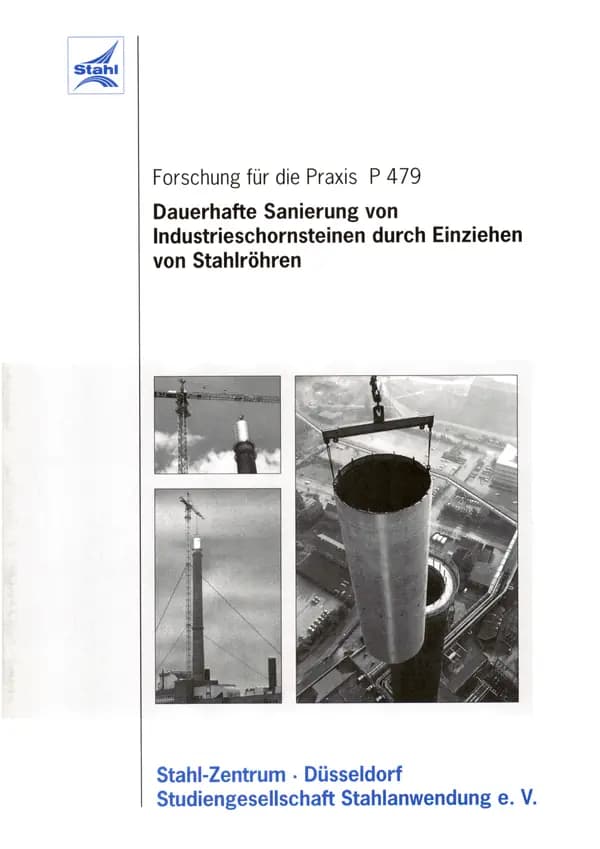
When adapting old, weakened masonry and concrete chimneys to modern operation with changing loads, the masonry lining usually has to be replaced. This can be done particularly favourably and permanently by installing a steel pipe. The task of this research project was to develop realistic principles for dimensioning and structural design. This included in particular - Degrees of freedom of the structural design - Relevant design criteria - Design instruments - Most appropriate process of structural design - Practical case studies on the design process - Hints for the practice The results of the work show how the serviceability, load-bearing capacity and economic efficiency of steel inner tubes can be controlled. The following questions are answered: - Pipe material Thermal and chemical resistance - Base formation Widening in the feed area - Internal insulation Lining in the feed area - Support design Diameter and spring stiffness - Guide design Number, height and rigidity - Wall staggering Distribution of sheet thicknesses The investigations now provide practice-orientated design methods for the design of internal steel pipes. On this basis, the structural characteristics to be determined in each case can be defined in an optimisation process. The practice-orientated principles developed in these investigations go beyond the relevant existing regulations. The new tools for the dimensioning and structural design of steel inner tubes for the permanent refurbishment of industrial chimneys are a valuable aid to persuasion, decision-making and design for operators, structural engineers and specialised companies. STUDIENGESELLSCHAFT STAHLANWENDUNG e.V. Publication: 2001 Authors: Dipl.-Ing. A. Harling, Prof. Dr.-Ing. P. Noakowski, Dipl.-Ing. M. Rost
available anytime
€20.00
excl. VAT

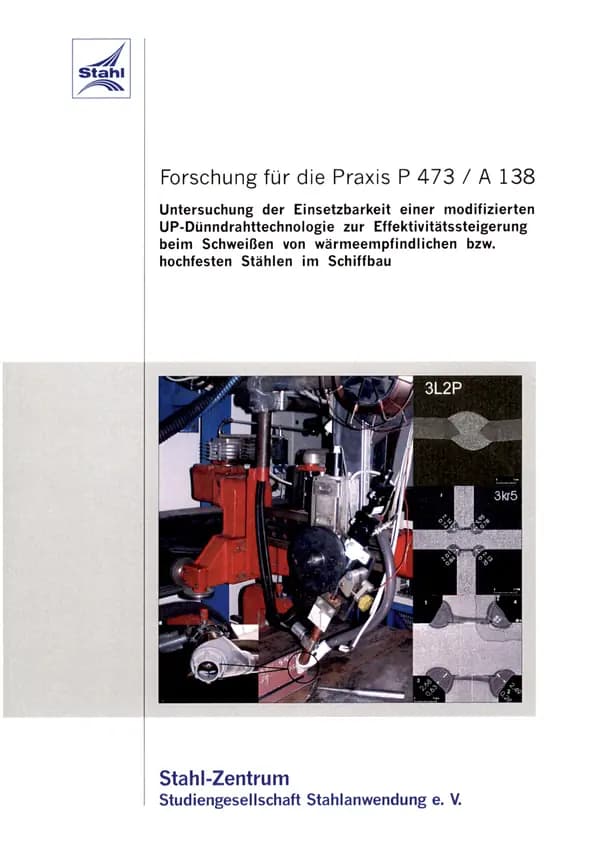
P 473 - Investigation of the applicability of a modified submerged-arc thin-wire technology to increase the efficiency of welding heat-sensitive or high-strength steels in shipbuilding Authors: U. Dilthey, T. Gräb, K. Willms Publication: 2002
available anytime
€20.00
excl. VAT

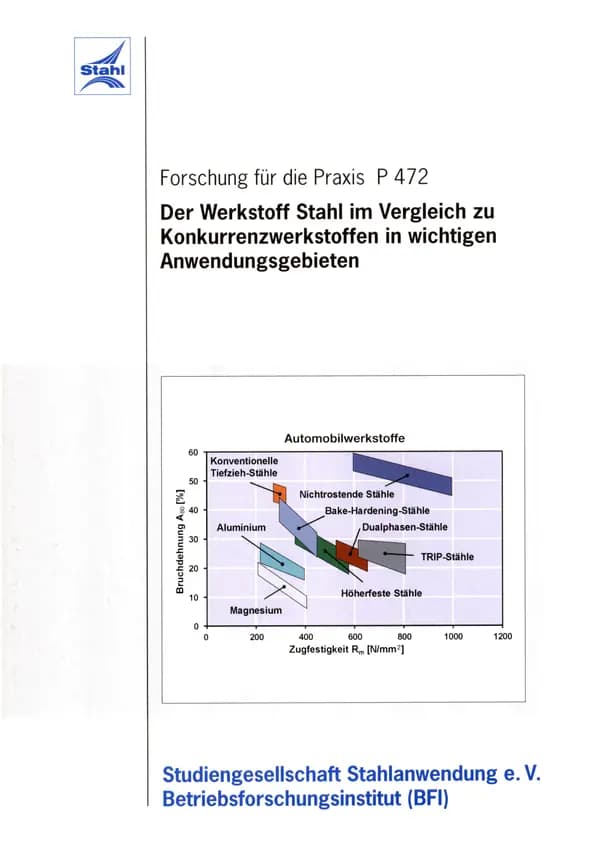
A fundamental misconception can often be observed in publicly funded research programmes: Very often, only a single material property, namely specific weight, is regarded as a viable criterion for the future. This one-sided judgement is not only grossly incomplete, but also wrong in view of the innovation potential inherent in steel. As an initial interim report, this study takes an objective look at steel as a versatile, high-quality, innovative material and provides comprehensive information on its advantages compared to other materials. In the case of component-neutral material properties, it is shown that the lightweight construction potential, energy absorption capacity, corrosion behaviour and wear resistance of steel are significantly better than those of competing metallic and non-metallic materials. For the investigation of material properties in further processing, a wealth of research results on innovative materials in particular were analysed. The result: The processing, in particular the forming behaviour, the possibilities for mechanical joining and bonding of steel, the suitability for welding and ultimately the excellent paintability of steel surfaces makes steel clearly superior to the comparable materials. In detail, component properties of different materials were compared with each other. The examples considered for car wheels, crash barriers, pipes for pipelines, pipes for building services, tailored blanks for automotive engineering, lightweight constructions, architecture and housing construction, as well as ropes, show that the steel materials used for these components, which are suitable for the stresses involved, fulfil the objective in every case. Optimally designed technology must also fulfil the requirements of economic efficiency, resource conservation and ecology. The innovative steel materials fulfil these requirements in an almost ideal way. An outlook concludes the investigations. It presents foreseeable further developments of steel as a material and the potential they harbour. STUDIENGESELLSCHAFT STAHLANWENDUNG e.V. Publication: 2000 Authors: Dr.-lng. O. Deutscher, Dipl.-Ing. V. Diegelmann, Dr J. Kurzynski, Dr R. Stelzer, Dipl.-Ing. S. Dietrich, Prof. Dr G. Frommeyer, Prof. Dr rer.nat. P. Neumann, Prof. Dr M. Stratmann, Dr M. Wildau, Prof. Dr W. Brockmann, Prof. Dr O. Hahn, Dr J. R. Kurzok
available anytime
€20.00
excl. VAT

P 447 - Integration of supporting structure and building services in steel office and production buildings for flexible utilisation Authors: G. Sedlacek, C. Ziller, K. Weynand, S. Stark, D. Thiel, H.J. Lemke, B. Döring, K. Lenzen Publication: 2004 The study presents possibilities to integrate building systems into the structural elements of a building in order to meet the different claims of the architects, the structural and mechanical engineers to design a modern building. Aspects like costs for construction and maintenance, energy consumption, fire control and customer requirements were considered. In the first part of the study the integration of building systems into Slim Floor ceiling systems were discussed. A main disadvantage of those integrated systems is the fact that the floors underneath are affected every time when operations of installation components are necessary especially when the building is used by different companies. In the second part of the project a dutch combined ceiling and floor concept called INFRA+ is introduced, a ceiling system which is turned upside down. INFRA+ is a concrete floor slab with integrated steel beams with perforated webs for passing ducts, pipes and cables which were installed from the top. The ceiling system is covered by a top floor of a dry mortarless construction. The advantages of the INFRA+ system are the reduction on storey-height of 10-15% compared to traditional floor/ceiling/raised floor constructions, no suspended ceiling using the accumulation capacity of the concrete, efficient water cooling/heating, reduction size of ducts, no installation "above head", simple control systems also for electric supply, lightning and fire control.
available anytime
€18.00
excl. VAT