The stud construction method with cold-formed profiles has been very successful in North America and Scandinavia for several years under the name cold-formed steel framing. In contrast to the familiar timber frame …
The stud construction method with cold-formed profiles has been very successful in North America and Scandinavia for several years under the name cold-formed steel framing. In contrast to the familiar timber frame construction, the ceiling and wall panels consist of load-bearing cold-formed profiles arranged in a grid of 40 cm to 80 cm and cladding on both sides. The sheet thickness of the profiles is usually 1.0 to 2.0 mm. The connection of the cold profiles with the panelling creates an elastic composite construction, the so-called panel. As with timber frame construction, these panels can be used to reinforce the building as ceiling or wall panels.
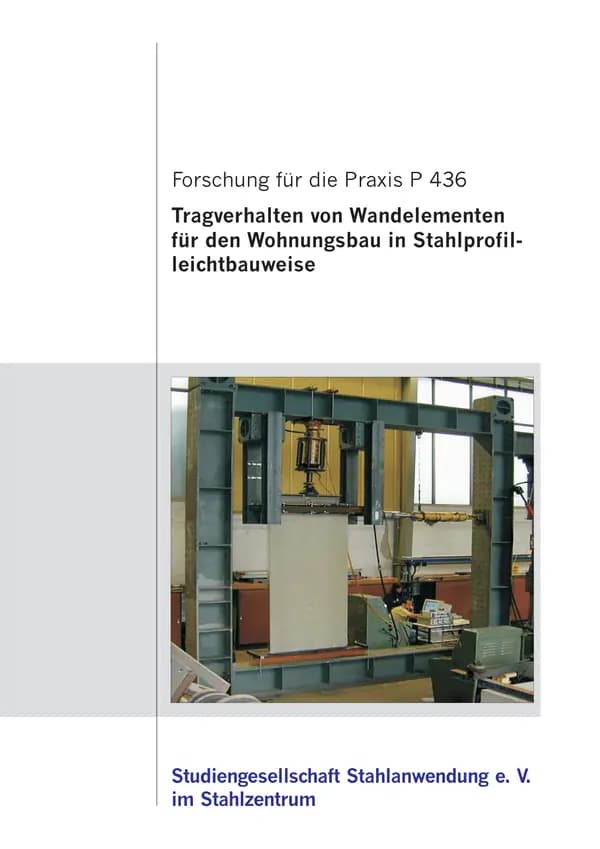
A wall panel is then subjected to both vertical and horizontal loads from the ceiling disc. The structure of the wall panels is identical to that of lightweight partition walls. The studs are C-profiles that are placed in the floor and ceiling profiles with a U-cross-section. The panelling is attached to the steel substructure with self-drilling screws. On the basis of several series of tests, a calculation model for the load-bearing behaviour of wall panels made of cold-formed profiles and cladding on both sides was developed at the Institute of Steel Construction and Mechanics of Materials at TU Darmstadt. While in the first series of tests the limit horizontal force of the 1.25 m wide and 2.60 m high panels with different claddings was determined, in the subsequent series of tests the load-bearing behaviour under additional vertical loads was investigated. The connection between the cold-formed profile and the cladding with self-drilling screws is the most important parameter when analysing the load-bearing behaviour of the wall panel. The limit force and load-displacement curves of this connection were therefore determined in a third series of tests. A design method was derived that allows the horizontal loads that can be absorbed to be determined using a simple manual calculation. At the same time, it was shown that when the wall panel is subjected to vertical and horizontal loads, the stabilisation of the cold-formed studs under pressure in the wall plane is ensured. Failure of the tested cold-formed profiles in the wall plane can be ruled out. C-profiles with the usual dimensions in residential construction therefore only need to be verified for bending buckling from the wall plane. If thicker-walled cold-formed profiles are used, however, it must be investigated whether the fasteners can withstand the deflection forces that occur. In conclusion, it can therefore be said that wall panels with cold-formed profiles and cladding on both sides can be used as a bracing system both for transferring horizontal loads from the floor slab and for stabilising the cold-formed profiles. as well as for stabilising the cold profiles. An indispensable basis for statements about the load-bearing behaviour of this composite component is knowledge of the load displacement behaviour of the cold-formed profile-cladding connection.
Payment by card (Stripe) or invoice (DE, AT, CH). Download link by email: automatically after ordering by card, after order approval for invoice (valid for 30 days). Terms
Machine-translated title and description. The document itself is in German.
Digital download
Other parts and editions as well as neighbouring documents of the same series.

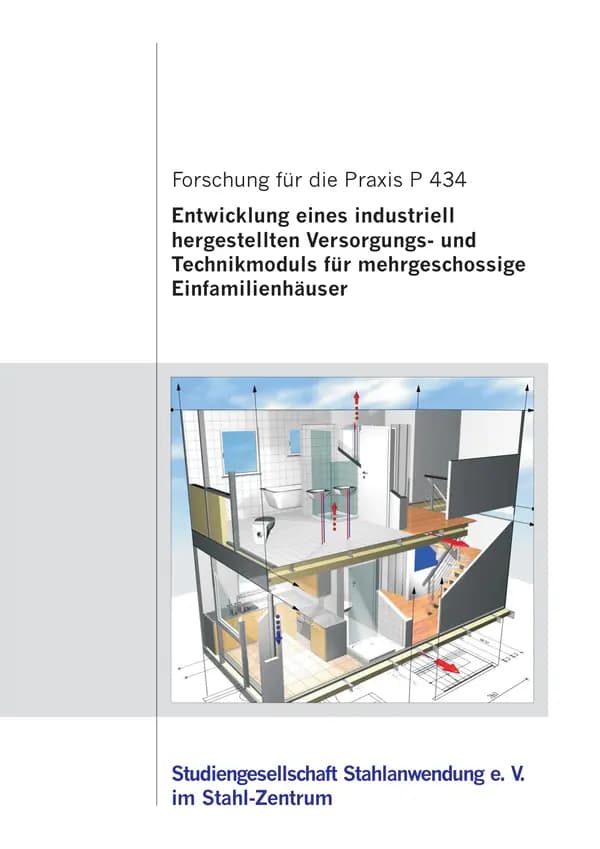
P 434 - Development of an industrially manufactured supply and technology module for multi-storey detached houses Authors: E. Schöne Publication: 2003 Normally, traditionally built houses as well as prefabricated houses have similar components as regards building technology. For example, this includes the supply with power and gas, the heating technology, the supply and disposal of water, sanitary equipment, communication technology as well as staircases and an optional lift. The current research project aimed at the concentration of these technologies to form a so-called supply and technical (VT) module for universal applications as far as possible. As an example, a product suitable for series production and adaptable to individual conditions was to be developed and produced for series production. The cost-efficient high-quality steel frame design proven in module construction was the starting point for this as a static support structure. During an intensive planning phase predictive requirements were collected and designed to form a model. Static calculation showed that the VT modules could compatibly be placed one above the other for houses with up to 5 floors. The concept is based on a strict separation of the VT modules from the other rooms in the building. All interfaces have largely been standardized and are of the plug-in or screw-type. Thus, building units erected with the traditional building technology, room module and prefabricated wood design can be interconnected easily. During a modernization of old buildings with multiple floors the specially designed VT modules can be “docked” to existing buildings.
available anytime
€25.50
excl. VAT

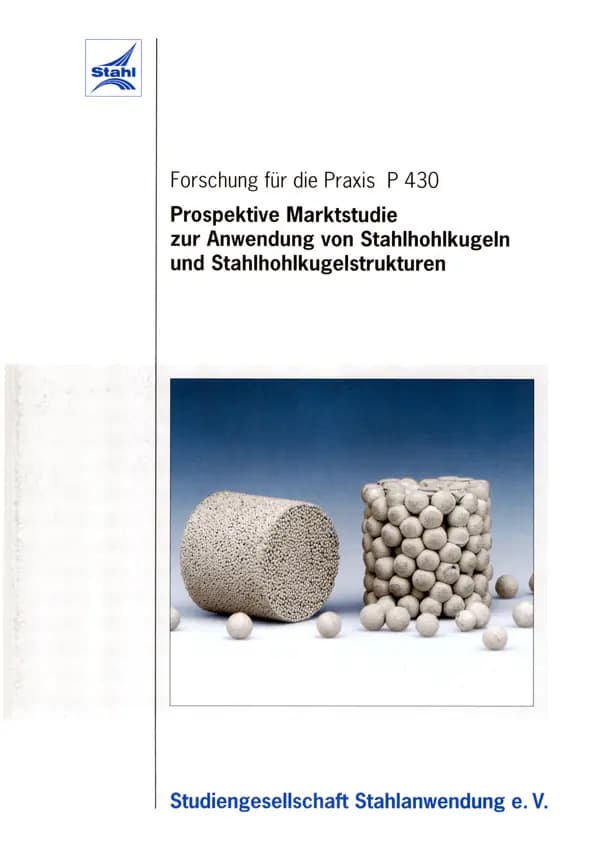
Metallic hollow spheres and hollow sphere structures made from them are an interesting technical alternative to metal foams. This study presents an assessment of the potential properties and possible applications of steel-based hollow sphere products. Based on literature and patent research, the currently available options for manufacturing hollow spheres are explained and compared. From today's perspective, the most favourable technology for mass production is the coating of polystyrene spheres with powdered materials and subsequent thermal treatment. The organic components are expelled and the metal powder particles are sintered to form a solid spherical shell. Requirements for the starting raw materials and the most interesting properties to be achieved, such as sphere diameter, shell thickness, bulk density, porosity and strength, are described. Possible applications for hollow steel spheres or structures made from them are seen in particular for crash absorbers, sound and heat insulators and lightweight structural elements. Comparisons are also drawn with the relatively similar application potential of metal foams, particularly those made of aluminium. The survey of industrial companies resulted in numerous suggestions for the market potential of hollow steel spheres or hollow steel sphere structures and the properties required. The study presents a development strategy for the manufacture and utilisation of products based on hollow steel spheres. The work is supplemented by an estimate of the likely manufacturing costs. The use and thus utilisation of secondary raw materials from steel production and processing may be a particularly advantageous option. STUDIENGESELLSCHAFT STAHLANWENDUNG e.V. Publication: 1999 Authors: Dr.-Ing. L. Schneider, Dipl.-Ing. U. Waag
available anytime
€20.00
excl. VAT

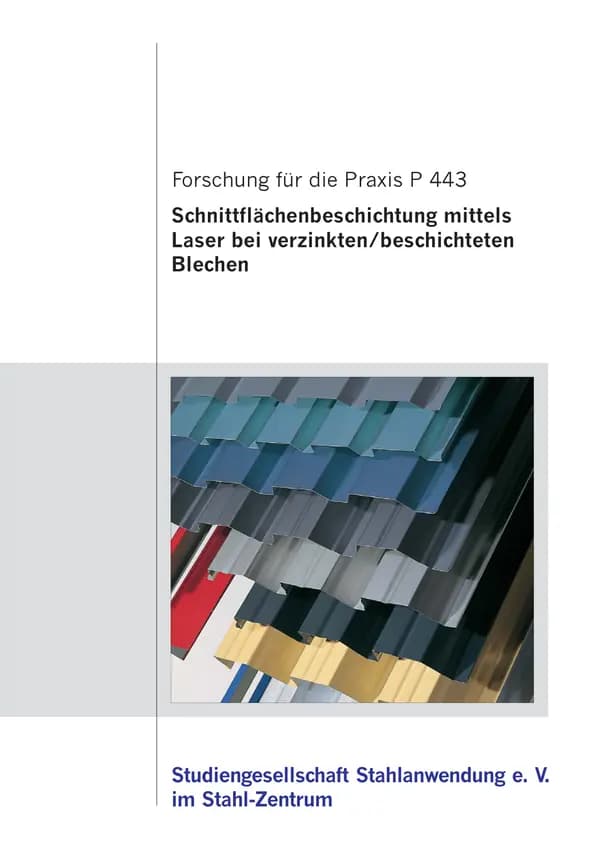
P 443 - Laser coating of cut surfaces on galvanised/coated sheet metal Authors: D. Maischner, K. Wissenbach, N. Pirch, H. Müller Publication: 2003 The corrosion protection of products out of steel sheets will be carried out mainly by continuous strip galvanics and subsequent coil coating with polymers (″Duplex″ technique). The cutting and stamping areas, which result from further manufacturing processes will be protected by conventional techniques like painting, lubricating, flanging of the edges and dip coating, which are not convincing solutions for the corrosion problem. Against this background the aim of this project is the development of basics for a laser induced coating process for cutting areas. The research work is focused on the process layout for a 1-step coating process for the cutting areas. This means that the powderised coating material and the laser beam interact simultaneously with the cutting area. For zinc coatings the zinc particles will be melted directly by the laser radiation and the laser heated cutting area. In contrast for polymer coatings the powder will be indirectly melted by the heated cutting area. The processing parameters will be adapted to prevent combustion and evaporation of the powder particles. The bonding strength and the corrosion resistance of the coated cutting areas were investigated. For zinc coatings as well as for the thermoplastic coating polyamid 11 (RILSAN) processing parameters could be developed, which show an excellent corrosion protection. Nd:YAG as well as diode lasers are suitable for this coating process.
available anytime
€25.50
excl. VAT

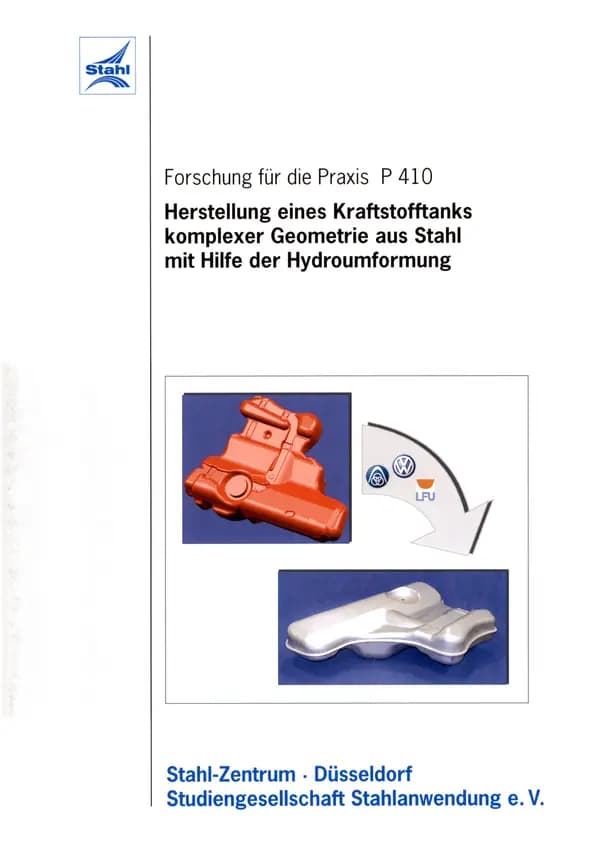
P 410: Production of a fuel tank of complex geometry from steel using hydroformingIn the course of stricter environmental protection requirements, the release of fuel oil components must be completely avoided. This requirement will soon apply to fuel tanks and can currently only be safely fulfilled with steel as a material. Design and safety requirements in car construction demand the positioning of the fuel tank in the less critical but very complex cavities of the car body in the event of a crash. The aim of this research project was to develop technical and economical solutions for the production of geometrically highly complex hollow bodies made of steel for this application with the help of active-media-based sheet metal forming. For the investigations, the tank of a New Beetle, PQ 34, from Volkswagen AG, which was previously made of plastic, was selected as an example for a medium-volume compact car. The austenitic stainless steel 1.4301, which had been tested in preliminary tests (P 242 Untersuchung der Herstellmöglichkeiten eines modernen Kraftstofftanks aus Stahl mit Hilfe hydromechanischer und hydrostatischer Umformverfahren, Order No. P 242, ISBN 3- 930621-78-9, Verlag und Vertriebsgesellschaft mbH, Düsseldorf), served as the material basis. In preliminary simulation work, promising forming processes, adapted process control and special tool design were investigated and selected. Finally, the upper shell of the tank was manufactured by deep-drawing 0.6 mm thick sheet metal. The geometrically much more demanding lower shell was successfully produced by single-stage hydromechanical deep drawing from 0.8 mm thick sheet metal. The tanks, which were joined to prototypes from the two half-shells using TIG welding, were then subjected to Volkswagen AG's factory-internal component tests. This showed that all necessary safety requirements could be fully met due to the material-specific high residual deformation capacity. Without further optimisation steps, a weight reduction of 1.7 kg or 20 % was achieved for the steel tank compared to the plastic version. In some cases, the wall thickness in steel is only one tenth of that in plastic, resulting in a filling quantity that is almost 3 litres or almost 4% higher. Based on these test results, it can be concluded that Stainless steels, and probably also other corrosion-protected steels, can be processed into geometrically very complex fuel tanks in conjunction with modern hydroforming processes and a process and material-appropriate design. Steel thus offers a highly topical alternative material for solving future environmental protection requirements for fuel tanks. STUDIENGESELLSCHAFT STAHLANWENDUNG e.V. Publication: 2001 Authors: Prof. Dr E. Friebe, Dipl.-Wirtsch.-lng. T.Langhammer, Dipl.-Ing. P. Corsten, ]}, Dr W. Homberg, Dipl.-Ing. A. Wellendorf, Dr A.t Birkert, Dr F. Trösken, M. Carl, Dr J. Krautschick, Dr P. Papaiacovou
available anytime
€20.00
excl. VAT
Payment by card (Stripe) or invoice (DE, AT, CH). Download link by email: automatically after ordering by card, after order approval for invoice (valid for 30 days). Terms