
FOSTA
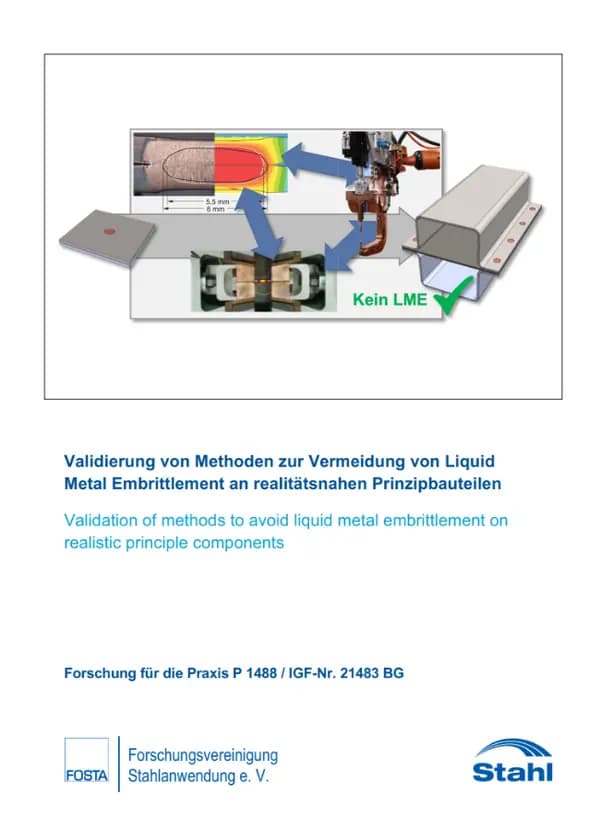
In this project, the LME susceptibility of a dual-phase steel was investigated experimentally and simulatively under various influencing variables in both WPS-based tests and Gleeble tests. The results show that …
In this project, the LME susceptibility of a dual-phase steel was investigated experimentally and simulatively under various influencing variables in both WPS-based tests and Gleeble tests. The results show that increasing the welding time during the WPS process has a significant influence on the type and intensity of LME cracks. Pre-stretching has no significant influence on crack formation, which was confirmed by both WPS and Gleeble tests. In the WPS test, the application of an external load during the welding process led to a significant increase in LME intensity, which was also confirmed by Gleeble tests. When analysing disturbance variables on the WPS process, offset welding was identified as the most serious disturbance variable for the user.
A new type of LME crack was also observed for this disturbance variable. On the basis of numerical investigations, an optimised welding program was developed that avoids the occurrence of LME cracks. In Gleeble tests, the following influencing variables on the LME intensity were determined: Increasing temperature intensifies the occurrence of LME. Furthermore, both an increased strain rate and an increasing heating rate led to a reduction in LME intensity. Applying a high pre-tensioning force in the elastic range caused a reduction in LME intensity, whereas a plastic pre-tensioning force caused an increase. In addition, no LME occurred with a long holding time (3s) and high temperatures (850 °C). The effect of LME on the load-bearing capacity of a realistic principle component was tested under a three-point bending load. Experimental results show that specimens with LME had a lower load-bearing capacity compared to those without LME and their energy absorption capacity is also significantly reduced. These results were confirmed by numerical analyses. The objective of the research project was achieved.
Machine-translated title and description. The document itself is in German.
Payment by card (Stripe) or invoice (DE, AT, CH). Download link by email: automatically after ordering by card, after order approval for invoice (valid for 30 days). Terms
Digital download
Other parts and editions as well as neighbouring documents of the same series.
P 1481 - Development of standardised column-beam connections for steel and composite structures in German earthquake zones Steel and steel-concrete composite structures subjected to earthquakes have an excellent dissipation potential. This property is utilised in modern constructions in order to erect high-performance and efficient structures in areas affected by strong seismicity. However, the planned utilisation of dissipation requires that strict design rules - the so-called capacity design - are followed so that the dissipative plastic mechanisms in the components are activated before other (brittle) limit states are reached. In rigid frame structures, the beams are generally designed as dissipative elements; their connections to the columns and the columns themselves must be designed and constructed with sufficient overstrength compared to the plastic bending capacity of the beams. In regions where structures have to be designed for weak or moderate seismicity, the aforementioned approach is often not economical, as the required dissipation capacity in these regions is significantly lower. This leads to solutions in which the dissipation capacity is dispensed with altogether by designing the structures for elastic behaviour under earthquake loads. The reason for this is the considerable effort required for the beam-to-column connections, which must be designed according to the capacity rules even for low behaviour coefficients. This practice negates both the dissipation capacity of steel and composite structures and the economic advantage, as larger cross-sections have to be used. An alternative to this are dissipative beam-to-column connections, which provide the required degree of dissipation. However, the current draft earthquake standards lack rules and methods for the design and dimensioning of dissipative connections, although consideration of connection flexibility and verification of the rotational capacity of the connections under cyclic loading are required. Only a few verification methods have been implemented in the new version of the European seismic standard. The research project aimed to close these existing knowledge gaps. The methodology included the identification of common column-beam connections, the analysis of their behaviour and the optimisation of their properties for appropriate behaviour in the plastic range. Both steel and composite connections for buildings with different uses (office, industrial buildings) were optimised. The performance of these connections was verified experimentally through component and system tests (connections, frames). This experimental data was used to develop numerical models for both connections and frames, which were extended by parameter studies. Finally, component models of the connections were developed and integrated into structural models in order to assess the seismic performance of steel and composite structures. Finally, recommendations for the design were formulated on the basis of the research results. The goal of the research project was achieved Publication: June 2024 Authors: Prof. Dr.-Ing. Hoffmeister, Dr.-Ing. R. Don, Dipl.-Ing. G. Balaskas, Dr.-Ing. C. Vulcu, Prof. Dr.-Ing. U. Kuhlmann, Dipl.-Ing. G. Skarmoutsos
available anytime
€30.00
excl. VAT
P 1480 - On the spatial load-bearing behaviour of combined steel sheet pile walls Experimental and numerical investigations were carried out by the Hamburg University of Technology (Institute for Geotechnics and Construction Management, TUHH) and the University of Stuttgart (Institute for Construction and Design, KE) to optimise design methods for combined steel sheet piles and sheet pile walls. Combined steel sheet pile walls and steel sheet pile walls are used in quay wall construction to secure ground leaps. The following objectives and sub-areas were focussed on: Optimisation of the horizontal load-bearing behaviour of combined steel sheet pile walls through investigations on the load and resistance side (earth and water pressure loads and resistance on the steel construction side) Optimisation of the vertical load-bearing behaviour of steel sheet pile walls and combined steel sheet pile walls on the resistance side (component and earth resistance) Evaluation of the results and updating and improvement of standardisation regulations as well as recommendations for practical application To achieve the objectives, the work was divided into work packages (WP): Work package 1: Parameter identification In the research project, the basics were first determined by parameter identification and the state of the art was explained. The focus here was on common profiles that are used in combined steel sheet pile walls. Common profiles in quay wall construction included H-shaped beams as load-bearing piles and Z-shaped beams as intermediate piles. Current valid and common design methods were analysed and the load transfer and failure mechanism were explained. WP 2: Horizontal load-bearing behaviour (TUHH | KE) In the second work package, laboratory tests were carried out to determine the influences of the spatial load-bearing behaviour. Various geometric parameters and soil parameters were taken into account. At the same time, FE investigations were carried out on vault formation in order to investigate the behaviour of the combined walls in more detail. Furthermore, large-scale tests were carried out on a combined steel sheet pile wall in the laboratory. The beams were elastically loaded in stages, followed by loading of the intermediate piles until failure. In addition, tests were carried out to analyse the influence of the bending stiffness of the intermediate piles on the bending stiffness of the beams and to investigate the approach of the plate effect of the intermediate piles with uneven load distribution. WP 3: Vertical load-bearing behaviour (TUHH | KE) In the third work package, combined bending-compression tests were carried out on sheet piles in order to record the vertical load-bearing behaviour more precisely. In addition to residual stress measurements, which have an influence on buckling, extensive FE parameter studies were carried out in order to adapt the simplified interaction equation for buckling for a load consisting of bending and normal force. In addition, numerical simulations were carried out to analyse the vertical load-bearing behaviour of combined walls in the ground and to determine the areas and forces required for the resistances. WP 4: Preparation of the results for practice and standardisation, final report (TUHH | KE | PbA) Finally, the results were prepared for practical application and standardisation. The newly developed design rules were applied to identified practical examples of the design of combined walls in real projects in order to estimate the economic consequences by comparing solutions. Resistance models and calculated design examples were created for practical use. Background documents were produced for standardisation and explicit proposals for changes were developed, particularly for vertical load-bearing behaviour. These have now also been partially incorporated into the new draft standard prEN 1993-5:2024. Publication: August 2024 Authors: Dr.-Ing. U. Kuhlmann, A. Enders, Prof. Dr.-Ing. J. Grabe, J. Beuße
available anytime
€30.00
excl. VAT
P 1438 - Development and testing of a modelling framework for the predictive investigation of erosive wear in pneumatic conveyors As part of the research project, wear in pneumatic conveyors was analysed by means of numerical and experimental investigations both on the microscopic length scale of individual particle impact events and on the macroscopic scale of pipe bends. A total of four steel grades - three stainless steels and one structural steel - and one plastic were experimentally analysed with regard to their wear resistance in contact with round and angular bulk material particles in different wear situations. This enabled the materials to be assessed in terms of their wear resistance in different applications and the significant influence of the shape of the bulk material particles to be identified. The relevance of the particle shape for erosive wear was confirmed by detailed numerical simulations using SPH. Based on the simulation results, an established, analytical erosion model, which quantifies the wear per impact, was successfully extended by two parameters that characterise the particle shape. This has created a model that is suitable both for rapid estimations of the wear behaviour of a specific bulk material and can also be integrated directly into CFD-DEM simulations for process analysis. Experiments were carried out to characterise the particles used in order to obtain contact parameters for CFD-DEM simulations. These include, for example, particle-particle and particle-wall contact parameters, with the help of which contact phenomena of the materials to be analysed could later be validly represented. Furthermore, experimental investigations have shown that typical wear patterns on paint coatings can be generated and are reproducible. In addition, methods for measurement were investigated with which a quick and simple evaluation should be possible. The method shows new possibilities for realising material-friendly wear tests within the shortest possible time or not necessarily requiring special measurement technology. The implementation of a validation simulation using CFD-DEM showed that experimental results could be reproduced with a high level of agreement, which opens up the possibility of varying system and process parameters and investigating the influences on wear. In addition to the variation of velocities and mass loadings, these parameters also include the use of different wear-reducing pipe bend geometries and their influence on wear rates, pressure loss and particle loading. This showed that, depending on the application, wear rates can be significantly reduced without a disproportionate increase in pressure loss. The objective of the research project was achieved. Publication: August 2022 Authors: Prof. Dr.-Ing. H. Kruggel-Emden, M. Sc. E. Drescher, Dr C. Bierwisch, Dr Sh. Mohseni-Mofidi
available anytime
€30.00
excl. VAT
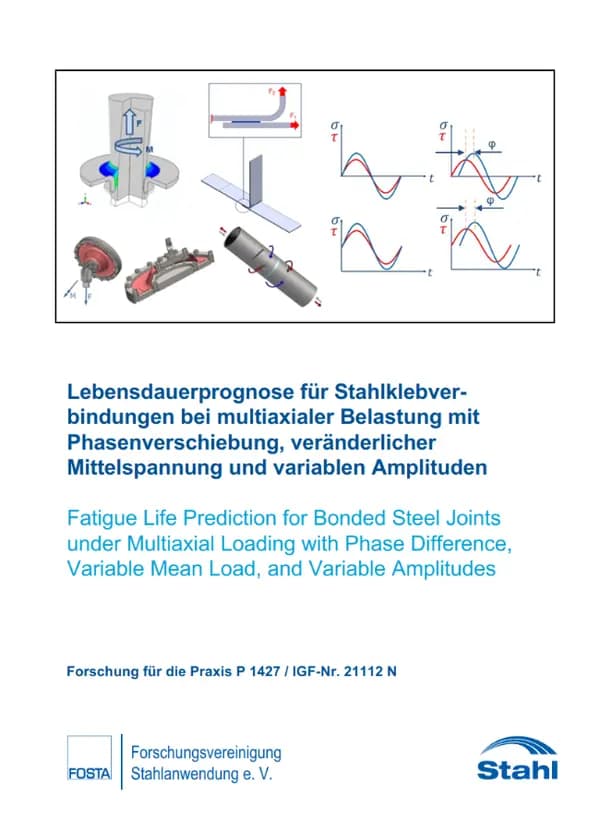
P 1427 - Service life prediction for steel bonded joints under multiaxial loading with phase shift, variable mean stress and variable amplitudes The project P 1427 / IGF-No. 21112 N "Lifetime prediction for steel bonded joints under multiaxial loading with phase shift, variable mean stress and variable amplitudes LAMbdA" aims to efficiently and reliably estimate the lifetime under these complex loads. To achieve this goal, bonded joints with steel substrates and two structural epoxy-based adhesive systems are being investigated: SikaPower 480 (EP1, unmodified system) and Betamate 1496 V (EP2, toughened system). The tests carried out as part of the project were performed at room temperature. To characterise the fatigue behaviour of the structural adhesives, basic tests were carried out on butt-bonded double pipe samples under cyclic pure tensile, pure torsional and multi-axial loading (tensile-torsional). To validate the prediction approaches, fatigue tests were carried out on bonded samples with an inhomogeneous stress state in the bonded layer. The following specimens were selected as representative specimens: the flanged round bar specimen (EP1) and the L-shaped specimen (EP2) with constant amplitude and the cup specimen (EP1, EP2) with variable amplitude. At constant amplitude, baseline and validation tests showed that (i) the lifetime decreases with increasing mean stress and (ii) the variation of the phase shift does not significantly influence the lifetime. With variable amplitude, however, both the mean voltage and the phase shift had an influence on the service life. Lifetime prediction approaches were developed on the basis of the experimental results. For cyclic loading with constant amplitudes, both invariant-based (BELTRAMI criterion) and critical-plane-based approaches (FINDLEY criterion) were used. Furthermore, a hybrid concept considering stress anisotropy was developed. For cyclic loading with variable amplitude, a multiaxial counting method was combined with an invariant-based failure criterion. The linear damage accumulation according to Palmgren and Miner proved to be expedient. A rheological material model with damage for predicting the service life of bonded joints within the framework of continuum damage mechanics was extended to include the investigated influences and validated using the test results. The model parameters for the rheological model were determined using uniaxial test data series after the modelling had been completed. The rheological model was implemented in FEA for the prediction of a component-like sample. Satisfactory accuracy of the service life estimation was achieved with the developed approaches. The determination of characteristic values is based on uniaxial tests on simple samples with a simple geometry, which significantly reduces the implementation hurdle and the costs for parameter identification for SMEs. The results obtained provide practical added value for those involved in adhesive bonding technology with regard to the service life prediction of bonded steel joints under complex stress conditions with constant and variable amplitude. The objective of the research project was achieved. Publication: 2024 Authors: B. Mayer, Christof Nagel, V. C. Beber, P. Fernandes, A. Matzenmiller, Ch. Köster, T. Melz, J. Baumgartner, M. Hecht, G. Meschut, K. Tews, S. Çavdar
available anytime
€30.00
excl. VAT
Payment by card (Stripe) or invoice (DE, AT, CH). Download link by email: automatically after ordering by card, after order approval for invoice (valid for 30 days). Terms