Matplus LogoMatplus Shop
/
/
HomeStoreFOSTAFOSTA Documentation
Topics
Matplus LogoMatplus ShopFollow us on LinkedIn
FOSTA
  • FOSTA Overview
  • FOSTA Documentation
  • Topics
  • Technical Standards
  • Steel-iron worksheets (SEB)
  • Steel and iron usage lists (SEE)
  • Steel-iron delivery terms (SEL)
  • Steel-iron test sheets (SEP)
  • Steel-iron material sheets (SEW)
Legal
  • FAQ
  • Imprint
  • Cookie Policy
  • Privacy Policy
  • Legal Notice
  • Withdrawal policy
  • Withdraw from contract
  • General Terms and Conditions

Payment by card (Stripe) or invoice (DE, AT, CH) · Digital delivery: download link to your PDFs by email, automatically after ordering by card, after order approval for invoice; valid for 30 days.

© 2026 Matplus Shop. All rights reserved.

Header
FOSTA

P 1471 - Diamond-coated carbide active elements for the production of highly efficient electric motors

The shearing of electrical laminations is an essential production step in the manufacture of rotors and stators for electric motors. However, the shearing cutting process and the additional use of worn active elements …

Content

Publication
March 2025
Authors
A. Schrepfer, W. Volk, Ch. Stein

The shearing of electrical laminations is an essential production step in the manufacture of rotors and stators for electric motors. However, the shearing cutting process and the additional use of worn active elements leads to an increase in remagnetisation losses in the motor, which reduces the overall efficiency. The size of the cutting gap also has an influence on the efficiency of the motor. A small cutting gap reduces the losses introduced, but leads to greater wear, resulting in a conflict of objectives. A reduction in active element wear can be achieved by using CVD diamond coatings specially developed for this application.

Show full description

This results in a reduction in remagnetisation losses in the motor. The aim of the research project was to increase the productivity, quality and cost-effectiveness of shearing processes in electrical sheet metal processing by developing innovative diamond coatings adapted to the cobalt content of the tool material. The following systematic procedure was followed to achieve this goal: First, the wear behaviour of different carbide materials with a cobalt content of 6% to 12% was investigated in continuous stroke tests. It was found that the chemical composition of the WC-Co carbides has a considerable influence on wear resistance and suitability for use in the production of large quantities of electrical steel sheets. Carbides with higher hardness failed prematurely due to their lower fracture toughness. In contrast, punches made of comparatively softer carbides could be used for a long time due to their high fracture toughness. However, they exhibited higher abrasive wear over their service life. An analysis of the influence of the wear condition of the cutting punch on the magnetic properties of the shear-cut sheet showed an increase in iron losses of up to 14 per cent compared to samples cut with a sharp-edged cutting punch. For the coating of carbide tools with CVD diamond, comprehensive test results of various pre-treatments are available, which were tested and evaluated on a total of six different materials with cobalt binder contents in the range of 6 % to 12 %. In addition to the established chemical etching process, seven different intermediate layers were considered as an alternative pre-treatment. The large sample size and the quantitative evaluation of the load-bearing capacity of the different carbide-diamond composites allowed a material-specific selection of suitable pre-treatments and coating variants. Compared to the stamps tested with industrial coatings, the CVD diamond coatings developed show a significantly higher potential for reducing abrasive wear. In individual tests in which the diamond coating was stable for up to 250 thousand strokes, no significant punch wear was observed, but essentially only a smoothing of the coating. However, there is a need for further research into the stability of the coating process and the coated punches. As a rule, premature chipping of the coating or the base material occurred here compared to the uncoated reference. The potential applications go well beyond the project focus and also include applications in forming and machining technology and for highly stressed tribological components and parts. In future projects, this potential is to be tapped for promising fields of application. The objective of the research project was partially achieved.
P 1471 - Diamond-coated carbide active elements for the production of highly efficient electric motors
Zum Zoomen hovern
€30.00excl. VAT

Payment by card (Stripe) or invoice (DE, AT, CH). Download link by email: automatically after ordering by card, after order approval for invoice (valid for 30 days). Terms

P 1471 - Diamond-coated carbide active elements for the production of highly efficient electric motors—
€30.00
Machine-translated title and description. The document itself is in German.

What's included

✓

Digital download

Similar documents

Other parts and editions as well as neighbouring documents of the same series.

  • Thumbnail
    FOSTA

    P 1478 - Consistent design model for steel composite beams with web openings

    P 1478 - Consistent design model for steel composite beams with web openings The increasing integration of building services into the load-bearing structures of modern residential and office buildings requires innovative solutions in order to optimise storey heights and the use of resources. One promising strategy is the use of composite beams with large web openings, which make it possible to reduce the ceiling height. As part of this research project, specific issues relating to such beams were investigated in order to improve their load-bearing behaviour and design and to evaluate the draft standards now available for the second generation of the Eurocode. The report deals comprehensively with the local and global load-bearing mechanisms influenced by web openings and their effects on load-bearing capacity and serviceability. Central areas of investigation include the combined shear-tensile loading of shear stud dowels, the shear capacity of the concrete chord, the stability behaviour of webs between openings, and the redistribution of internal forces in statically indeterminate systems. In addition, numerical models of different levels of complexity were developed to analyse specific problems such as dowel loads and internal forces. The results largely confirm the suitability of the new draft standards, but extend their scope of application and contribute to the optimisation of the design concepts. In particular, proposals for improving the shear load-bearing capacity of the concrete chord and for reducing modelling inaccuracies in the stability failure of the steel webs were introduced. The study thus provides a valuable basis for the further standardisation and practical application of composite beams with large web openings. The findings can also be incorporated into the development of the national annexes before the new generation of Eurocodes is officially introduced by 2028. Publication: December 2024 Authors: Univ.-Prof. Dr.-Ing. W. Kurz, M. Risch, Univ.-Prof. Dr.-Ing. J. M. Claßen, Univ.-Prof. Dr.-Ing. E. h. J. Hegger, Dr.-Ing. G. Christou, T. Janiak, Univ.-Prof. Dr.-Ing. M. Feldmann, K. Wolters, N. Rittich

    available anytime

    €30.00

    excl. VAT

    View details →
  • Thumbnail
    FOSTA

    P 1438 - Development and testing of a modelling framework for the predictive investigation of erosive wear in pneumatic conveyors

    P 1438 - Development and testing of a modelling framework for the predictive investigation of erosive wear in pneumatic conveyors As part of the research project, wear in pneumatic conveyors was analysed by means of numerical and experimental investigations both on the microscopic length scale of individual particle impact events and on the macroscopic scale of pipe bends. A total of four steel grades - three stainless steels and one structural steel - and one plastic were experimentally analysed with regard to their wear resistance in contact with round and angular bulk material particles in different wear situations. This enabled the materials to be assessed in terms of their wear resistance in different applications and the significant influence of the shape of the bulk material particles to be identified. The relevance of the particle shape for erosive wear was confirmed by detailed numerical simulations using SPH. Based on the simulation results, an established, analytical erosion model, which quantifies the wear per impact, was successfully extended by two parameters that characterise the particle shape. This has created a model that is suitable both for rapid estimations of the wear behaviour of a specific bulk material and can also be integrated directly into CFD-DEM simulations for process analysis. Experiments were carried out to characterise the particles used in order to obtain contact parameters for CFD-DEM simulations. These include, for example, particle-particle and particle-wall contact parameters, with the help of which contact phenomena of the materials to be analysed could later be validly represented. Furthermore, experimental investigations have shown that typical wear patterns on paint coatings can be generated and are reproducible. In addition, methods for measurement were investigated with which a quick and simple evaluation should be possible. The method shows new possibilities for realising material-friendly wear tests within the shortest possible time or not necessarily requiring special measurement technology. The implementation of a validation simulation using CFD-DEM showed that experimental results could be reproduced with a high level of agreement, which opens up the possibility of varying system and process parameters and investigating the influences on wear. In addition to the variation of velocities and mass loadings, these parameters also include the use of different wear-reducing pipe bend geometries and their influence on wear rates, pressure loss and particle loading. This showed that, depending on the application, wear rates can be significantly reduced without a disproportionate increase in pressure loss. The objective of the research project was achieved. Publication: August 2022 Authors: Prof. Dr.-Ing. H. Kruggel-Emden, M. Sc. E. Drescher, Dr C. Bierwisch, Dr Sh. Mohseni-Mofidi

    available anytime

    €30.00

    excl. VAT

    View details →
  • Thumbnail
    FOSTA

    P 1427 - Service life prediction for steel bonded joints under multiaxial loading with phase shift, variable mean stress and variable amplitudes

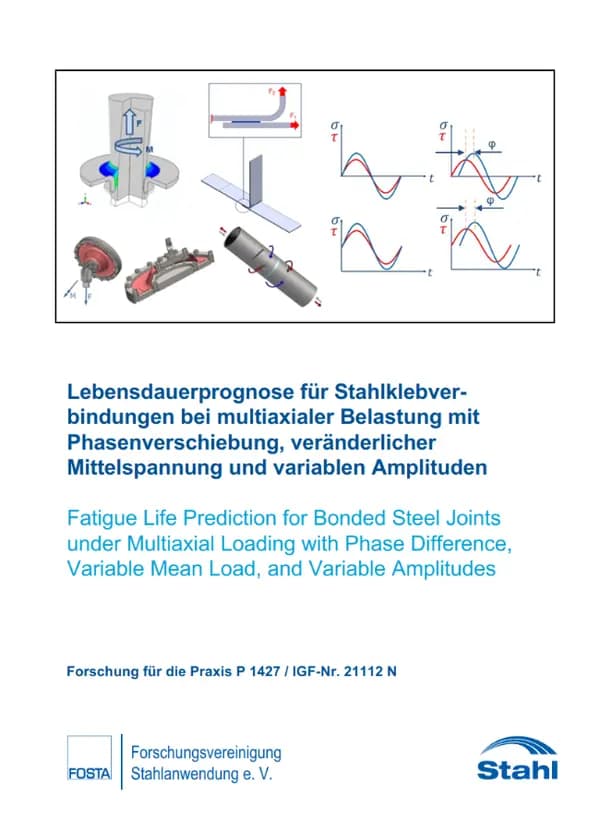
    P 1427 - Service life prediction for steel bonded joints under multiaxial loading with phase shift, variable mean stress and variable amplitudes The project P 1427 / IGF-No. 21112 N "Lifetime prediction for steel bonded joints under multiaxial loading with phase shift, variable mean stress and variable amplitudes LAMbdA" aims to efficiently and reliably estimate the lifetime under these complex loads. To achieve this goal, bonded joints with steel substrates and two structural epoxy-based adhesive systems are being investigated: SikaPower 480 (EP1, unmodified system) and Betamate 1496 V (EP2, toughened system). The tests carried out as part of the project were performed at room temperature. To characterise the fatigue behaviour of the structural adhesives, basic tests were carried out on butt-bonded double pipe samples under cyclic pure tensile, pure torsional and multi-axial loading (tensile-torsional). To validate the prediction approaches, fatigue tests were carried out on bonded samples with an inhomogeneous stress state in the bonded layer. The following specimens were selected as representative specimens: the flanged round bar specimen (EP1) and the L-shaped specimen (EP2) with constant amplitude and the cup specimen (EP1, EP2) with variable amplitude. At constant amplitude, baseline and validation tests showed that (i) the lifetime decreases with increasing mean stress and (ii) the variation of the phase shift does not significantly influence the lifetime. With variable amplitude, however, both the mean voltage and the phase shift had an influence on the service life. Lifetime prediction approaches were developed on the basis of the experimental results. For cyclic loading with constant amplitudes, both invariant-based (BELTRAMI criterion) and critical-plane-based approaches (FINDLEY criterion) were used. Furthermore, a hybrid concept considering stress anisotropy was developed. For cyclic loading with variable amplitude, a multiaxial counting method was combined with an invariant-based failure criterion. The linear damage accumulation according to Palmgren and Miner proved to be expedient. A rheological material model with damage for predicting the service life of bonded joints within the framework of continuum damage mechanics was extended to include the investigated influences and validated using the test results. The model parameters for the rheological model were determined using uniaxial test data series after the modelling had been completed. The rheological model was implemented in FEA for the prediction of a component-like sample. Satisfactory accuracy of the service life estimation was achieved with the developed approaches. The determination of characteristic values is based on uniaxial tests on simple samples with a simple geometry, which significantly reduces the implementation hurdle and the costs for parameter identification for SMEs. The results obtained provide practical added value for those involved in adhesive bonding technology with regard to the service life prediction of bonded steel joints under complex stress conditions with constant and variable amplitude. The objective of the research project was achieved. Publication: 2024 Authors: B. Mayer, Christof Nagel, V. C. Beber, P. Fernandes, A. Matzenmiller, Ch. Köster, T. Melz, J. Baumgartner, M. Hecht, G. Meschut, K. Tews, S. Çavdar

    available anytime

    €30.00

    excl. VAT

    View details →
  • Thumbnail
    FOSTA

    P 1423 - Qualification of numerical simulations for the characterisation and evaluation of the boundary layer condition of free thermal cut surfaces

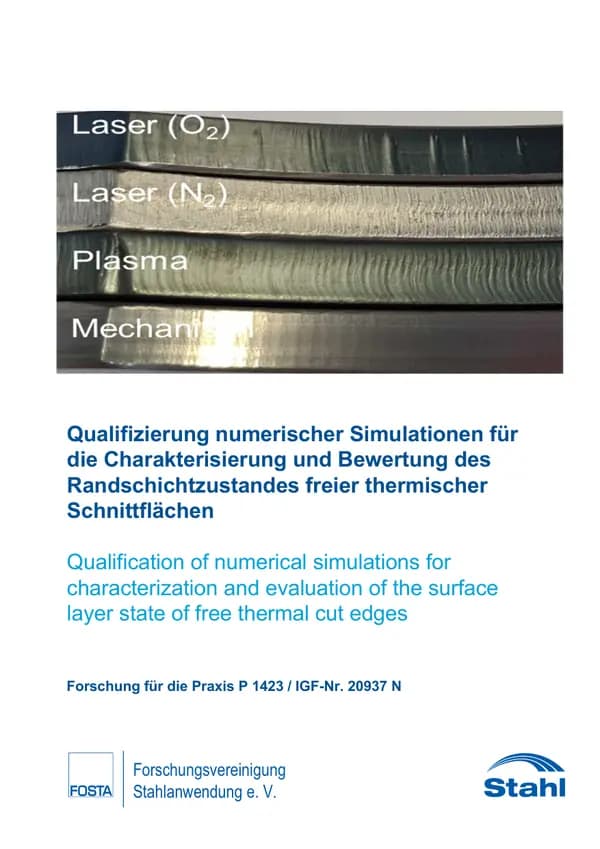
    P 1423 - Qualification of numerical simulations for the characterisation and evaluation of the boundary layer condition of free thermal cut surfaces As part of the research project "Qualification of numerical simulations for the characterisation and evaluation of the surface layer condition of free thermal cut surfaces", thermal cutting tests were carried out, the characteristic quality features were determined experimentally and compared with the results from the numerical investigations. For this purpose, the laser cutting process was selected as the main method and tests were carried out on a structural steel S355NC and a high-strength steel S1100M. It can be seen that the hardness integrity value of DIN EN 1090 is clearly exceeded with S1100M and that the maximum hardness of around 570 HV1 is not directly at the cutting edge. It drops to around 480 HV1 to 520 HV1 up to the surface. A decreasing carbon content at the cutting edge could be one reason for this. In comparison to the numerical investigations, the following points can be determined: The dimensions of the heat-affected zone can be determined via the numerical calculations and are in good agreement with the micrographs. The phase fractions at the low cooling rates indicate a complete transformation into martensite at the surface layer. The maximum hardness of the HAZ agrees with the experimental results. The hardness distribution over depth in relation to the HAZ is in good agreement. Deviations in the width of the HAZ are very small. The results show that the cutting process can be modelled by numerical simulation and that the surface layer condition can be evaluated after the cutting process. The microstructure, the maximum temperatures and the hardness distribution can be determined and thus offers the possibility of saving time and costs when determining the quality of thermal cutting edges. The effort required to create the numerical models must be put into perspective here and the method must be accepted in quality testing. The aim of the research project was achieved. Publication: December 2022 Authors: M. Sc. P. Diekhoff, Dr.-Ing. J. Sun, Dr.-Ing. T. Nitschke-Pagel, Prof. Dr.-Ing. K. Dilger

    available anytime

    €30.00

    excl. VAT

    View details →
€30.00excl. VAT

Payment by card (Stripe) or invoice (DE, AT, CH). Download link by email: automatically after ordering by card, after order approval for invoice (valid for 30 days). Terms

P 1471 - Diamond-coated carbide active elements for the production of highly efficient electric motors—
€30.00