
FOSTA
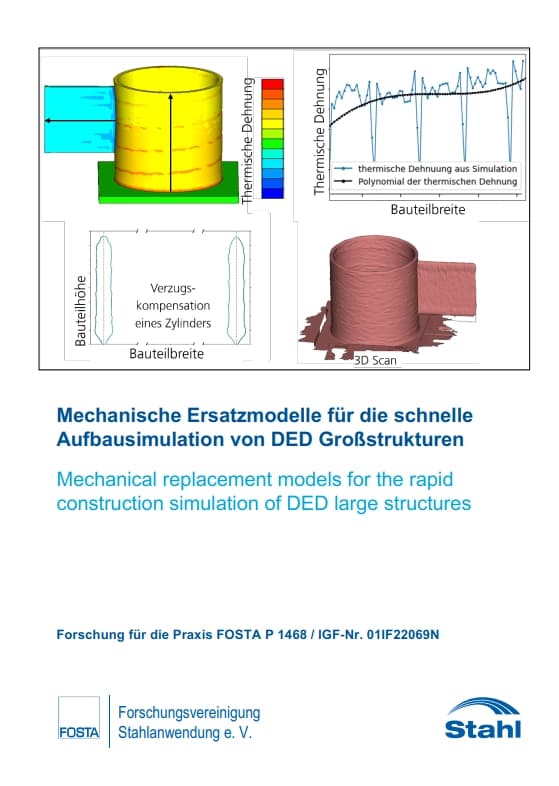
As part of this project, the application of the inherent strain method was tested using mechanical replacement models on directed energy deposition simulations. The results show that the method, which originally comes …
As part of this project, the application of the inherent strain method was tested using mechanical replacement models on directed energy deposition simulations. The results show that the method, which originally comes from classical welding technology, can also be used in additive manufacturing or DED. It was shown that an inverse determination of the inherent strain can be used to identify a value for this, which can be used to map the warpage of 20-layer walls in a meaningful way. Studies have also shown that previous approaches and calculation principles for inherent strain from classic welding technology and the calculation principles of modified inherent strain cannot be applied to the process under investigation.
Subsequently, a proprietary method for determining inherent strain values was developed based on the largest occurring thermal strain in the thermomechanical simulation. It was shown that the heat balance of a geometry has a significant influence on the choice of inherent strain values and that it is necessary to choose a layerdependent inherent strain. The method of inherent strain was tested on single-layer walls and transferred to threedimensional, more complex geometries. Finally, the inherent strain method was applied to the construction of an industrial demonstrator and the distortion was successfully calculated and compensated for.
The objective of this research project was accomplished.
Published in: 2026
Payment by card (Stripe) or invoice (DE, AT, CH). Download link by email: automatically after ordering by card, after order approval for invoice (valid for 30 days). Terms
Digital download
Payment by card (Stripe) or invoice (DE, AT, CH). Download link by email: automatically after ordering by card, after order approval for invoice (valid for 30 days). Terms
Other parts and editions as well as neighbouring documents of the same series.
P 1466 - Use of localised gas flows in laser beam welding at high welding speeds to increase capillary stability and reduce seam imperfections The use of high-alloy steels is essential in various industries, with laser beam welding being widely used industrially due to its process-related advantages. However, seam imperfections occur at welding speeds of > 8 m/min, particularly in the form of spatter. This currently limits the economic potential of new solid-state lasers, as reworking steps are necessary and the resulting seam cross-section is reduced due to mass loss. The aim of this research project was to develop strategies and procedures to reduce seam imperfections during laser beam welding of high-alloy steels at welding speeds of up to 20 m/min. The use of a local gas flow influenced the capillary and weld pool behaviour in order to reduce the formation of spatter during welding at high welding speeds. The shielding gas flow was fed to the upper capillary opening to apply an additional dynamic pressure and the associated influence on the pressure balance. In addition to argon, the shielding gases nitrogen and helium were also analysed. Furthermore, oxygen was added to the shielding gas to expand the understanding of the process. A process measuring chamber was developed as part of the research project for welding in a global shielding gas atmosphere and setting a global overpressure. In addition to welding under variation of the welding speed and flow rate, tests were carried out for through-welding. It was also possible to transfer the findings to butt joint welding. The welding of a demonstrator component enabled the results to be transferred to an industrial application and demonstrated the potential of the gas flow for reducing the formation of spatter. A final consideration of the mode of action of the gas flow summarised the investigations carried out. The reduction in spatter formation using the gas flow can primarily be attributed to an increase in surface tension by shielding the molten bath from the ambient atmosphere. The mechanism of action changes when the set volume flow is increased. The increased momentum transfer of the gas flow to the capillary back wall and weld pool leads to an influence on the weld pool behaviour and to the formation of melt accumulations on the top of the weld seam. In summary, suitable process parameters were identified, taking into account the effect of a localised gas flow to reduce spatter formation during laser deep penetration welding of high-alloy steels at high welding speeds. The objectives of the research project were fully achieved. Publication: August 2023 Authors: M.Sc. Ch. Diegel, M.Sc. L. Schmidt, Dr.-Ing. K. Schricker, Univ.-Prof. Dr.-Ing. habil. J. P. Bergmann
available anytime
€30.00
excl. VAT
P 1438 - Development and testing of a modelling framework for the predictive investigation of erosive wear in pneumatic conveyors As part of the research project, wear in pneumatic conveyors was analysed by means of numerical and experimental investigations both on the microscopic length scale of individual particle impact events and on the macroscopic scale of pipe bends. A total of four steel grades - three stainless steels and one structural steel - and one plastic were experimentally analysed with regard to their wear resistance in contact with round and angular bulk material particles in different wear situations. This enabled the materials to be assessed in terms of their wear resistance in different applications and the significant influence of the shape of the bulk material particles to be identified. The relevance of the particle shape for erosive wear was confirmed by detailed numerical simulations using SPH. Based on the simulation results, an established, analytical erosion model, which quantifies the wear per impact, was successfully extended by two parameters that characterise the particle shape. This has created a model that is suitable both for rapid estimations of the wear behaviour of a specific bulk material and can also be integrated directly into CFD-DEM simulations for process analysis. Experiments were carried out to characterise the particles used in order to obtain contact parameters for CFD-DEM simulations. These include, for example, particle-particle and particle-wall contact parameters, with the help of which contact phenomena of the materials to be analysed could later be validly represented. Furthermore, experimental investigations have shown that typical wear patterns on paint coatings can be generated and are reproducible. In addition, methods for measurement were investigated with which a quick and simple evaluation should be possible. The method shows new possibilities for realising material-friendly wear tests within the shortest possible time or not necessarily requiring special measurement technology. The implementation of a validation simulation using CFD-DEM showed that experimental results could be reproduced with a high level of agreement, which opens up the possibility of varying system and process parameters and investigating the influences on wear. In addition to the variation of velocities and mass loadings, these parameters also include the use of different wear-reducing pipe bend geometries and their influence on wear rates, pressure loss and particle loading. This showed that, depending on the application, wear rates can be significantly reduced without a disproportionate increase in pressure loss. The objective of the research project was achieved. Publication: August 2022 Authors: Prof. Dr.-Ing. H. Kruggel-Emden, M. Sc. E. Drescher, Dr C. Bierwisch, Dr Sh. Mohseni-Mofidi
available anytime
€30.00
excl. VAT
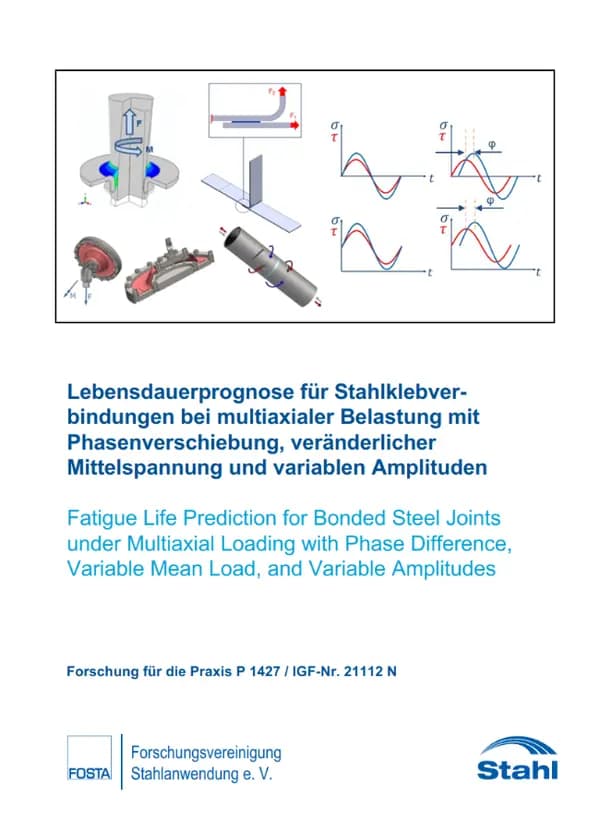
P 1427 - Service life prediction for steel bonded joints under multiaxial loading with phase shift, variable mean stress and variable amplitudes The project P 1427 / IGF-No. 21112 N "Lifetime prediction for steel bonded joints under multiaxial loading with phase shift, variable mean stress and variable amplitudes LAMbdA" aims to efficiently and reliably estimate the lifetime under these complex loads. To achieve this goal, bonded joints with steel substrates and two structural epoxy-based adhesive systems are being investigated: SikaPower 480 (EP1, unmodified system) and Betamate 1496 V (EP2, toughened system). The tests carried out as part of the project were performed at room temperature. To characterise the fatigue behaviour of the structural adhesives, basic tests were carried out on butt-bonded double pipe samples under cyclic pure tensile, pure torsional and multi-axial loading (tensile-torsional). To validate the prediction approaches, fatigue tests were carried out on bonded samples with an inhomogeneous stress state in the bonded layer. The following specimens were selected as representative specimens: the flanged round bar specimen (EP1) and the L-shaped specimen (EP2) with constant amplitude and the cup specimen (EP1, EP2) with variable amplitude. At constant amplitude, baseline and validation tests showed that (i) the lifetime decreases with increasing mean stress and (ii) the variation of the phase shift does not significantly influence the lifetime. With variable amplitude, however, both the mean voltage and the phase shift had an influence on the service life. Lifetime prediction approaches were developed on the basis of the experimental results. For cyclic loading with constant amplitudes, both invariant-based (BELTRAMI criterion) and critical-plane-based approaches (FINDLEY criterion) were used. Furthermore, a hybrid concept considering stress anisotropy was developed. For cyclic loading with variable amplitude, a multiaxial counting method was combined with an invariant-based failure criterion. The linear damage accumulation according to Palmgren and Miner proved to be expedient. A rheological material model with damage for predicting the service life of bonded joints within the framework of continuum damage mechanics was extended to include the investigated influences and validated using the test results. The model parameters for the rheological model were determined using uniaxial test data series after the modelling had been completed. The rheological model was implemented in FEA for the prediction of a component-like sample. Satisfactory accuracy of the service life estimation was achieved with the developed approaches. The determination of characteristic values is based on uniaxial tests on simple samples with a simple geometry, which significantly reduces the implementation hurdle and the costs for parameter identification for SMEs. The results obtained provide practical added value for those involved in adhesive bonding technology with regard to the service life prediction of bonded steel joints under complex stress conditions with constant and variable amplitude. The objective of the research project was achieved. Publication: 2024 Authors: B. Mayer, Christof Nagel, V. C. Beber, P. Fernandes, A. Matzenmiller, Ch. Köster, T. Melz, J. Baumgartner, M. Hecht, G. Meschut, K. Tews, S. Çavdar
available anytime
€30.00
excl. VAT
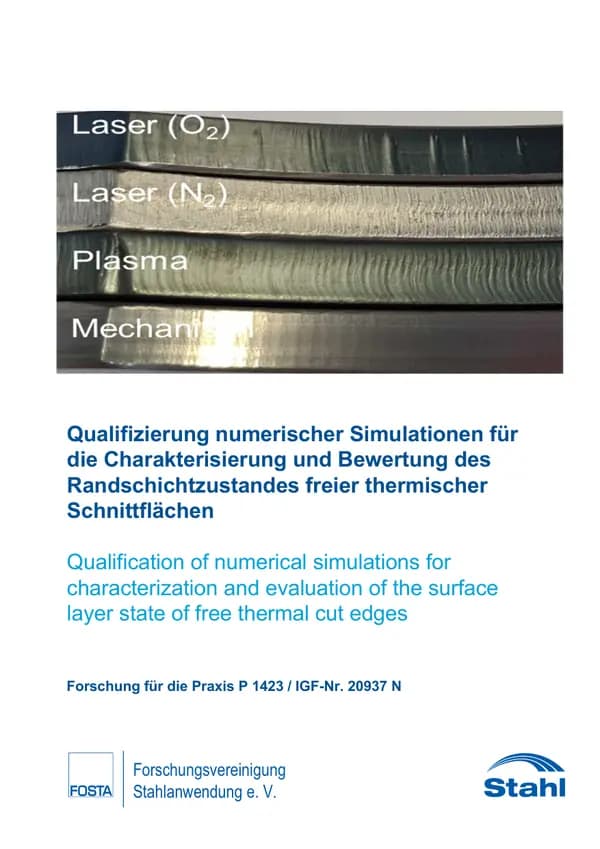
P 1423 - Qualification of numerical simulations for the characterisation and evaluation of the boundary layer condition of free thermal cut surfaces As part of the research project "Qualification of numerical simulations for the characterisation and evaluation of the surface layer condition of free thermal cut surfaces", thermal cutting tests were carried out, the characteristic quality features were determined experimentally and compared with the results from the numerical investigations. For this purpose, the laser cutting process was selected as the main method and tests were carried out on a structural steel S355NC and a high-strength steel S1100M. It can be seen that the hardness integrity value of DIN EN 1090 is clearly exceeded with S1100M and that the maximum hardness of around 570 HV1 is not directly at the cutting edge. It drops to around 480 HV1 to 520 HV1 up to the surface. A decreasing carbon content at the cutting edge could be one reason for this. In comparison to the numerical investigations, the following points can be determined: The dimensions of the heat-affected zone can be determined via the numerical calculations and are in good agreement with the micrographs. The phase fractions at the low cooling rates indicate a complete transformation into martensite at the surface layer. The maximum hardness of the HAZ agrees with the experimental results. The hardness distribution over depth in relation to the HAZ is in good agreement. Deviations in the width of the HAZ are very small. The results show that the cutting process can be modelled by numerical simulation and that the surface layer condition can be evaluated after the cutting process. The microstructure, the maximum temperatures and the hardness distribution can be determined and thus offers the possibility of saving time and costs when determining the quality of thermal cutting edges. The effort required to create the numerical models must be put into perspective here and the method must be accepted in quality testing. The aim of the research project was achieved. Publication: December 2022 Authors: M. Sc. P. Diekhoff, Dr.-Ing. J. Sun, Dr.-Ing. T. Nitschke-Pagel, Prof. Dr.-Ing. K. Dilger
available anytime
€30.00
excl. VAT