Tailored stringer sheet forming shows great potential for improving the lightweight quality of sheet metal structural components through customised product design. Previous research has focussed on the development …
Tailored stringer sheet forming shows great potential for improving the lightweight quality of sheet metal structural components through customised product design. Previous research has focussed on the development, improvement and industrial transfer of the process chain. Based on this, the full lightweight construction potential of sheet metal web construction can be exploited by means of a methodology for component design adapted to requirements while optimising the component mass. For this reason, this project deals with the development of solutions for the customised adjustment of the product properties of web plate components.
In a first step, the project focuses not only on stiffness but also on formability, energy absorption, structural integrity under dynamic load, vibration behaviour and surface quality. In a comprehensive experimental investigation, various process and semi-finished product parameters were systematically varied in order to create a matrix of interdependencies with regard to the aforementioned component properties. The web height, web thickness and base plate thickness were found to be the most influential parameters. The finite element method is indispensable for the design of components. However, conventional modelling strategies for sheet metal forming are not readily applicable to web plate components. The modelling of web plate components using continuum shell elements, which combine the advantages of volumetric meshing with high efficiency, has been developed as a practical alternative. It reproduces the experimentally found effective relationships well. Based on the experimental and simulative investigations, a method for the customised design of web plate components was developed. A battery box lid, which absorbs loads from the front seat assembly and the seat cross member, served as a model for the demonstrator geometry realised with this method. A procedure for minimising the component mass while adjusting the component properties to meet the requirements forms the core of the method, whereby a surrogate model was used to reduce the numerical calculation effort. Simulative results showed a possible reduction in component mass of 37%, which could also be verified using the customised demonstrators produced. A workshop identified application examples in various industries, which were integrated into a guideline for industrial application. This guideline enables the realisation of sheet metal forming in practice. Using the project results, the existing process knowledge has now been supplemented with product-side knowledge so that web plate components can now be customised to meet the requirements placed on them. The objective of the research project was achieved.
Payment by card (Stripe) or invoice (DE, AT, CH). Download link by email: automatically after ordering by card, after order approval for invoice (valid for 30 days). Terms
Machine-translated title and description. The document itself is in German.
Digital download
Payment by card (Stripe) or invoice (DE, AT, CH). Download link by email: automatically after ordering by card, after order approval for invoice (valid for 30 days). Terms
Other parts and editions as well as neighbouring documents of the same series.

P 1438 - Development and testing of a modelling framework for the predictive investigation of erosive wear in pneumatic conveyors As part of the research project, wear in pneumatic conveyors was analysed by means of numerical and experimental investigations both on the microscopic length scale of individual particle impact events and on the macroscopic scale of pipe bends. A total of four steel grades - three stainless steels and one structural steel - and one plastic were experimentally analysed with regard to their wear resistance in contact with round and angular bulk material particles in different wear situations. This enabled the materials to be assessed in terms of their wear resistance in different applications and the significant influence of the shape of the bulk material particles to be identified. The relevance of the particle shape for erosive wear was confirmed by detailed numerical simulations using SPH. Based on the simulation results, an established, analytical erosion model, which quantifies the wear per impact, was successfully extended by two parameters that characterise the particle shape. This has created a model that is suitable both for rapid estimations of the wear behaviour of a specific bulk material and can also be integrated directly into CFD-DEM simulations for process analysis. Experiments were carried out to characterise the particles used in order to obtain contact parameters for CFD-DEM simulations. These include, for example, particle-particle and particle-wall contact parameters, with the help of which contact phenomena of the materials to be analysed could later be validly represented. Furthermore, experimental investigations have shown that typical wear patterns on paint coatings can be generated and are reproducible. In addition, methods for measurement were investigated with which a quick and simple evaluation should be possible. The method shows new possibilities for realising material-friendly wear tests within the shortest possible time or not necessarily requiring special measurement technology. The implementation of a validation simulation using CFD-DEM showed that experimental results could be reproduced with a high level of agreement, which opens up the possibility of varying system and process parameters and investigating the influences on wear. In addition to the variation of velocities and mass loadings, these parameters also include the use of different wear-reducing pipe bend geometries and their influence on wear rates, pressure loss and particle loading. This showed that, depending on the application, wear rates can be significantly reduced without a disproportionate increase in pressure loss. The objective of the research project was achieved. Publication: August 2022 Authors: Prof. Dr.-Ing. H. Kruggel-Emden, M. Sc. E. Drescher, Dr C. Bierwisch, Dr Sh. Mohseni-Mofidi
available anytime
€30.00
excl. VAT

P 1445 - Prediction of residual formability on preformed shear-cut component edges in open and closed section The use of the shear-cutting production process can lead to a reduced residual deformation capacity of the shear-cut component edges. If an edge produced in this way is subsequently formed, this can result in premature material failure starting from the component edge. This problem occurs in particular when processing high-strength and ultra-high-strength sheet materials such as dual-phase steels. In practice, complex components are often manufactured as a sequence of several deep-drawing, trimming, remoulding, set-off or collar-drawing operations. However, the influence of prior sheet metal forming on edge crack sensitivity is insufficiently and sometimes contradictorily described in the literature. In this thesis, the influence of sheet metal pre-forming on edge crack sensitivity for different shear cutting strategies is investigated using three different dual-phase steels. For this purpose, samples are taken from homogeneously preformed sheets with different preforming types and amounts and the edge crack sensitivity is determined using the Edge Fracture Tensile Test (EFTT). The test results show that sheet preforming results in a reduction in edge crack sensitivity for all sheet materials and initial edge crack-sensitive shear cutting strategies. The pre-forming required to completely eliminate the edge crack sensitivity is a material parameter and therefore independent of the cutting strategy or the initial edge crack sensitivity without pre-strain. Using microhardness measurements in the area of the cutting edge, a correlation can be established between the hardness ratio of the area close to the edge compared to the base material and the edge crack sensitivity. By taking into account a pre-strain-dependent edge crack sensitivity in the component design in the FEM simulation, an extension of the process window can be achieved. In contrast, fixing only one edge crack sensitivity factor in the simulation, which is independent of the pre-strain, would result in an underestimation of the formability of the edges. The aim of the research project was achieved. Publication: October 2022 Authors: M. Sc. A. Kindsmüller, Prof. Dr.-Ing. W. Volk
available anytime
€30.00
excl. VAT

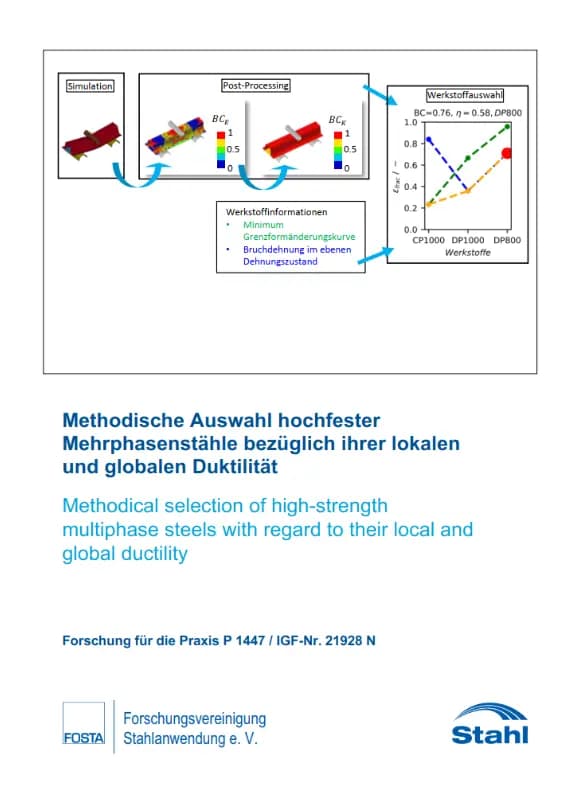
P 1447 - Methodical selection of high-strength multiphase steels with regard to their local and global ductility Increasing safety requirements and stricter emission limits have led to considerable research efforts in the field of high-strength steels, including the targeted application of high-strength multiphase steels with regard to their local and global ductility. In this research project, a computer-aided method (finite element method) was developed for the systematic selection of steels with regard to their global and local ductility. Since bending is associated with local ductility and membrane stress with global ductility, a bending coefficient was first introduced in order to be able to describe the bending portion of a deformation stress. For the evaluation routine, the bending coefficients are determined at element level in the first step and then weighted by the proportion of internal energy absorbed, so that an averaged bending coefficient is available for each component. An evaluation criterion for material selection was then derived with the aim of avoiding crack initiation, so that the material with the highest failure strain for this bending coefficient is selected for a corresponding bending coefficient. This was done on the basis of the shell kinematics, the plane stress state and a material model that differentiates between failure due to local necking and ductile fracture. It is possible to adapt the described criterion using company expertise. It was also shown that the selection of the material with the highest failure strain for a specific bending coefficient depends on both global and local ductility. The method was confirmed in initial simulations at sample and component level. The objective of the research project was achieved. Publication: March 2025 Authors: T. Tröster, T. Marten, S. Luig
available anytime
€30.00
excl. VAT

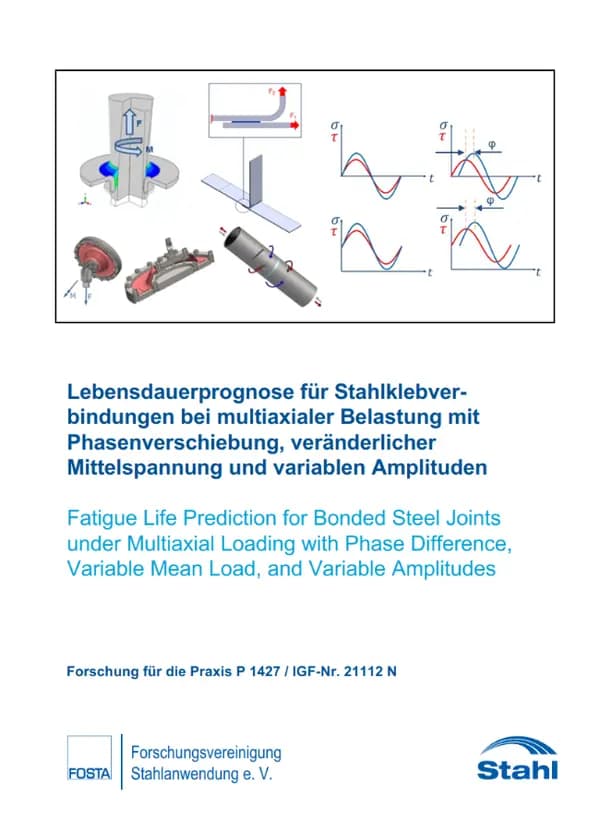
P 1427 - Service life prediction for steel bonded joints under multiaxial loading with phase shift, variable mean stress and variable amplitudes The project P 1427 / IGF-No. 21112 N "Lifetime prediction for steel bonded joints under multiaxial loading with phase shift, variable mean stress and variable amplitudes LAMbdA" aims to efficiently and reliably estimate the lifetime under these complex loads. To achieve this goal, bonded joints with steel substrates and two structural epoxy-based adhesive systems are being investigated: SikaPower 480 (EP1, unmodified system) and Betamate 1496 V (EP2, toughened system). The tests carried out as part of the project were performed at room temperature. To characterise the fatigue behaviour of the structural adhesives, basic tests were carried out on butt-bonded double pipe samples under cyclic pure tensile, pure torsional and multi-axial loading (tensile-torsional). To validate the prediction approaches, fatigue tests were carried out on bonded samples with an inhomogeneous stress state in the bonded layer. The following specimens were selected as representative specimens: the flanged round bar specimen (EP1) and the L-shaped specimen (EP2) with constant amplitude and the cup specimen (EP1, EP2) with variable amplitude. At constant amplitude, baseline and validation tests showed that (i) the lifetime decreases with increasing mean stress and (ii) the variation of the phase shift does not significantly influence the lifetime. With variable amplitude, however, both the mean voltage and the phase shift had an influence on the service life. Lifetime prediction approaches were developed on the basis of the experimental results. For cyclic loading with constant amplitudes, both invariant-based (BELTRAMI criterion) and critical-plane-based approaches (FINDLEY criterion) were used. Furthermore, a hybrid concept considering stress anisotropy was developed. For cyclic loading with variable amplitude, a multiaxial counting method was combined with an invariant-based failure criterion. The linear damage accumulation according to Palmgren and Miner proved to be expedient. A rheological material model with damage for predicting the service life of bonded joints within the framework of continuum damage mechanics was extended to include the investigated influences and validated using the test results. The model parameters for the rheological model were determined using uniaxial test data series after the modelling had been completed. The rheological model was implemented in FEA for the prediction of a component-like sample. Satisfactory accuracy of the service life estimation was achieved with the developed approaches. The determination of characteristic values is based on uniaxial tests on simple samples with a simple geometry, which significantly reduces the implementation hurdle and the costs for parameter identification for SMEs. The results obtained provide practical added value for those involved in adhesive bonding technology with regard to the service life prediction of bonded steel joints under complex stress conditions with constant and variable amplitude. The objective of the research project was achieved. Publication: 2024 Authors: B. Mayer, Christof Nagel, V. C. Beber, P. Fernandes, A. Matzenmiller, Ch. Köster, T. Melz, J. Baumgartner, M. Hecht, G. Meschut, K. Tews, S. Çavdar
available anytime
€30.00
excl. VAT