Pretensioned bolted connections in steel construction are regulated by DIN EN 1090-2 and in Germany additionally by the National Annex DIN EN 1993-1-8/NA and DASt Guideline 024. These standards and guidelines provide …
Pretensioned bolted connections in steel construction are regulated by DIN EN 1090-2 and in Germany additionally by the National Annex DIN EN 1993-1-8/NA and DASt Guideline 024. These standards and guidelines provide specifications for the reliable tightening of prestressed bolted connections to defined prestressing force levels and regulate the tightening methods applicable in German steel construction. In Germany, the modified torque pretensioning method and the combined pretensioning method can be used for pretensioning. The yield point-controlled prestressing method established in mechanical engineering may not currently be used in steel construction and in the construction of wind turbines due to a lack of tests under practical conditions and unresolved issues relating to the use of HV bolt sets.
With the yield point-controlled pretensioning method, it is possible to achieve high pretensioning forces with optimum utilisation of the fittings without risking overstressing. In this research project, the yield point-controlled prestressing method was investigated for use in steel construction. The aim was to develop normative principles for the process-reliable yield point-controlled tightening of pretensioned bolted connections of diameters M12 to M72 in steel construction. In addition, the structural integrity of HV fittings pretensioned to the yield point was to be validated. Extensive investigations were carried out to evaluate this. In addition to prestressing tests for single and multiple prestressing, load-bearing capacity and fatigue tests were also carried out to analyse the static and dynamic load-bearing capacity of HV wires. The large number of test results obtained made it possible to gain fundamental insights into the yield point-controlled prestressing method in conjunction with HV wires. It was shown that the yield point controlled pretensioning method can be used to apply high pretensioning forces with a high degree of reliability. The knowledge gained can be used to formulate standardised recommendations for the further use of the yield point controlled pretensioning method. The objective of the research project was achieved.
Payment by card (Stripe) or invoice (DE, AT, CH). Download link by email: automatically after ordering by card, after order approval for invoice (valid for 30 days). Terms
Machine-translated title and description. The document itself is in German.
Digital download
Other parts and editions as well as neighbouring documents of the same series.

P 1386 - Development of normative principles for the load-bearing behaviour of tensile shear / perforated joints made of stainless austenitic and austenitic-ferritic steel M12 to M36 In the construction industry, bolted connections made of stainless steel are mainly used as non-preloaded shear/hole bearing connections, tensile-stressed connections or as tensile-stressed shear/hole bearing connections, predominantly made of austenitic steel and, in recent years, increasingly as austenitic-ferritic (duplex) steel. The current normative regulations for the design of tensile shear/hole bearing connections made of stainless steel, the so-called Category A and Category D connections according to DIN EN 1993-1-8, are essentially based on the regulations for connections made of carbon steel. However, it was completely unclear which regulation reflects the actual load-bearing behaviour of stainless steel bolts and this is the subject of the research project. In addition to the pure shear strength, the research project also investigated the tension-shear interaction and the tensile load-bearing capacity of bolted connections made of stainless steel. As stainless austenitic screws do not fail in the thread due to strain hardening in the thread area under tensile stress, but in the shank due to fracture, a significantly different load-bearing behaviour is to be expected here compared to carbon steel screw sets. The bearing behaviour of stainless austenitic and duplex sheets was also examined to verify the existing normative regulations, but only to a small, limited extent. It was shown that more economical designs of the tensile, shear and combined tensile-shear load-bearing capacity of stainless bolts are possible. An increase in the tensile load-bearing capacity Ft,Rd of stainless bolts using k2 = 1.0 is statistically verified and thus follows the already existing normative requirement of DIN EN ISO 3506-1 with regard to the minimum breaking load Fmf of stainless bolts with fub ? As (analogue to the design approach of Australian Standard AS 4100). Based on the experimental investigations of the shear strength Fv,Rd, new shear strength coefficients ? were proposed for the design of non-preloaded bolted connections made of austenitic stainless steel and duplex stainless steel for FK 50 to 100. Furthermore, it could be shown that for all proposed shear strength coefficients ? the determined partial safety factors ?M* are below ?M2 = 1.25 for all subgroups. In the case of combined tension-shear loading of stainless bolts, different interaction equations were evaluated and separate, more economical interaction equations were developed for both the case of the bolt shank in the shear joint and the bolt thread in the shear joint. The bilinear interaction according to DIN EN 1993-1-4 is on the safe, but also clearly uneconomical side for both load cases. A more economical design of the bearing capacity Fb,Rd of stainless steel sheets is possible by using the design aid for stainless steels in construction (4th edition) with sufficiently high safety margins. Publication: 2021 Authors: Prof. Dr.-Ing. habil. N. Stranghöner, Ch. Abraham, M.Sc.
available anytime
€30.00
excl. VAT

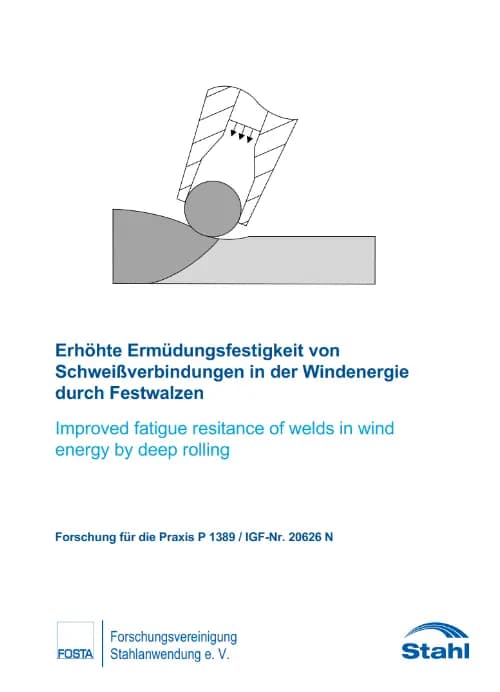
P 1389 - Increased fatigue strength of welded joints in wind energy by deep rolling The expansion of renewable energies is essential in order to achieve energy policy goals. In Germany, this can only be achieved by expanding wind energy and is stipulated in the latest version of the Renewable Energy Sources Act (EEG). Offshore wind turbines will make a decisive contribution to the expansion of renewable energies in the future. Technical innovations are therefore absolutely essential to drive this expansion forward. In particular, an economical construction method for welded steel structures (monopiles) is necessary. In order to achieve material savings while maintaining at least the same fatigue strength, the automated deep rolling process established in mechanical engineering was transferred to welded heavy plates in this project. This is particularly suitable for integration into the automated production chain for the manufacture of monopiles. The project focussed in particular on the geometry, surface and edge zone properties induced by the deep rolling process. In particular, the residual stress state, which has a decisive influence on the fatigue strength of steel components, was analysed in detail. As part of the investigations, the influences of the deep rolling process on the residual stress state of welded samples were quantified. In addition, permissible stresses were determined that still guarantee the stability of the residual stress state. The overall aim of the project was to quantify the increase in the fatigue strength of welded steel sheets through the deep rolling process. The increase in fatigue strength was demonstrated and quantified in experimental investigations. The objective of the project was achieved. Publication: August 2022 Authors: Prof. Dr.-Ing. P. Schaumann, Ch. Dänekas, M. Sc., apl. Prof. Dr. rer. nat. habil B. Breidenstein, St. Heikebrügge, M. Sc
available anytime
€30.00
excl. VAT

P 1315 - Control of heat input during GMAW thick-wire welding using the example of fine-grain structural steels GMAW thick-wire welding with wire diameters up to d = 4.0 mm is a promising high-performance welding process which, however, has not yet enabled reproducible and economical joint welding of long weld seams. The applicability of the high-performance welding process in the area of temperature-sensitive, high-strength fine-grain structural steels was also previously unknown. In the research project, the new welding process was analysed and validated with regard to its suitability for the material-specific processing of fine-grain structural steels in the thick plate range (t ? 10 mm). The base material S690Q (1.8931) was used as the reference material for the group of high-strength fine-grain structural steels within the process qualification. In preliminary tests, a thermophysical material characterisation was carried out on a dilatometer, whereby the critical limit ranges of the cooling times t8/5 were defined and confirmed (5 s ? t8/5 ? 15 s). Within the project, systematic welding tests were carried out to analyse the influence of different wire diameters on the welding behaviour and the welding result at the upper technical test limit for MSG thick-wire welding. Solid wires of type G69 with diameters of d = 2.4; 3.0; 3.2 and 4.0 mm were used for this purpose. The solutions for controlling the energy input into the base material were aimed at extending the determined technical test limit in the upper performance range. For example, upstream wire heating, which was achieved by increasing the contact tube spacing (?s = 30 mm), resulted in a reduction in the absolute welding power requirement of up to 20 %. With the solid wire, deposition rates of approximately MR = 20 kg/h could be achieved. This corresponded to an increase in deposition rate of approx. 30 %. Furthermore, the use of a basic cored wire with a diameter of d = 3.0 mm had a positive effect on the welding behaviour and allowed deposition rates of up to approx. MR = 30 kg/h to be achieved. A separate cold wire feed into the melt during the welding process made it possible to increase the deposition rate of the thick wire process by up to 60 %. Alternatively, significantly reduced cooling times t8/5 could be realised with the help of targeted process adaptation: - Use of cored wire - 35 % - Increased contact tube spacing - 25 - Cold wire feed - 10 % In addition to the direct control of the energy and heat input into the base material, this made it possible to increase economic efficiency by increasing the deposition rate during GMAW thick-wire welding. With the process combination of cored wire, increased contact tube spacing and cold wire feed, maximum deposition rates of approx. MR = 45 kg/h were achieved in the project, which represents the current maximum value for GMAW thick wire welding. The pulsed and alternating current technologies were not considered to be effective in terms of reducing the energy input for the GMAW thick-wire welding process. In comparison with submerged arc welding, the potential of GMAW thick-wire welding was determined with regard to welding parameters and economic parameters, as well as mechanical-technological quality values for joint welds of fine-grain structural steels. Here, t = 20 mm thick sheets of grade S690Q were welded together in only 70 % of the time and with 60 % of the total costs of the submerged arc welding process using GMAW thick wire welding, while saving on powder costs and powder handling. In addition, MSG thick-wire welding enables joint welds up to t = 25 mm with just two welding beads. The process qualification (tensile tests, hardness measurements, notch impact tests and bending tests) did not result in any negative impairment of the mechanical-technological quality values of the high-strength fine-grain structural steel (S690Q) used in the case under consideration with regard to the cooling times t8/5 and processing using GMAW thick-wire welding. It was reproducibly and economically possible to place the failure location of the welded high-strength component outside the weld seam and the heat-affected zone. Publication: 2021 Authors: Prof. Dr.-Ing. Hensel, Dr.-Ing. M. Kusch, Dr.-Ing. A. Hälsig, ]}, M. Sc. J. Kimme
available anytime
€30.00
excl. VAT

P 1314 - Space-forming load-bearing structures made of sandwich elements In addition to their outstanding space-enclosing function and thermal insulation properties, (steel) sandwich elements have load-bearing properties that allow loads to be transferred in and out of their plane. Single-storey buildings, such as small warehouses, petrol station shops and car washes, can therefore only be built with sandwich elements without additional load-bearing frame substructures. There is a lack of verification methods, in particular for load transfer, which would enable this economical construction method. The aim of the research project was to validate existing calculation approaches for load-bearing and serviceability and the detailed solutions for load transfer and distribution by means of experimental investigations and, if necessary, to develop them further. The knowledge gained from the holistic consideration of the construction method should then serve as a basis for the acquisition of a building authority approval. To achieve these goals, a self-supporting construction made of sandwich elements was first designed as an example object. For this purpose, all necessary construction drawings and detailed solutions for the formation of the load application points and joints were worked out and defined for this application. Experimental investigations into the load-bearing behaviour of a self-supporting construction made of sandwich elements were carried out using a test matrix defined in the research proposal. The extensive local and global axial compression tests were carried out on test specimens, taking into account a practical and application-related design of the load application points. The deformations and maximum loads were measured. The measured loads were then statistically evaluated and the actual local and global load-bearing capacity as well as the failure behaviour of the self-supporting construction made of sandwich elements were analysed. The analytically determined ultimate loads in the ultimate and serviceability limit states were used as a reference. It was found that the experimentally determined loads were far higher than the analytically calculated values. This showed that the design of the structure with the existing design approaches provides conservative results and is therefore on the safe side. The design of the load introduction structure for uplifting forces could also be ensured using a presented design approach. In order to ensure a holistic view of the construction, an economic and ecological analysis of the construction method was carried out. In the economic analysis, it was shown that self-supporting constructions made of sandwich elements without a steel substructure save approx. 9% of the investment costs and approx. 10% of the heating costs. The life cycle assessment also showed that the construction method results in emission and energy savings and is more environmentally friendly. Overall, the research report provides a sound scientific and technical basis for the design, construction and dimensioning of self-supporting structures made of sandwich elements, as well as the necessary test results and analyses for obtaining building authority approval. Publication: September 2022 Authors: Univ.-Prof. Dr.-Ing. D. Ungermann, M.Sc. G. A. Eseme
available anytime
€30.00
excl. VAT
Payment by card (Stripe) or invoice (DE, AT, CH). Download link by email: automatically after ordering by card, after order approval for invoice (valid for 30 days). Terms