For the generation of renewable energy, the state of the art offers various approaches for photovoltaics and solar thermal energy. In the field of photovoltaics, there are many current research projects and already …
For the generation of renewable energy, the state of the art offers various approaches for photovoltaics and solar thermal energy. In the field of photovoltaics, there are many current research projects and already mature façade solutions. In contrast, there are fewer options for solar thermal energy. Solar thermal absorbers for façades always have the same structure and offer little scope for design. The planar absorber layer largely determines the appearance and is not desirable for large-scale design. It is therefore desirable to design functionally integrated solar-thermally activated façade elements that do not initially reveal their function directly.
In this research project, the basics of incremental sheet metal forming and the design of façade elements, constructions and superstructures currently available on the market are first analysed. Various design studies finally led to possible concepts, which were tested for some components and finally the most functional and efficient form was selected. Various moulding tests were carried out to determine the limits of the design in the manufacturing process and the design of the façade panel was adapted to the production process. Various problems were also uncovered in the welding and coating processes, which led to further development of the geometry. It was found that the working space, spacing, angle, curvature, elongation, shading and solar incidence were the most important factors influencing the design. Springback effects during manufacturing were also a major constraint on the process and altered the geometry. Finally, a manufacturing-orientated design strategy for solar thermal façade elements was developed, including a prototype digital analysis tool for specialist planners. One demonstrator was built for each research facility, which can be used for demonstration purposes at trade fairs and congresses. The aim of the research project was achieved.
Machine-translated title and description. The document itself is in German.
Payment by card (Stripe) or invoice (DE, AT, CH). Download link by email: automatically after ordering by card, after order approval for invoice (valid for 30 days). Terms
Digital download
Payment by card (Stripe) or invoice (DE, AT, CH). Download link by email: automatically after ordering by card, after order approval for invoice (valid for 30 days). Terms
Other parts and editions as well as neighbouring documents of the same series.

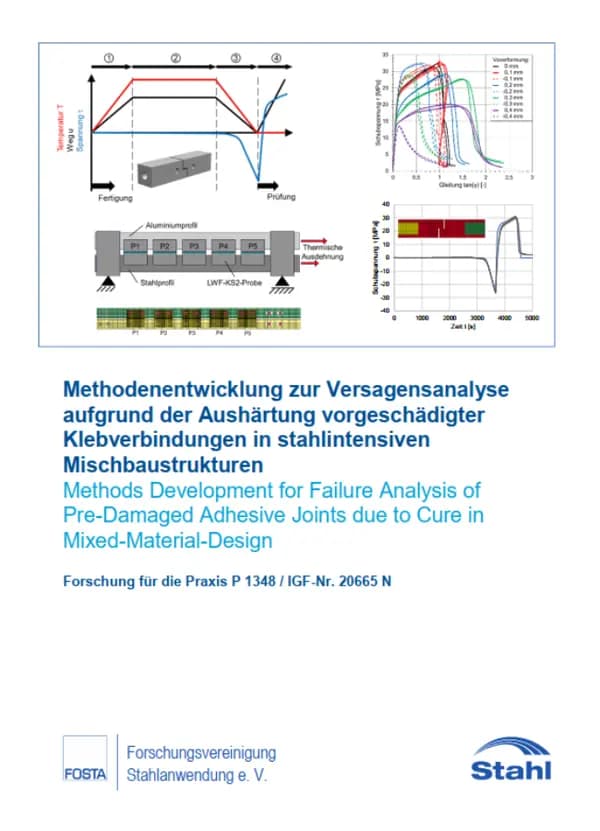
P 1348 - Method development for failure analysis due to the curing of pre-damaged bonded joints in steel-intensive mixed structures The continuing introduction of metallic composite construction in the development of lightweight and efficient products places new demands on the design of bonded composite structures with different materials. In this context, bonded joints with thermosetting, structural 1 K adhesives based on epoxy resins play a particularly important role, as these are cured at high temperatures during the production process of the composite structure. The different thermal expansion coefficients of the joining partners cause mechanical stress on the adhesive layer, which leads to changes in the material properties of the adhesive and even damage. In the case of a subsequent load on the bonded joint, a change in strength can be observed in addition to the pre-damage, depending on the deformation history during the manufacturing process. In the course of this, the direction of the subsequent load is decisive for the stressability of the adhesive layer. The aim of the project is to develop a method for failure analysis of structural adhesive bonds in metallic mixed structures under crash loading with pre-damage due to curing. The previously described influence of the manufacturing process on the mechanical properties of the adhesive layer is taken into account. In order to design metallic lightweight structures as accurately as possible, the aim is to improve the prediction quality for crash analyses. To this end, an experimental test methodology is being developed that characterises the relevant material properties both during the manufacturing process and under subsequent stress. The findings of the experimental test methodology are used to further develop the Toughened Adhesive Polymer (TAPO) model in order to take into account the pre-damage and the influence of the manufacturing process in the crash calculation. This provides engineering firms, which are often SMEs, with a tool that enables them to optimise the design of joined structures. Publication date: July 2022 Authors: M. Sc. F. Beule, Prof. Dr.-Ing. G. Meschut, M.Sc. T. Aubel, Prof. Dr.-Ing. A. Matzenmiller
available anytime
€30.00
excl. VAT

P 1349 - Bar bundle columns with high-strength reinforcing steel The IGF project 20352 N "Bar bundle columns with high-strength reinforcement" of the Forschungsvereinigung Stahlanwendung e. V. (FOSTA) is a sub-project of the FOSTA - Forschungsverbund HOCHFEST and was funded via the AiF within the framework of the programme for the promotion of joint industrial research (IGF) by the Federal Ministry of Economics and Climate Protection on the basis of a resolution of the German Bundestag. As part of this project, the load-bearing behaviour of bundle beam columns in cold and fire conditions was investigated in accordance with the research application. Beam bundle columns are a new type of composite column. For this purpose, a bundle of high-strength reinforcing bars with a yield strength of 670 N/mm2 is inserted into a steel tube and then grouted with mortar. The bundle can consist of 1, 3, 7 or 19 bars. In order to analyse the load-bearing behaviour, the individual material parameters were determined in cold and fire conditions. Large-scale tests were then carried out. An FE model was created and calibrated from the collected results. Numerous parameter studies were carried out with the aid of the FE model, on the basis of which a design concept was created. Publication: September 2022 Authors: Univ.-Prof. Dr.-Ing. M. Mensinger, M. Sc. R. Röß, Univ. Prof. Dr.-Ing. Zehfuß, M. Sc. S. Ameri
available anytime
€30.00
excl. VAT

P 1315 - Control of heat input during GMAW thick-wire welding using the example of fine-grain structural steels GMAW thick-wire welding with wire diameters up to d = 4.0 mm is a promising high-performance welding process which, however, has not yet enabled reproducible and economical joint welding of long weld seams. The applicability of the high-performance welding process in the area of temperature-sensitive, high-strength fine-grain structural steels was also previously unknown. In the research project, the new welding process was analysed and validated with regard to its suitability for the material-specific processing of fine-grain structural steels in the thick plate range (t ? 10 mm). The base material S690Q (1.8931) was used as the reference material for the group of high-strength fine-grain structural steels within the process qualification. In preliminary tests, a thermophysical material characterisation was carried out on a dilatometer, whereby the critical limit ranges of the cooling times t8/5 were defined and confirmed (5 s ? t8/5 ? 15 s). Within the project, systematic welding tests were carried out to analyse the influence of different wire diameters on the welding behaviour and the welding result at the upper technical test limit for MSG thick-wire welding. Solid wires of type G69 with diameters of d = 2.4; 3.0; 3.2 and 4.0 mm were used for this purpose. The solutions for controlling the energy input into the base material were aimed at extending the determined technical test limit in the upper performance range. For example, upstream wire heating, which was achieved by increasing the contact tube spacing (?s = 30 mm), resulted in a reduction in the absolute welding power requirement of up to 20 %. With the solid wire, deposition rates of approximately MR = 20 kg/h could be achieved. This corresponded to an increase in deposition rate of approx. 30 %. Furthermore, the use of a basic cored wire with a diameter of d = 3.0 mm had a positive effect on the welding behaviour and allowed deposition rates of up to approx. MR = 30 kg/h to be achieved. A separate cold wire feed into the melt during the welding process made it possible to increase the deposition rate of the thick wire process by up to 60 %. Alternatively, significantly reduced cooling times t8/5 could be realised with the help of targeted process adaptation: - Use of cored wire - 35 % - Increased contact tube spacing - 25 - Cold wire feed - 10 % In addition to the direct control of the energy and heat input into the base material, this made it possible to increase economic efficiency by increasing the deposition rate during GMAW thick-wire welding. With the process combination of cored wire, increased contact tube spacing and cold wire feed, maximum deposition rates of approx. MR = 45 kg/h were achieved in the project, which represents the current maximum value for GMAW thick wire welding. The pulsed and alternating current technologies were not considered to be effective in terms of reducing the energy input for the GMAW thick-wire welding process. In comparison with submerged arc welding, the potential of GMAW thick-wire welding was determined with regard to welding parameters and economic parameters, as well as mechanical-technological quality values for joint welds of fine-grain structural steels. Here, t = 20 mm thick sheets of grade S690Q were welded together in only 70 % of the time and with 60 % of the total costs of the submerged arc welding process using GMAW thick wire welding, while saving on powder costs and powder handling. In addition, MSG thick-wire welding enables joint welds up to t = 25 mm with just two welding beads. The process qualification (tensile tests, hardness measurements, notch impact tests and bending tests) did not result in any negative impairment of the mechanical-technological quality values of the high-strength fine-grain structural steel (S690Q) used in the case under consideration with regard to the cooling times t8/5 and processing using GMAW thick-wire welding. It was reproducibly and economically possible to place the failure location of the welded high-strength component outside the weld seam and the heat-affected zone. Publication: 2021 Authors: Prof. Dr.-Ing. Hensel, Dr.-Ing. M. Kusch, Dr.-Ing. A. Hälsig, ]}, M. Sc. J. Kimme
available anytime
€30.00
excl. VAT

P 1314 - Space-forming load-bearing structures made of sandwich elements In addition to their outstanding space-enclosing function and thermal insulation properties, (steel) sandwich elements have load-bearing properties that allow loads to be transferred in and out of their plane. Single-storey buildings, such as small warehouses, petrol station shops and car washes, can therefore only be built with sandwich elements without additional load-bearing frame substructures. There is a lack of verification methods, in particular for load transfer, which would enable this economical construction method. The aim of the research project was to validate existing calculation approaches for load-bearing and serviceability and the detailed solutions for load transfer and distribution by means of experimental investigations and, if necessary, to develop them further. The knowledge gained from the holistic consideration of the construction method should then serve as a basis for the acquisition of a building authority approval. To achieve these goals, a self-supporting construction made of sandwich elements was first designed as an example object. For this purpose, all necessary construction drawings and detailed solutions for the formation of the load application points and joints were worked out and defined for this application. Experimental investigations into the load-bearing behaviour of a self-supporting construction made of sandwich elements were carried out using a test matrix defined in the research proposal. The extensive local and global axial compression tests were carried out on test specimens, taking into account a practical and application-related design of the load application points. The deformations and maximum loads were measured. The measured loads were then statistically evaluated and the actual local and global load-bearing capacity as well as the failure behaviour of the self-supporting construction made of sandwich elements were analysed. The analytically determined ultimate loads in the ultimate and serviceability limit states were used as a reference. It was found that the experimentally determined loads were far higher than the analytically calculated values. This showed that the design of the structure with the existing design approaches provides conservative results and is therefore on the safe side. The design of the load introduction structure for uplifting forces could also be ensured using a presented design approach. In order to ensure a holistic view of the construction, an economic and ecological analysis of the construction method was carried out. In the economic analysis, it was shown that self-supporting constructions made of sandwich elements without a steel substructure save approx. 9% of the investment costs and approx. 10% of the heating costs. The life cycle assessment also showed that the construction method results in emission and energy savings and is more environmentally friendly. Overall, the research report provides a sound scientific and technical basis for the design, construction and dimensioning of self-supporting structures made of sandwich elements, as well as the necessary test results and analyses for obtaining building authority approval. Publication: September 2022 Authors: Univ.-Prof. Dr.-Ing. D. Ungermann, M.Sc. G. A. Eseme
available anytime
€30.00
excl. VAT