The coating of high-strength steel sheets influences the occurrence of liquid metal induced cracking (LME). For this reason, this thesis characterised the structure and chemical composition of standard industrial …
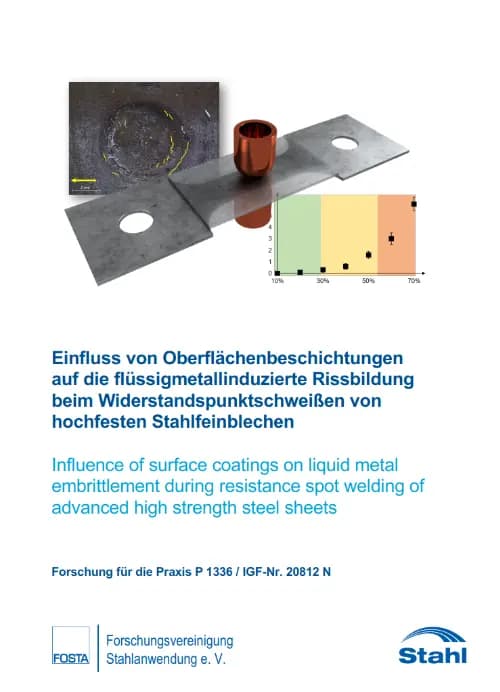
The coating of high-strength steel sheets influences the occurrence of liquid metal induced cracking (LME). For this reason, this thesis characterised the structure and chemical composition of standard industrial coatings with the same base material and investigated their susceptibility to LME. From this comparative study, potentials for resistance to LME were identified. These potentials are tested experimentally using a method developed by the research centre. In addition to uncoated samples, the tests were carried out on standard industrial zinc coatings such as electrolytically galvanised, hot-dip galvanised, galvannealed and zinc-magnesium coatings.
The LME susceptibility of these different coatings was investigated using a welding under tensile load test setup. The resulting susceptibility is calculated from the crack lengths that occur and the probability of LME occurring in the individual tests. An LME susceptibility ranking was determined for the zinc coatings. Zinc-magnesium coatings were found to be particularly susceptible to LME, followed by hot-dip galvanised and galvannealed. The greatest LME resistance was found in electrolytically galvanised samples. Recommendations for action to increase processing safety and spot weld quality were derived from the results.
Machine-translated title and description. The document itself is in German.
Payment by card (Stripe) or invoice (DE, AT, CH). Download link by email: automatically after ordering by card, after order approval for invoice (valid for 30 days). Terms
Digital download
Payment by card (Stripe) or invoice (DE, AT, CH). Download link by email: automatically after ordering by card, after order approval for invoice (valid for 30 days). Terms
Other parts and editions as well as neighbouring documents of the same series.

P 1338 - Electron beam welding of duplex steel with nickel-based filler material without the use of post weld heat treatment Ferritic-austenitic duplex steels are used in a number of industries, such as the entire field of semi-finished product manufacturing as well as in mechanical engineering, apparatus engineering and plant construction. Components made of duplex steels with a high wall thickness (t > 12 mm), such as welded pipes, are preferably welded with electron beam (EB) for economic and quality reasons. However, the process-specific process characteristics of EB welding lead to the formation of an unfavourable microstructure of the weld metal with an unacceptably high ferrite content of approx. 90 %. This leads to a significant reduction in notched impact strength at low temperatures and corrosion resistance in the joining zone. To set permissible austenite/ferrite contents, the components therefore currently have to be solution annealed after the welding process. The aim of this project was to develop an EB welding process in which permissible austenite/ferrite contents can be set in the weld metal, thus eliminating the need for cost-intensive heat treatment. This objective was achieved by using nickel-based filler materials, as these can be used to specifically influence the chemical composition and thus the microstructure of the weld seam. In order to ensure adequate mixing between the base and filler materials, multi-bath technology and jet oscillation were used to greatly improve the weld pool dynamics. As a result, a significant enrichment with nickel was also achieved in the seam root, so that the austenite distributions along the seam depth show only small inhomogeneities even with greater material thicknesses. By adjusting the welding parameters, it was possible to transfer between different material thicknesses as well as between different material batches. Overall, joint welds were produced that fulfil the normative requirements in terms of corrosion resistance and mechanical-technological properties, with significantly less production effort than is currently required. Publication date: September 2022 Authors: T. Tóth, M.Sc., A.-Ch. Hesse, M.Sc., Univ.-Prof. Dr.-Ing. K. Dilger
available anytime
€30.00
excl. VAT

P 1315 - Control of heat input during GMAW thick-wire welding using the example of fine-grain structural steels GMAW thick-wire welding with wire diameters up to d = 4.0 mm is a promising high-performance welding process which, however, has not yet enabled reproducible and economical joint welding of long weld seams. The applicability of the high-performance welding process in the area of temperature-sensitive, high-strength fine-grain structural steels was also previously unknown. In the research project, the new welding process was analysed and validated with regard to its suitability for the material-specific processing of fine-grain structural steels in the thick plate range (t ? 10 mm). The base material S690Q (1.8931) was used as the reference material for the group of high-strength fine-grain structural steels within the process qualification. In preliminary tests, a thermophysical material characterisation was carried out on a dilatometer, whereby the critical limit ranges of the cooling times t8/5 were defined and confirmed (5 s ? t8/5 ? 15 s). Within the project, systematic welding tests were carried out to analyse the influence of different wire diameters on the welding behaviour and the welding result at the upper technical test limit for MSG thick-wire welding. Solid wires of type G69 with diameters of d = 2.4; 3.0; 3.2 and 4.0 mm were used for this purpose. The solutions for controlling the energy input into the base material were aimed at extending the determined technical test limit in the upper performance range. For example, upstream wire heating, which was achieved by increasing the contact tube spacing (?s = 30 mm), resulted in a reduction in the absolute welding power requirement of up to 20 %. With the solid wire, deposition rates of approximately MR = 20 kg/h could be achieved. This corresponded to an increase in deposition rate of approx. 30 %. Furthermore, the use of a basic cored wire with a diameter of d = 3.0 mm had a positive effect on the welding behaviour and allowed deposition rates of up to approx. MR = 30 kg/h to be achieved. A separate cold wire feed into the melt during the welding process made it possible to increase the deposition rate of the thick wire process by up to 60 %. Alternatively, significantly reduced cooling times t8/5 could be realised with the help of targeted process adaptation: - Use of cored wire - 35 % - Increased contact tube spacing - 25 - Cold wire feed - 10 % In addition to the direct control of the energy and heat input into the base material, this made it possible to increase economic efficiency by increasing the deposition rate during GMAW thick-wire welding. With the process combination of cored wire, increased contact tube spacing and cold wire feed, maximum deposition rates of approx. MR = 45 kg/h were achieved in the project, which represents the current maximum value for GMAW thick wire welding. The pulsed and alternating current technologies were not considered to be effective in terms of reducing the energy input for the GMAW thick-wire welding process. In comparison with submerged arc welding, the potential of GMAW thick-wire welding was determined with regard to welding parameters and economic parameters, as well as mechanical-technological quality values for joint welds of fine-grain structural steels. Here, t = 20 mm thick sheets of grade S690Q were welded together in only 70 % of the time and with 60 % of the total costs of the submerged arc welding process using GMAW thick wire welding, while saving on powder costs and powder handling. In addition, MSG thick-wire welding enables joint welds up to t = 25 mm with just two welding beads. The process qualification (tensile tests, hardness measurements, notch impact tests and bending tests) did not result in any negative impairment of the mechanical-technological quality values of the high-strength fine-grain structural steel (S690Q) used in the case under consideration with regard to the cooling times t8/5 and processing using GMAW thick-wire welding. It was reproducibly and economically possible to place the failure location of the welded high-strength component outside the weld seam and the heat-affected zone. Publication: 2021 Authors: Prof. Dr.-Ing. Hensel, Dr.-Ing. M. Kusch, Dr.-Ing. A. Hälsig, ]}, M. Sc. J. Kimme
available anytime
€30.00
excl. VAT

P 1314 - Space-forming load-bearing structures made of sandwich elements In addition to their outstanding space-enclosing function and thermal insulation properties, (steel) sandwich elements have load-bearing properties that allow loads to be transferred in and out of their plane. Single-storey buildings, such as small warehouses, petrol station shops and car washes, can therefore only be built with sandwich elements without additional load-bearing frame substructures. There is a lack of verification methods, in particular for load transfer, which would enable this economical construction method. The aim of the research project was to validate existing calculation approaches for load-bearing and serviceability and the detailed solutions for load transfer and distribution by means of experimental investigations and, if necessary, to develop them further. The knowledge gained from the holistic consideration of the construction method should then serve as a basis for the acquisition of a building authority approval. To achieve these goals, a self-supporting construction made of sandwich elements was first designed as an example object. For this purpose, all necessary construction drawings and detailed solutions for the formation of the load application points and joints were worked out and defined for this application. Experimental investigations into the load-bearing behaviour of a self-supporting construction made of sandwich elements were carried out using a test matrix defined in the research proposal. The extensive local and global axial compression tests were carried out on test specimens, taking into account a practical and application-related design of the load application points. The deformations and maximum loads were measured. The measured loads were then statistically evaluated and the actual local and global load-bearing capacity as well as the failure behaviour of the self-supporting construction made of sandwich elements were analysed. The analytically determined ultimate loads in the ultimate and serviceability limit states were used as a reference. It was found that the experimentally determined loads were far higher than the analytically calculated values. This showed that the design of the structure with the existing design approaches provides conservative results and is therefore on the safe side. The design of the load introduction structure for uplifting forces could also be ensured using a presented design approach. In order to ensure a holistic view of the construction, an economic and ecological analysis of the construction method was carried out. In the economic analysis, it was shown that self-supporting constructions made of sandwich elements without a steel substructure save approx. 9% of the investment costs and approx. 10% of the heating costs. The life cycle assessment also showed that the construction method results in emission and energy savings and is more environmentally friendly. Overall, the research report provides a sound scientific and technical basis for the design, construction and dimensioning of self-supporting structures made of sandwich elements, as well as the necessary test results and analyses for obtaining building authority approval. Publication: September 2022 Authors: Univ.-Prof. Dr.-Ing. D. Ungermann, M.Sc. G. A. Eseme
available anytime
€30.00
excl. VAT

P 1313 - Bimodal toughness behaviour of ultra-high toughness pipeline steels - cross-scale root cause analysis and adapted evaluation concepts For many decades now, fossil fuels have been transported through kilometres of pipelines. The need for a reliable pipeline transport network will continue to be indispensable in the future in order to make hydrogen available to end consumers as an energy source in addition to fossil fuels. The pipeline steels required for the conversion and expansion of the supply network have been continuously improved in recent years thanks to the great efforts of the steel and pipeline industry. Thanks to thermo-mechanical rolling strategies and an increase in the purity of the steels, damage-tolerant microstructures have been developed, leading to an increase in strength and toughness properties. These excellent material property profiles offer great resource-saving lightweight construction potential for future applications. However, these modern pipeline steels are subject to failure phenomena during toughness testing that have not yet been sufficiently researched. These include inverse fracture behaviour, fracture surface tearing and compressed or overlapping transition behaviour. The latter is characterised by an overlap of the low and high layer branches over a temperature range of 10-30°C in the notched impact energy-temperature diagram, which in turn leads to uncertainties in component design and associated application inhibitions. As part of this project, a bainitic pipeline material of grade X65, which exhibits overlapping toughness behaviour, was extensively characterised. Titanium nitrides (TiN) and calcium sulphides (CaS) were identified as crack-initiating structural components for both brittle and ductile material failure. Using microstructure simulations, it could be shown that the local stress and strain concentrations in the microstructure vary greatly depending on the position, size and tilting of the inclusion. The highest stress concentration was found for a 6 µm TiN inclusion with a 45° tilt. The development of a cross-scale simulation methodology subsequently made it possible to evaluate the influence of different inclusion configurations on the material and component behaviour. The microstructure-related parameter sets derived in the simulation of representative volume elements (RVE) were used in the macroscopic damage model to map the material behaviour in the notched bar impact test. Using this methodology, the compressed transition behaviour could be described numerically and the model transferred to piping applications. In the component simulations, brittle or ductile component failure occurs in the pipeline pipe depending on the selected microstructure-based parameter set. A microstructure with critical inclusion leads to brittle component failure and a higher crack propagation velocity, while a microstructure without critical inclusion causes ductile component failure. The developed cross-scale simulation approach for microstructure-based component evaluation can be transferred to other material concepts and areas of application in the future. On the one hand, this makes it possible to support the clarification of material-physical phenomena and, on the other hand, to inspire integrative material and component design for resource-saving lightweight construction. Publication: 2021 Authors: Prof. Dr.-Ing. S. Münstermann, M.Sc. Y. Sparrer
available anytime
€30.00
excl. VAT