
FOSTA
The use of hot cutting for the production of structural components made of carbon-martensitic chromium steels in the automotive industry offers economic advantages over the currently predominant laser cutting. For …
The use of hot cutting for the production of structural components made of carbon-martensitic chromium steels in the automotive industry offers economic advantages over the currently predominant laser cutting. For example, the elimination of downstream laser trimming leads to a considerable reduction in process time and contributes to an increase in productivity. With hot cutting, no material deposits occur on the surface as a result of spatter and there is potential for savings in tool costs, as cooling channels close to the surface, as required when processing the heat-treatable steel 22MnB5, are not necessary. Chromium steels are currently hardly used in the production of car body components.
One reason for this is the lack of experience with regard to the process parameters for hot cutting. As part of this research project, the influence of the process parameters on the cut surface geometry, dimensional accuracy and expansion capacity was therefore scientifically investigated. The focus was on the change in the individual cut surface parameters as a result of different parameter combinations. In addition, fundamental knowledge was gained about the effect of upstream and downstream forming operations on the quality and static properties of the cut parts. The result of the research is the provision of optimal process parameters and thus an increase in the operational readiness of hot cutting processes for the production of mould-hardened components made of chromium steel.
Machine-translated title and description. The document itself is in German.
Payment by card (Stripe) or invoice (DE, AT, CH). Download link by email: automatically after ordering by card, after order approval for invoice (valid for 30 days). Terms
Digital download
Payment by card (Stripe) or invoice (DE, AT, CH). Download link by email: automatically after ordering by card, after order approval for invoice (valid for 30 days). Terms
Other parts and editions as well as neighbouring documents of the same series.
P 1221 - Design method for cyclically stressed steel/CFRP bonded joints with special consideration of crack propagation Due to its specific properties and low weight, the lightweight material CFRP (carbon fibre reinforced plastic) is an established material that enables innovative constructions to meet high demands on design, safety and comfort and, not least, realises more efficient construction methods in the transport sector by reducing weight. The relatively high costs of this material require the economical use of CFRP where its specific lightweight construction potential can be effectively utilised. In combination with high-strength steels, lightweight and safe structures can be produced economically. Bonding technology represents a versatile and at the same time material-compatible joining technology for fibre-reinforced plastics in mixed construction. The design of steel/CFRP bonded joints requires precise knowledge of the joint and failure behaviour, particularly under changing types and speeds of loading. The aim of this research project is to qualify a test concept for the design of steel/CFRP bonded joints in various branches of industry. The test concept used is based on rigid steel joining parts with bonded CFRP coupons, which enables the most homogeneous and, above all, uniaxial loading of the bonded layer possible. This allows the reciprocal influences of the CFRP and the adhesive on the joint to be analysed. The basic tests are carried out quasi-statically. Building on this, strain rate-dependent tests and tests under vibration stress are carried out on steel/steel and steel/CFRP bonded joints and compared with the reference tests. The aim is to gain a comprehensive understanding of the mechanical properties and failure behaviour. In addition to continuum mechanical tests under the main types of loading, tensile and shear, fracture mechanical test specimens are developed which are used to investigate the crack propagation behaviour and the detection of interphase-specific effects. The testing of a component-like specimen rounds off the experimental investigations. Finally, the knowledge gained is summarised in a procedure model for testing and designing steel/CFRP bonded joints. In addition to sample production, testing and test interpretation, the process model also contains information on the design of the bonded joint, which can be derived depending on the epoxy resin and polyurethane adhesives used and the underlying stresses. Publication: 2020 Authors: Prof. Dr.-Ing. G. Meschut
available anytime
€30.00
excl. VAT
P 1226 - Holistic modelling of short-term tempering in the process of inductive surface hardening Induction hardening is an energy-efficient process in which undesirable crack-inducing residual stresses also arise due to process-related thermal gradients between the surface and core areas. These are conventionally countered by tempering in the first tempering stage for up to two hours, which is associated with additional transport and energy costs in the process chain. A resource-saving and environmentally friendly alternative is induction tempering, which takes just a few seconds and can be integrated into a running production line. This allows the existing induction hardening process chain to be made more flexible while maintaining the same product and process quality and at the same time enhancing the ecological value of the process. The empirical determination of the induction tempering parameters involves considerable effort, which is why potential users are reluctant to use this process. A virtual process design can significantly reduce the experimental effort and thus increase the attractiveness of this innovative tempering technology. Existing induction tempering models concentrate on modelling electromagnetic-thermal processes and the resulting material hardness without considering the preceding induction hardening process. As a result, the complex coupled thermal-microstructural aspects are neglected, so that the informative value of the models is severely limited. Based on this problem, a holistic numerical model for induction tempering in the induction hardening and tempering process chain was developed in this research project, with which an efficient determination of optimal tempering parameters is possible with reduced effort and a deeper understanding of the process. The model was implemented as an example in the commercial simulation software ANSYS and validated experimentally. Publication: 2021 Authors: Prof. Dr.-Ing. Nacke, Prof. Dr.-Ing. H. J. Maier
available anytime
€30.00
excl. VAT
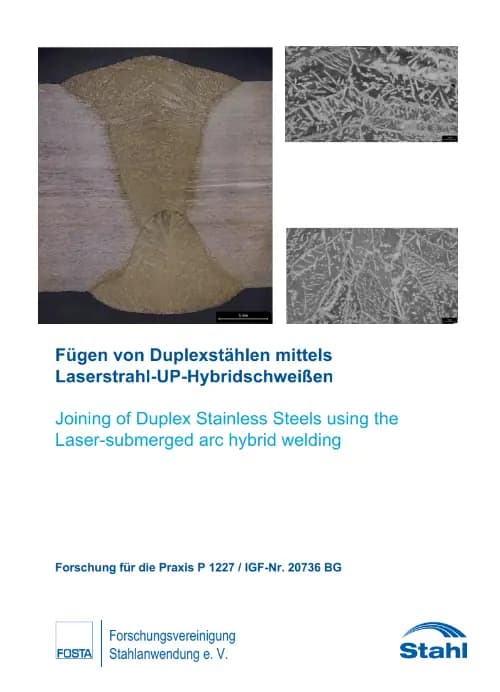
P 1227 - Joining of duplex steels by means of laser beam-UP hybrid welding Due to their excellent properties, duplex steels are used for applications in the oil and gas industry and in ship and bridge building that are subject to corrosion. In addition to corrosion resistance, such steels are characterised by high strength and toughness, which is due to a delta ferrite-austenite microstructure ratio of at least 30 % austenite. This microstructure ratio can be lost during welding due to unfavourable heat conduction. Arc welding processes, such as SAW and GMAW, have become established in practice for welding duplex steels. These welding processes can produce joints with the required microstructure ratio, but at the compromise of low productivity. The beam welding processes laser beam welding or electron beam welding, on the other hand, have a high productivity, but cannot produce welded joints with the required microstructure ratio. Laser beam-UP hybrid welding combines the advantages of both welding processes and can be a good alternative with high productivity. The aim of the research project was to be able to produce weld seams on duplex steel 1.4462 (up to 30 mm) with high weld seam quality in terms of mechanical-technological properties and corrosion resistance using laser beam-UP hybrid welding in a reliable and efficient process. As part of the welding process development, welded joints were produced from duplex steel 1.4462 by varying process parameters such as laser beam power, feed rate and oscillation amplitude and evaluated in terms of metallurgical and mechanical properties based on standards and regulations. Cross-sections, EDX analyses, microstructural analyses, notched bar impact bending tests, tensile tests and corrosion tests were used to qualify weld seams. As a key result, efficient high-performance welding processes with a laser beam power of up to PL = 16 kW and a submerged arc power of PUP = 15 kW at a welding speed of up to vS = 1.0 m/min were achieved. The welded joints produced do not exhibit any critical irregularities and for the most part achieve the required austenite content of 30 %, the required impact energy of KV-min = 40 J at a test temperature of -40 °C and corrosion resistance in line with requirements. Based on these results, laser beam-UP hybrid welding has proven to be a reliable welding process with high productivity, which could play an important role in the future for the welding production of components made of duplex steels. Publication date: July 2022 Authors: Dipl.-Ing. M. Puschmann, P. Urbanek, Dr.-Ing. F. Riedel, Prof. Dr.-Ing. St. Kaierle, Dr.-Ing. R. Lahdo, Dr.-Ing. S. Nothdurft, Dr.-Ing. J. Hermsdorf
available anytime
€30.00
excl. VAT
P 1228 - Tool-side influence on tribological conditions during press hardening The service life of press hardening tools, which is largely determined by adhesive and abrasive wear, plays a central role in terms of the economic efficiency of the press hardening process. The tribological conditions in the effective joint between the semi-finished product and the tool elements therefore represent a critical factor that has a decisive influence on the quality of press-hardened components. In view of the research work to date, it is clear that the existing knowledge of the tribological conditions is not sufficient to achieve a relevant improvement in the process design or to derive effective tool-side measures for a significant increase in service life. The objective of the research project is to determine the functional interactions between the topography of the tool surface and the tool material and the tribological behaviour of tools during press hardening. By understanding the functional relationships, measures can be derived that increase the service life of press hardening tools and thus the economic efficiency of the process. In order to achieve the research objective, three tool materials were selected for the investigations in consultation with the industrial partners. In addition, different methods for processing the tool surface and tool coatings were analysed on the basis of the strip drawing test. The investigations have shown that the roughness of the tool surface has no effect on the resulting friction behaviour in the laboratory tests. However, both the choice of tool material and its heat treatment can have an influence on the tribological behaviour. In addition, both friction and wear were significantly reduced by the use of PVD tool coatings. Finally, the results were successfully verified using a B-pillar geometry on a laboratory scale. This showed good transferability of the findings from the strip drawing tests to the press hardening process with a practice-relevant geometry. Publication: 2019 Authors: Prof. Dr.-Ing. M. Merklein
available anytime
€30.00
excl. VAT